

5 of the Most Interesting Radio Messages from Spanish Grand Prix
With a runaway winner and the top four drivers finishing in the order they started, last weekend's Spanish Grand Prix is unlikely to live long in the memory of Formula One enthusiasts.
But there were at least a number of fascinating interactions over team radio over the course of the race, a number of which offered clues over the Mercedes team's state of mind at this stage of the 2015 campaign.
Heading to the Circuit de Barcelona-Catalunya, Nico Rosberg was a man under pressure having failed to win any of the opening four races. But the German gave himself the best possible chance of claiming his first victory of the year by claiming pole position, breaking team-mate Lewis Hamilton's pole-setting streak.
And while Hamilton could have challenged his 2014 championship rival for a fourth victory of the season in the latter stages, two crucial radio messages—one to Lewis, the other to Nico—suggested Mercedes had decided to present a long-overdue win to Rosberg, giving the German a boost when he most needed it.
By that point, the challenge posed by Sebastian Vettel and Ferrari had faded, with the four-time world champion turning on his team as he coasted toward a distant third-place finish, revealing much about his uncompromising attitude just five races into his career with the Italian team.
With a look to the troubles endured by Romain Grosjean and Jenson Button, here are the most interesting radio messages from the Spanish GP.
Lewis Hamilton Persuaded Against Challenging Nico Rosberg
1 of 5
After completing the last of his three pit stops on Lap 51 of 66, Lewis Hamilton was faced with a dilemma.
Twenty seconds off the lead, but with the faster medium-compound tyres at his disposal, he could have set the timing screens alight in the hope of passing Nico Rosberg for a fourth victory in five races.
Or—having spent much of the Spanish Grand Prix wrestling Ferrari's Sebastian Vettel for second place, compensating for a poor start—he could have accepted the runner-up spot was the best possible result on the day and coasted to the finish.
The notion of settling for second, however, is alien to Hamilton, and the reigning world champion immediately set his focus on reeling in Rosberg. But on Lap 57, Hamilton's race engineer, Peter Bonnington, advised the British driver to give up the fight and protect his car from any late reliability issues.
"Looks like it may be a big ask to do it, so probably best to consolidate the position," Bonnington said, according to the FIA television feed.
Hamilton replied: "If you're telling me it's not possible, let me know."
"Yeah, I don't think it'll be possible with the remaining laps, Lewis, so probably just better looking after this one. Let him (Rosberg) have it (the win)."
But Hamilton wasn't quite ready to throw in the towel, pushing Bonnington further.
"Is it impossible? That's the question."
"Yes, Lewis. He's gonna respond if we pick the pace up, so I think we just need to consolidate the position. It'll be impossible."
Hamilton must be commended for ignoring his racing instincts—and, for that matter, not ignoring Bonnington's pleas—but the team may have talked the two-time world champion out of yet another win in Spain.
Although Rosberg certainly had the pace to counteract any move made by Hamilton, the German has been prone to mistakes when pressurised by his team-mate since the beginning of 2014, which could have helped Hamilton in his quest for victory.
Yet on a weekend Rosberg dominated from start to finish, it would have been immoral of Mercedes to let Hamilton launch a serious challenge for the win, meaning Lewis simply had to take one for the team.
Nico Rosberg Reassured by Mercedes After Rejoining Behind Lewis Hamilton
2 of 5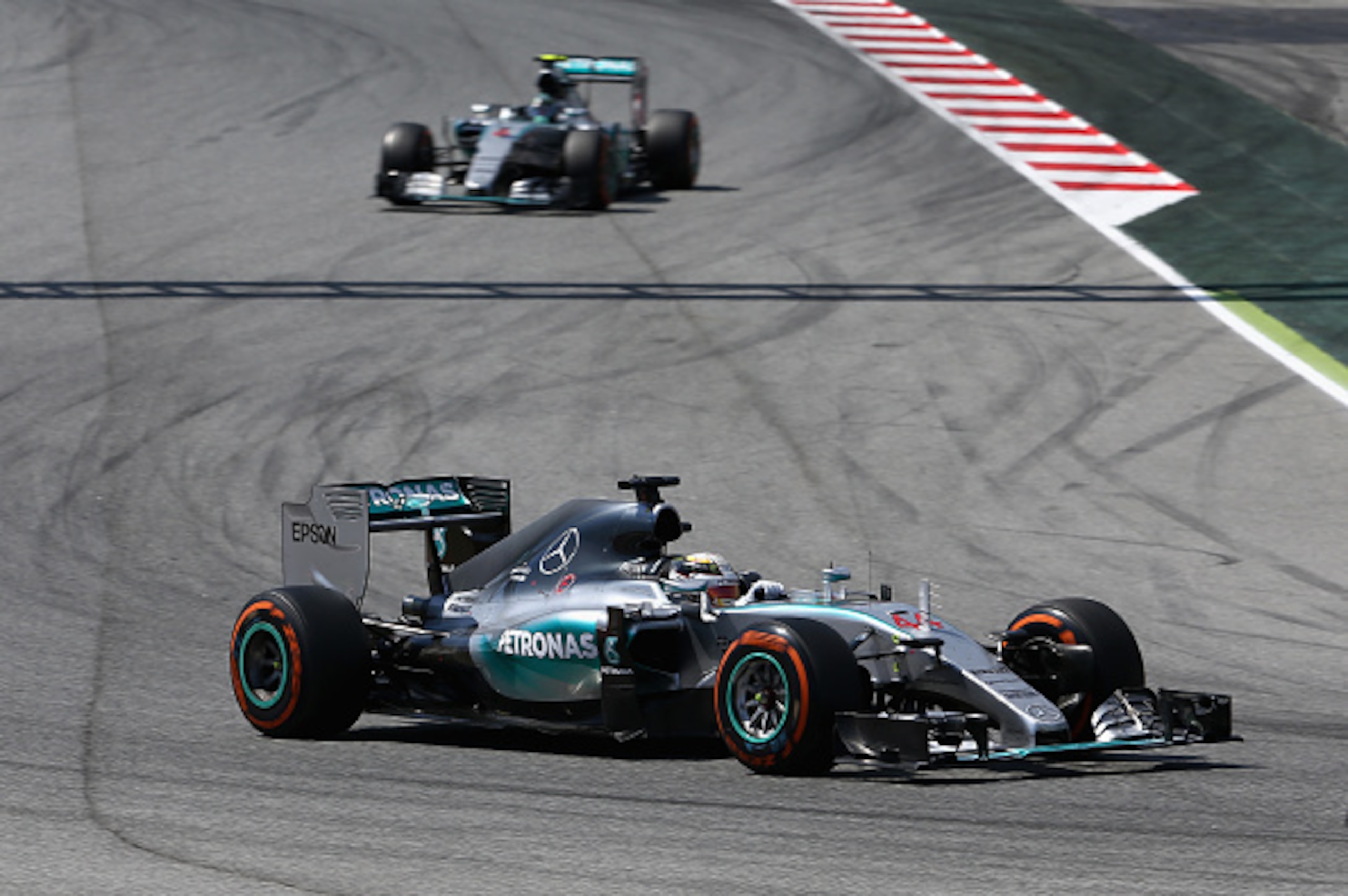
Yet more evidence that Mercedes had allocated victory to Nico Rosberg well in advance of the chequered flag was how the team reassured the German immediately after his second and final pit stop.
After setting pole position and disappearing into the distance, en route to a relatively easy win, Rosberg might have been slightly bemused to rejoin the track behind team-mate Lewis Hamilton on Lap 46.
And although Rosberg wasn't broadcast asking about the situation over the radio, you could almost hear the voices of deceit running around his head as he stared at Hamilton's gearbox.
How had Hamilton, behind for so much of the grand prix, got ahead? Had the team kept some vital information from him? Was the race in danger of slipping from his grasp even when he thought it was won?
Fortunately, Mercedes killed any potential suspicion within seconds of Rosberg's departure from the pit lane in an expert display of psychology, explaining Hamilton's change to a three-stop strategy as the British driver focused on beating Sebastian Vettel to second place.
"Lewis in front is racing Vettel. He is on a different strategy and has one more stop to make," said Rosberg's race engineer, Tony Ross, according to the FIA TV feed in a very concise, matter-of-fact way, instantly draining his driver's mind of any doubt.
As noted by F1 journalist Peter Windsor, Mercedes—having seen off the challenge of Vettel—could have reverted Hamilton back to a two-stop strategy and kept the reigning world champion on track for the remainder of the grand prix, letting their drivers fight head-to-head for victory.
But from the moment Ross reassured Rosberg—effectively telling the German he was in a race of his own, promising that Hamilton was not a genuine threat—the team were obliged to pit Hamilton for a third time, clearing the path for Nico to claim a routine victory.
Sebastian Vettel Criticises Ferrari Strategy as Lewis Hamilton Claims Second
3 of 5
Sebastian Vettel made up for his horror show in Bahrain by driving superbly throughout the Spanish Grand Prix, keeping Lewis Hamilton behind for two-thirds of the race.
The Mercedes driver, switched to a three-stop strategy in his bid to pass his Ferrari counterpart, was always bound to get ahead at some point, but Vettel was far from impressed when Hamilton emerged from his final pit stop in a comfortable second place.
The German was forced to navigate through traffic after making the last of his two stops for hard tyres on Lap 40, while Hamilton stretched his own stint on hards to Lap 51, with Vettel unable to even fight for the position as the reigning world champion rejoined the track.
And the four-time title winner made sure the team knew where the race against Hamilton was won and lost, berating the Ferrari pit wall just seconds after his fate was sealed.
"We lost too much time in traffic," lectured Vettel, as per the FIA TV feed. "I know they are doing their own race but still... We're losing a lot in traffic."
Ferrari might not have appreciated the public reprimand—Sebastian's voice distorting as he said, "still," made the message sound particularly menacing—but Vettel's frustration offered an insight about how the German has emerged as the team leader since his arrival from Red Bull Racing.
Although, deep down, he would have accepted third place was the best possible result on the day, Vettel's obsession with making constant improvements, no matter how small, was evident.
Instead of finishing 45 seconds behind the race winner, as he did at the Circuit de Barcelona-Catalunya, he would rather take the chequered flag 30 seconds after the victor, even if it would make no difference to the overall result.
It's that nagging—ensuring the team acknowledge and learn from their mistakes—that will accelerate Vettel and Ferrari's return to the top of F1.

.jpg?w=2560 "Rams Raiders Football")

Lotus Get Tough with Romain Grosjean as Gear Issue Appears
4 of 5
Romain Grosjean scored points for the third consecutive race in the Spanish Grand Prix, but he had to work hard for an eighth-place finish.
As well as colliding with team-mate Pastor Maldonado on Lap 4 and overshooting his pit-box on Lap 40, the Frenchman had to contend with a gearbox issue, which forced Grosjean to manage fourth gear—but only after the Lotus hierarchy had ordered him to do so.
On Lap 22, Grosjean's race engineer, Julien Simon-Chautemps, was heard over the FIA television feed advising his driver to lift off the throttle whenever he shifted up to fourth, stating: "OK Romain, you need to lift when you use the bad gear. Lift when you use the bad gear."
Yet Grosjean offered a rather feeble response, simply saying: "I can't."
That no doubt left the Lotus pit wall enraged, and it was left to Alan Permane, the head of trackside operations, to deal with the disobedient driver.
Permane has built a reputation for being a stern talker—see his radio exchange with Kimi Raikkonen in the 2013 Indian GP—and ensured Grosjean had no option but to follow the team's orders, barking: "Romain, if you don't do that you will blow the engine up. Alright? You have to."
The silence was deafening, and the fact that Grosjean had to be told by a senior member of the team reveals as much about the Frenchman's attitude as Permane's authority.
With each car limited to just four power units across 2015, there is a huge emphasis on teams to preserve their engines as long as possible to minimise the risk of grid penalties later in the year.
Grosjean's initial reluctance to follow the instructions, therefore, highlighted a lack of respect for the team and, indeed, his new race engineer, perhaps suggesting he is yet to establish a strong working relationship with Simon-Chautemps.
But you can always rely on Permane to bring a driver firmly into line.
Jenson Button Fights a Losing Battle with McLaren MP4-30
5 of 5
Jenson Button referred to the first half of the Spanish Grand Prix as "the scariest 30 laps of my life," according to Motorsport.com's Pablo Elizalde, and his fears were more than apparent over team radio.
McLaren-Honda had intended to make significant strides up the pecking order at the Circuit de Barcelona-Catalunya, but Button's struggles—never mind Fernando Alonso's pit lane drama—confirmed the team's miserable campaign is bound to get worse before it gets better.
Button is regarded as the most sensitive driver on the grid when it comes to car balance, but it seems even the most adaptable performer would have struggled in the conditions the 2009 world champion faced in Spain, where the MP4-30 was predictably unpredictable in terms of handling.
"Massively struggling with the rear," Button reported as early as Lap 7, according to the FIA TV feed. "I still have understeer in the car. I have understeer, but as soon as I touch the throttle, the rear's gone."
Despite being one of the first to change tyres, heading to the pit lane after just 11 laps, Button—among the most delicate manipulators of the accelerator pedal, remember—continued to complain about bursts of power.
On Lap 26, he told the team: "As soon as I touch the throttle, I have wheelspin. It's, er, not normal."
With excess wheelspin causing problems in both slow and fast corners, an indication of the Honda power unit's horrendous driveability, merely keeping the car pointing in the right direction was a good achievement for Button in Spain.
And although Button and Alonso must still dream of battling the opposition this season, winning the fight against their own machinery should be the priority for now.

.jpg?w=2560 "Steelers Saints Football")
.jpg?w=2560 "Packers Safety Slams Refs 🤬")

.jpg?w=2560 "🚨 Week 8 AP Top 25 Poll")
