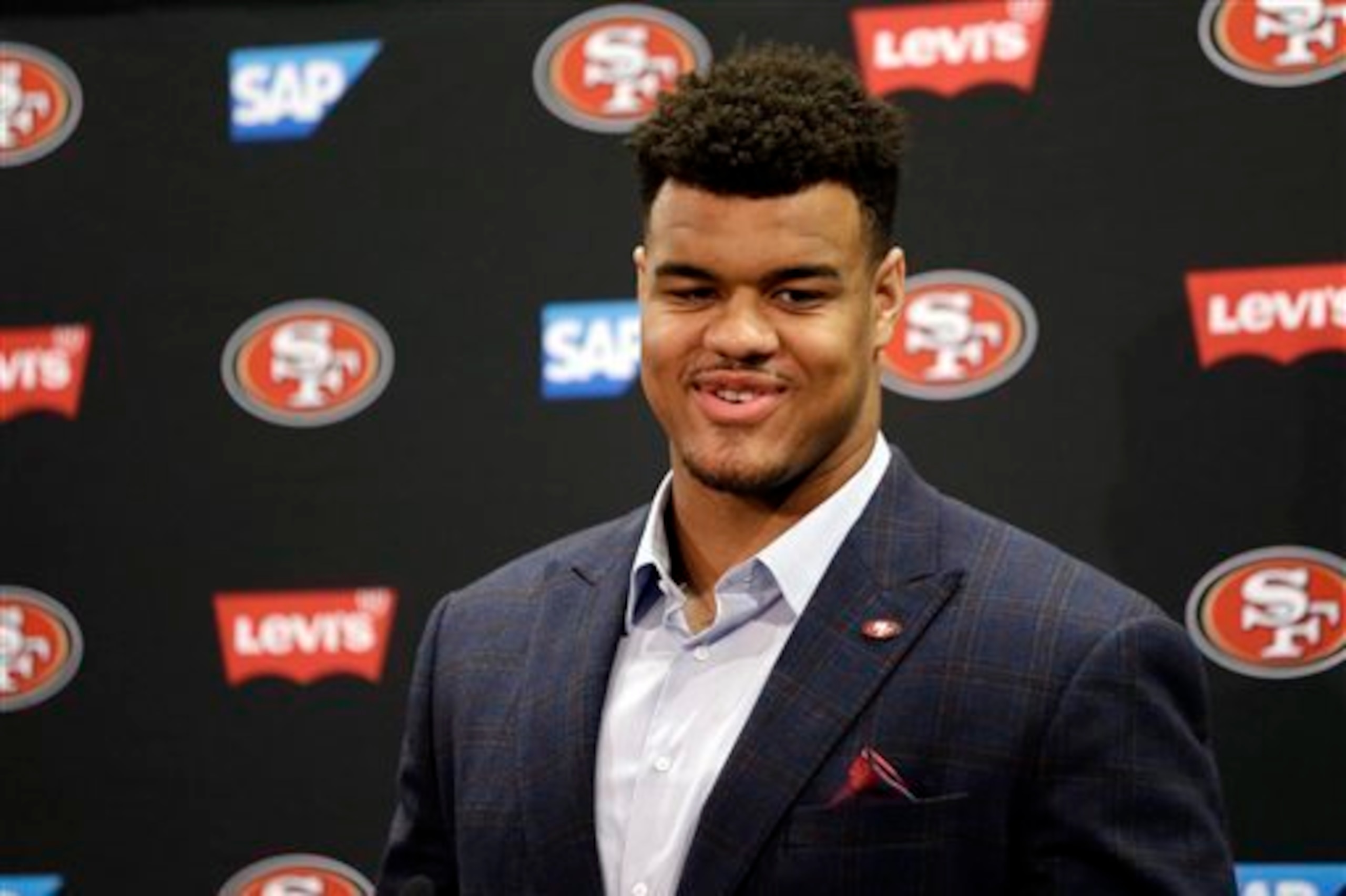

Best- and Worst-Case Scenarios for Each San Francisco 49ers Rookie
The days and weeks following the NFL draft provide plenty of excitement and anticipation for rookie players joining pro teams for the first time.
Such is the case for the newest class of San Francisco 49ers—10 total draft picks and a number of undrafted free agents (UDFAs). Each of these players will compete for a spot on the 49ers' 53-man roster in the regular season.
Some will make that roster as it gets trimmed down from 90 players. Others will not. That is the nature of the NFL.
But what are the best- and worst-case scenarios for each player? Generally speaking, the higher a player is selected, the higher the expectation. Prospects drafted in Rounds 1 or 2 are largely projected to have a higher impact than late-round draftees.
Yet some players selected in the latter rounds can make an immediate splash. The 2014 selection of linebacker Aaron Lynch in Round 5 is a perfect example of a best-case scenario coming true.
Here is the list of each of the 49ers' draft picks from 2015:
- DE Arik Armstead, Oregon
- SS Jaquiski Tartt, Samford
- OLB Eli Harold, Virginia
- TE Blake Bell, Oklahoma
- RB Mike Davis, South Carolina
- WR DeAndre Smelter, Georgia Tech
- P Bradley Pinion, Clemson
- OG Ian Silberman, Boston College
- OG Trenton Brown, Florida
- TE Rory "Busta" Robinson, South Carolina
San Francisco also added nine UDFAs—the list of which is provided courtesy of the team's website.
So what are the expectations from each of these rookies heading toward the 2015 season? What can the 49ers hope for, and what is the team looking to avoid?
Let's break down the scenarios for each of these rookie players.
Undrafted Free Agents
1 of 11
San Francisco tabbed nine UDFAs after the draft—a list compiled via 49ers.com:
- WR Dres Anderson, Utah
- WR Isaac Blakeney, Duke
- WR DiAndre Campbell, Washington
- WR Darius Davis, Henderson State
- OL Patrick Miller, Auburn
- DL Marcus Rush, Michigan State
- QB Dylan Thompson, South Carolina
- WR DeAndrew White, Alabama
- S Jermaine Whitehead, Auburn
UDFAs are unique commodities in that they rarely crack an active roster. Most are merely selected as flier picks to round out a 90-man roster entering training camp. Such players provide competition and, every so often, reveal a surging player who exceeds expectations that resulted in him being undrafted.
Last season, the 49ers signed UDFA center Dillon Farrell out of New Mexico. He ended up playing in eight games along an offensive line that lost linemen Daniel Kilgore and Marcus Martin for extended periods of time.
Will 2015 provide a similar player?
The 49ers drafted just one wideout in seven rounds—Georgia Tech's DeAndre Smelter—despite losing three receivers this offseason (Michael Crabtree, Stevie Johnson and Brandon Lloyd).
One name to keep an eye on is former Utah wide receiver Dres Anderson. CBS Sports tabbed the 6'1", 187-pound target as a late third- or early fourth-round pick. San Francisco grabbing him as a UDFA might end up being a steal.
According to Jeff Deeney of Pro Football Focus, Anderson's best attributes came on deep routes—an aspect upon which the 49ers could use some improvement in coming seasons:
"36.4% of #49ers WR Dres Anderson's targets last year came on deep routes (20+ yards) which was highest of any Pac-12 WR in this draft class.
— Jeff Deeney (@PFF_Jeff) May 9, 2015"
While Anderson may be a long shot to make the roster, he is worth a close evaluation and could turn some heads.
TE Busta Anderson
2 of 11San Francisco's final pick of the 2015 draft was used on South Carolina tight end Rory "Busta" Anderson.
Anderson has some freakish attributes that could make him a matchup nightmare for the 49ers offense. His 6'5", 244-pound frame makes him a likable option in the red zone. But Anderson wasn't much of a factor in South Carolina's offense last year. He hauled in just 22 receptions for 260 yards and one touchdown over 10 games.
But as Rob Rang of CBS Sports pointed out, Anderson comes with a history of injuries to his hamstrings and biceps. These could continue to be chronic issues as Anderson transitions from the collegiate level to the pros.
The 49ers have some question marks at tight end. No. 1 tight end Vernon Davis is entering a contract year this season and is coming off of one of the poorest efforts of his career in 2014. He hauled in just two touchdowns on 245 yards last year.
And San Francisco doesn't have many options behind him. Backup tight end Vance McDonald has yet to justify his selection in Round 2 of the 2013 draft. Last year, McDonald hauled in just two passes for 30 yards and appeared in just eight games.
Other tight ends on the roster include Derek Carrier, Garrett Celek, Asante Cleveland, Xavier Grimble and rookie Blake Bell.
This creates a lot of competition for the position heading into camp. Teams rarely keep more than three tight ends on their active rosters, and it's hard to imagine the 49ers moving on from Davis and McDonald just yet.
But Anderson does have some strengths aside from his sheer size. Per Matt Maiocco of CSN Bay Area, Anderson has the "blocking fundamentals to be considered a legitimate combination tight end in the NFL":
"The book on Rory 'Busta' Anderson, #49ers last draft pick in 2015 (via @MaioccoCSN) http://t.co/SOzOZyCPLi #NFL pic.twitter.com/RXbCcX8u4o
— Comcast SportsNet (@CSNAuthentic) May 2, 2015"
Perhaps this attribute will be the best asset to Anderson cracking the roster.
Best-Case Scenario: Anderson is able to impress enough in training camp to secure a spot as the No. 3 tight end on San Francisco's 53-man roster.
Worst-Case Scenario: Injuries continue to derail Anderson's efforts, which result in the 49ers parting ways with him. The prospect then fails to land a job with another NFL team given his injury history.
OG Trenton Brown
3 of 11The 49ers needed some developmental depth along the offensive line after losing starting left guard Mike Iupati and swing tackle Marcus Martin during the offseason.
General manager Trent Baalke waited until the latter rounds of the draft to address this need—selecting offensive guards Ian Silberman and Trenton Brown in Rounds 6 and 7, respectively.
Brown's 6'8", 355-pound frame makes him worth a late-round flier, although Dane Brugler of CBS Sports admits that his size makes him suitable only to the inside of the line and not at the tackle position. And that size always raises questions about long-term durability.
Yet the 49ers recognize the need for Brown to stay at a healthy weight. Head coach Jim Tomsula commented on Brown's weight loss via Ryan Sakamoto of NinerFans.com:
"#49ers Jim Tomsula talks about Trenton Brown's weight loss. pic.twitter.com/9QquIY8YaU
— Ryan Sakamoto (@SakamotoRyan) May 2, 2015"
San Francisco has good depth along its interior positions. Center Daniel Kilgore should return after suffering a season-ending leg injury last season. O-linemen Brandon Thomas and Marcus Martin will probably end up competing for Iupati's No. 1 spot. And the 49ers have right guard Alex Boone tabbed as a starter for at least one more season.
Brown won't secure a starting job any time soon. But a promising camp combined with finding a healthy weight could make him a long-term option for a backup position along the O-line.
Best-Case Scenario: Brown has a minimally slim chance of becoming a starter at the NFL level. But there is a good chance he emerges as a solid backup in 2016. But that would mean San Francisco would have to find a way to stash him for one season if if the coaching staff likes what they see.
Worst-Case Scenario: Weight problems and a lack of development thwart Brown's chances to make the active roster. The "gentle giant," per Brugler, never lives up to his sheer size and potential.

.jpg?w=2560 "Steelers Saints Football")
.jpg?w=2560 "Rams Raiders Football")
OG Ian Silberman
4 of 11Former Boston College offensive lineman Ian Silberman also helps reinforce San Francisco's O-line depth in 2015.
Taken a round earlier than guard Trenton Brown, Silberman's 6'5", 306-pound frame gives him a little more flexibility for interior and exterior positions at the NFL level. Silberman played offensive tackle in college, but will likely project to a guard in the pros, per David Fucillo of Niners Nation (h/t Trove.com).
Silberman may fill a long-term need for the 49ers as a swing tackle—a necessity after the team parted ways with offensive tackle Jonathan Martin this offseason.
But the 49ers also added O-lineman Erik Pears in free agency, and Fucillo believes that Pears will be the guy tabbed to fill this void.
As such, it would be hard to envision Silberman making the 53-man roster in 2015. The 49ers will only carry so many linemen entering the regular season.
Yet the team may try to find a way to stash Silberman on the practice squad this season.
This might be the route taken given that right guard Alex Boone will hit the free-agent market in 2016, per Spotrac.com.
There is a long-term need here, and Silberman could be the guy who helps fill the void should it emerge.
Best-Case Scenario: Silberman gets stashed on the practice squad for his rookie season. But with depth questions surfacing in 2016, the former Boston College lineman develops into a worthy interior backup.
Worst-Case Scenario: The 49ers never find a way to work Silberman into their long-term plans. While he may have some talents, San Francisco moves on from Silberman and leaves him to an uncertain fate.
P Bradley Pinion
5 of 11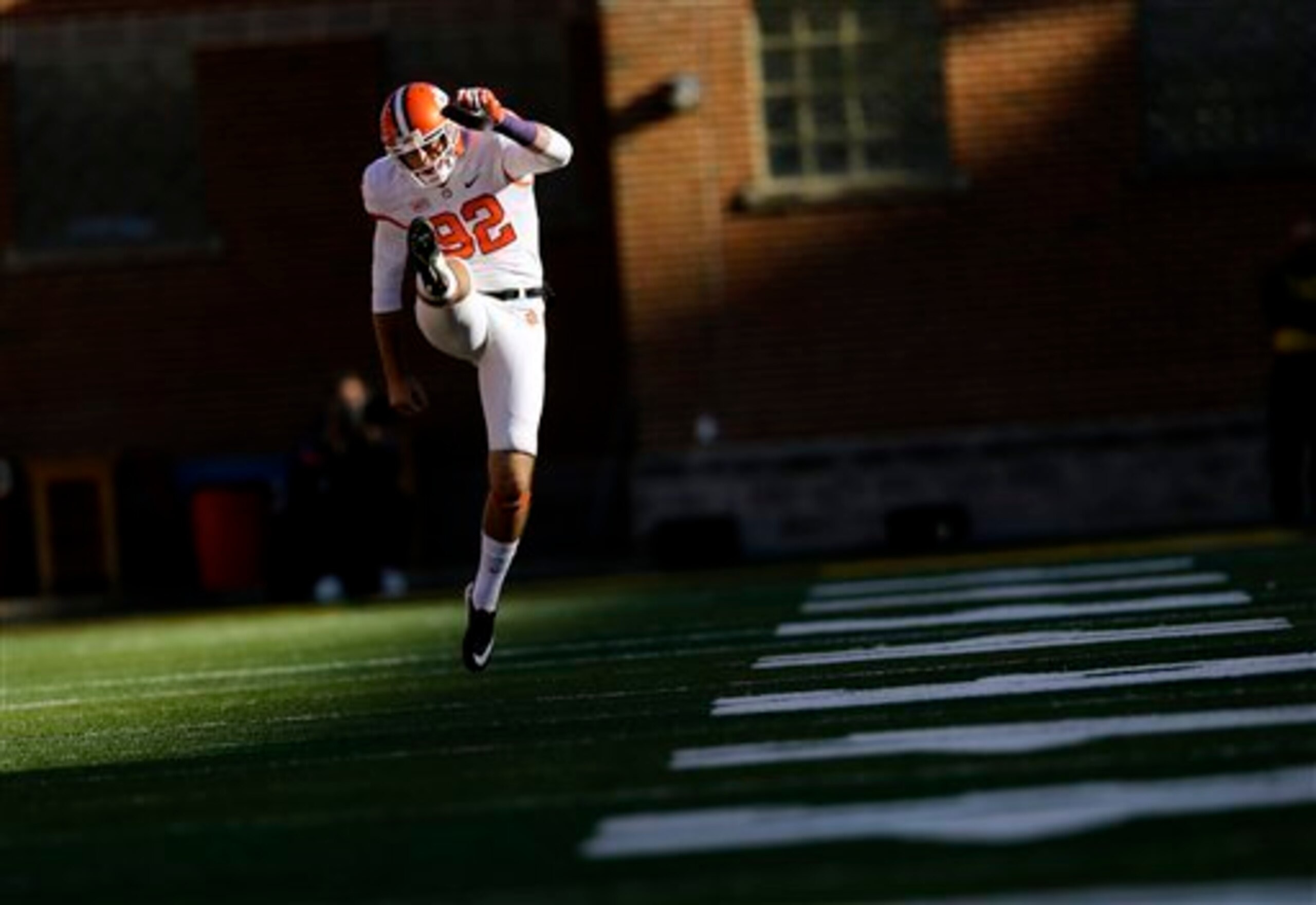
Most teams do not draft punters. Even fewer take a punter earlier than Rounds 6 or 7. But general manager Trent Baalke did do this when he selected former Clemson punter Bradley Pinion in Round 5:
"Leaving early as a punter is crazy, getting drafted is even crazier. Bradley Pinion is a boss. #Clemson (@pinion92) pic.twitter.com/pihxZWM4fk
— Tiger Talk (@TigerTalk_CU) May 4, 2015"
The move is even more questionable when considering the fact that the 49ers already have three-time Pro Bowl punter Andy Lee on the roster—currently the longest-tenured player in San Francisco.
While drafting Pinion so high may never make sense, the numbers game makes Baalke's decision to add a punter clearer. And, as is so often the case, financial reasons are to blame.
Lee is signed through 2018 with an average yearly salary of $3.4 million, per Spotrac.com.
Despite his tenure and accolades, Lee's financial obligations make him a prime candidate for the hot seat entering 2015, per Matt Maiocco of CSN Bay Area:
"Teams do not select punters in the fifth round unless they believe he will end up winning the job. Pinion will be punting for some team in the NFL next season. The only question is whether it’ll be with the 49ers or a team that claims him after the final cuts. Pinion is young and he’s a lot less expensive than Lee, who is scheduled to earn $2.05 million this season. Lee must prove that he is far-and-away the better option or the 49ers can be expected to go with their draft pick.
"
A similar situation took place with long snapper Brian Jennings in 2013. San Francisco picked up rookie long snapper Kevin McDermott that year in an effort to get younger and cheaper at the position. McDermott won the job that season, but eventually lost his spot to Kyle Nelson in 2014.
Will the battle between Pinion and Lee follow a similar path?
Best-Case Scenario: Pinion wins the training camp competition over Lee and emerges as the team's punter, which saves the 49ers a considerable amount of cap space in the future.
Worst-Case Scenario: Lee proves that he is the far-superior option at the position despite the contractual differences, and the 49ers essentially waste a fifth-round pick on Pinion. Pinion gets picked up by another NFL team.
WR DeAndre Smelter
6 of 11Instead of using one of their early picks on a bona fide wide receiver threat, the 49ers elected to grab Georgia Tech wideout DeAndre Smelter in Round 4.
The 6'2", 226-pound Smelter suffered a torn ACL last November, per Dane Brugler of CBS Sports, which certainly dropped his draft stock in 2015. While Smelter doesn't exactly have elite speed, Brugler points out that Smelter's huge and soft hands help make him an intriguing target for a team willing to accept the injury risk.
Those hands helped Smelter amass 20.4 yards per reception in 2014.
Additionally, Smelter's injury may not keep him out of his rookie season entirely. General manager Trent Baalke hinted via the team's website that Smelter might miss training camp but could be available at some point directly afterward.
"Baalke on WR DeAndre Smelter (ACL): "He may not be ready for training camp, but he could be ready after that.” #49ersDraft
— San Francisco 49ers (@49ers) May 2, 2015"
The likely scenario here would be for the 49ers to place Smelter on the non-football injury (NFI) list similar to what the team did with offensive guard Brandon Thomas and cornerback Keith Reaser last season.
As such, Smelter would have the time needed to fully recover and learn the offense while not being pressured into a larger role. San Francisco's current crop of wideouts—including Anquan Boldin, Torrey Smith, Jerome Simpson, Bruce Ellington and Quinton Patton—will likely handle the load.
Smelter might be worked into the equation following 2015. Boldin will hit free agency after this season, and the door will be open for the rookie wideout to make the roster.
Best-Case Scenario: Smelter could be stashed on the NFI list in 2015, but Baalke's assessment of making an appearance this season is a possibility. At best, Smelter provides a legitimate impact in 2016 when the 49ers will have deeper questions at this position.
Worst-Case Scenario: Like former 49ers running back Marcus Lattimore, Smelter's injury never fully recovers. Smelter never takes the field in a regular-season game.
RB Mike Davis
7 of 11Running back was not necessarily a position of need for the 49ers in this draft class despite losing Frank Gore to free agency this offseason.
San Francisco had backs Carlos Hyde, Kendall Hunter and the newly acquired Reggie Bush to round out this position. But Trent Baalke tabbed running back Mike Davis out of South Carolina anyway.
It's hard to envision that trio not making the 53-man roster in 2015, which makes Davis' selection seem somewhat of a wasted pick. But Davis' attributes make him an intriguing option during training camp competition.
Both Hunter and Bush are coming off injury-plagued seasons last year. Both players' contracts also expire in 2016, per Spotrac.com. It's feasible that this move puts either Bush or Hunter on the hot seat entering camp.
Bush probably has the safer slot given his receiving prowess out of the backfield. But Bush's age and injury concerns can't rule him out of being cut.
And it isn't as if Davis' attributes weren't worth the selection:
"Last season, Mike Davis averaged 1.67 Yards Per Route Run, which was 3rd highest among CFB RBs. #49ers pic.twitter.com/61roYNO9rc
— #49ers Stats (@49ers_Stats) May 5, 2015"
The 49ers probably won't keep more than three running backs on their active roster, which means Davis will have to thwart the efforts of Bush or Hunter. If he can do this, San Francisco would have a nice long-term option to back up Hyde moving beyond 2015.
Best-Case Scenario: Davis wins out in training camp over Bush or Hunter and earns a spot as either the No. 2 or 3 running back on the roster. Combined with Hyde, the 49ers would have a legitimate two-headed attack emanating out of the backfield.
Worst-Case Scenario: Neither Bush nor Hunter relent their hold on the depth chart, which forces the 49ers to find a way to stash Davis for the season until the two veterans' contracts expire. Another franchise swoops in and signs Davis in his rookie season.
TE Blake Bell
8 of 11While seventh-round tight end Rory Anderson might be a long shot to make the roster, San Francisco's Round 4 pick Blake Bell could emerge as a dark-horse candidate for the tight end position in 2015.
The 49ers' concerns at tight end have been documented herein. No. 1 tight end Vernon Davis was downright awful in 2014, and he's in a contract year. Backup Vance McDonald hasn't done much outside of blocking over his two-year career.
Behind this tandem, San Francisco has tight ends Derek Carrier, Garrett Celek, Asante Cleveland and Xavier Grimble. Carrier and Celek have the best chance to crack the roster out of this group, but the addition of Bell thwarts their chances.
Perhaps Bell endangers McDonald's chances of staying with the 49ers in 2015. This is what Matt Maiocco of CSN Bay Area suggested:
"In 23 games since the 49ers selected him in the second round of the 2013 draft, McDonald has 10 receptions for 149 yards. McDonald received good marks from Pro Football Focus for his blocking last season, especially in the run game. The 49ers signed Derek Carrier to a two-year extension this offseason. And on Saturday, they added two draft picks. Blake Bell was chosen in the fourth round, and Busta Anderson was the best player on their board when they selected him with their final selection. The meaning is clear: McDonald will have to earn his spot this season as Vernon Davis’ top backup.
"
Nicknamed the "Belldozer," via James Brady of Niners Nation, the 6'6", 252-pound Bell originally played quarterback at Oklahoma before converting to tight end his senior year:
"#49ers rookie @B_Bell10 isn't the first converted QB to try to make it in the NFL as a TE. http://t.co/cPMDekKu0r pic.twitter.com/iOaIcBzVBB
— San Francisco 49ers (@49ers) May 11, 2015"
But his receiving numbers that year were anything but spectacular. He hauled in only 16 passes for 214 yards and four touchdowns in 2014, per Brady.
Bell will have to impress beyond a doubt in camp. While McDonald's struggles are noteworthy, San Francisco may still be best suited to give him one last shot in 2015.
Can Bell surpass either Carrier or Celek on the depth chart?
Best-Case Scenario: Bell is able to emerge as the No. 3 tight end on San Francisco's 53-man roster, which forces the 49ers to make decisions regarding Carrier and/or Celek. Bell's best chance to impact the offense may come in 2016 with both Davis and McDonald potentially being elsewhere.
Bell may even be a No. 3 option for the quarterback position if absolutely needed.
Worst-Case Scenario: Bell is never fully able to adjust to the tight end position at the NFL level despite playing there for one season at Oklahoma. The 49ers might be able to stash him on the practice squad for a year or two, but Bell never emerges as a legitimate active-roster candidate.
OLB Eli Harold
9 of 11Perhaps the most NFL-ready selection the 49ers made in the 2015 draft was that of defensive end/outside linebacker Eli Harold out of Virginia.
Teams can never have too many pass-rushers, and Harold fits the mold. The 6'3", 247-pound defender will likely convert to outside linebacker in San Francisco's 3-4 defense, which gives head coach Jim Tomsula an added piece to rush opposing quarterbacks.
With Harold initially projected as a late first- or early second-round pick, per CBS Sports, the 49ers' selection of him in Round 3 has to be considered a steal:
"Third-round steal? Many experts thought #49ers LB @EliHarold_ had first-round talent. http://t.co/ho1K4It0WB pic.twitter.com/4CNeBIGO5H
— San Francisco 49ers (@49ers) May 7, 2015"
Harold will supplement the pass-rushing abilities of edge-rushers Aldon Smith, Aaron Lynch and Ahmad Brooks in 2015.
Brooks' future is perhaps the most intriguing of the veteran cast of players here. The 31-year-old linebacker lost substantial playing time last season after the emergence of Lynch, and it's a possibility the 49ers move him this offseason to cut costs—a possibility pointed out by Matt Maiocco of CSN Bay Area.
Or Brooks could be moved back to inside linebacker—the position at which he started his pro career—to supplement the losses of linebackers Patrick Willis and Chris Borland.
But David Fucillo of Niners Nation offers up another scenario:
"If the 49ers were to release [Brooks], it opens the door for significant playing time for Harold. If Brooks remains on the roster heading into the upcoming season, obviously it is a little less playing time.
But operating under the assumption that Brooks is on the roster, maybe we see the 49ers move to a significantly deeper rotation in the pass rush. They could keep their unit fresh by having four different guys rotating in and out.
"
This will be the scenario until other news develops. San Francisco hasn't moved, or moved on, from Brooks just yet. And perhaps the 49ers give Harold a chance to work his way into the rotation instead of being relied upon right away.
Best-Case Scenario: Harold's pass-rushing prowess is too good to pass up, and he is inserted into a regular role behind Smith and Lynch. This would likely mean the end of Brooks' tenure at outside linebacker, and it would be up to Trent Baalke whether to suggest a move to the inside or potentially moving him.
Worst-Case Scenario: Harold's 247-pound frame never adds the muscle to be effective as a pass-rusher at the NFL level. Instead of supplementing the 49ers' pass-rushing efforts, Harold turns into another Corey Lemonier-type player (one sack in two pro seasons).
SS Jaquiski Tartt
10 of 11Trent Baalke added another safety to the defense even though the 49ers already boasted a tandem of Eric Reid and Antoine Bethea.
A second-round move here is questionable on the surface. But it makes sense when evaluating some critical facts.
The first of which is Reid's concussion history. Reid has suffered from multiple concussions and has missed time due to these injuries. And backing him up with veteran safety Craig Dahl might not inspire that much confidence.
Bethea's tenure in San Francisco might also be coming to a close. The veteran safety will turn 31 years old prior to the regular season. He is also entering the second season of a four-year, $21 million deal that averages $5.25 million per season, according to Spotrac.com. Bethea could wind up being a cap casualty beyond 2015.
But what about this season?
Tartt brings an explosive, mean demeanor to the field, per Rob Rang of CBS Sports. This is an attribute largely missing from the 49ers secondary since the free-agent departure of safety Donte Whitner prior to 2014.
While Tartt might not be a starting safety this year, it's worth exploring the possibility of using him in various passing situations facing off against the pass-happy nature of today's NFL:
"Tartt would play down at ILB next to Bow, Reid/Bethea over top, Ward slot. With a front of Aldon, Lynch, Dockett and Justin/Tank.. I'm good
— 49ers Hub (@49ersHub) May 6, 2015"
This is probably what will be seen out of Tartt in his rookie season. Once his coverage abilities develop, the 49ers would have the option to either move on from Bethea or at least insert Tartt into a more prominent role.
Best-Case Scenario: Tartt's physicality allows the 49ers defense to use him as an inside linebacker-type player in passing situations. His hard-hitting abilities give the defense the much-needed intimidation factor heading into 2015. His coverage improves enough to warrant consideration for a starting role in 2016.
Worst-Case Scenario: If there is a knock against Tartt, it's his lack of straight-line speed, per Rang. Tartt's coverage abilities never fully develop, and the rookie continues to be a liability in defending against the pass. San Francisco experiments with him for a couple of seasons, but Tartt never emerges as a worthy force in the secondary.
DE Arik Armstead
11 of 11The 49ers' selection of former Oregon defensive end Arik Armstead in Round 1 is perhaps the most polarizing pick of Trent Baalke's efforts in the 2015 draft.
Armstead has boom-or-bust accolades written all over him. On one hand, it's impossible to overlook his massive 6'7", 292-pound frame and all the potential that comes with it. But one cannot ignore his uninspiring statistics with the Ducks either.
Over three seasons at Oregon, Armstead posted a mere four sacks and 10.5 tackles for a loss—certainly not the numbers desired out of a first-round prospect.
This has lead to the assumption that Armstead has yet to play up to his potential. But Pete Prisco of CBS Sports felt that Armstead can emerge as that force worthy of the 49ers' first selection.
"This kid has a ton of ability, but he didn't always play like it," Prisco wrote. "Can he reach his potential on the next level? I think he can."
Armstead also feels as if he can improve his efforts while retaining his physical abilities:
""I pride myself on my physicality and imposing my will on others." - Arik Armstead. #49ers http://t.co/Tl3kLoRsVq pic.twitter.com/gKzk5pEXWT
— San Francisco 49ers (@49ers) May 4, 2015"
Time will be the ultimate judge in determining whether Armstead develops to his full potential. But the 49ers may already have immediate needs up front.
Much of this depends on the possible retirement of veteran defensive end Justin Smith. Smith has yet to make a decision, per Matt Barrows of the Sacramento Bee, but the 49ers aren't necessarily in a position where Armstead needs to produce right away.
San Francisco has a deep defensive line that consists of Tank Carradine, Glenn Dorsey, Ian Williams, Quinton Dial, Tony Jerod-Eddie and the newly signed Darnell Dockett. Armstead doesn't need to provide an immediate impact.
But the 49ers will want a more-than-positive return on their first-round investment. And the sooner-the-better argument certainly applies here.
Best-Case Scenario: Armstead develops his NFL technique and rotates into the 49ers D-line in year one. While not a pass-rushing specialist, Armstead is capable of locking up multiple blockers and allowing for San Francisco's other edge-rushers to make plays. His maturation process continues after an effective rookie year, and Armstead eventually proves doubters wrong.
Worst-Case Scenario: The worries surrounding Armstead's ethic and his abilities versus potential come true. Head coach Jim Tomsula is not able to "whip" Armstead into shape and develop him into the bona fide force that San Francisco had envisioned. Armstead becomes the worst first-round selection of the 49ers since the 2012 Round 1 pick of wide receiver A.J. Jenkins.
All statistics, records and accolades courtesy of Pro-Football-Reference.com and Sports-Reference.com unless otherwise indicated. Draft information courtesy of CBSSports.com.
Peter Panacy is a Featured Columnist for Bleacher Report, covering the San Francisco 49ers.
Follow him @PeterPanacy on Twitter.
.jpg?w=2560 "Cowboys Packers Football")
.jpg?w=2560 "Titans Ravens Football")

.jpg?w=2560 "🚨 Week 8 AP Top 25 Poll")
.jpg?w=2560 "Mahomes Told Teammate to Leave Meeting")

