Breaking Down How Kyle Korver Can Get Back on Track for the Atlanta Hawks
Kyle Korver entered the playoffs coming off the best season of his 12-year career. He made his first All-Star team and spearheaded the Eastern Conference’s top seed with an unprecedented combination of accuracy and volume from behind the three-point line.
The Atlanta Hawks were never better on both ends than when Korver was on the court and never worse than when he sat. He struck fear in the heart of opposing help defenders with a league-leading true shooting percentage (.699). Coming off screens, he sucked bigs to the perimeter, forced uncomfortable switches and twisted opposing teams into a pretzel.




But the postseason isn’t the regular season, and Korver’s inability to create his own shot has left Atlanta with a real problem on its hands. He’s still a knife, but hyper-specific game plans to slow him down have dulled what’s normally one of the sharpest weapons in the league.
After bringing teams to their knees for six months, Korver’s shooting percentages have taken an unexpected dip over the last couple weeks. He’s 37.5 percent from behind the three-point line and 41.1 percent from the floor.
It’s only a two-game sample size, but Atlanta’s offense has been 6.4 points per 100 possessions better in the second round when Korver’s on the bench (the sample here is only 18 minutes, so really small).
Some of this is simply evidence that Korver is in fact a human being, and human beings tend to slump from time to time. According to SportVU, Korver’s shooting 26.6 percent from long range when a defender is within four feet (defined as “tight” or “very tight” coverage). Naturally, that number bumps to 45.5 percent when a defender is at least four feet away (defined as “open” or “wide open”).

What matters more, though, is how many of Korver’s looks are clean. During the regular season, 4.1 of his threes per game were open and 1.9 were contested. In the playoffs, 5.5 are open and 4.5 are contested (yes, Korver’s averaging a completely insane 10 threes per game).
So, basic math says that during the regular season, a little under a third of his threes came with a defender nearby. But in the playoffs, we've seen his contested attempt percentage jump to nearly half (45 percent).
Why? The Brooklyn Nets made "Stop Kyle Korver" their unofficial team slogan in the first round, aggressively tracking him everywhere on the court.
"Nets aren't just staying home on Kyle Korver, they're grounded, shut-ins, under quarantine. No cheating whatsoever.
— Kevin Arnovitz (@kevinarnovitz) April 25, 2015"
The Washington Wizards have picked up where the Nets left off, shadowing Korver in transition, forcing him to defend the ball when they have possession and making it a priority as best they can to always help whoever’s guarding him in half-court sets.
It’s not a bad strategy.
With Bradley Beal expected to assume even more of Washington’s ball-handling duties now that John Wall's status is officially in doubt going forward—thanks to five fractures in his left wrist and hand, per a team statement—it’s probably wise Korver slides up or down a position.
This isn’t a perfect solution—Paul Pierce can bang Korver in the post, and Ramon Sessions could run just as many, if not more pick-and-rolls than Beal—but should be necessary, especially when Otto Porter or Garrett Temple is on the floor.
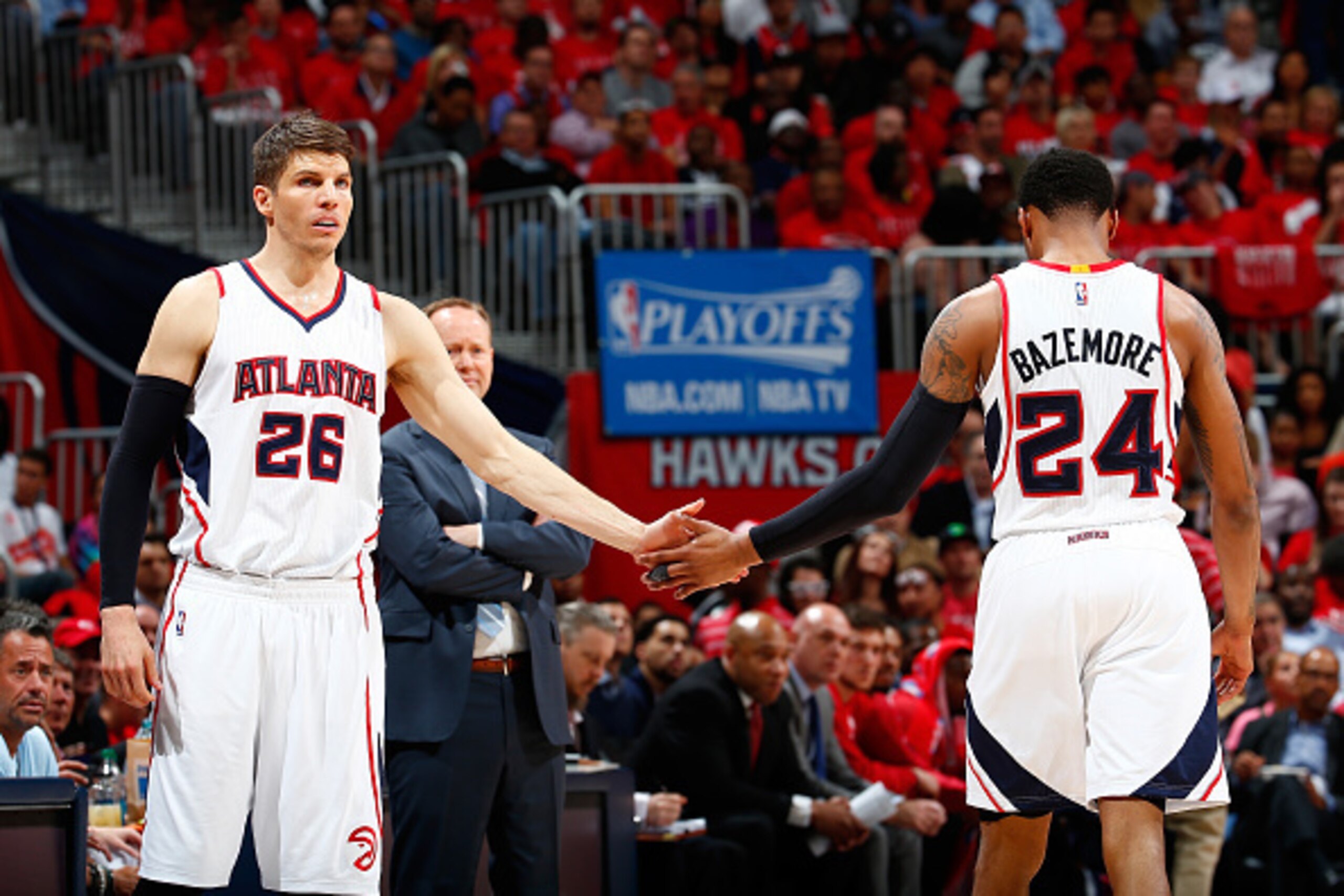
In Game 2, Korver ran himself ragged as a defender, trying his best to stay with Beal, who was the center of Washington’s attack. All that work takes a toll and isn’t allowing Korver to spring off his own screens when Atlanta has the ball.
He’s 34 years old and averaging 38.4 minutes per game, making him the 19th player in NBA playoff history to exert so much at such an “old” age (minimum 300 minutes). A heavy work load coupled with all the miles Korver’s racked up throughout his career can’t be overlooked.
By the time the fourth quarter rolls around, his shooting percentages plummet to 23.1 percent from deep and 21.4 percent overall. (Korver nailed 57.4 percent of his fourth-quarter threes in the regular season.)
There's a clear connection between Korver's individual success and the Hawks' winning percentage. Even when he's missing shots, having him on the court, even as a decoy, positively impacts their chances. Korver's mere presence running around in a half-court set can make an entire defensive unit buckle.
There’s no margin for error, as you can see from this DeMarre Carroll three in Game 1. Beal slips, then all hell breaks loose.

Korver has always been viewed as a luxury item, the Rolex complimenting a Jeff Teague-Al Horford-Paul Millsap three-piece suit. But in the playoffs, he's officially emerged as the very fabric of Hawks basketball. It doesn't work without him in position to lob tide-turning grenades at a moment's notice.
No deficit is insurmountable when Korver's on your side. He's a blowtorch who needs no more than 90 seconds to melt nine points into the scoreboard. He's taller than J.J. Redick and more fluid than Klay Thompson. Korver is always wound up and ready to set the other team on fire.
But Thabo Sefolosha's injury put the Hawks between a rock and a hard place at the shooting guard position, and it's forced Korver to step into an expanded role.
Would Hawks head coach Mike Budenholzer be willing to decrease his All-Star guard's playing time in order to maximize Korver's output when he's out there? It may be a necessity.
All statistics are courtesy of Basketball-Reference.com or NBA.com unless otherwise noted.
Michael Pina is an NBA writer who lives in Los Angeles. Follow him on Twitter @MichaelVPina.

.jpg?w=2560 "Raiders Could Start Mendoza")

.jpg?w=2560 "Rodgers Iced Out on Plane 💎")
.jpg?w=2560 "Packers Safety Slams Refs 🤬")
.jpg?w=2560 "🚨 Week 8 AP Top 25 Poll")