
Minnesota Vikings Draft Picks: Results, Analysis and Grades
The Minnesota Vikings have dipped their toes into the 2015 NFL draft, and we'll continue keep track of it here with live analysis and updates on what's happening in Chicago and back at Winter Park.
The team will have several goals to accomplish throughout the draft, a few of which will require trades. The team has stated a desire to accumulate 10 draft picks and has expressed that even those late picks can be valuable.
The Vikings weren't able to trade down their first or second pick but traded down twice in the third round to get more draft capital for Day 3 of the draft.
In the final day of the draft, the Vikings could continue to look at defensive backs—both safeties and corners—linebackers to play special teams and add competition to the bottom of the depth chart, a receiver who can win in the red zone or intermediate areas (they lack either at the moment), a backup tackle, a guard who may compete for a backup or starting role and a developmental quarterback.
Needless to say, it will be difficult to meet all of those needs. As it is, we'll keep you updated here with the latest analysis and news regarding the Minnesota Vikings in this year's draft.
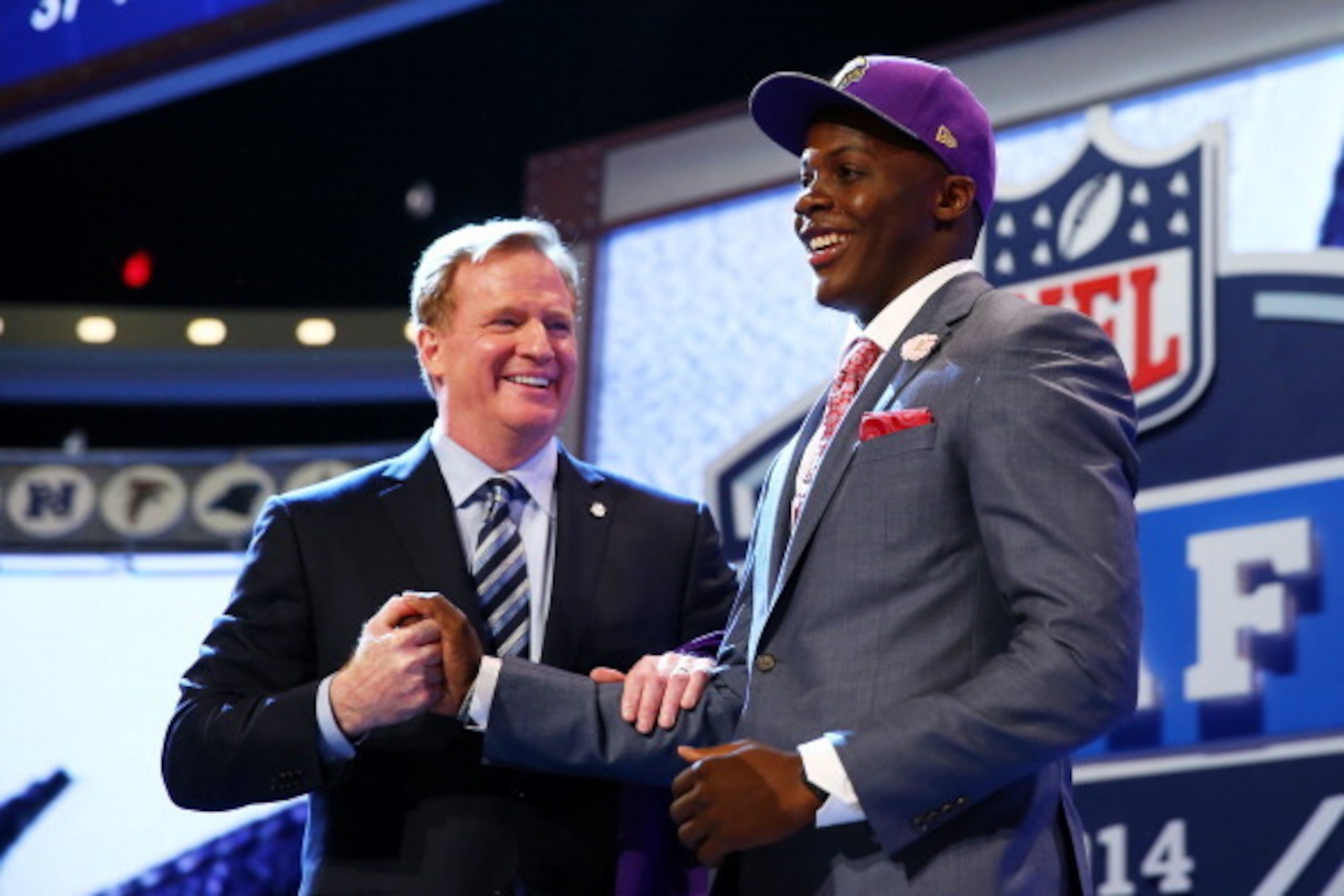
Pick 11: Minnesota Vikings Select Trae Waynes, CB Michigan State
1 of 10
For the first time in a few years, the Minnesota Vikings have done exactly what everyone expected them to and drafted Trae Waynes, the cornerback from Michigan State. Notable for his 4.31 40-yard dash at the NFL combine, he has production to his name in addition to speed.
The Vikings evidently valued Waynes quite a bit, as they reportedly were fielding trade-down offers from three teams before eventually turning the pick in, according to NFL.com's Ian Rapoport.
Known for only giving up two touchdowns in the past two years, Waynes' ability to protect against vertical threats is unparalleled in college. He should provide the Vikings with some protection against the deadly passing attacks of the NFC North, which features deep threats and quarterbacks who like to exploit them.
With Kevin White (Chicago) in the division, it increases the importance of a player who can keep up with his speed and provide some protection over the top.
There are a number of concerns about Waynes going in, some of which match the issues that Xavier Rhodes had coming out of the draft, including a predilection for grabby play and issues with short-area quickness.
Known for his high character, Waynes puts in time in the film room and can read receivers well.
On the flip side of that is a limited ability to read offensive concepts, and he struggles with route combinations. For the most part, the quarters defense at Michigan State made it less important to do so, although that unique defense also raises questions about his capacity to cover interior routes.
Those issues will be important when it comes to projecting into NFL systems, particularly a pattern-match system in Minnesota that requires reading entire offensive concepts and not just individual receivers. The addition of having interior responsibilities will put head coach Mike Zimmer's coaching to the test.
Waynes is a physical player who is willing to mix it up. He plays press coverage with pop, but his size is another concern that the team will have to overcome. While he has good height (6'0") and length (31" arms) for an NFL corner, carrying 186 pounds is a bit of a problem.
For a more in-depth analysis on Waynes, you can read this prior piece that broke him down as a prospect.
Grade: B
It's good to add a corner who can help Rhodes and Waynes isn't a bad prospect, but there are system issues and the difference between him and the other first-round CBs is negligible and the Vikings could have added value by taking a significant trade down and grabbing Byron Jones, Marcus Peters or Kevin Johnson—even if there are also system fit issues for Johnson.
Pick 45: Minnesota Vikings Select Inside Linebacker Eric Kendricks
2 of 10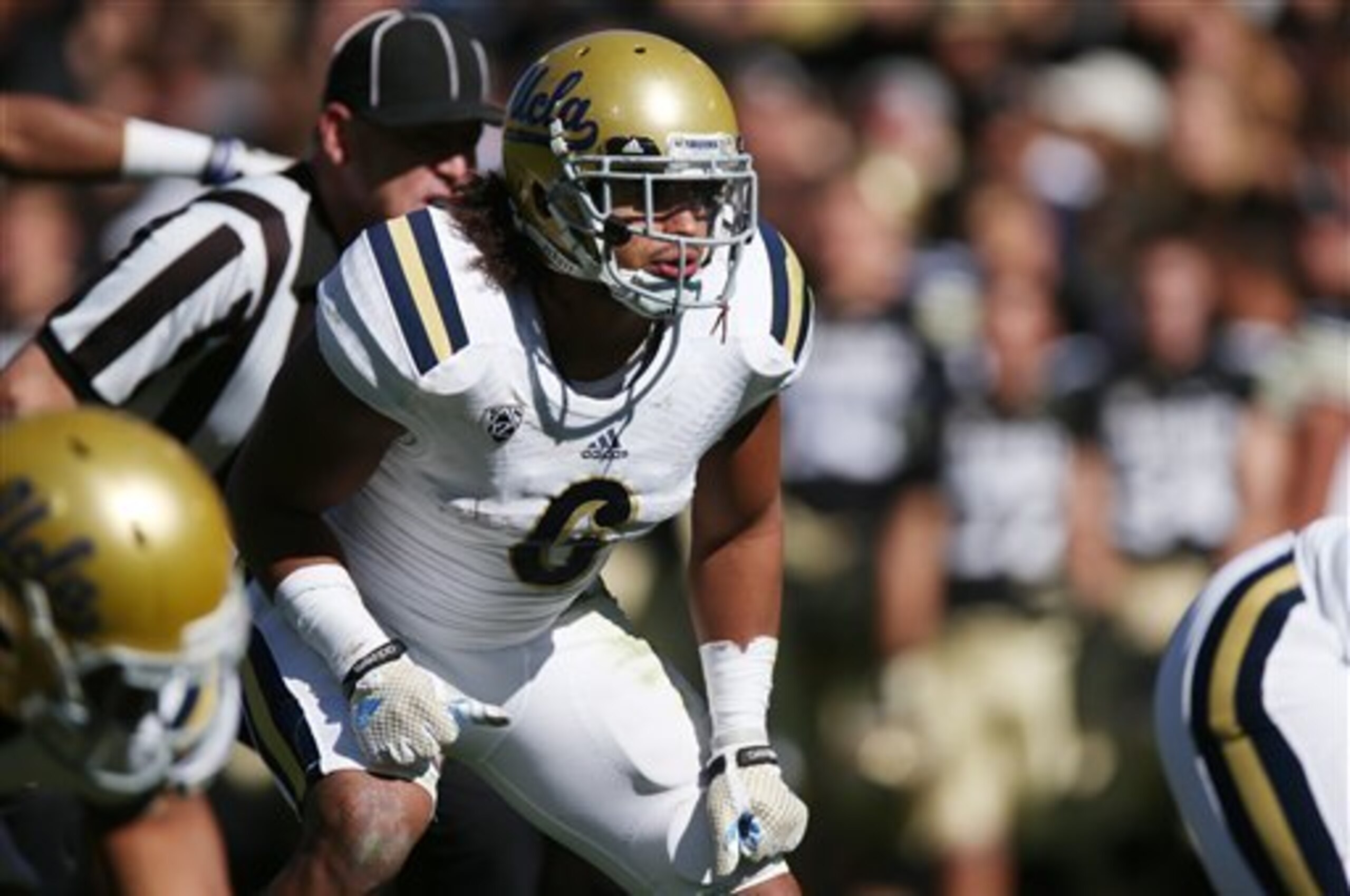
Having recognized the issues they've had at linebacker, the Minnesota Vikings selected UCLA linebacker Eric Kendricks with the 45th pick in the draft. Pairing him with former teammate Anthony Barr, Minnesota has bought into the concept of chemistry.
Or it just got a very good player from a very good defense for two years running.
Either way, the Vikings landed not only the most instinctive linebacker in the draft but also one of the best cover linebackers in the country. Those instincts allow him to take steps before the snap and anticipate the offense, often lining up in the gap the running back will run to before he even receives the ball.
Kendricks has exceptional character as a player, and his work ethic is extraordinary. A natural leader, he led the defense at UCLA for four years, both as a signal-caller and producer. Initially, those who take a look at some of the advanced metrics might not be as impressed, but he actually has extremely high athleticism scores and tackle-share numbers.
He had three 100-tackle seasons for the Bruins, and two of his seasons rank in the top five in tackles in UCLA's history.
After teammate Anthony Barr left, Kendricks' share of the team's tackles and tackles for loss jumped to 16.4 percent and 15.8 percent, respectively—the best tackle share of any draftable linebacker this year and second-best tackle-for-loss share of any linebacker who didn't play on the edge (behind Ben Heeney).
Regardless, it solves a need at either the "Will" or "Mike" linebacker position, depending on how the Vikings want to move around linebacker Chad Greenway, who has in the past taken snaps in training camp at middle linebacker. The Vikings have shown a willingness to try that sort of thing again if possible.
Barr, in a conference call to gathered reporters, told us that Kendricks is his best friend and provides a lot to the defense in terms of physicality, smarts and instincts, allowing it to achieve its goal of being a top-five defense this year.
The Vikings may use a late-round pick on another linebacker like they have in each of the past three years, but they will also want to address their pass rush and potentially add a safety to the roster. They've indicated in the past that they're interested in a developmental quarterback, as well. Offensive linemen are on their radar, too.
Grade: A
The Vikings immediately fixed a need while sticking to their model. Kendricks was considered by many to be a first-round talent, and he brings several unique aspects to his game that are not found elsewhere in the draft. Their linebackers had troubles against the pass last year and this should go a long way to resolving that. He is not a perfect system fit, however, and it would have been nice to add a player like Stephone Anthony who is not as instinctive, but whose skills match the schematic requirements a bit better.
Pick 88: Minnesota Vikings Select Danielle Hunter, DE LSU
3 of 10
The Minnesota Vikings selected one of the most athletic defensive ends in the draft, once again picking a "force player"—a player on the defensive line who meets certain athletic parameters that correlate highly with success in the NFL.
Other Vikings selections that met that criteria last year include Anthony Barr and Scott Crichton along with undrafted free agent Rakim Cox. There were only 17 last year, so it seems as if the Vikings are prioritizing this kind of player.
| 40 Time | 10 Time | Bench | Vertical | Broad | Short Shuttle | Three Cone | |
| Danielle Hunter | 4.57 | 1.58 | 25 | 36 ½" | 10'10" | 4.31 | 6.95 |
| Average 250-255-lb DE | 4.73 | 1.61 | 22 | 33" | 9'10" | 4.38 | 7.19 |
In every category but his 10-yard split, Hunter exceeded the average combine performance of an edge-rusher.
Hunter is a well-conditioned athlete with an impressive physique, and though he is an extremely raw player, he does have traits that are difficult to teach like lightning-quick reflexes and good awareness. His ability to defend the run is excellent and an underrated part of his game.
He doesn't have very much production, recording 1.5 sacks last year, but there's a good chance that how he was used—often as a 5-technique or "base" defensive end—restricted his production more than his talent did. Still, he is an extremely raw player who will need time to learn the position.
Don't expect him to make a big impact in Week 1, but he should feature in the rotation heavily.
Grade: A-
The Vikings had issue with their pass rush last year, and this won't go any further towards fixing it because Hunter will likely be off the field for the entirety of the year. On the other hand, getting rare athletic talent that is coachable and high character in the third round is so difficult to do that the Vikings deserve to be lauded, especially for overlooking production in favor of traits, which translate better than college stats.
.jpg?w=2560 "Titans Colts Football")
.jpg?w=2560 "Chiefs Giants Football")
.jpg?w=2560 "Colts Football")
Pick 110: Minnesota Vikings Select T.J. Clemmings, OT Pittsburgh
4 of 10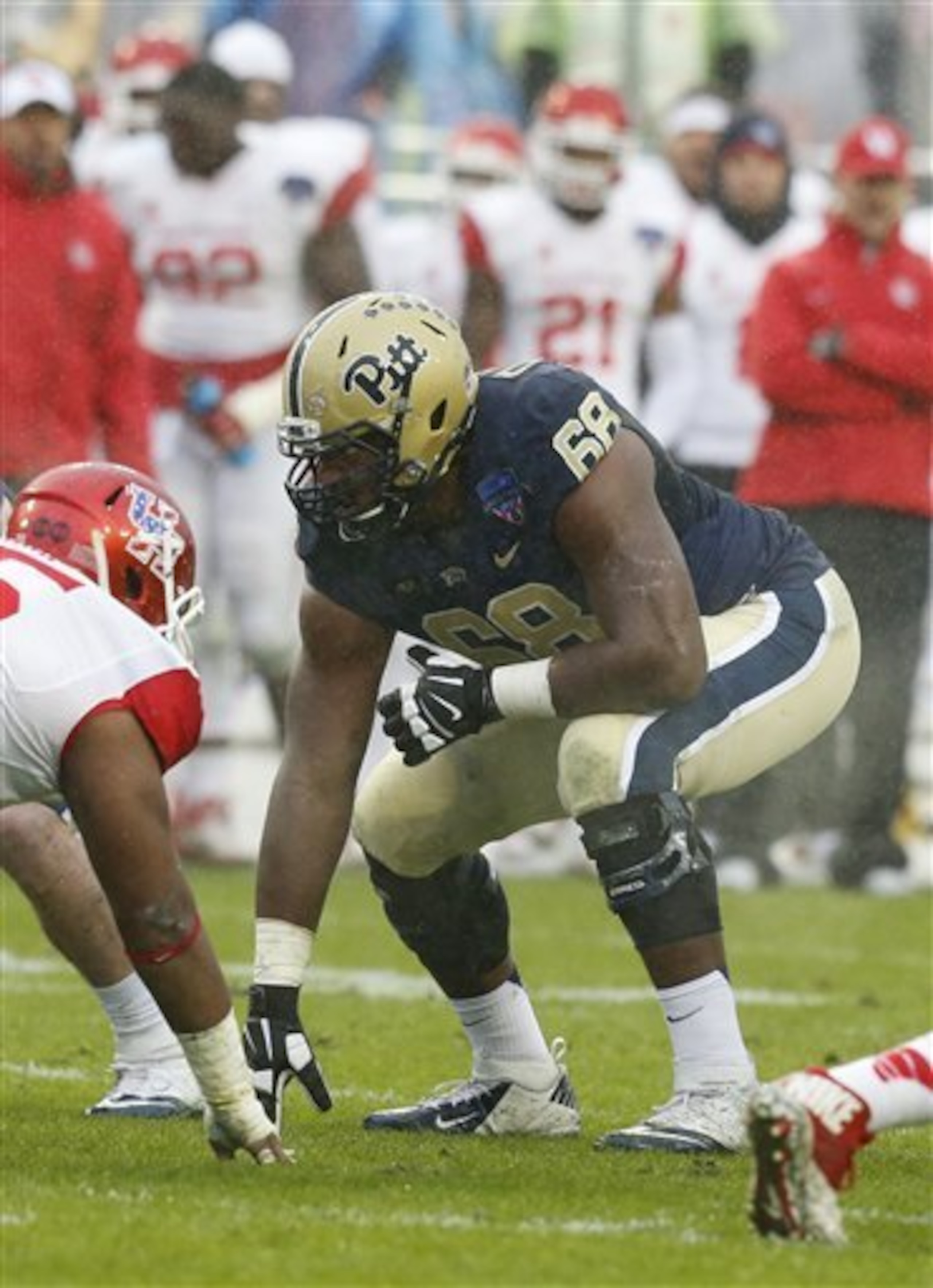
With the 110th pick in the NFL draft, the Minnesota Vikings have selected T.J. Clemmings, tackle out of Pittsburgh.
Described as a mauler with a nasty attitude, Clemmings has issues translating his offensive-line ready attitude to play on the field because of his incredible lack of technical sophistication.
Still, as a raw athlete and football player, he fits the mold of the kind of player the Vikings want to pick. Often projected in the first round, concerns about his foot injury that cropped up late in the process have likely dropped him all the way to the fourth round.
His agent says that Clemmings has suffered no foot pain nor has he missed games because of his foot, but clearly the NFL found something in its medical checks because the player fell. Keeping in mind that fact, remember that most criticisms you'll see of Clemmings are more nitpicky than damning.
An athletic player who physically compares to Daryn Colledge and Travelle Wharton, Clemmings' physical ability and profile is difficult to find. Switching sports in high school and sides of the ball in college, Clemmings is raw and can be molded by smart offensive line coaches.
He's a strong player who loves to bully with an enormous wingspan (second-largest among offensive linemen, according to NFL Draft Scout's Dane Brugler).
The good thing about prospects with limited experience is that they do not have time to develop bad habits as they practice good ones. For more in-depth analysis on Clemmings, Eric Stoner has an exhaustive and instructive piece here.
Grade: A+
Fantastic pick for a first-round talent but needs a lot of seasoning. By picking him late, the Vikings have insurance against potential injury concerns while also giving him time to learn the polish he critically needs. He would be an iffy pick without injury concerns in the first round, but he is fantastic here.
Pick 143: Minnesota Vikings Select MyCole Pruitt, TE Southern Illinois
5 of 10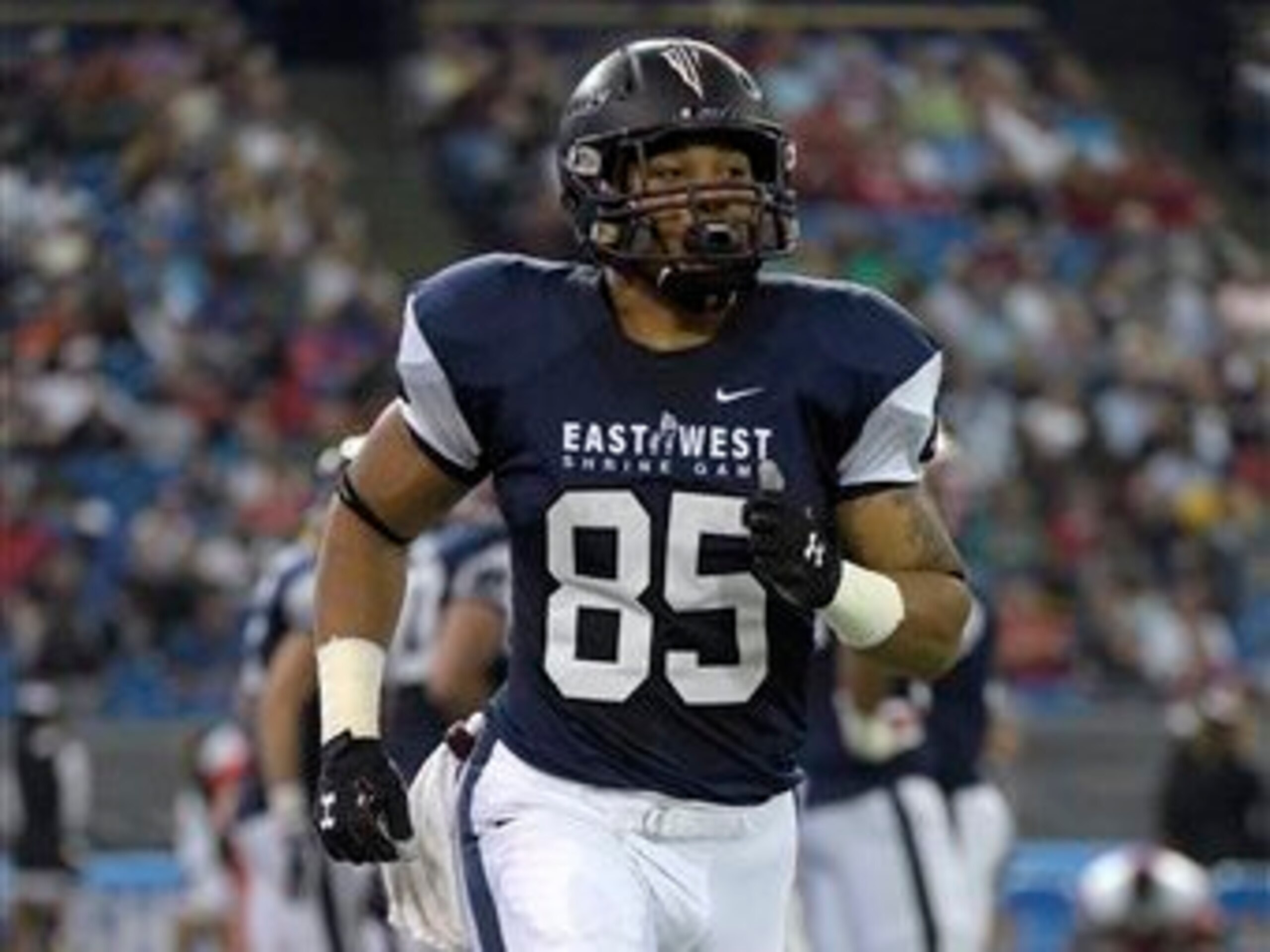
The Minnesota Vikings hold true to taking unique athletes. One of the two tight ends to blow up the combine, MyCole Pruitt provides explosiveness and speed to a roster of tight ends who don't have it—Kyle Rudolph, for all the talent he has, lost speed coming off an injury at Notre Dame and hasn't had it back.
This should give the Vikings a matchup piece to move around, much like Charles Clay did for the Miami Dolphins. Pruitt is a good receiver who can get separation at the line of scrimmage, but he isn't the greatest at running routes at the moment.
His after-the-catch vision is superb, and his power with the ball in his hands is underrated. He can be a gadget-type player who allows the offense to be versatile and create matchup problems.
In order to complete his game, the supremely athletic Pruitt will have to be a better blocker so that teams will always "be wrong" when matching up personnel on him, but his natural strength and explosiveness imply that his tools are there.
He's not quite a jump-ball tight end because of his height (6'2"), but his vertical ability (at 252 pounds) can make up for it.
Though he doesn't have deception or precision in his route running, his agility can spring him free against linebackers, but against safeties, he will have to be a bit more physical. He should be able to stretch the seam, however, and projects to give the Vikings serious offensive weaponry.
Grade: B-
He's not the same as Rudolph, Chase Ford or Rhett Ellison, so thinking of him as "another tight end" isn't quite accurate, but it is important to get more players at a position that doesn't have similar players. With Rudolph consistently injured, it's smart to get another tight end. But there were more talented players on the board with more athletic ability and polish at positions of need, like Tre McBride, Cedric Thompson or one of many guards. He's useful, but he's somewhat of a luxury.
Pick 146: Minnesota Vikings Select Stefon Diggs, WR Maryland
6 of 10
The Vikings seemingly love the concept of matchups. Shortly after trading Percy Harvin, Minnesota drafted Cordarrelle Patterson. The team found another gadget player who wins after the catch in Stefon Diggs.
| Height | Weight | 40-yard dash | 20-yard split | 10-yard split | Vertical | Broad | Shuttle | Cone | |
| Stefon Diggs | 6'0" | 195 | 4.46 | 2.58 | 1.53 | 35 | 9'7" | 4.11 | 7.03 |
| Cordarrelle Patterson | 6'2" | 216 | 4.42 | 2.61 | 1.6 | 37 | 10'8" | 4.40 | 7.28 |
The two don't seem all that comparable in terms of measurables, but they do have comparable on-field skill sets, though of course Patterson's play demanded more attention at Tennessee than Diggs' did at Maryland.
Explosive after the catch, Diggs has been used to take advantage of underneath space. He's fluid and quick, and he should be able to challenge Marcus Sherels for the punt-return job. His explosiveness as he catches the ball will allow for better upfield burst.
His route running is somewhat limited, but he wins separation consistently when given less sophisticated routes, like crossers and seam routes, and his agility gives him the natural tools to develop into a premier route-runner soon.
An advantage he may have over Patterson is his strong hands. He has good hands technique, tracks the ball well and knows when to catch away from his body and when to secure it against contact. His adjustment to the ball might already be the best on the Vikings' roster, and his highlight-reel catches are seductive.
His release off the line is excellent as well, though he will need to do more work to win against press coverage.
He doesn't have the natural or functional strength of Patterson or Harvin, however, and though he has the tools to be a good route-runner, his technique could use a lot of work. He needs to more consistently deceive defensive backs at the next level. He doesn't have the frame to really add weight, so his functional strength may limit him from being a consistent starter.
It's good to have backups at positions that are hard to replicate. If Patterson goes down with an injury, they will not have to change the offense. That is the primary value of Diggs, though his punt returning helps a lot.
Grade: C+
Diggs is talented but will likely never have the upside to start. He has limited growth potential, and though he had highlights in college, he may struggle at the next level because of that strength. It's a good addition to the roster because of the ability to keep the offense going if backups go down, but the value question will override that. The raw talent of other receivers (or needs) on the board at the moment don't make it a great pick, but it's not a bad one either. It may have been better to diversify the offense than provide insurance.
Pick 185: Minnesota Vikings Select Tyrus Thompson, OT Oklahoma
7 of 10
The Vikings decided to double up on offensive tackles by selecting Tyrus Thompson, the left tackle from Oklahoma playing opposite Daryl Williams, drafted above him. While Williams is a pristine character pick that played much more consistently, Thompson has much more exploitable physical talent.
Maybe the most interesting thing about Thompson is his background. Born in Germany, the son of military parents, Thompson married as a redshirt sophomore in college—to a woman also raised by a military family. Thompson's mother-in-law was a sniper in the Army.
The former Oklahoma left tackle was hit hard with rumors of a lazy work ethic and soft play (substantiated by scouts quoted in Nolan Nawrocki's 2015 NFL Draft Preview), but Thompson pushed back against that characterization in a phone conference call to gathered reporters.
For what it's worth, Thompson's highs are really high. He nearly blanked Shawn Oakman in their matchup against Baylor and had other good games throughout the season. At other times, his speed looked limited. He revealed a lisfranc injury that bogged him down, and that might explain why his 2013 tape looks so good.
Still that inconsistency between high-level, almost elite, play and liability is a problem.
Like other Sooners tackles, Thompson comes with an enormous frame, and is a 324-pound package in a 6'5" body, with long arms. He has a good understanding of angles, and if he had played stronger, he would have gone much earlier.
Both Clemmings and Thompson could potentially play guard, but their heights may make it difficult. They both have the speed and length the Vikings covet on the outside.
Grade: B+
The Vikings need backup tackles, and they insured themselves against the injury risk of T.J. Clemmings, and so deserve a decent grade. But there is tons of talent available late that the Vikings decided not to invest in, including fast, special teams-capable linebackers, large receivers and safeties. It's possible they read the board well, however, and those needs could fall.
Pick 193: Minnesota Vikings Select B.J. DuBose
8 of 10
Grabbing a versatile defensive lineman with a quicker ability to contribute than the one they grabbed in the third round, DuBose played as a 3-4 end in the Louisville defense but over the course of the year played every spot on the line in one-gapping 4-3 fronts and two-gapping 3-4.
That versatility likely means DuBose plays the right end position, more of an edge-setter than pass-rusher. That doesn't mean he's a poor pass-rusher, simply that he has a wide array of responsibilities, with the ability to kick inside on nickel downs or back up the 3-technique spot if need be.
DuBose moves well for his size and can penetrate into the backfield, though he wasn't asked to do it very often at Louisville.
His responsibilities were clearly defined for him. He's not a very creative player, but as a role player, that's fine. His instincts are average, and he doesn't have a nose for the ball, but he'll fill his gap well.
He has excellent strength but relies on it too much and hasn't developed a variety of moves. He'll continue to develop in Minnesota, and if he drops some weight, he may be able to add some speed moves, too.
Grade: B
It's never bad to get a versatile role player, so there's not a chance this would be a C grade or lower. In terms of pass-rushing talent on the outside, there were some better players like Ryan Russell or Obum Gwacham. Inside pass-rushing talent like Christian Covington and Rakeem Nunez-Roches would have been superior as well. The Vikings paid a little extra for the versatility, but other players had more upside with the same versatility (Brian Mihalik and Martin Ifedi). The difference between those players and DuBose isn't extraordinary, though, and Vikings fans can look forward to competent role play.
Pick 228: Minnesota Vikings Select Austin Shepherd, OL Alabama
9 of 10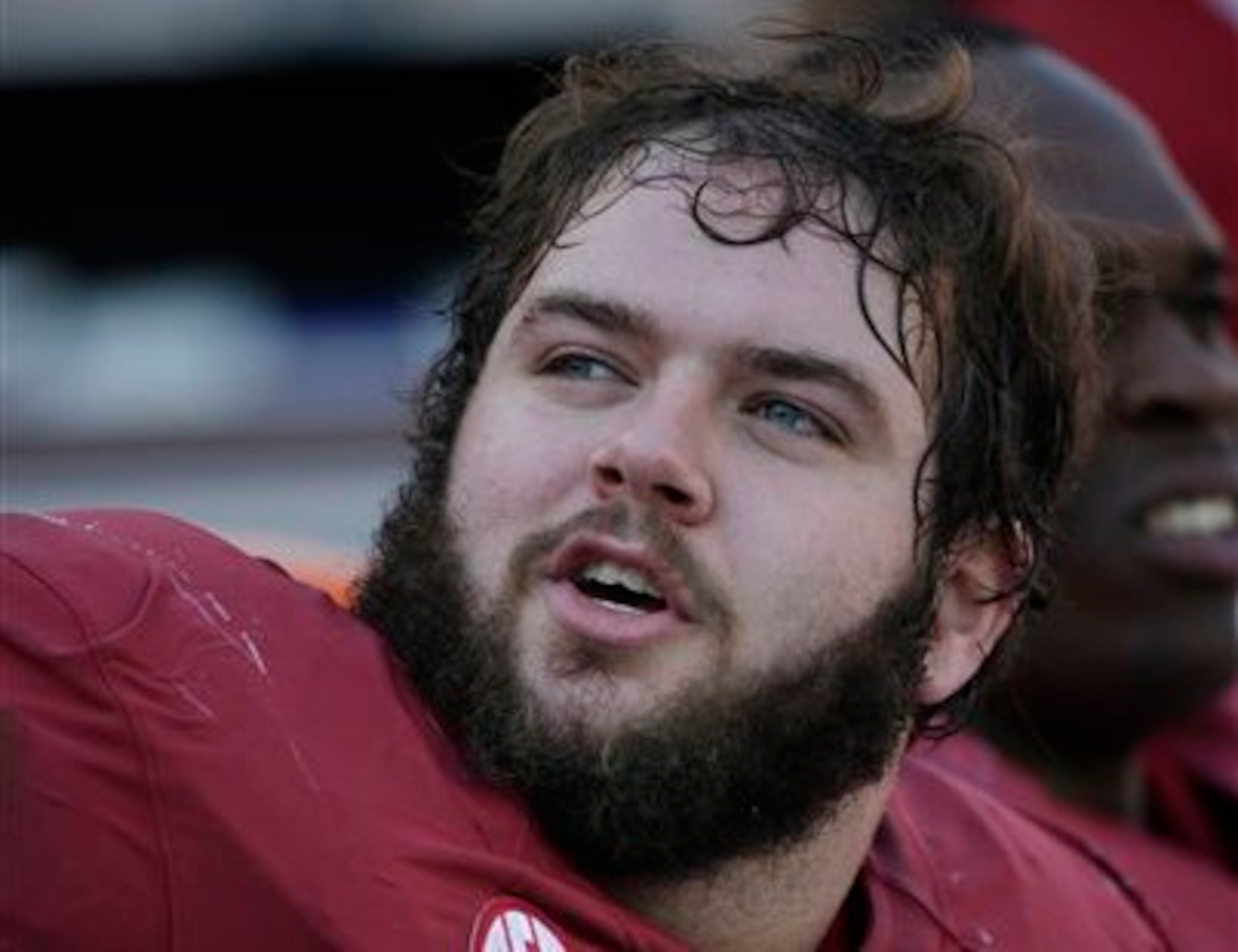
With a masters degree in marketing, Austin Shepherd certainly has a plan in place if this football thing doesn't work out. In the meantime, the Minnesota Vikings have selected a prototypically sized offensive guard who should hold down a backup spot for some time if he lives up to his scouting reports.
He played tackle in college, but his athletic limitations and issues with edge-rushers make him less of a tackle and more of a guard.
He has average take-on strength and below-average agility, but he makes up for it with a good understanding of blocking angles and advanced understanding of the offensive schematic concepts in Alabama and high-level awareness.
Shepherd was solid at picking up blitzes and squaring up to late rushers at Alabama and should be able to fill in anywhere on the line in a pinch.
He lacks movement skills, especially on the second level, to sustainably create a positive blocking game, and his length shows up with how often he loses the battle for first contact, setting him back. He lacks some technical ability as well and won't push through blocks, allowing stronger defensive tackles to own the point of attack
Grade: C
It's not an issue to add another offensive lineman to a crowded group of them, but Shepherd has a "high" floor for a seventh-round picked coupled with an astonishingly low ceiling. Players like Quinton Spain were available who had a similar floor, higher ceiling and excellent character as well.
C grades in the seventh round aren't worrisome, but if it is possible to do better, might as well try.
Pick 232: Minnesota Vikings Select Edmond Robinson, LB Newberry
10 of 10
The Vikings stick to the plan they have for the past three years and draft another linebacker late in the draft, this time uber-athletic Edmond Robinson from Division II Newberry College, the first Division II player in the draft to be selected.
Robinson was given grades as high as the fourth round by some draft analysts and was truly one of the better small-school prospects available in the draft. We wrote about Robinson as a potential target for the Vikings not too long ago, in part because he perfectly fit the model for what the Vikings pursue at the position:
"After Benardrick McKinney and Jordan Hicks, the best workout for off-ball linebackers at the combine belonged to small-school linebacker Edmond Robinson. At 245 pounds, he is slightly larger than the average off-ball linebacker has been in the NFL this year and despite that exceeded the averages at his position for height and weight.
A linebacker of his size (6'3", 245 lbs) would normally be expected to post a 4.73-second 40-yard dash, 1.62-second 10-yard split, 33" vertical leap and 114" broad jump. Instead, Robinson ran a 4.61-second 40-yard dash with a 1.62-second 10-yard split while jumping 37 inches high and 121 inches far.
The only test he didn't beat the expected score was the three-cone drill, as he ran a slow 7.49-second drill when a 7.15-second one was expected. He did make up for it by winning the other agility drill, going 0.01 seconds under the 4.39-second expectation in the short shuttle.
Though the agility drills are important for a linebacker, more important are raw speed, size and explosiveness, all of which he demonstrated with significant room to spare.
"
Aside from his impressive workouts and athleticism, he showed a lot of versatility while at Newberry, covering receivers and tight ends in the slot and out of the box. While that depressed his tackle numbers, he still led the team in solo tackles and ended up with 9.9 percent of its total solo tackles.
His production could have improved if the team decided to play him on the edge or stacked behind the line, but his athletic versatility was too much for Newberry to ignore. His raw skills are rough, and he will need to learn how to read more complex offenses while learning more sophisticated techniques to shed blocks. He may be destined to be a chase linebacker, but he has the build to play all three positions.
Grade: A
The Vikings have a plan that functionally requires picking a linebacker late in the draft, and this was potentially one of the best possible prospects to that end. If the Vikings are happy with their plan at safety, spending on a linebacker to compete for the bottom of the roster is smart, especially, when they have more upside than the other late-round linebacker picks.
.jpg?w=2560 "Eagles Jaguars Football")
.jpg?w=2560)