

Brooklyn Nets Have Golden Opportunity to Play 2015 Postseason Spoiler
Every year, without fail, at least one potential postseason spoiler is born during the first round of the NBA playoffs. And while these bracket-busters are always surprises, this year's lone possible party pooper can be found in the most unlikely place: the Brooklyn Nets' locker room.
Luxury-tax-paying franchises are not Cinderella stories. Let's make that clear. More than the Nets are a dark horse, they're a serial underachiever—the expensive offshoot of failed attempts to bypass patience, process and other traditional team-building tenets.
But the Nets are underdogs insofar as they, the Eastern Conference's No. 8 seed, aren't supposed to advance past the first-place, 60-win, championship-chasing Atlanta Hawks. Yet, after their 120-115 overtime victory in Game 4 Monday night, they have an opportunity to bend the postseason arc in their favor.
TOP NEWS

Pic of LeBron's Helicopter Commute 🚁

Duren Calls Out 'False' Rumors
Trade Idea to Give Warriors Alternative All-Star Upgrade 🏀
Deron Williams took a trip down Time Machine Lane, totaling 35 points while controlling the tempo of Brooklyn's offense and hitting big shot after big shot—impossibly contested or otherwise:
Brook Lopez pitched in 26 points of his own along with four blocks and two steals. He continued serving as (gulp) the Nets' defensive linchpin, inserting himself as the last form of defense between the three-point line and the rim.
Substandard free-throw shooting (14-of-21) and insufficient rebounding (minus-15 on the glass) nearly torpedoed the Nets. They trailed by as many as 12 points in the second half and seemed incapable of coming up with stops midway through the third quarter.
But head coach Lionel Hollins made adjustments on the fly, fielding smaller lineups to combat Atlanta's floor spacing. From there, the Nets were able to attack the middle and create some open looks for Alan Anderson, Joe Johnson and Bojan Bogdanovic.
Plus, you know, Williams. His performance—which included a 16-point fourth quarter—remains beyond words. Not even Hollins could find a way to describe it, per Barclays Center's Lenn Robbins:
Fear not, though. Complex's Russ Bengtson found a way:
It's imperative we make another thing clear at this point: The Hawks are not suddenly playoff peons. They have not substantiated the cries and concerns of detractors who view their regular-season success as a months-long anomaly.
What they have done, even in victory, is open the door for a team that shouldn't be in their vicinity. That's where any hope of Brooklyn's pulling off the upset begins.

The Hawks swept the Nets during their regular-season series, winning all four games by an average of 17.3 points. But not one of their first two victories in this series has come by double digits. The Nets have never trailed by more than 16 points or entered the fourth quarter down more than 12.
That's not the Hawks. They posted the fourth-best net rating during the regular season and made mincemeat of sub-.500 outfits, going 36-9 against losing teams. They are not in the business of letting inferior opponents hang around.
At least they never used to be.
Thanks in large part to a stumbling offense, the Hawks are turning their first-round matchup into a competitive affair. Though they're sticking to their guns on the surface, with most of their buckets coming off assists (64.6 percent), Game 4's efforts are a series exception. Leading into Monday night, they were averaging a pitiful 94.1 points per 100 possessions, the second-worst mark among all 16 playoff squads.
Certain aspects of this decline—Atlanta pumped in 106.2 points per 100 possessions throughout the regular season—are self-inflicted. The Hawks are missing shots they normally make and continue to admit as much.

"I feel like we got some good shots and they'd didn't fall for us," Al Horford said after shooting 3-of-12 from the floor in Game 3, per ESPN.com's Kevin Arnovitz. "I mean if you look at my shots, I had a lot of open looks, they just didn't fall. Sometimes it happens."
Horford wasn't the only one laboring in Game 3. The Hawks shot 31.1 percent (14-of-45) on uncontested looks as a whole and 38.4 percent on open opportunities through the first three tilts (48-of-125).
Troubling still, the Hawks are struggling from perceived areas of strength. They're not hitting three-pointers consistently and rank as the postseason's worst shooting team when inside the paint:
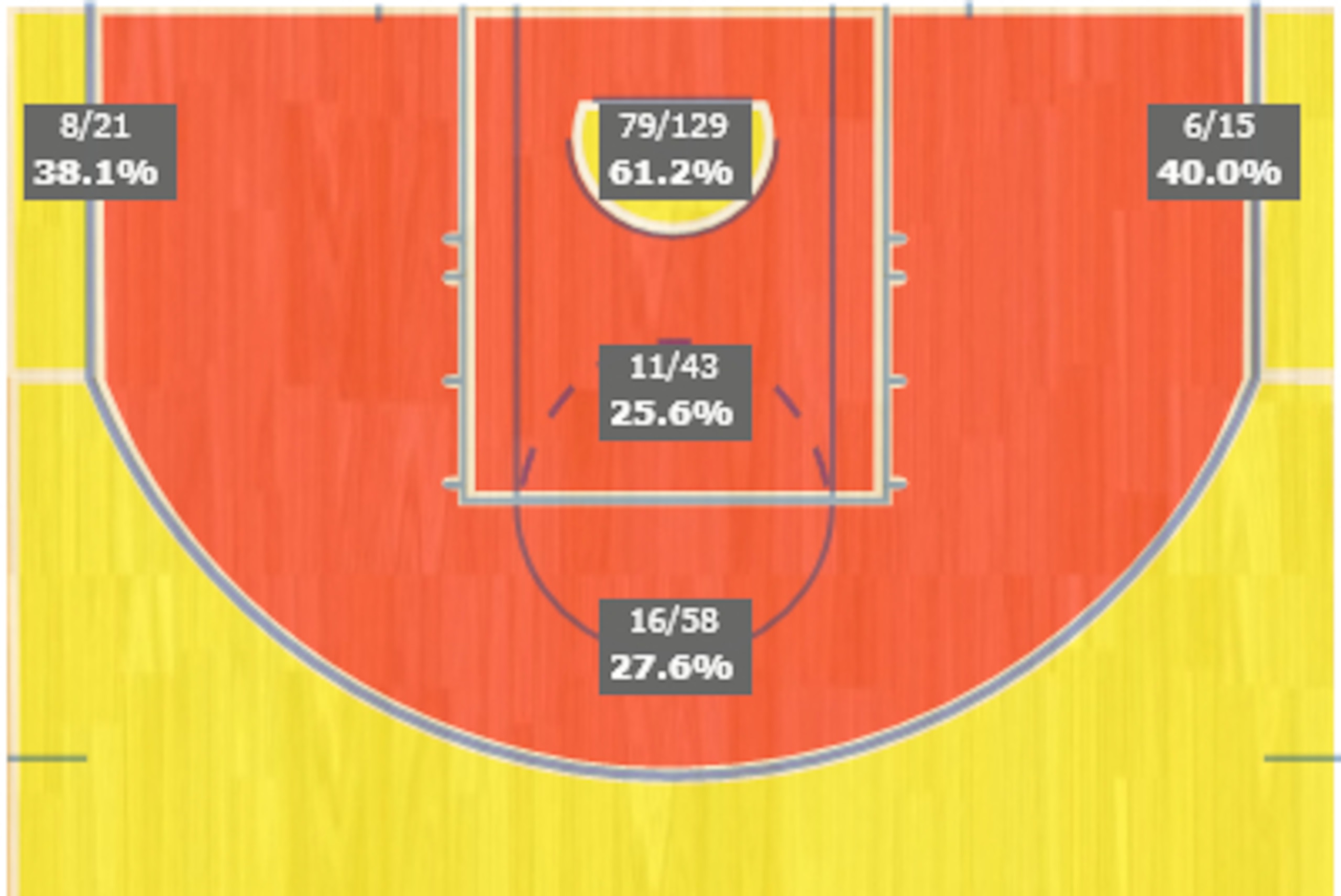
This is where the Nets themselves come in.
While the Hawks are doing plenty wrong on their own accord, the Nets aren't making things any easier. They're swarming the perimeter, playing the type of defense that forces Atlanta to rely more on individual playmaking than off-ball movement and pinpoint passing.
CBSSports.com's Zach Harper summed up Brooklyn's philosophy thusly after Game 3:
"You don't see the 3-point line taken away from the Hawks like this often. The perfect example of how well the Nets defended in this game is finding the possessions in which the Hawks killed ticks on the clock trying to find an open Kyle Korver. It just wasn't allowed and so when Korver did catch the ball without much space, he'd either have to pass off without much threat of creating anything or he'd rush a jumper off-balance, which you almost never see.
"
By guarding against the three-point shot and off-ball screens, the Nets are essentially inviting the Hawks into the lane, an approach that only works if you have a big man mobile enough to recover and force mid-shot adjustments.
The Nets don't have that big man on paper.
Lopez, however, has done just enough to satisfy those requirements, as Grantland's Zach Lowe previously pointed out:
Indeed, Lopez deserves a lot of credit. He's not necessarily defending one player on any given set. He's something of a nomad, patrolling the area in between the three-point line and elbow, strategically placed to goad Atlanta into long twos like this:
Or harshly angled running layups like this:
With the exception of a reeling Dennis Schroder, the Hawks were able to find their groove at different stages of Game 4. But the Nets' defensive methodology still proved tough to crack, so the point remains.
If they're able to pull off an upset, their role in disrupting the Hawks' offensive flow will be why. Their offense has been comparably anemic compared to Atlanta's, and they are not the shining example of system basketball.
Instead, the Nets are playing like a more unrefined model of Hollins' Memphis Grizzlies teams from years past. They're riding the offensive contributions of one or two players and using a deliberate defensive approach tailored specifically to the opponent they're facing.
Granted, pulling off this upset isn't a given. The Hawks' starting lineup is beating the Nets into statistical submission when on the floor, and it's never looked truly broken, even while coping with injuries (Horford) and failing by its own standards.
Most importantly, teams that jump out to 2-0 leads in best-of-seven series don't generally lose; they win 93.9 percent of the time, according to WhoWins.com.
That the Nets are in this at all, though, is the real story—irrespective of whether they actually win.
This series was pegged as a four- or five-gamer. It will now go at least six. It could go seven.
It could swing in the Nets' favor entirely, at which point, as they prepare for a second-round matchup with the Washington Wizards, the Eastern Conference Finals would suddenly be within reach.
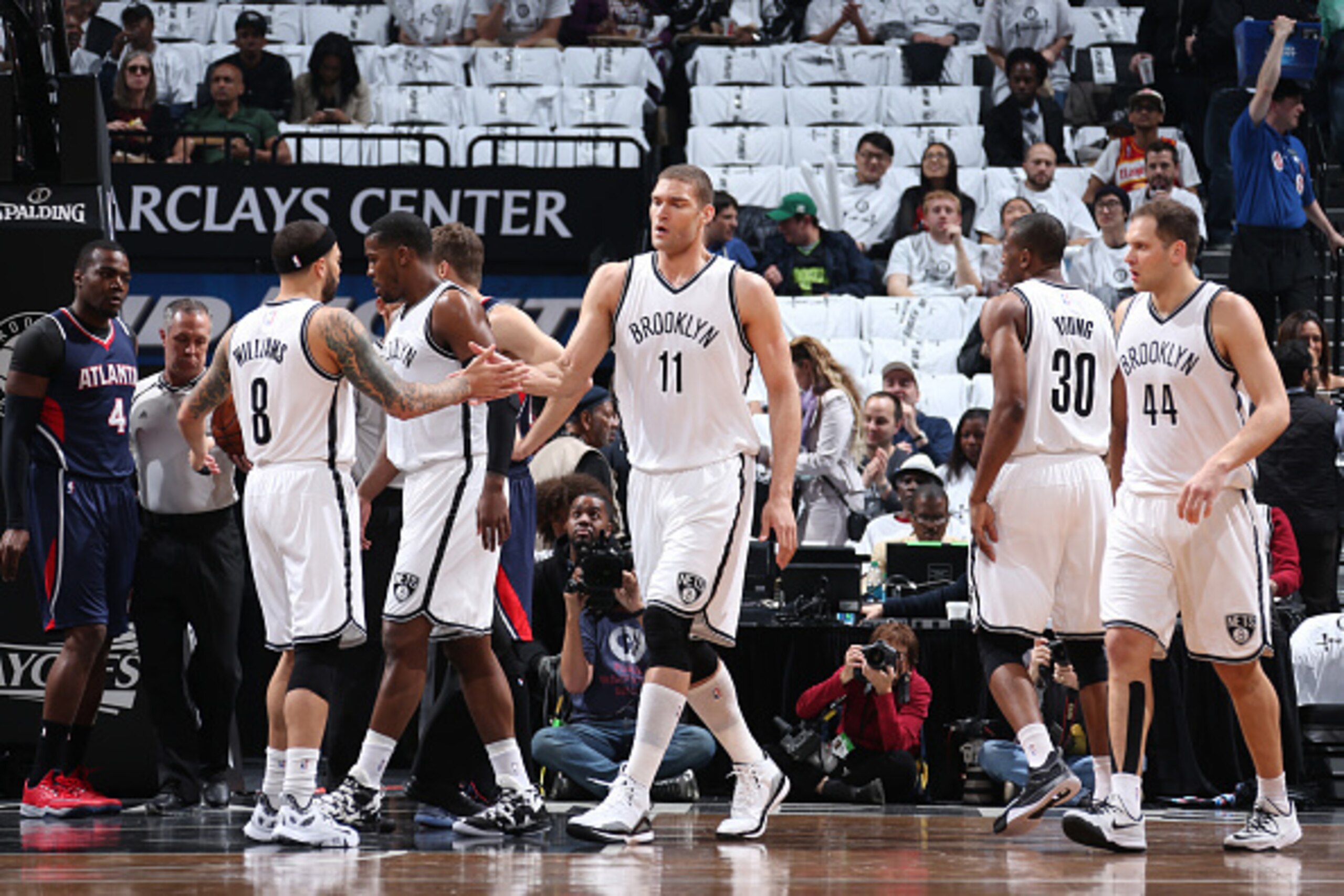
No outcome is off-limits now. Not with the way this matchup continues to unfold. Not when the Hawks haven't once looked the part of an invincible contender.
To the contrary, they've never appeared more vulnerable. And now, after already delivering a scare the Hawks weren't yet supposed to incur, the Nets go back to Atlanta for Game 5, momentum in hand, two wins away from completing an upset the Hawks aren't supposed to endure.
Stats courtesy of Basketball-Reference.com and NBA.com unless otherwise cited.
Dan Favale covers the NBA for Bleacher Report. Follow him on Twitter: @danfavale.



.jpg?w=2560 "NFL investigating 2 referees for separate viral exchanges")
.jpg?w=2560 "OBJ Calls Out Giants 😳")


.jpg?w=2560 "Tyreek makes another cryptic post amid Chiefs rumors")
.jpg?w=2560 "Ward Nearly Walks Out of Presser 😳")