The Sky Is the Limit as John Wall Breaks Through His Projected Ceiling
The expectations that come with being the No. 1 overall pick in the NBA draft have always hovered over John Wall.
When he wasn't an immediate success, there were questions as to whether Wall would ever join the ranks of the elite point guards across the league. His raw tools were still raw. The Washington Wizards weren't winning, or even progressing. His career felt stagnant.
Much of that stemmed from his inability to shoot from the outside. He's certainly made steady progress since he entered the NBA in 2010, but knocking down jumpers from the perimeter has never been Wall's calling card.
TOP NEWS

Brown with an all-time summary of relationship with Tatum

Heat, Giannis were down by 20+ in each of their 3 losses
Worst NBA Predictions 🫣
Speed, athleticism, ball-handling and court vision have always been his strongest assets, but bulldozing his way to the rim with bursts of acceleration can only take him so far. NBA defenses have adjusted to Wall with softer coverages, choosing to pack the paint and daring him to beat them from the outside.
Wall's first adjustment to this defensive shift was to fire away. Take enough jumpers, the thinking went, and he'll eventually coax the defense out. This, of course, played right into opponents' hands.
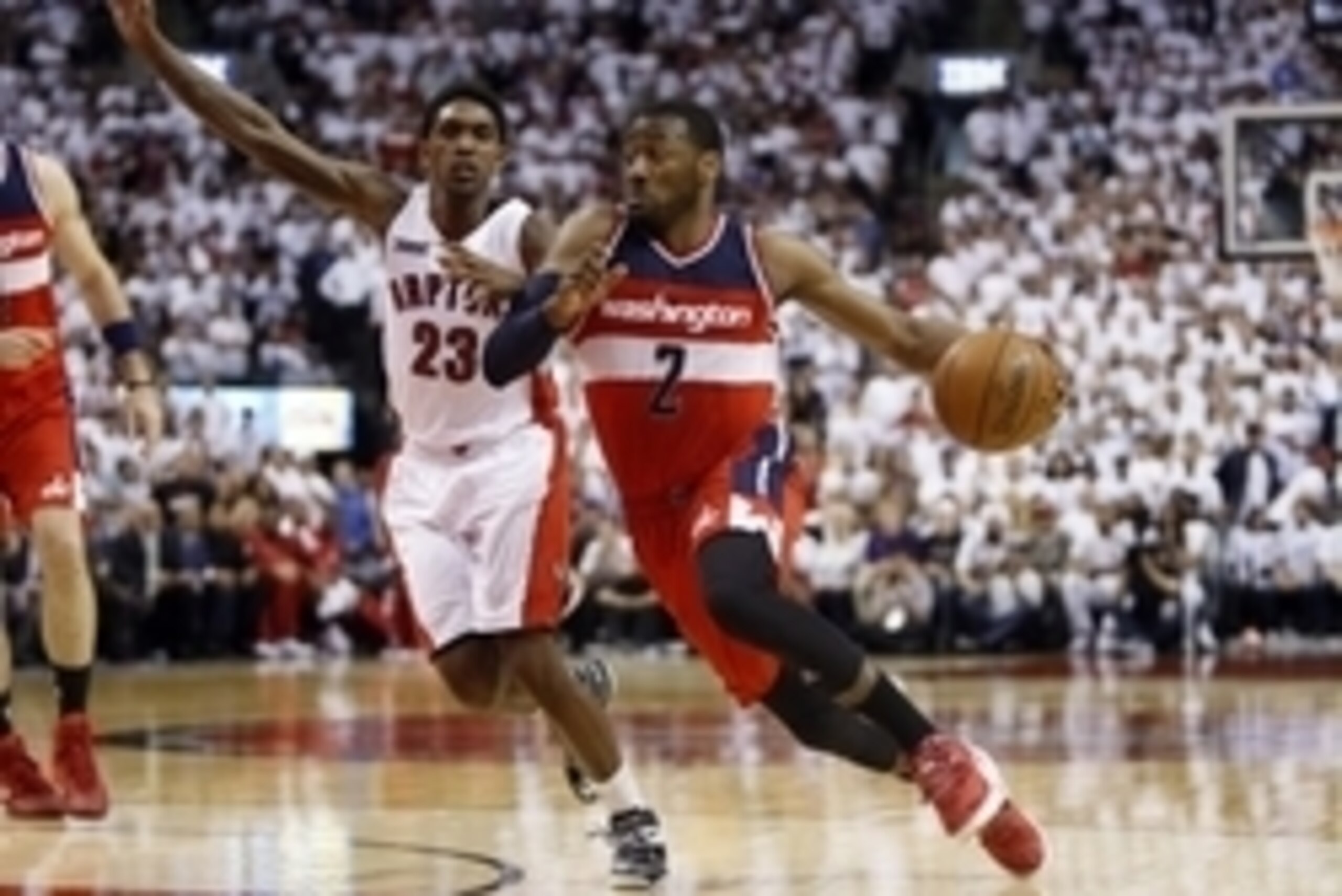
The proper, but more difficult solution was to take his foot off the gas pedal and think. Breathe while dribbling. Push, probe, dance. Use the threat of his speed as a weapon to wield against wary opponents.
This is how Wall racked up 26 points and 17 assists in Game 2 of the Wizards' opening-round series against the Toronto Raptors, and it's what has turned him into an All-Star. Moving forward, it's what Washington will need if they hope to win this series and make any type of deep run through the 2015 playoffs.
Every type of defense has holes. Teams that lock up the three-point line tend to struggle with pinpoint interior passing. Teams that protect the rim at all costs give up threes. Teams that try to keep the basketball on one side of the floor leave themselves vulnerable to weak-side fade screens and backdoor action. There is no perfect NBA defense.
So teams pick and choose their spots. They try to cut off X and give up Y. But even a narrower focus on preventing certain types of shots lends itself toward overaggression in that respect: Focus too much on cutting off three-pointers and teams will feast in the paint. There's no point in defending beyond the arc if you give up layups all game long.
The same thinking applies to how NBA teams typically guard John Wall. Particularly in the pick-and-roll, opponents have their on-ball defenders fight underneath any screens, thereby cutting off angles for penetration while giving Wall room to shoot.
Wall is 3-of-7 on off-the-dribble jumpers in pick-and-roll situations thus far in the playoffs, according to Synergy Sports, an indicator that Toronto's plan is working.
It's too bad that number is wildly misleading.
For all the pick-and-rolls Wall snakes through during a game, seven jumpers is a minuscule number. What this tells us instead is that Wall is not settling, instead navigating his way through the screens while looking for easier baskets for both himself and teammates.
This is a nuanced art that doesn't require natural athletic gifts. It's about timing, skillful dribbling and heady play. It's why Chris Paul, who's quite clearly not one of the NBA's elite athletes, is the best at it.
Wall is still learning, but he's shown flashes of growing patience and vision. Take this pick-and-roll from early in Game 2, when Nene runs in to set a "drag" screen—a type of pick in which the offensive big man runs in at an angle parallel to the baseline during a semi-transition situation.
Lou Williams, who is matched up on Wall, gets hit by the pick, but takes a low angle of recovery. You can see by his footwork that he's working his way back to the elbow, giving Wall plenty of space. He cannot go underneath the screen because it comes at pace, but he wants to maintain the discipline of the game plan by providing ample room for Wall to shoot:
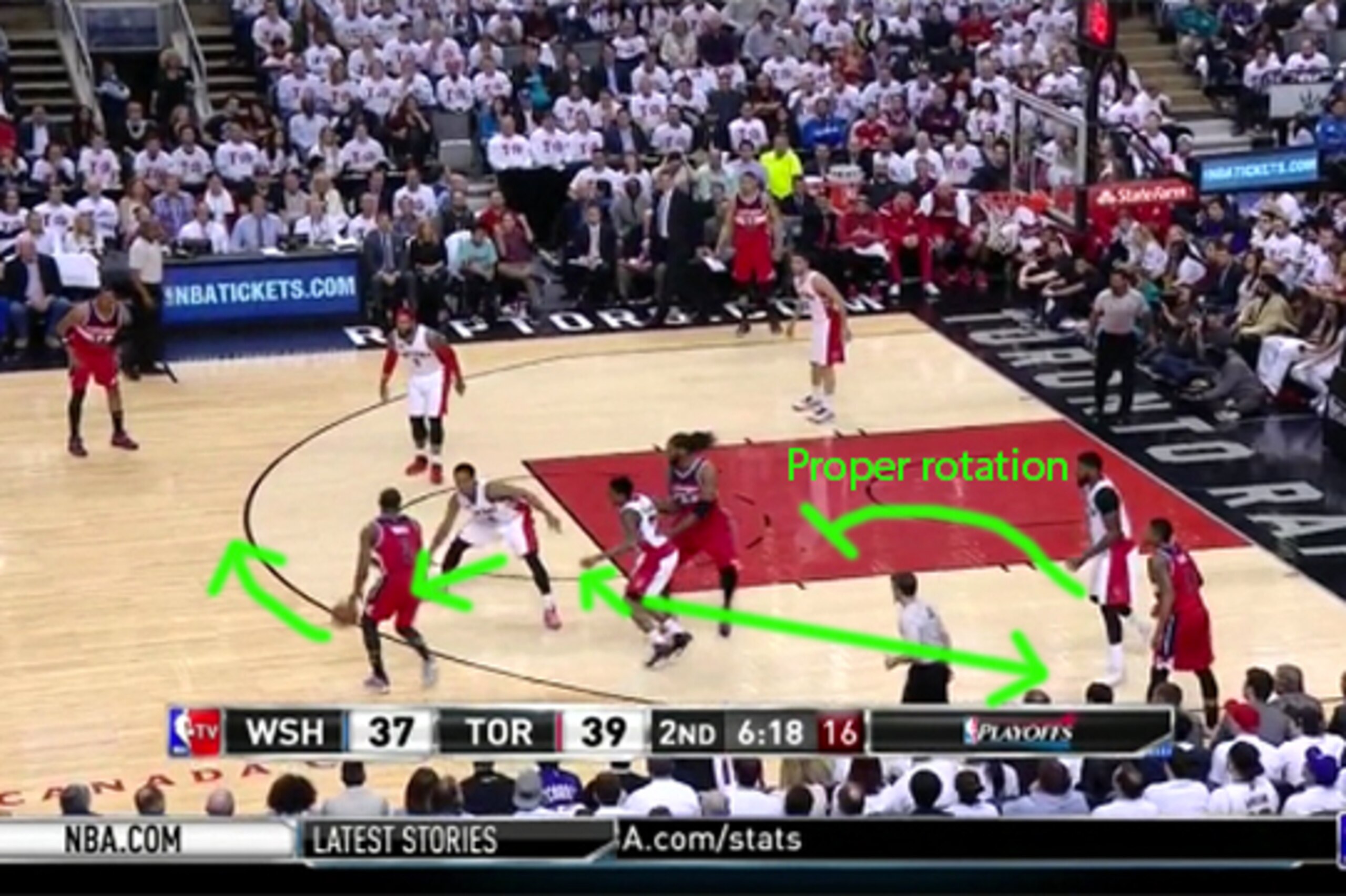
DeMar DeRozan has Nene in a transition cross-match—when the defense cannot get its matchups set and must pick up whoever is closest—and leaps out at Wall briefly as the screen occurs.
Because DeRozan and Williams are both guards, DeRozan likely expects a straight switch to alleviate confusion. When that doesn't happen, it's up to Toronto's lowest defenders to take Nene as he rolls to the rim.
In this case it's James Johnson, who's guarding Bradley Beal in the corner. But moments later, Nene has the ball in his hands for an uncontested dunk while Williams and Johnson are both glued to Beal:
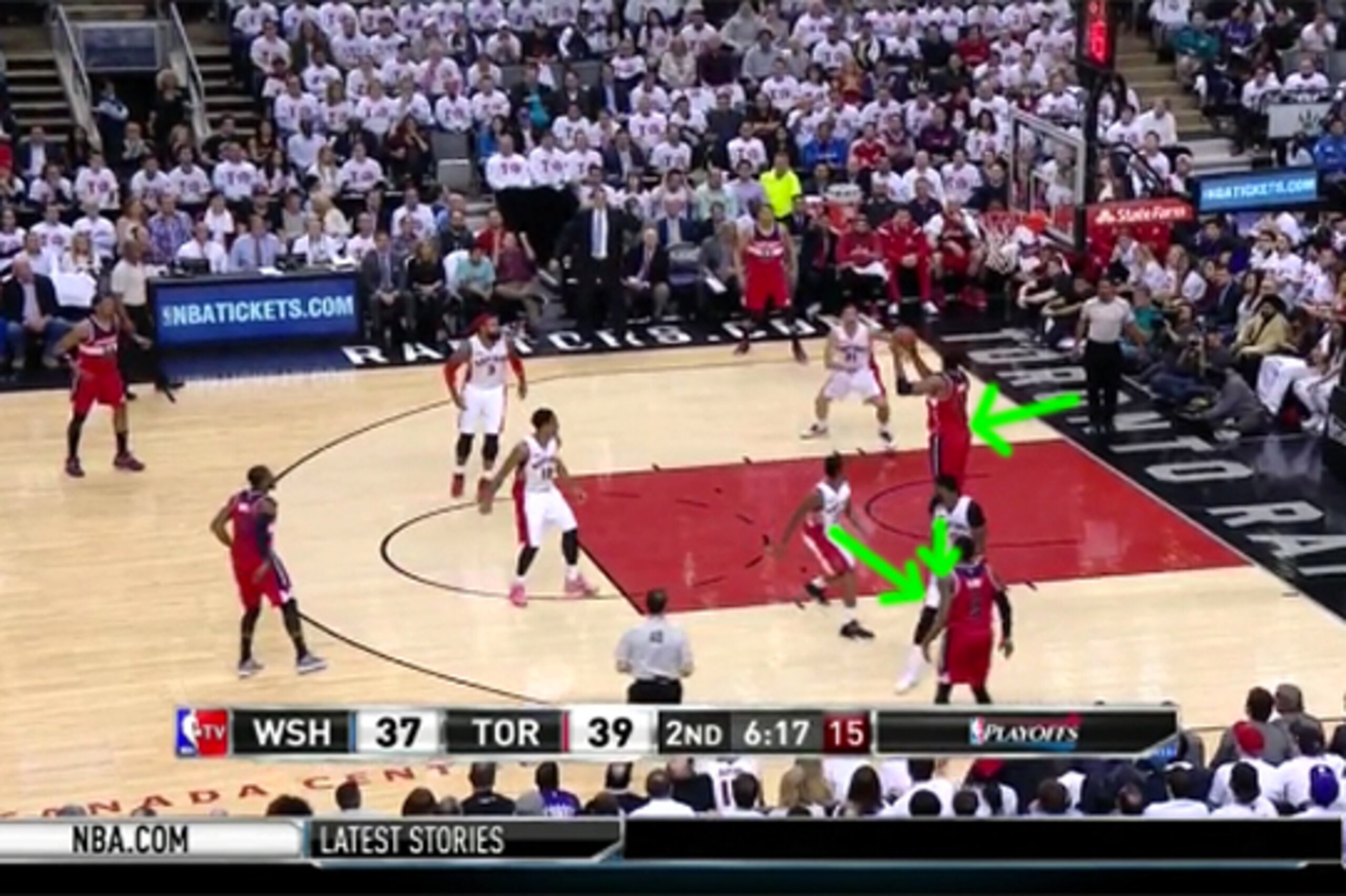
So what happened?
It's brief, but lock in on Wall's eyes and head as you watch the video. When you view it a second time, key on Johnson's movement:
As Wall picks up his dribble to fire a two-handed overhead pass, he briefly locks onto Beal. That's all it takes to halt Johnson's middle rotation and send him careening back to the corner. A split second later, Wall's pass betrays his eyes and slices right through the teeth of the defense.
Williams is expecting Johnson to rotate low so he can shift onto Beal, but that slight feint from Wall is enough to throw Toronto's defense completely out of whack—it's the difference between a missed opportunity and an easy two points.
This is a learned skill. In the blink of an eye, Wall identifies the Raptors' rotating defender, controls his movements with a glance and fires an on-point pass to his teammate.
What makes Wall even more dangerous is that his elite burst always lurks in his back pocket. He can break it out at any time and devastate an unsuspecting defender. The caution this instills in a retreating opponent can often be leveraged into generating a great shot.
During the third quarter of Game 2 when Washington was threatening to run Toronto out of the gym, the crowd noise swelled and the Raptors ramped up the defense a few notches.
Williams, therefore, got a bit overaggressive on the perimeter and started pressuring Wall 40 feet away from the basket. Instead of panicking and trying to punish Williams too quickly, Wall gently drew him farther away from the basket until he hit him with a quick crossover:
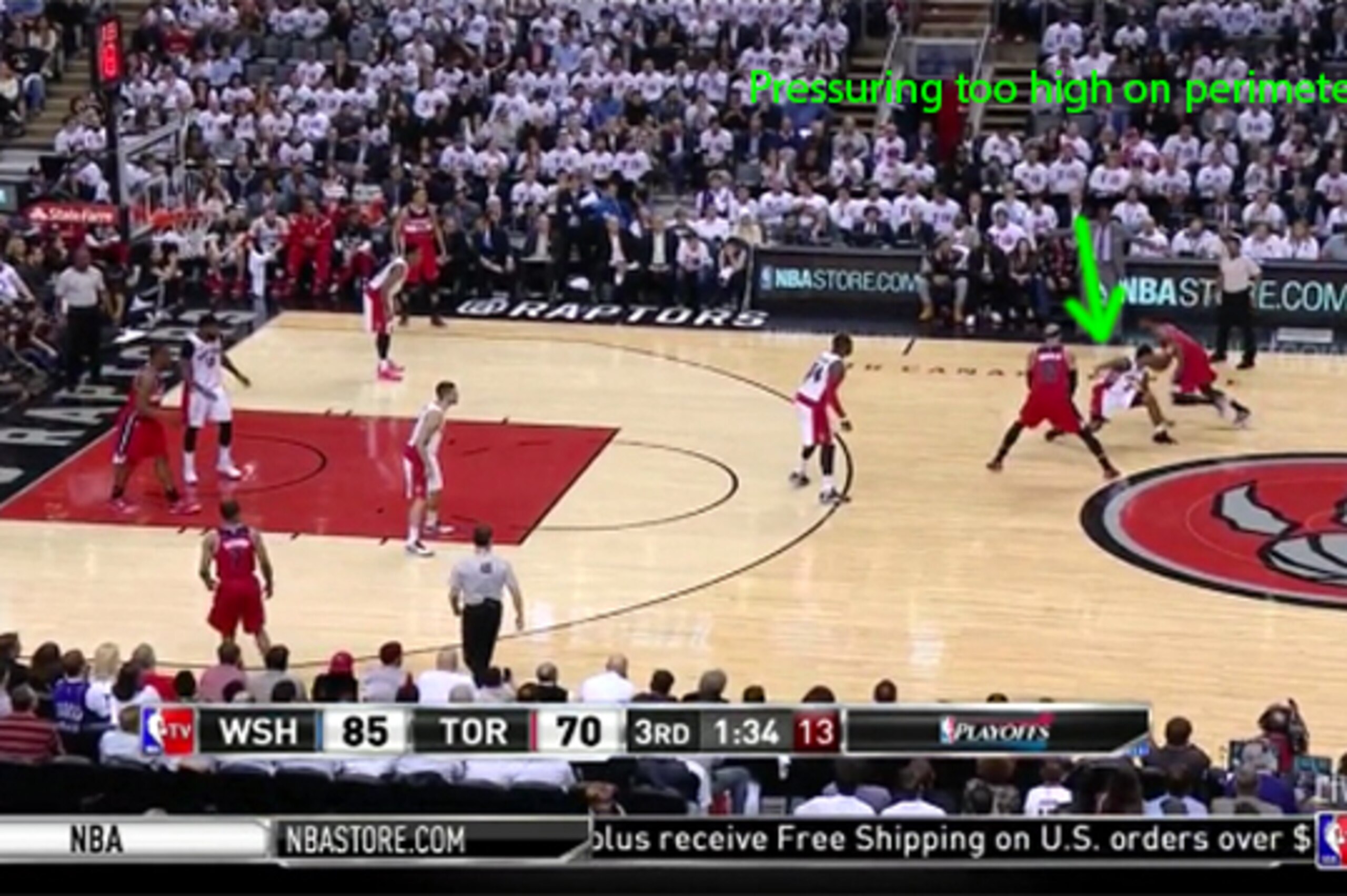
At this point, Williams is toast. It's up to the rest of the Toronto defense to rotate and contain Wall, who's heading toward the rim at a high rate of speed.
Closer evaluation of the play, however, reveals that Wall doesn't actually have any particularly enticing options.
Because Wall started so far away from the rim, Amir Johnson has had plenty of time to plant himself between Wall and the basket; he's ready to spring vertically and contest. Throwing back to Drew Gooden is nearly impossible. Otto Porter is blanketed in the corner. Greivis Vasquez is sitting on Kevin Seraphin's knees to prevent an easy drop-off pass or lob. He's also smartly right in the way of a cross-court laser pass to Beal:
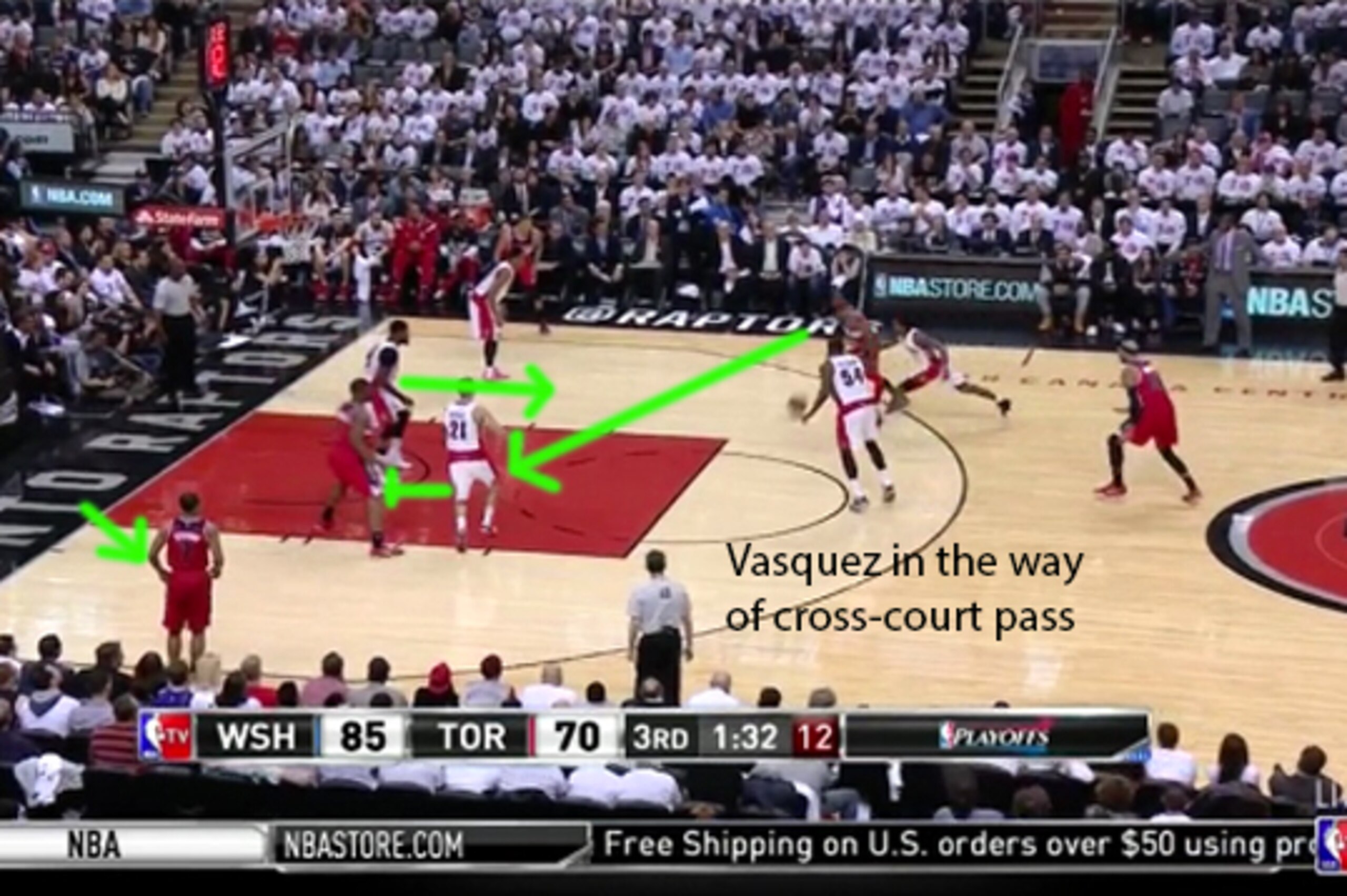
So what does Wall do? He actually slows his attack just a touch and waits. Vasquez is stuck between two players and has to commit, so he further cements his position in front of Seraphin. This opens up the passing lane to Beal, who Wall hits for a wide-open corner three-pointer:
There's even more going on here that's a testament to Wall's improved patience. Instead of recklessly attacking the rim, he makes a point of throwing the pass early as opposed to late. If he gets caught in too deep, the angle of the pass disappears while the difficulty increases. Being closer to the rim means more defensive hands, which in turn means a greater chance of having his pass deflected.
There's also the matter of defensive momentum. While it's only a minute detail, it can be the difference between an open shot attempt or a contested look.
Notice how Wall's dart is thrown while Vasquez is rotating to the middle. If he were already rotated and at a complete stop, it would be easier to fly back to the corner and contest. Yet because his momentum is carrying him away from Beal, it's almost impossible for Vasquez to turn and pivot in a timely manner.
Wall's improved passing ability has been on great display in these playoffs. When he kicks the ball out on his pick-and-rolls, Washington is deriving 1.148 points per possession, according to Synergy Sports—a number that places him fourth in the league during the playoffs. All of this, by the way, comes without the threat of a legitimate jumper.
These first two games against Toronto are the blueprint for how Wall can succeed in spite of his greatest weakness. He'll have to knock down a shot every now and again, but there are plays to be made if he shows proper restraint.
There are certainly times for him to unleash his world-class speed and rocket down the court. However, playoff basketball requires more half-court play, and Wall will have to excel in these tight quarters to help his Wizards compete for a title.
If he's able to excel in this area of his game, Wall's potential is limitless. Very few players can combine elite skill and athleticism, and Wall is on the cusp of doing just that.


.jpg?w=2560 "5 Teams Eyeing Jonathan Taylor")
.jpg?w=2560 "Mahomes Told Teammate to Leave Meeting")


.jpg?w=2560 "Jonathan Taylor Landing Spots 📍")