

Reassessing Buccaneers' Offseason Plan and Breaking Down What's Left to Address
If you’ve ever seen Jay Z looking for a new ride for him and his entourage, only to leave the car dealership with a two-door Honda Civic, you may actually have seen a reenactment of the Tampa Bay Buccaneers’ offseason up to this point.
It’s not that the Civic doesn’t provide some solid value for Mr. Carter, but it doesn’t come close to meeting all of his needs.
Free agency has slowed to a crawl, and while the Bucs have enjoyed a far more sensible offseason than they have in the past few years, they still have plenty of issues in both the starting lineup and with regard to depth, all the while sitting on a decent chunk of cap room.
TOP NEWS

New NFL contenders starting to emerge after Week 4
.jpg?w=2560 "Cardinals Giants Football")
NFL investigating 2 referees for separate viral exchanges
Buzz: Chiefs Reached Out to Tyreek
How have the Bucs approached this offseason, and what still needs to be done for this year’s attempt to be a success? Let’s take a look.
The Plan
After three straight offseasons of breaking the bank for top free agents, with most of those high-profile signings turning into huge disappointments, the Bucs went into this free-agency period wanting to change gears. Turning the focus toward finding economical players who fit their schemes, the Bucs would hope to avoid the embarrassment of recent failures like Michael Johnson and Anthony Collins.

Johnson and Collins were both cut after just one season, despite the Bucs having to eat a considerable amount of dead money to let them walk. Other high-priced strikeouts over the past few offseasons include Carl Nicks, Eric Wright, Josh McCown and Dashon Goldson, who was just recently traded to Washington for next to nothing.
This time around, the team would take a more conservative, measured approach to bringing in new talent from across the league, hoping to fill needs and bolster their depth heading into this year’s draft.
How It Went Down
Despite having plenty of cap space to work with, the Bucs stayed relatively quiet during the first week of free agency, leading to a generous helping of frustration from many fans, who wondered how a 2-14 team could sit on their hands while the top names on the market signed elsewhere.
But general manager Jason Licht and company were content to meander methodically through the frenzy of free agency’s opening week, waiting for the dust to settle before making some sensible signings.

The Bucs signed Bruce Carter to replace the departed Mason Foster as the starting middle linebacker, while teammate Henry Melton was brought in to strengthen an already impressive rotation at defensive tackle. Another former Dallas Cowboy, Sterling Moore, was signed as an upgrade over Leonard Johnson at the nickel corner spot, while Chris Conte was added to give some depth to the safety spot.
All four of those players came at a reasonable price, and they all have plenty of experience in the Tampa 2 defense.
In the following weeks, the Bucs added a few more players that are likely nothing more than camp bodies. The most notable move still on the horizon is the signing of Lions defensive end George Johnson to a three-year offer sheet, which Detroit is running out of time to match.
What’s Left?
The Bucs were wise to be more frugal with their spending this offseason, but the flip side of that coin shows a team with plenty of glaring holes left to fill heading into the draft.
Assuming they take a quarterback with the top overall pick, the two areas that need to be addressed early in the draft are at offensive tackle and defensive end.
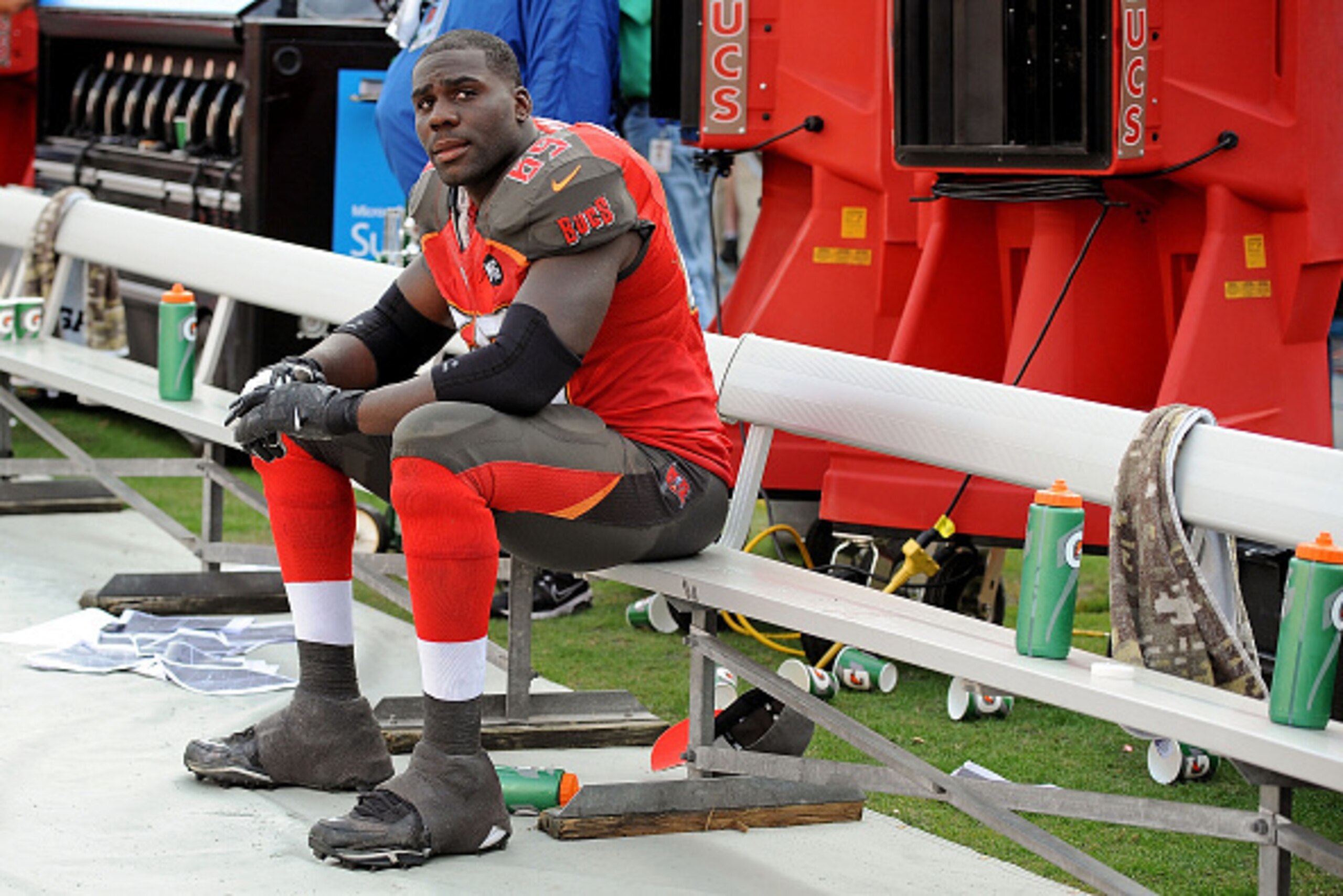
Demar Dotson is more experienced at right tackle, but he proved over the last three games of 2014 he can handle the left tackle duties just fine, if necessary. Either way, it’s imperative Tampa Bay finds an immediate starter across from Dotson.
The Bucs were thin at defensive end even before cutting Johnson, but now things look particularly bare. Jacquies Smith racked up 6.5 sacks over the final eight games of 2014, but he’s probably best suited for a rotational role as opposed to being an every-down defender. This year’s draft class is stocked full of talented pass-rushers, and it wouldn't shock me to see the Bucs take one early, then grab another one later for depth.
Other starting roles that still need to be upgraded are at right guard and slot receiver, where last year’s options simply didn’t get the job done. Thankfully for the Bucs, those positions could very well offer potential starters in the middle rounds of this year’s draft.

One big item on the to-do list is to work out a long-term extension with linebacker Lavonte David, who is one of the best in the league at his position. That will require a decent chunk of the Bucs’ available cap room, which could easily be another reason they’re keeping a tight lid on their spending for the moment.
The Verdict
Bucs fans should be encouraged that the new regime is willing to admit past mistakes and move on, but the decision-makers need to prove they’re willing to bring in the talent it takes to be successful in the NFL.
The moves made by Tampa Bay so far are a step in the right direction, and there’s still a small handful of names on the market who could be added to help address needs. But as things currently stand, the Bucs still have plenty of work to do if they want to look more like a playoff contender than a bottom-feeder in 2015.
If the Bucs can come out of this draft with four or five new starters, it would be huge. It might seem like a bit of a long shot, but the draft is very deep at some of the positions the Bucs need to address most, which could put them in an advantageous spot to do just that.
Luke Easterling is a Featured Columnist covering the Tampa Bay Buccaneers and NFL Draft for Bleacher Report. He is also a Senior NFL Draft Analyst at Draft Breakdown. Follow him on Twitter @LukeEasterling.
.jpg?w=2560 "Titans Giants Football")
.jpg?w=2560 "Dolphins Bills Football")




.jpg?w=2560 "Ward Nearly Walks Out of Presser 😳")