

5 Statistics That Show How Poor the New Jersey Devils Have Been This Season
For the first time since the 1980s, the New Jersey Devils are going to miss the playoffs for a third consecutive season.
Two seasons ago, the Devils dominated for the first month and a half of a lockout-shortened season, but injuries to Martin Brodeur and Ilya Kovalchuk derailed the promising start. New Jersey missed the playoffs by seven points.
Last season, a slow start, the unexpected departure of Kovalchuk and a historically abysmal shootout record were too much to overcome. Despite a strong finish, the Devils missed the playoffs by five points.
This season may be the biggest punch in the gut to Devils fans. New Jersey is poised to miss the playoffs by 20 or more points and has scored only 2.16 goals per game, third-worst in the NHL.
Exactly how bad have the Devils been this season? This list will look at five of the most painful statistics regarding New Jersey's 2014-15 season, leaving little room to doubt how poor the Devils have been for most of the year.
Cory Schneider Is Fourth in Major Goalie Statistics—and Still Below NHL .500
1 of 5
If there is one Devil who has definitely not disappointed this season, it is Cory Schneider.
Schneider is currently fourth in the NHL in goals against average and save percentage at 2.20 and .927, respectively. Given that he started the season somewhat slowly and that he plays for a mediocre team, this is incredibly impressive.
Unfortunately for Schneider, stellar play has not been enough to reach a respectable record. Reaching NHL .500 (having more wins than regulation losses) is a common measuring stick for both teams and individual goalies, but it is not a particularly impressive mark. For context, only six NHL teams are below NHL .500 this season.
Yet, Schneider's record is 26-28-9, making him one of only two goalies in the NHL's top 20 for both goals against average and save percentage not to reach this average baseline measure. The other is Philadelphia's Steve Mason, who has a 16-17-11 record and has started 20 fewer games than Schneider.
In another season, Schneider's play might have gotten him into the Vezina Trophy conversation. Instead, due in large part to the poor play of the team in front of him, Schneider will end the season with a record that does not even reach a standard of mediocrity.
Steve Bernier Is Third on the Team in Goals
2 of 5
Steve Bernier is in the midst of one of his best offensive seasons in the NHL. While he deserves credit for playing solid hockey, particularly during the second half of the year, his ascension to the team's top-six forward group says more about how offensively inept the Devils have been than it does about Bernier's play.
His best previous offensive season came in 2006-07 with the San Jose Sharks, when he picked up 15 goals and 16 assists in only 62 games. He also had 15 goals in 81 games in 2008-09 with the Vancouver Canucks. So, while he can clearly be a useful offensive player, Bernier is not someone who should be third on a team in goals.
Bernier's 13 goals in 62 games give him more than Patrik Elias, Travis Zajac, Michael Ryder, Martin Havlat, Tuomo Ruutu and Dainius Zubrus. That Bernier is having a better season offensively than so many forwards that entered the season with higher expectations is a clear sign of New Jersey's struggles.
Adam Henrique Leads Devils with 41 Points, the Lowest Tally for Any Team Leader
3 of 5
That Adam Henrique has 41 points this season is not necessarily a bad thing. He is one of the team's few young, talented forwards and has shown the ability to both score and create goals this season as well as in past seasons.
Perhaps a total of between 40 and 50 points is all that the Devils can expect from Henrique in an average season. If he could regularly post that point total, he would be a productive second-line center or left wing in New Jersey.
The problem is, of course, that Henrique's 41 points are the most by any player on the Devils this season. Only one other team has a scoring leader with such a low point total; Keith Yandle leads the Coyotes with 41 points in spite of being dealt to the Rangers over a month ago.
Through this lens, it is easy to see one of the biggest problems the Devils face—they simply do not have any elite forwards.
Michael Cammalleri has been excellent this season and would likely lead the team in points if he had not missed so many games due to injury, but he turns 33 over the summer. In addition to likely being past his prime, he is, like Henrique, a gifted player with plenty to offer New Jersey, but he is not good enough to carry the team.
After Henrique and Cammalleri, the offensive pickings get slim quickly. Patrik Elias is coming to the end of his career. Scott Gomez is 35 and having his first productive season since 2010-11. Travis Zajac has not produced like a top-line center since 2009-10.
With offensive problems like these, it is easy to see why the Devils struggled this season.



New Jersey's Top Defensive Forwards Have a Combined Plus/Minus of Minus-29
4 of 5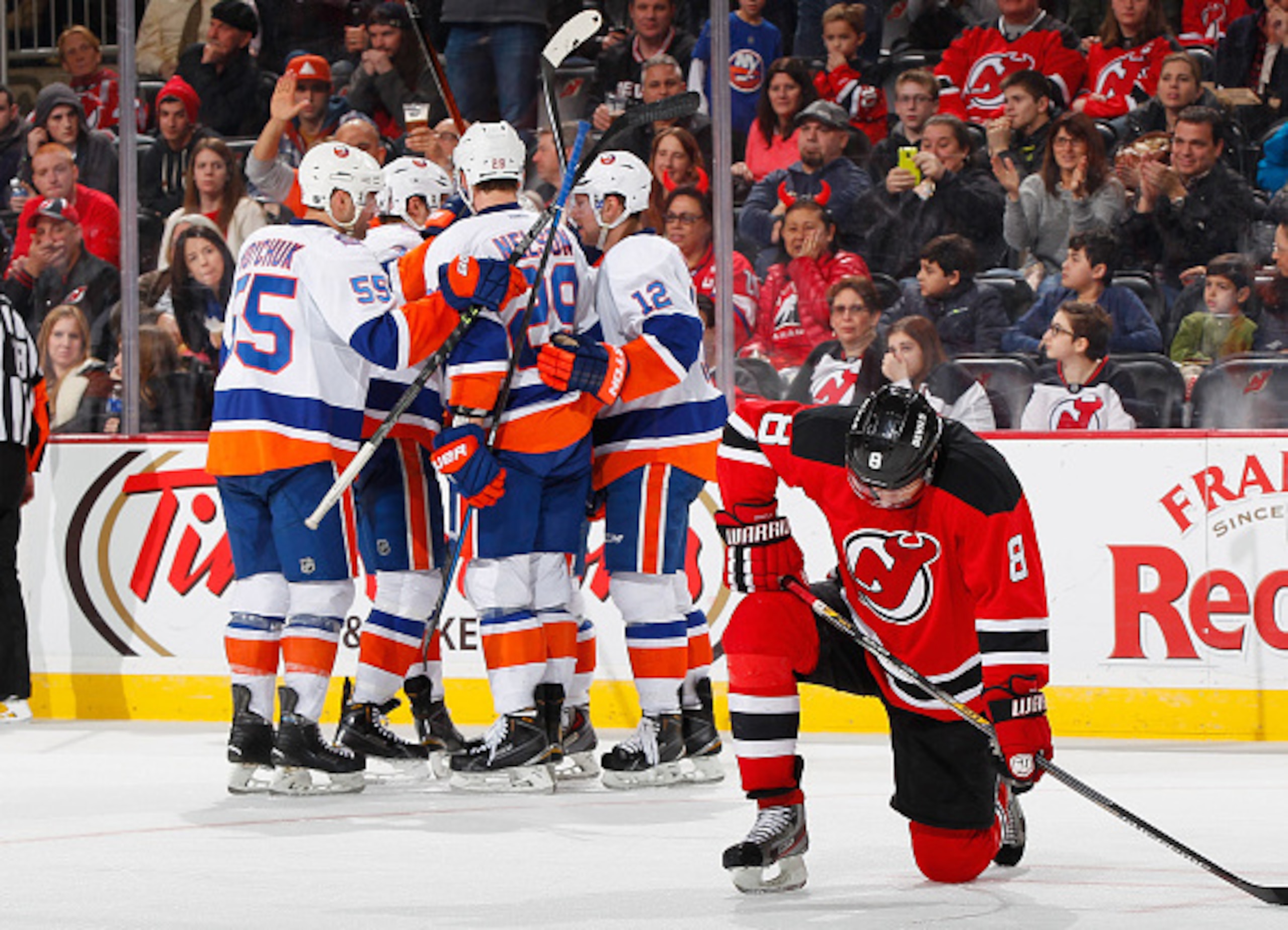
Historically, the Devils have relied on forwards to both attack and defend. The Devils have bottom-six forwards like Stephen Gionta and Jacob Josefson who have been defensively solid this season, but are not expected to contribute offensively.
Rather, the role of a true, two-way forward fell to Adam Henrique, Patrik Elias, Travis Zajac and Dainius Zubrus this season. Last season, these players carried an offensive load for the Devils, amassing 170 points, but also proved they could be relied on defensively by putting up a combined plus/minus of plus-three.
This season, the same four players have a combined plus/minus of minus-29.
Last season, the Devils as a team gave up 10 more goals than they scored, compared to this season's deficit of 22 goals, so the team's quality as a whole may play a role, but only a small one.
Age may be a factor for the declines in play of Elias and Zubrus, but Henrique, 25 years old and Zajac, 29, are too young to use that excuse.
The sobering fact is that these players have simply not played well for long stretches of the season. While the previous two slides made clear that this was the case in the offensive zone, we can also see that top forwards have had issues in the defensive zone as well.
The Devils Are 10-2-1 Against Teams Below Them in the Standings
5 of 5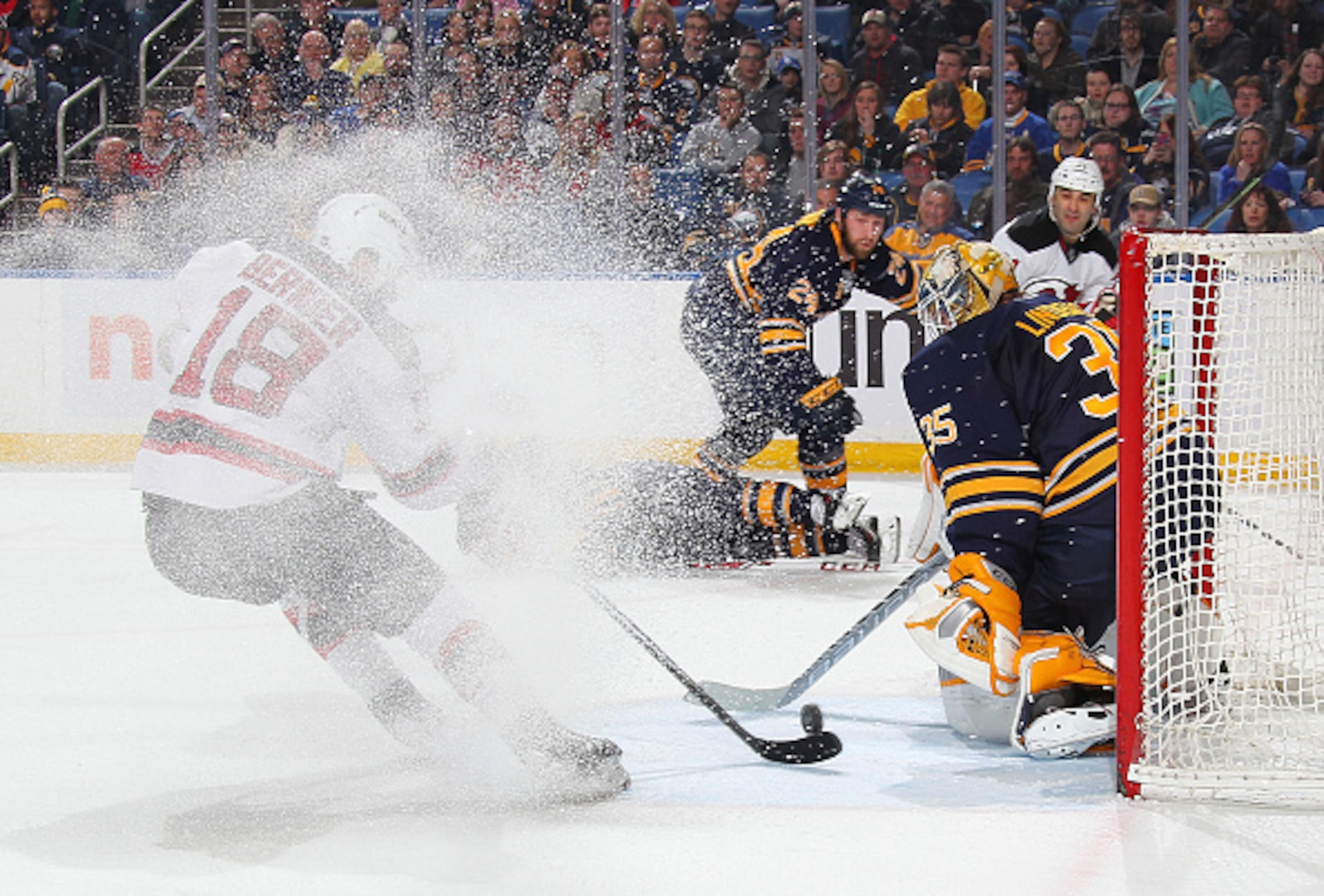
With 75 points and a 31-33-13 record, the Devils sit in 25th place overall in the NHL. They have an eight-point cushion between themselves and the Carolina Hurricanes, who are one of the impressively bad teams in the NHL this season.
Carolina and the Toronto Maple Leafs could conceivably finish the season with fewer than 70 points, something only three teams managed last season. Below them are the Edmonton Oilers with 59 points, the Arizona Coyotes with 54 points and the Buffalo Sabres with 52 points.
As a reference, last season's bottom five teams finished with 52, 66, 67, 77 and 79 points. So, there are several remarkably poor teams in the NHL this season.
The Devils are 10-2-1 against these teams in 2014-15. Of course, by itself this statistic is not troubling—decent teams should have such impressive records against particularly bad teams.
Conversely, the Devils are 21-31-12 against teams above them in the standings. That gives them a measly 54 points in 64 games, only 0.844 points per game.
With so many truly bad teams in the NHL this season, it is easy for Devils fans to delude themselves into thinking that because New Jersey is not among the bottom five, the team cannot be that poor.
By looking at the team's record against every team above it in the standings, it is easy to see that in other seasons the Devils could have been cellar dwellers. By managing to beat struggling teams, the Devils have made themselves watchable at times this season, but this should in no way obscure the fact that they have been poor this season.
.jpg?w=2560 "NHL Trade Grades Connor Hellebuyck")




.jpg?w=2560 "Mahomes Asked OT to Leave Meeting")
.jpg?w=2560 "Jonathan Taylor Landing Spots 📍")

.jpg?w=2560 "5 Teams Eyeing Jonathan Taylor")

