
Ranking the Top Playmakers in the 2015 NBA Draft
A pair of big men have dominated the 2015 NBA draft conversation this year, but lately I've been too busy marveling at the array of lethal playmakers in this crop.
The Big Ten and ACC each have a pair of prolific floor generals, and there's an electrifying guard returning to the states from China. There are also some big-time sleepers in the mix.
In our quest to determine which one is the best playmaker, we looked at several factors:
- The ability to create offense for teammates, namely via assists per possession.
- The ability to create offense for themselves, which is reflected in statistics like field-goals and free-throw attempts per possession.
- A high assist percentage compared to their turnover percentage.
- Strength of schedule is also accounted for, as players with decidedly tougher schedules were given the nod over players with similar statistics.
To be clear, the rankings are a reflection of who the best playmakers are right now, not who has the most playmaking potential. We're looking at who is most effectively forcing the action and generating offense for their team.
Who emerged from the rubble as our top choice?
8. Yogi Ferrell, Indiana PG (6'0", Junior)
1 of 8
Traditional Stats
Per Game: 34.9 MPG, 16.1 PPG, 4.9 APG, 1.9 TO, 3.7 FTA, .438 FG%, .308 3FG
Percentages: .268 AST%, .122 TOV% .438 FG%,
Strength of Schedule Rank: 70
Indiana's fleet-footed point guard Kevin "Yogi" Ferrell won't be a first-round pick, nor will he hold a prominent role in the NBA. His diminutive size will make for some difficult defensive assignments, and he won't dominate on the other end of the floor.
Nevertheless, he cracks our prospect rankings and hangs around that mid-second-round range. Why? Because he's speedy and shifty, and he can manufacture a bunch of plays without committing turnovers.
Ferrell knows how to whip up offense when his team needs it. His foot speed enables him to access the middle of the defense, where he gets off a variety of jumpers and runners. In addition, he's an underrated rim attacker, although that part of his game is unlikely to translate to the pros.
He doesn't tally outstanding passing production, but he has the wherewithal to splurge for the occasional double-digit assist night. Don't be surprised if he latches on with an NBA squad as a peripheral piece.
7. Tyus Jones, Duke PG (6'1", Freshman)
2 of 8
Traditional Stats
Per Game: 33.4 MPG, 11.6 PPG, 5.8 APG, 2.1 TO, 4.2 FTA, .415 FG%, .383 3FG
Percentages: .415 FG%, .283 AST%, .171 TOV%
Strength of Schedule Rank: 16
Duke's poised young point guard is a polished ball-handler and an accomplished passer. He has an excellent feel for the game compared to most freshmen, and he could potentially carve out a role in the NBA.
Why doesn't he rank higher on our playmaker list?
He's not an elite rim-attacker, which is reflected in his modest field-goal makes (6.0) and free-throw attempts (7.5) per 100 possessions. Jones can get into the lane, but not all the way to the bucket. His short stature and underwhelming leaping ability have resulted in 52 percent shooting at the rim (per Hoop-math.com)
If Jones was able to attack the basket at an elite level like many of the other prospects on this list, who knows how many more assists he would get.
Does he have enough playmaking juice to cut it at the next level? He won't likely be a starting point man, but he has enough handles, quickness and vision to run the pick-and-roll and create chances for his comrades.
6. Cameron Payne, Murray State G (6'2", Sophomore)
3 of 8
Traditional Stats
Per Game: 32.4 MPG, 20.3 PPG, 5.8 APG, 2.5 TO, 4.9 FTA, .455 FG%, .372 3FG
Percentages: .455 FG%, .382 AST%, .122 TOV%
Strength of Schedule Rank: 269
Scouts are gravitating toward one of the biggest sleepers in this year's draft class. Murray State's Cameron Payne can score the rock and make plays for teammates at will.
The southpaw guard plays the part of someone who could compete at the next level. He exhibits a crafty attacking style and elite playmaking instincts.
In an excellent breakdown of the underrated prospect, B/R's Jonathan Wasserman explained that Payne's electrifying impact more than compensates for his small frame:
"Payne's skinny, 180-pound frame is no reflection of his style of play or approach. He's fearless. And he has a killer instinct that ultimately helps fuel his overall likability as a player and prospect...With the ability to weave through traffic yet maintain vision on the move, you'll often see Payne look to push the tempo and find his teammates before the defense can set.
"
Payne's assist percentage is a robust 38.2, yet he manages to rack up 20-plus points per game for himself. That speaks volumes about his ability to play aggressively, yet effectively, and not settle for less-than-favorable plays.



5. D'Angelo Russell, Ohio State G (6'5", Freshman)
4 of 8
Traditional Stats
Per Game: 33.5 MPG, 19.3 PPG, 5.1 APG, 2.9 TO, 4.5 FTA .458 FG%, .415 3FG%
Percentages: .458 FG%, .307 AST%, .151 TOV%
Strength of Schedule Rank: 72
Don't be alarmed by the ranking. D'Angelo Russell passes the NBA eye test with flying colors, and he'll almost certainly be a star combo guard in the pros. He's worth a top-three pick in June.
However, he doesn't lead our playmakers list because he doesn't create for teammates quite as much as the top-ranked studs. He's also competing against the stats of several upperclassmen.
Given his scoring skills and shooting touch, it's doubtful he'll be anything close to a traditional point guard in the Association. He'll be more of a scoring combo guard with a penchant for stretching defenses.
His ability to fill up the hoop is outstanding (34.8 points per 100 possessions), but it's important to credit his promising passing skills.
Russell is an upper-echelon quarterback when it comes to delivering highly difficult dimes. Once he cuts down on the turnovers and learns to break down defenses more effectively, he'll be an entertaining playmaker in the Association.
4. Delon Wright, Utah PG (6'5", Senior)
5 of 8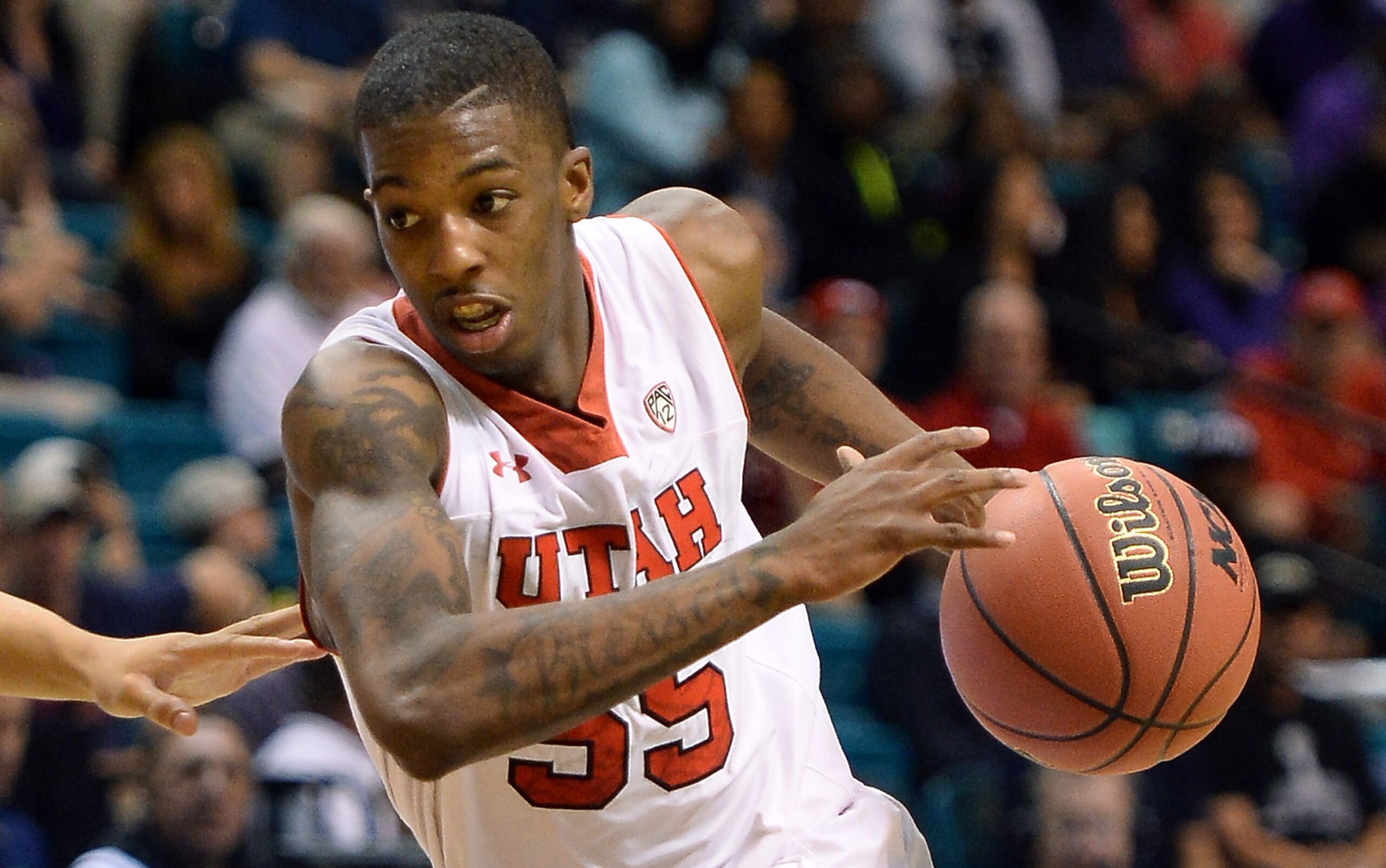
Traditional Stats
Per Game: 33.1 MPG, 14.9 PPG, 5.3 APG, 1.8 TO, 5.1 FTA, .529 FG%, .371 3FG%
Percentages: .529 FG%, .344 AST%, .132 TOV%
Strength of Schedule Rank: 50
The most creative playmaking prospect west of the Mississippi is Utah Utes guard Delon Wright.
Blessed with a 6'5" frame along with exceptional handles and coordination, Wright can slice his way into the lane and force the action all game long. Few players employ change-of-pace moves as lethally as he does.
He's always in attack mode, but he uses his gifts for the entire team's benefit.
"He’s just one of those guys that lifts the level of everybody,” Utes skipper Larry Krystkowiak told Grantland.com's Brett Koremenos.
When he's not busy finding his own shot or dropping a dime to a teammate, odds are he's generating offense by drawing a foul in the lane. Wright's 9.8 free-throw attempts per 100 possessions is a lofty number for a guard.
3. Emmanuel Mudiay, China PG (6'5", 1996)
6 of 8
Traditional Stats: 31.5 MPG, 18.0 PPG, 5.9 APG, 3.3 TO, .478 FG%, .342 3FG%
Playmaking Stats (Per-40 Min): 7.5 AST, 9.3 FGM, 5.0 FTA, 4.1 TO
We don't have per-100 possessions stats for Emmanuel Mudiay, but it's safe to say those numbers would be high considering his per-40-minute production. The 19-year-old prodigy overwhelmed his Chinese competition during the 12 games he played for the Guangdong Southern Tigers this season.
Mudiay has the elusiveness and agility of a football running back, along with promising ball-handling skills and expansive physical tools. As such, he was able to penetrate the defense constantly and find playmaking opportunities in the CBA.
That speed and size generates a lot of the highlight-reel hype surrounding Grant, but his court vision and passing instincts are equally attractive. Although he's young and makes teenage-esque mistakes, his knack for finding teammates is readily apparent.
"Mudiay's pick-and-roll passing is probably going to be his most underrated skill come draft time," said Derek Bodner of Draft Express.
He may not ever live up to the John Wall comparisons, but he's already one of the elite playmakers of this draft class.
2. Jerian Grant, Notre Dame PG (6'5", Senior)
7 of 8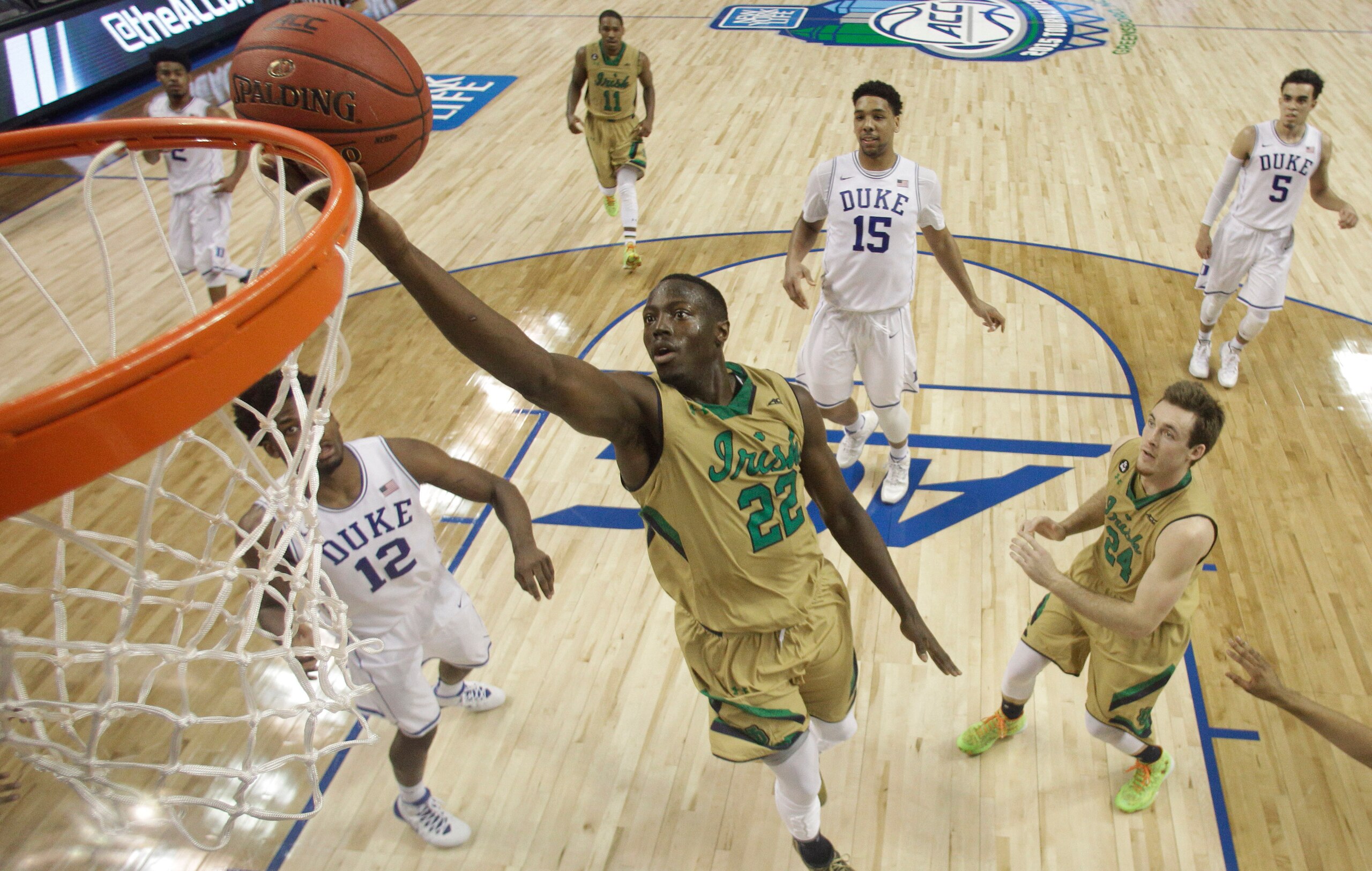
Traditional Stats
Per Game: 36.6 MPG, 16.6 PPG, 6.5 APG, 2.2 TO, 5.5 FTA, .488 FG%, .329 3FG
Percentages: .488 FG%, .334 AST%, .135 TOV%
Strength of Schedule Rank: 79
Thanks to his advanced age (23 years old), Jerian Grant's draft value isn't high enough to garner consensus lottery recognition. But make no mistake, the Notre Dame floor general's talent and impact are up there with any guard in the country.
His 10-assist performance in the Irish's ACC title-game victory is fresh evidence of his offensive mastery.
Speed and agility are his greatest weapons, and he knows how to use them to exploit opposing defenses. Once Grant turns the corner and gets into the lane, he can accelerate and elevate for a bucket or sharply connect with a teammate.
With his pick-and-roll prowess and innovative playmaking expertise, coach Mike Brey leans on him to fuel the Irish's high-octane attack. Grant's leadership and production is a huge reason Notre Dame owns one of the most fearsome offensive units in the NCAA.
"He has a brilliant basketball mind,” Brey told David Gardner of Sports Illustrated. “He’s like a computer out there."
1. Kris Dunn, Providence PG (6'3", Sophomore)
8 of 8
Traditional Stats
Per Game: 34.1 MPG, 15.8 PPG, 7.6 APG, 4.1 TO, 5.3 FTA, .480 FG%, .347 3FG%
Percentages: .480 FG%, .505 AST%, .223 TOV%
Strength of Schedule Rank: 8
Now that his shoulder issues are largely in the past, Providence star Kris Dunn has been able to flourish in the Big East this season.
He's the most prolific creator and passer from coast to coast, and he owns the best assist percentage (50.5 percent) among the top draft prospects. Think about that: When Dunn's on the floor, he records an assist on more than half of all his teammate's field goals.
During his return from injury, he worked intensely on his ball-handling and passing technique, as Brian Hamilton of Sports Illustrated explains:
"Dunn was what (Coach Ed Cooley) calls a “wind-up passer,” wasting motion for tenths of a second before sending the ball to a teammate. Focusing on tighter, crisper delivery made it that much more difficult for defenses to recover or jump the pass. Likewise coaches worked with Dunn on simple jump-stops in the lane to limit the offensive fouls his aggressiveness brought about early in his career.
"
His turnover numbers are high, but that's partially a product of the incredibly heavy workload Providence demands from him. He should have no problem carving out a role in the NBA as a drive-and-dish and pick-and-roll distributor.
Note: Unless otherwise indicated, all stats come from Sports-Reference.com/CBB. Strength-of-schedule rankings based on Kenpom.com Ratings.
Follow Dan O'Brien on Twitter for more NBA draft coverage: @DanielO_BR

.jpg?w=2560 "Mahomes Told Teammate to Leave Meeting")
.jpg?w=2560 "5 Teams Eyeing Jonathan Taylor")

.jpg?w=2560 "Baker Gets Glove From Rays 🧤")

.jpg?w=2560 "NFL investigating Eagles")
.jpg?w=2560 "🚨 Week 8 AP Top 25 Poll")
.jpg?w=2560 "Steelers Roll Saints in Paris 🇫🇷")
.jpg?w=2560 "Jonathan Taylor Landing Spots 📍")