

2015 NBA Mock Draft: Full 2-Round Projections Entering NCAA Tournament
The NCAA tournament is ultimately the last chance for most NBA draft prospects to make their final pitch.
And except for the international players, almost every prospect on this year's first-round radar will be suiting up for the Big Dance.
The next few weeks could determine who the No. 1 pick will be. While we know who's in the conversation—Duke freshman Jahlil Okafor, Kentucky freshman Karl-Anthony Towns, Ohio State freshman D'Angelo Russell and Emmanuel Mudiay, who played in China—each prospect still has some convincing to do.
When projecting the 2015 draft, we also have to predict who will stay in school versus who will declare.
The notable underclassmen we expect to return to school include Maryland's Melo Trimble and Jake Layman, Kentucky's Dakari Johnson, North Carolina's Kennedy Meeks and Louisville's Terry Rozier.
1. New York Knicks: Karl-Anthony Towns, Kentucky, 6'11", PF/C, Freshman
1 of 60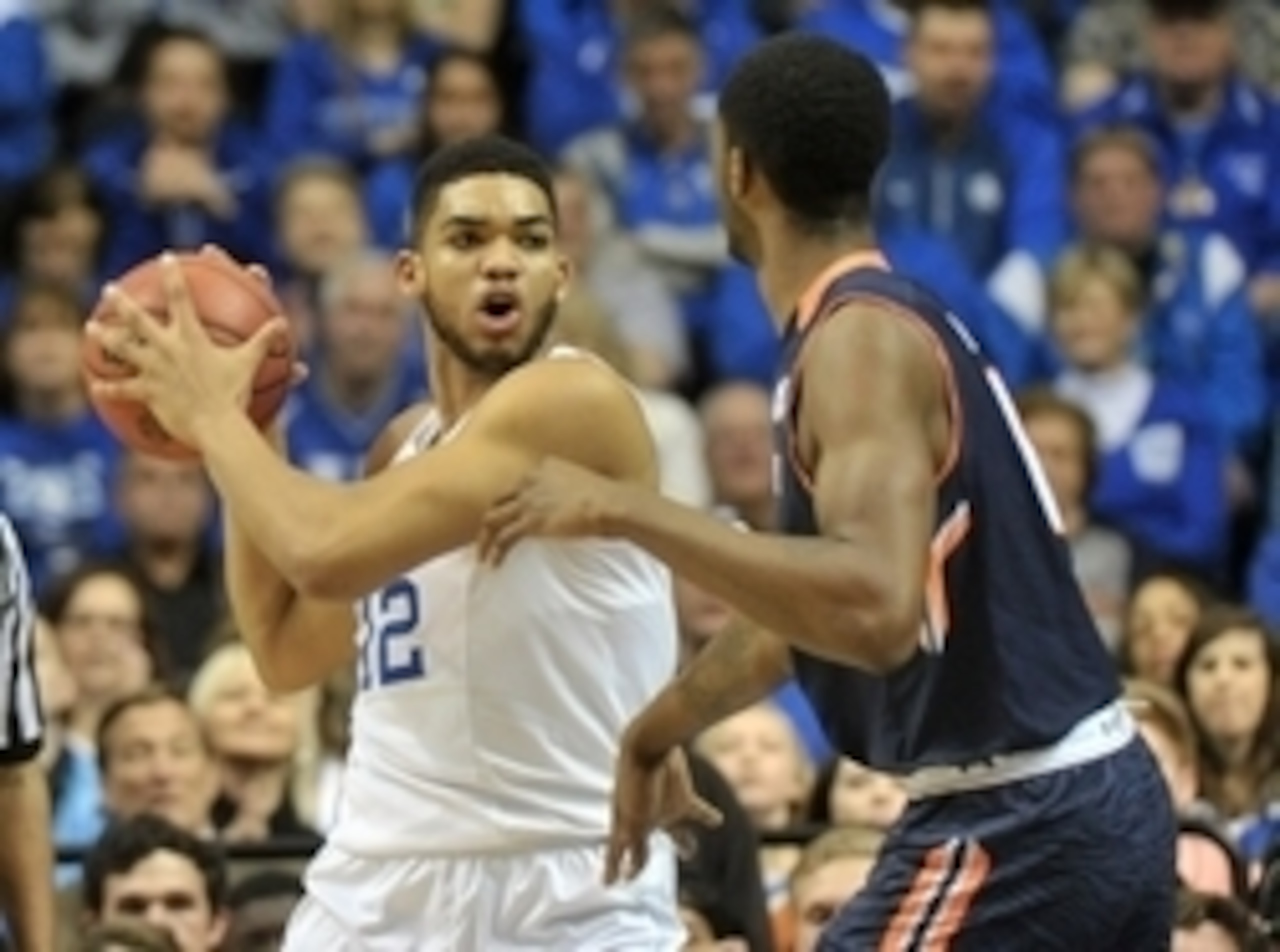
We knew all along that Towns' ceiling stood higher than any prospect's in the country. But given his limited minutes, touches and production, it's been tough to fully buy in.
That's no longer the case. Towns has been incredibly convincing over the past two months. While we only saw glimpses of his upside flashed sporadically throughout the first half of the season, we've seen them a lot more consistently as of late.
And if you're the New York Knicks, it's impossible to ignore how good his fit would be for the triangle, a system that values big men who can face up, shoot and pass.
According to ESPNNewYork.com's Ian Begley, "the Knicks have had either a front-office member or scout at approximately 20 of the past 30 Kentucky practices and games."
Towns continues to show promise with his shooting stroke, whether it's on pick-and-pop jumpers or at the line, where he's shooting a spectacular 81.4 percent. And he's become comfortable and effective finding teammates and picking up hockey assists out of double-teams.
His low-post game has also improved significantly. He's turning over the shoulder through contact and converting those hooks in the lane.
Towns' defensive potential is another selling point. He's blocked a whopping 80 shots in 705 minutes. Meanwhile, Duke freshman Okafor has 44 blocks in 976 minutes. It's night and day. Towns is easily the more natural defender and rim protector. And you have to question just how much Okafor will be able to improve at this end.
We aren't cementing Towns in yet as the No. 1 pick, but if the Knicks get it, the match just seems too good.
Playing a major role on a Kentucky championship run should only enhance his believability as the top prospect.
2. Minnesota Timberwolves: Jahlil Okafor, Duke, 6'11", C, Freshman
2 of 60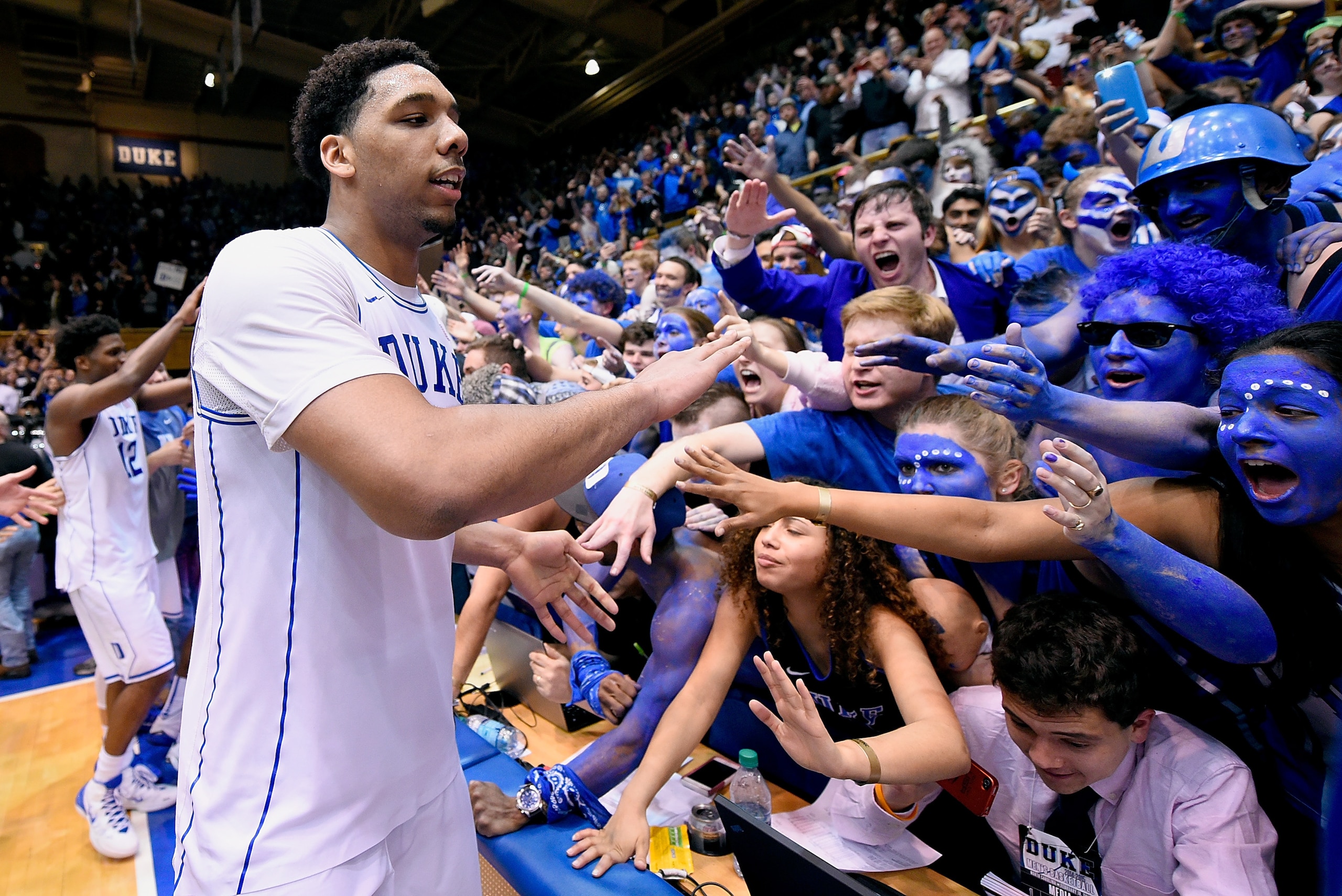
If the Minnesota Timberwolves wind up at No. 2, Okafor wouldn't be such a bad consolation prize. To many, he's still the No. 1 prospect in the country.
Okafor would give the Timberwolves a high-percentage option to go to in the half court, as well as a double-team magnet who can open up shots for teammates.
Though the Wolves already have a center in place, I'm not sure Nikola Pekovic's presence is strong enough to justify passing on Okafor at No. 2 overall.
If Minnesota is more interested in Ohio State guard D'Angelo Russell, it might be better off trading down a pick or two.
But I'm not sure how general manager Flip Saunders ultimately passes on the opportunity of pairing Andrew Wiggins with Okafor. Together, they'd have the potential to form one of the most promising inside-out duos in the league.
3. Philadelphia 76ers: Emmanuel Mudiay, 6'5", PG, 1996
3 of 60
After trading Michael Carter-Williams, the Philadelphia 76ers will likely be targeting a guard this upcoming June. And chances are Mudiay has been on general manager Sam Hinkie's radar all season long.
Mudiay is the superior athlete to Ohio State freshman guard Russell, which will likely show up during individual workouts with the team.
And that's the next time scouts and executives will get a chance to check him out. Mudiay's season ended in China after losing to Stephon Marbury's Beijing Ducks in the playoffs.
However, you'd have to consider his stint overseas a success. Even though an ankle injury limited him to just 12 total games, Mudiay more than held his own as a teenager playing against pros and grown men.
He has every tool and attribute a general manager can ask for in a point guard, starting with mismatch size, lighting quickness and ball-on-string handle.
If his jumper improves down the road, the Sixers will have found themselves a keeper.


4. Los Angeles Lakers: D'Angelo Russell, Ohio State, 6'5", SG, Freshman
4 of 60
With Towns, Okafor, Mudiay and Russell expected to round out the top four prospects, you'd like to think the Lakers will take whoever falls to them.
They each make sense for L.A. in terms of talent and fit. Russell offers lead guard potential and rebuilding flexibility given his ability to play either backcourt position.
He has the vision and passing instincts of a point guard and the 6'5" size, scoring range and shooting stroke (41.5 percent from three, 2.7 threes made per game) to slide off the ball.
Russell is ultimately the type of offensive player capable of taking over games. He'll have the chance to improve his standing even more with a winnable round-of-64 matchup against VCU and Arizona likely waiting in the third round.
5. Orlando Magic: Stanley Johnson, Arizona, 6'7", SF, Freshman
5 of 60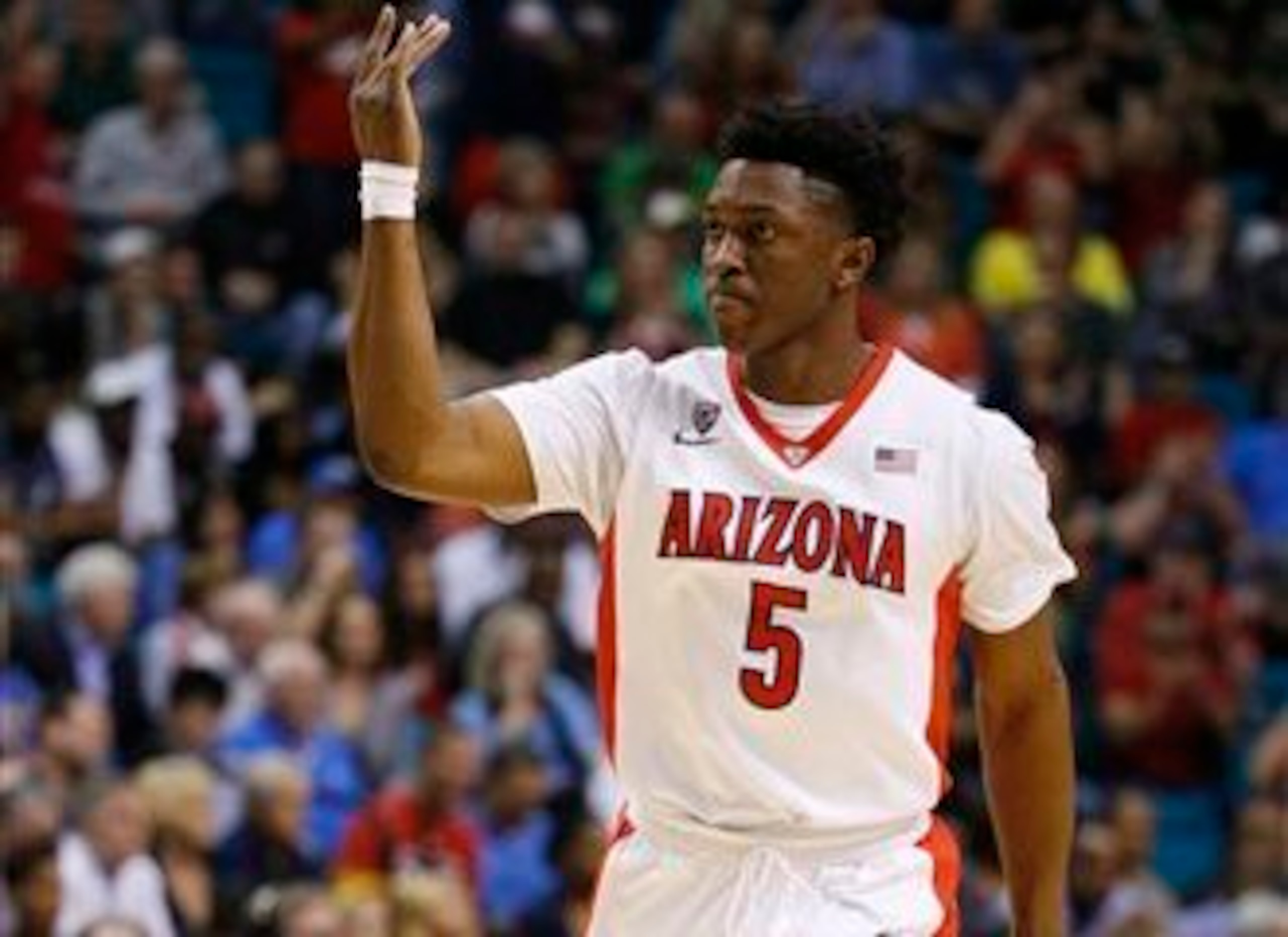
Stanley Johnson chipped in an average of 16 points and 6.3 rebounds during Arizona's effortless Pac-12 tournament title run.
And he's a big reason as to why the Wildcats were able to secure a No. 2 seed in the NCAA tournament after losing Aaron Gordon and Nick Johnson to the 2014 draft.
At 6'7", 245 pounds, Johnson is just too much for college 2-guards and forwards. His blend of size, strength and athleticism should translate quite favorably to the NBA wing as well.
Johnson is still struggling around the rim, shooting 52.9 percent, per Hoop-Math.com, but he's making a strong 45.3 percent of his two-point jumpers (pull-ups, floaters, runners) and a respectable 36.6 percent of his threes.
The Orlando Magic could be losing Tobias Harris to restricted free agency this summer. They might actually be better off saving some money, letting Harris walk and replacing him with a pro-ready Johnson.
6. Sacramento Kings: Kristaps Porzingis, Latvia, 7'0", PF, 1995
6 of 60There might not be a more versatile offensive weapon in the field outside Towns. At 7'0", Kristaps Porzingis can score from all three levels, with the ability to spot up from downtown, separate into mid-range jumpers and finish above the rim.
Given his skill set and strengths, he'd seem to fit nicely alongside DeMarcus Cousins, where Porzingis' stretch-4 potential could complement Cousins' post presence.
Porzingis still needs to add a good 15 pounds to his upper body, but he has a game built for today's NBA and some glaring two-way upside.
Consider him one of the higher risk-reward options to choose from.
7. Detroit Pistons: Mario Hezonja, Croatia, 6'8", SF, 1995
7 of 60Mario Hezonja could help the Detroit Pistons kill two birds with one stone. Arguably the top talent on the board, he also fills a huge need at the wing, where the Pistons offer very little firepower.
At 20 years old, he's shooting 40 percent from downtown and averaging 19.5 points per 40 minutes in Euroleague.
He's actually cooled off a bit as of late, though not enough to negate the promise he's flashed throughout the season.
At 6'8", he has world-class athletic ability and the skill set of a 2-guard or 3. Hezonja can stretch the floor off the ball, score and pass as a pick-and-roll ball-handler and pick up easy buckets off drives and fast breaks.
Kentucky's Willie Cauley-Stein might look enticing, but Hezonja's upside and fit in Detroit could be even tougher to pass on. He'll get realistic looks from every team outside the top four.
8. Denver Nuggets: Willie Cauley-Stein, Kentucky, 7'0", C, Junior
8 of 60
The Denver Nuggets shouldn't be picky with their first-round selection. They'll need to target the top option on the board, regardless of position. That could make it tough to pass on Willie Cauley-Stein, even with Jusuf Nurkic already in the middle.
Cauley-Stein ultimately brings a different dimension of athleticism and defensive versatility to the table, given his ability to guard out on the perimeter, pick up full court and protect the rim.
But he'll actually be entering the NCAA tournament coming off two of his best offensive performances of the year—an 18-point game against Auburn and a 15-point game against Arkansas. Cauley-Stein has even started to flash some touch at the foul line (14-of-18 shooting in the SEC tournament) and in the mid-range.
The Nuggets really just need to continue stockpiling assets and worry about fit later. And at No. 8, I'm not sure there's a potentially more valuable asset than Cauley-Stein left on the board.
9. Atlanta Hawks (via Nets): Justise Winslow, Duke, 6'6", SF, Freshman
9 of 60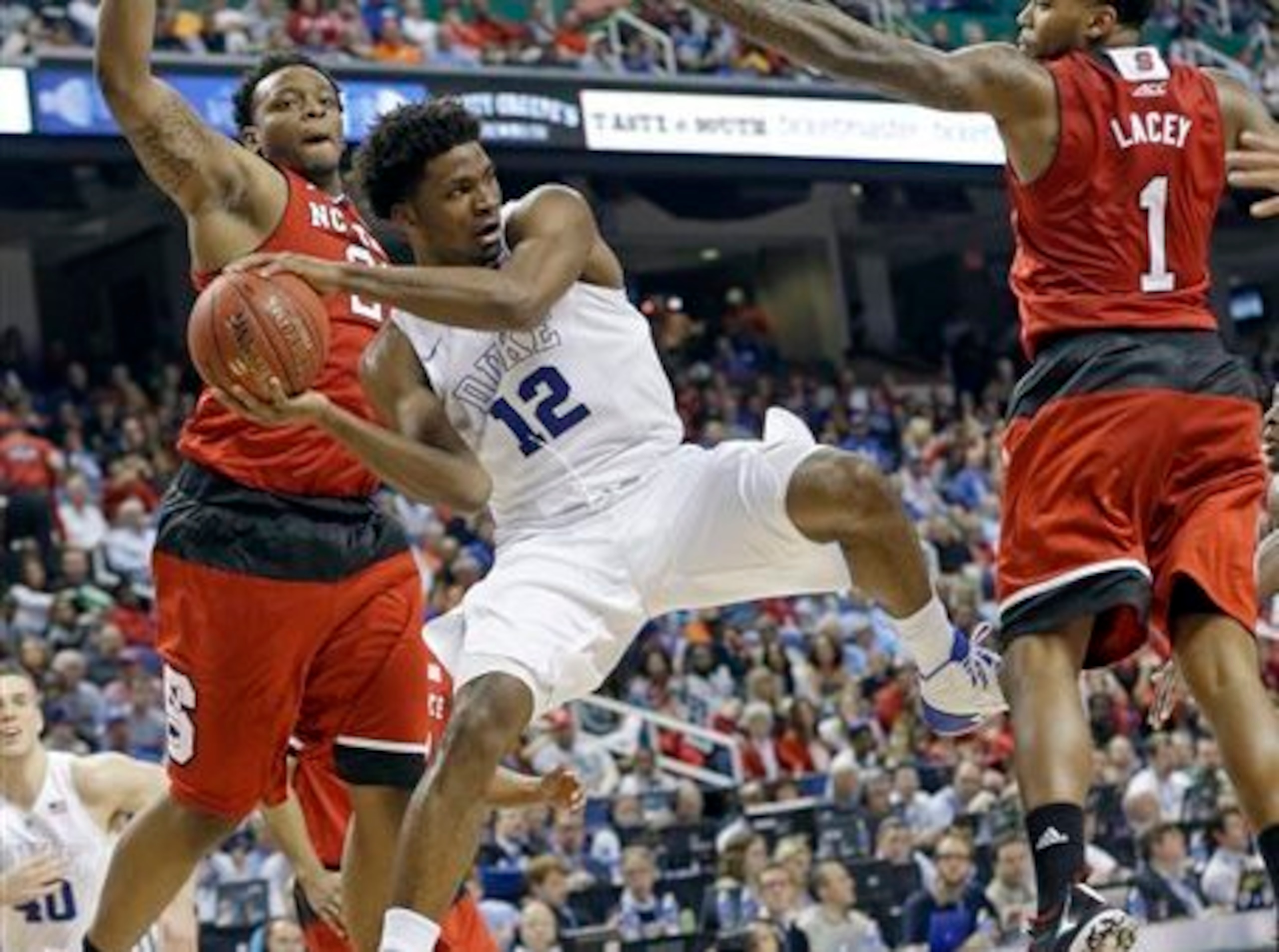
Justise Winslow will be entering the NCAA tournament having finished with double figures in scoring in 14 consecutive games. And he's shot at least 54 percent from the floor in 10 of them.
While it's Winslow's athleticism and defensive motor that ultimately drive his NBA appeal, his offensive game has started to come around. He isn't the sharpest one-on-one scorer, but he's a dangerous slasher and attacker, and he's hit a three-pointer in 28 of Duke's 33 games.
Winslow actually has a little Michael Kidd-Gilchrist in him, only his spot-up jumper (39.6 percent from downtown) looks a lot more promising.
The Atlanta Hawks could use another wing, regardless of whether or not DeMarre Carroll returns next year. Winslow could work as either the immediate backup or long-term replacement at small forward.
10. Boston Celtics: Myles Turner, Texas, 6'11", PF/C, Freshman
10 of 60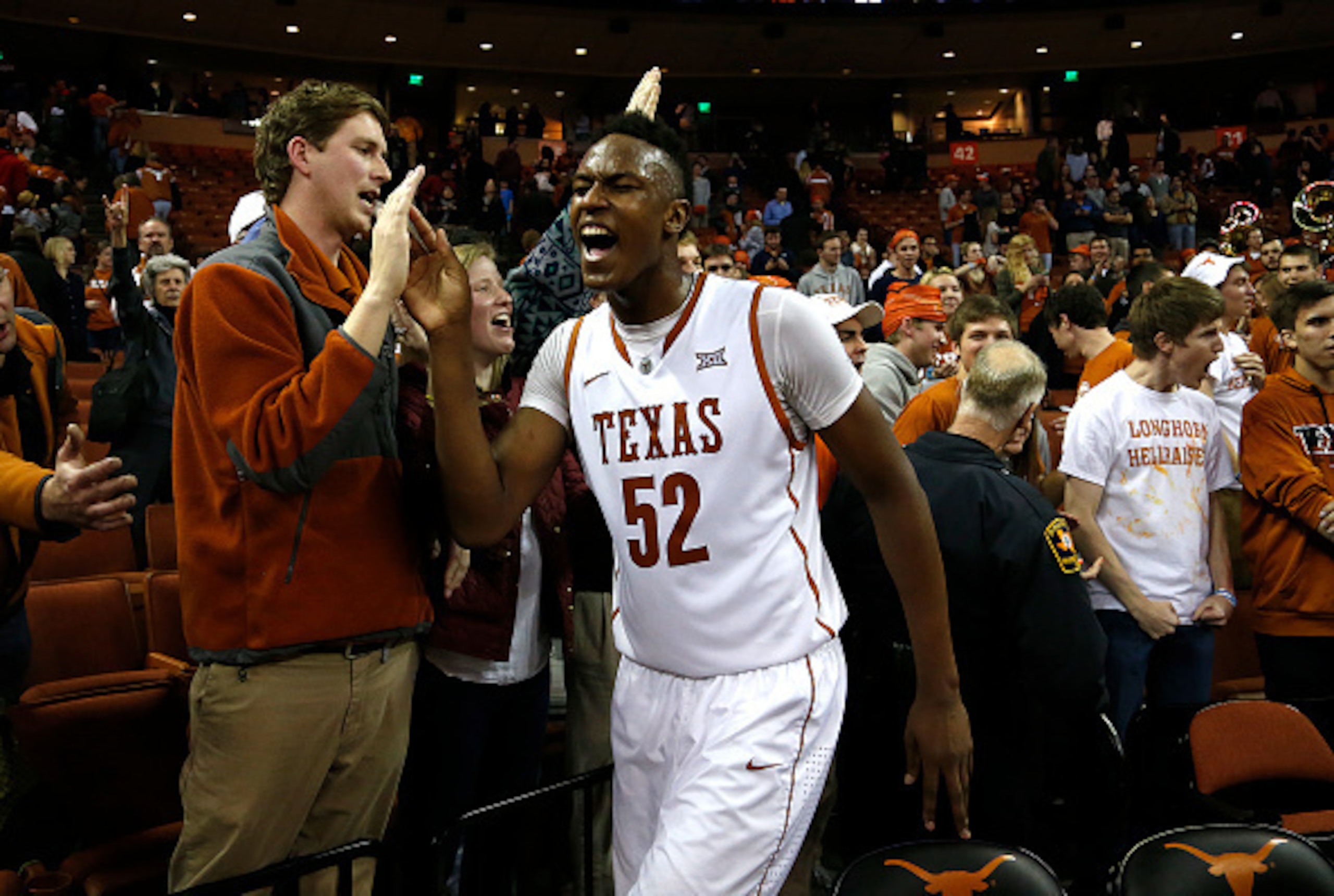
The Boston Celtics might want to add to their frontcourt with injuries getting the best of Jared Sullinger once again.
At 6'11", Myles Turner offers a rare blend of perimeter scoring and shot-blocking, as well as the versatility to play either the 4 or 5.
He isn't quite ready to go—Turner hasn't scored more than eight points in a game in four attempts so far this March. But that shouldn't bother the Boston Celtics, who'll be rebuilding through the next couple of drafts.
Turner has the potential to offer major value at No. 10 as a stretch big man and rim protector. But he'll need to add muscle and improve his shooting consistency.
11. Utah Jazz: Devin Booker, Kentucky, 6'6", SG, Freshman
11 of 60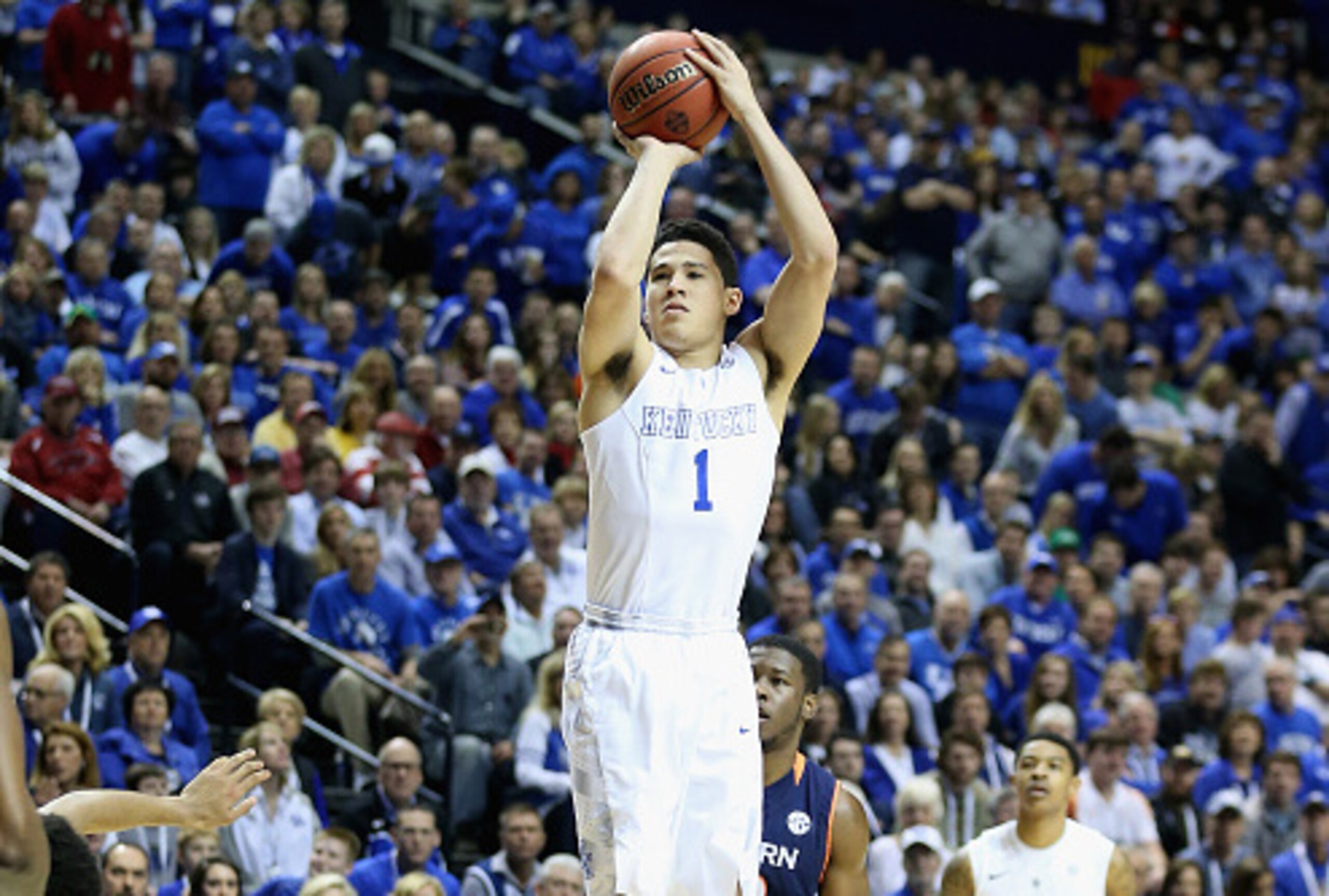
The Utah Jazz could use another shooter in their backcourt, considering Trey Burke, Dante Exum and Joe Ingles each shoot below 33 percent from downtown.
Cue Devin Booker, one of the most dangerous snipers and natural scorers in the country. With a 42.7 percent three-point mark and a 61.1 percent true shooting percentage, per Sports-Reference.com, Booker ultimately specializes in putting the ball in the hole.
As the season has progressed, so has his shot-creating ability. An obvious spot-up threat, Booker has become more effective stopping-and-popping off the dribble as well as hitting open lanes and finishing around the basket.
Not turning 19 years old until October, he's one of the youngest, safest options to choose from outside the top 10. Booker makes sense for the Jazz at No. 11 from a talent, fit and need standpoint.
12. Philadelphia 76ers (via Heat): Kelly Oubre, Kansas, 6'7", SF, Freshman
12 of 60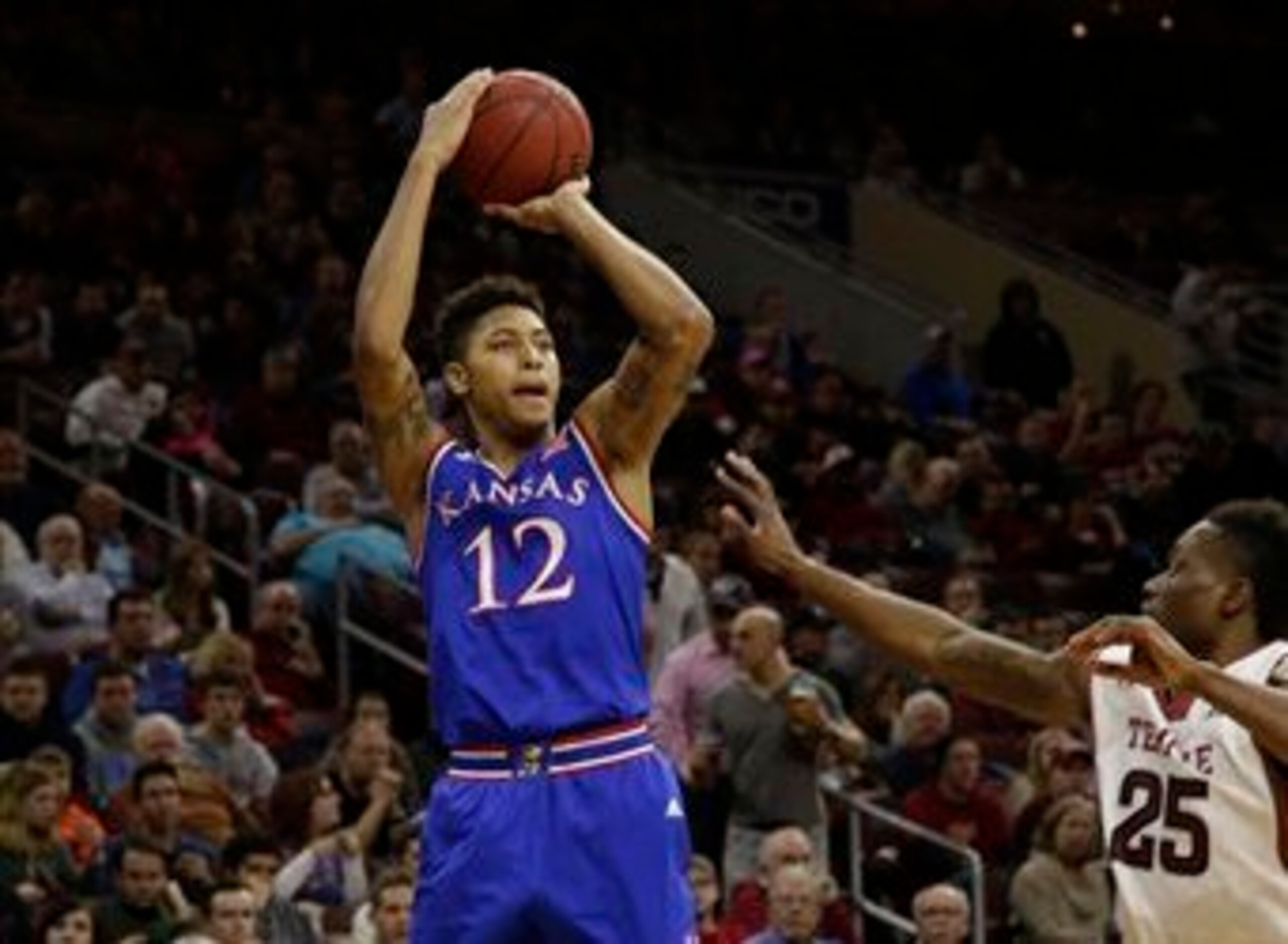
Kelly Oubre's touches, role and numbers have fluctuated throughout the season. After dropping 25 points Thursday against TCU, he went 2-of-6 shooting against Baylor and then had a 1-of-3 performance in a loss to Iowa State in the Big 12 tournament final.
Still, there's no doubting Oubre's talent. At 6'7", he's a smooth athlete with three-point shooting range and sound scoring instincts off the dribble.
He reminds me a little bit of Boston Celtic' rookie James Young on offense, but his defensive tools are sharper.
He'll have to improve his shot creativity in terms of getting himself easier looks, but the upside tied to him figuring it out should attract top-10 interest—even after an up-and-down freshman year.
13. Phoenix Suns: Frank Kaminsky, Wisconsin, 7'0", PF/C, Senior
13 of 60
Frank Kaminsky continues to make the case for the title of best college player in the country after helping Wisconsin come from behind late against Michigan State in the Big Ten tournament final.
Down eight with just over six minutes left, Kaminsky scored eight points of his own over the next four minutes and 32 seconds.
Though not the most athletic big man, he makes up for speed and explosiveness with touch and footwork. Double-teams haven't been as effective—Kaminsky has already totaled 90 assists, up from the 49 he dished out last year.
Meanwhile, he's hit 34 threes in 33 games. His shot-making ability at 7'0" should allow him to step in right away and give the Phoenix Suns some minutes.
14. Houston Rockets (via Pelicans): Kris Dunn, Providence, 6'3", PG, Sophomore
14 of 60
Kris Dunn's NBA pitch continues to get more convincing by the day. He just went for 17 points and 11 assists in a win Thursday over St. John's, and though he came up just short in a two-point loss, Dunn still managed to go for 22 points and nine assists against Villanova, a No. 1 seed in the NCAA tournament.
He really looks the part of a pro point guard with 6'3" size, a strong 205-pound frame and lighting quickness. Dunn is ultimately a nightmare cover off the dribble given his change-of-direction ability, vision and scoring instincts.
He leads the country in assist percentage while averaging 15.8 points on 48 percent shooting.
Even the red flags aren't that alarming. He appears to be healthy as can be following back-to-back shoulder surgeries, and his jumper (42.2 percent on two-point jumpers, 34.7 percent from three) looks far from broken. Dunn turns the ball over a ton, and he'll certainly have to tighten up his decision-making, but he's also used in 27.8 percent of Providence's possessions.
The Houston Rockets could really use another point guard. Dunn might not be an immediate solution, but he does offer starter potential down the road.
Providence is looking at either Boise State or Dayton in the second round, with Oklahoma, a beatable team, as a possible third-round matchup. A breakout tournament for Dunn could shoot him up some boards.
15. Charlotte Hornets: Jerian Grant, Notre Dame, 6'5", PG, Senior
15 of 60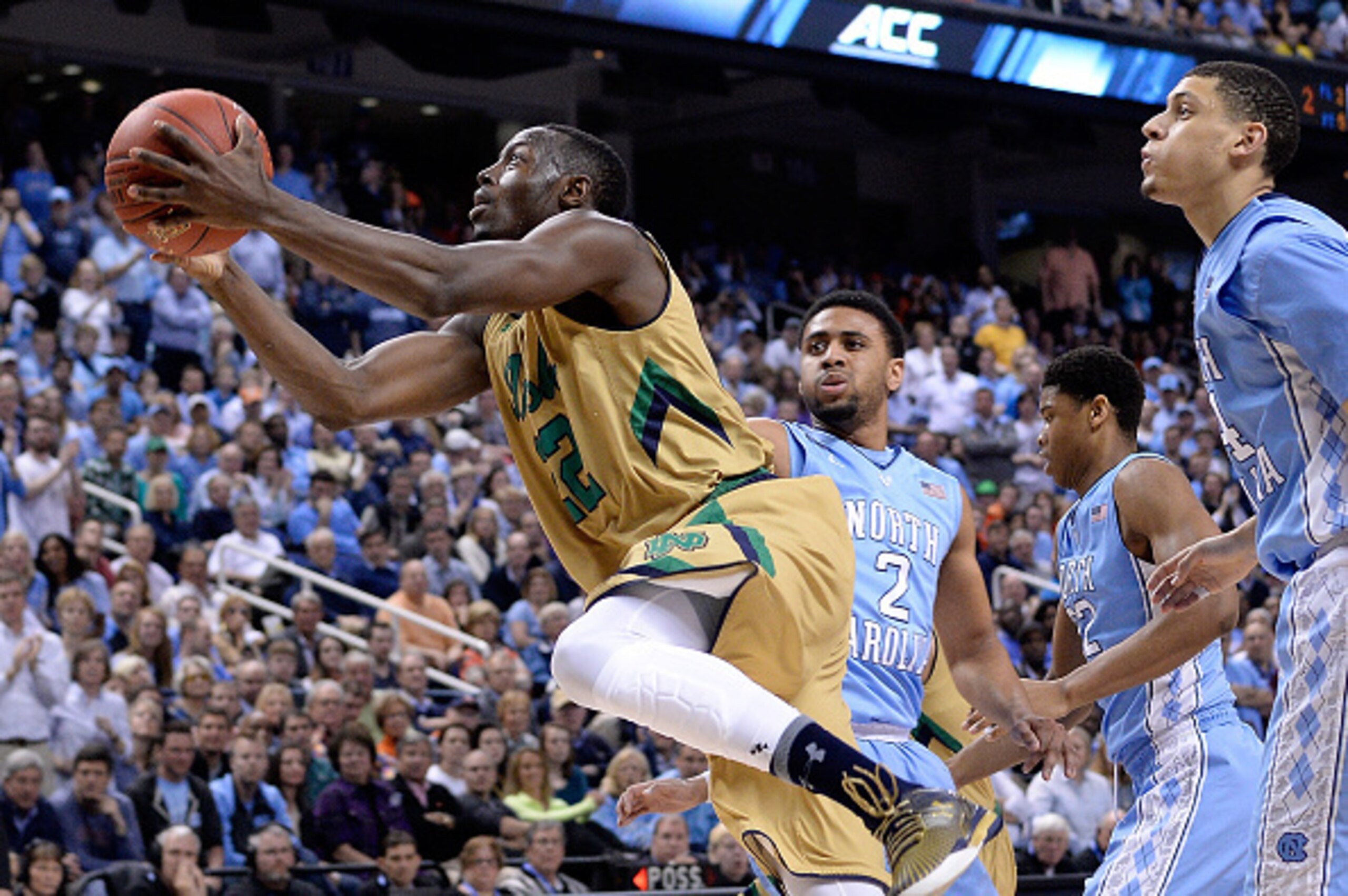
Though the Hornets have their point guard in Kemba Walker, they could certainly use another passer in the lineup. Jerian Grant, who also has the size to slide off the ball, is one of the best passers this draft has to offer.
Grant's ability to create open shots for teammates off drives and ball screens should be valued in Charlotte, where most of the Hornets' guards are shoot-first offensive players.
He's sporting a terrific 6.6-2.1 assist-to-turnover ratio, while his 6.07 pure point rating ranks No. 7 in the country, per DraftExpress.
Though not the quickest or most explosive, Grant's skill level is really impressive. He's an excellent finisher around the basket (shoots 76 percent at rim) and dangerous scorer off the dribble, while his facilitating instincts look as sharp as anyone's.
He's coming off a 24-point, 10-assist effort in a win over North Carolina in the ACC tournament final.
After missing the last 20 games of his junior season due to academic issues, Grant has emerged as one of the country's most valuable players (ranks No. 4 in win shares).
Whether you view him as a need for Charlotte or not, at some point, you just have to draft the best available player. Assuming he's still on the board at No. 15, Grant will be in the conversation.
16. Indiana Pacers: Kevon Looney, UCLA, 6'9", SF/PF, Freshman
16 of 60
Kevon Looney is more of a two-to-three year project, and that could discourage general managers from reaching high in the lottery.
But at 6'9", Looney's inside-out skill set and rebounding instincts fuel some pretty enticing upside.
He didn't make much noise during UCLA's run to the Pac-12 tournament final, where he finished with five points against Arizona and five against USC.
However, Looney has hit 13 of his last 20 three-point attempts, a reminder of his promising stretch potential and versatility.
At 220 pounds, he'll need to bulk up. Looney isn't much of a back-to-the-basket or post scorer. But he's a mismatch waiting to happen if he can continue sharpening up his perimeter ball skills.
17. Milwaukee Bucks: Trey Lyles, Kentucky, 6'10", PF, Freshman
17 of 60
He occasionally puts up a dud, but there's no questioning Trey Lyles' skill level, feel for the game or fit in the NBA.
Lyles just bounced back from a 1-of-8 performance against Florida with a couple of strong outings against Auburn and Arkansas.
At 6'10", he isn't much of a bully down low, which might keep teams from reaching in the lottery. But his pure mid-range shooting stroke (42.7 percent on two-point jumpers), high basketball IQ and face-up mobility should still hold plenty of value.
He projects as a pick-and-pop or drive-and-kick target, as well as a tough off-the-dribble cover against slower-footed power forwards.
Based on his size and offensive strengths, the Taj Gibson comparison seems fairly reasonable.
18. Oklahoma City Thunder: Delon Wright, Utah, 6'5", PG, Senior
18 of 60
Delon Wright could step in tomorrow and give the Oklahoma City Thunder 10-15 minutes off the bench. He's one of the more mature guards in the country—a sound pick-and-roll facilitator and relentless defensive presence.
This year, he's cut down on his turnovers dramatically (averaging 1.8 per game after averaging 2.5 last year), and though still a work in progress as a shooter, he's hit more than twice as many threes as he did in 2013-14.
Wright projects more as a backup point guard, considering he'll be 23 years old in April. But his ability to pressure ball-handlers, set the table and score in the lane could work right away.
19. Washington Wizards: Bobby Portis, Arkansas, 6'11", PF, Sophomore
19 of 60
Bobby Portis had been Mr. Consistent throughout the year, though he struggled to make an impact in Arkansas' last two games of the SEC tournament. He was just 1-of-14 shooting Saturday against Georgia before his 3-of-7, two-rebound effort against Kentucky.
If there's a reason Portis slips to No. 19, it's because he's isn't overly explosive or strong around the basket.
However, he's rebounded the ball much more effectively overall this season (8.6 per game), and he continues to look sharp on the perimeter, where he has one of the smoother jumpers you'll see from a 6'10" big (91 made two-point jumpers).
Portis can wheel and deal in the post and catch-and-shoot in that 15- to 20-foot range. I like the Antonio McDyess comparison when you consider his physical tools and skill set.
The Wizards could use another big man. Portis would be an ideal get this late in Round 1.
20. Chicago Bulls: R.J. Hunter, Georgia State, 6'5", SG, Junior
20 of 60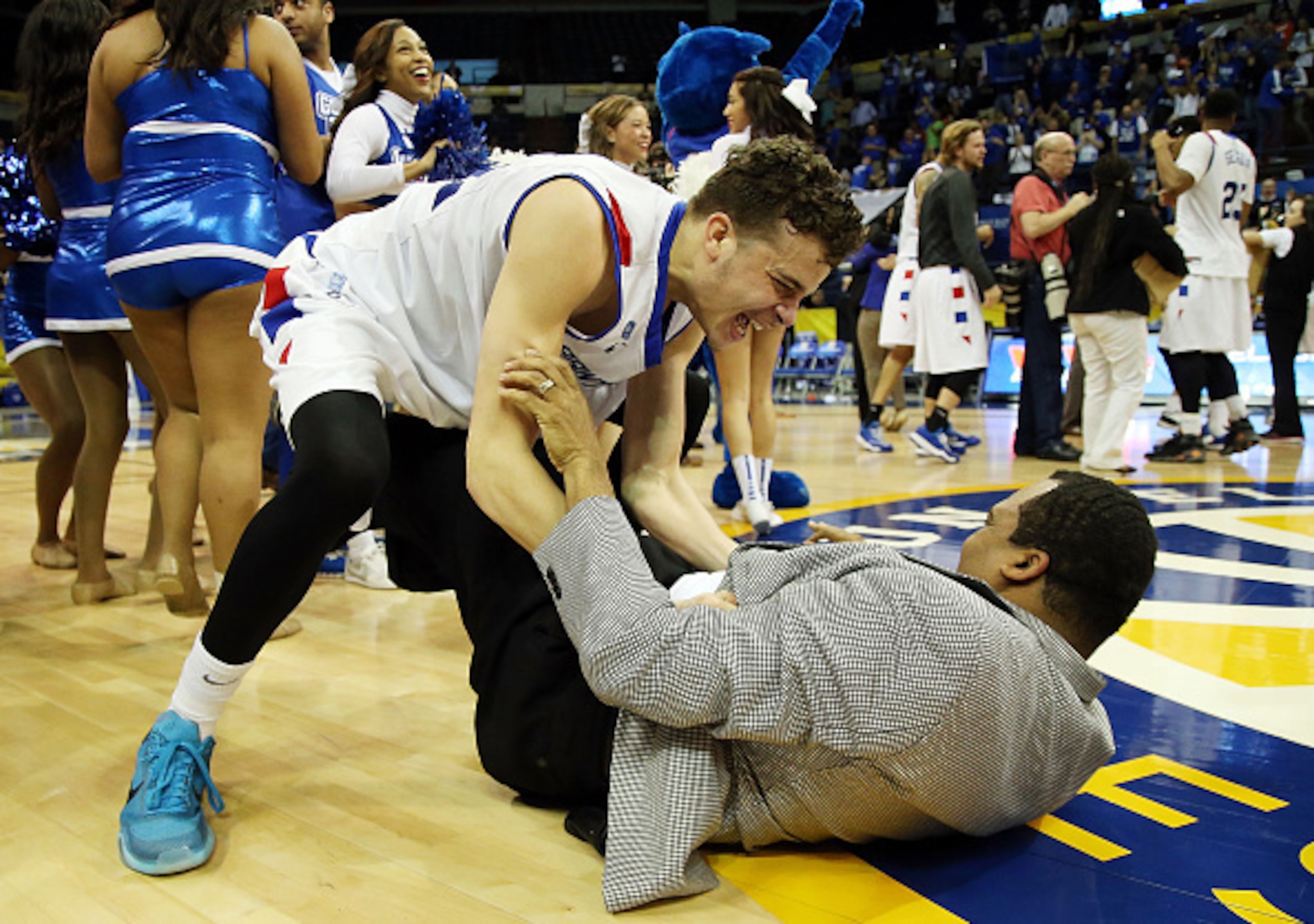
R.J. Hunter helped Georgia State punch its ticket to the dance by knocking down a pair of game-winning free throws against Georgia Southern in the Sun Belt tournament final.
He didn't shoot the ball anywhere near of what he's capable of this season, yet he's still managed to average 19.8 points and rack up 63 more assists than he did all last year.
Hunter has ultimately become a more complete offensive player, and though he's only shooting 30.4 percent from three, he's still making 2.3 triples per game as the focus of every opposing defense's game plan.
As the No. 5 option for the Chicago Bulls, it wouldn't be surprising to see Hunter suddenly relocate his long-range accuracy.
If he's able to lead his Panthers to an upset Thursday over No. 3 seed Baylor, look for the buzz surrounding Hunter to pick up.
21. Toronto Raptors: Montrezl Harrell, Louisville, 6'9", PF, Junior
21 of 60
Montrezl Harrell would be a fitting addition in Toronto, where the Raptors could use another power forward and energizer up front.
Harrell hasn't blossomed into the pick-and-pop, inside-out big man scouts were likely hoping he'd become. But he's maintained his motor and interior presence.
His explosiveness translates to an 81.6 percent conversion rate around the rim. It's also led to 40 putbacks and 9.5 rebounds per game.
Improving his shooting touch would raise his ceiling an extra story, but at No. 21, you target Harrell for the activity, toughness and athleticism he can bring to the paint at each end of the floor.
22. Dallas Mavericks: Christian Wood, UNLV, 6'11", PF, Sophomore
22 of 60
Given their lack of frontcourt athleticism, Christian Wood would be a fitting option for the Dallas Mavericks.
UNLV didn't make the NCAA tournament, but Wood's 15.7 points, 10 rebounds and 2.7 blocks per game were enough to generate buzz throughout the year.
At 6'11", he's an above-the-rim forward who can also put the ball on the floor and attack facing up.
Wood has even hit 25 threes this year, which plays a bit to his stretch 4 potential and versatility.
He'll need to bulk up and sharpen his post game, but between his physical tools, production and inside-out skill set, Wood may get looks from teams drafting late in the lottery.
23. Boston Celtics (via Clippers): Caris LeVert, Michigan, 6'7", SG, Junior
23 of 60
Caris LeVert hasn't played since January, but he did enough over his previous 55 games to justify first-round consideration.
At 6'7", he has terrific size and athleticism for a 2-guard and the versatility to score and pass out of pick-and-rolls or spot up off the ball (shot at least 40 percent from three in back-to-back seasons).
The big question with LeVert concerns his durability. He's now had surgery on the same foot twice. But the potential reward tied to LeVert is worth the risk for the Celtics, who have two first-round picks and a need for offense on the wing.
24. San Antonio Spurs: Jakob Poeltl, Utah, 7'0", C, Freshman
24 of 60
Jakob Poeltl might be a few years away, but there's no doubting his NBA tools or fit.
At 7'0", he has a big body to go with some impressive mobility and coordination, particularly as a finisher off pick-and-rolls.
Poeltl also sports an excellent 18.5 percent rebounding percentage and 8.1 percent block percentage.
He's extremely raw with regard to his skills, post game and jumper (shoots 43.8 percent from the line). But he should be able make a living off his ability to score around the basket, protect the rim and clean the glass.
Poeltl just happens to be playing some of his best ball of the year, having scored 18 points against Washington on March 7 and 16 against Stanford on Thursday. He'll be a key prospect to watch during the NCAA tournament.
25. Cleveland Cavaliers: Cameron Payne, Murray State, 6'5", PG, Sophomore
25 of 60
Nobody made a bigger late-season jump than Cameron Payne, whose production and impact have just been too strong to ignore.
He's averaging 20.3 points, 5.8 assists, 2.0 steals and 2.3 made threes per game.
Payne will be playing in this year's NIT, where he'll be one of the featured prospects scouts will likely continue flocking to see.
A crafty playmaker, confident shooter and pest at the defensive end, Payne could potentially give the Cavaliers an upgrade over backup point guard Matthew Dellavedova.
26. Los Angeles Lakers (via Rockets): Sam Dekker, Wisconsin, 6'9", SF, Junior
26 of 60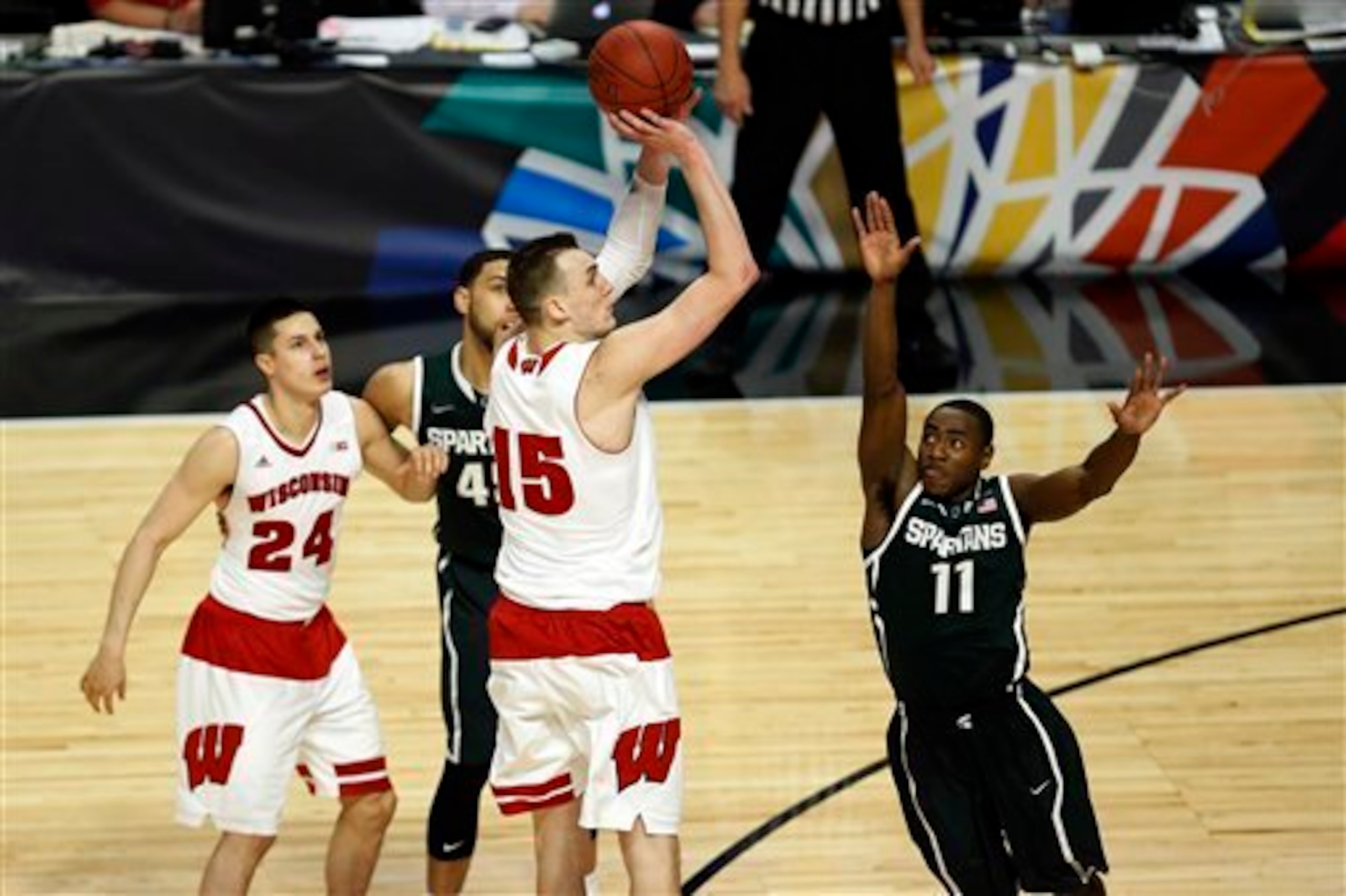
Assuming the Lakers will be looking to fill their roster with high-profile free agents, Sam Dekker would be a great get for them with their second first-round pick. He projects as a role player, a do-it-all glue guy who's likely to be more effective with less offensive responsibility.
Dekker isn't a particularly dangerous isolation scorer, but he's an excellent passer, driver and cutter off the ball. And he can knock down outside shots, though shooting consistency is something he'll need to improve.
With Wisconsin a No. 1 seed in the NCAA tournament, Dekker could still have a few games left to showcase his offensive versatility.
But if you're the Lakers, you target him for his basketball IQ and ability to make teammates better.
27. Portland Trail Blazers: Rondae Hollis-Jefferson, Arizona, 6'6", SF, Soph.
27 of 60
The Blazers won't be able to replace Wesley Matthews at No. 27, but Rondae Hollis-Jefferson would at least offer some of the lockdown defense they lost.
At 6'6" with long arms, great lateral quickness and a live motor, he guards up to three positions on the floor.
Hollis-Jefferson's lack of shooting range limits his offensive upside, but in a role that can allow him to play to his strengths, he'll have the potential to serve a purpose as a defensive specialist and slasher.
28. Memphis Grizzlies: Tyus Jones, Duke, 6'1", PG, Freshman
28 of 60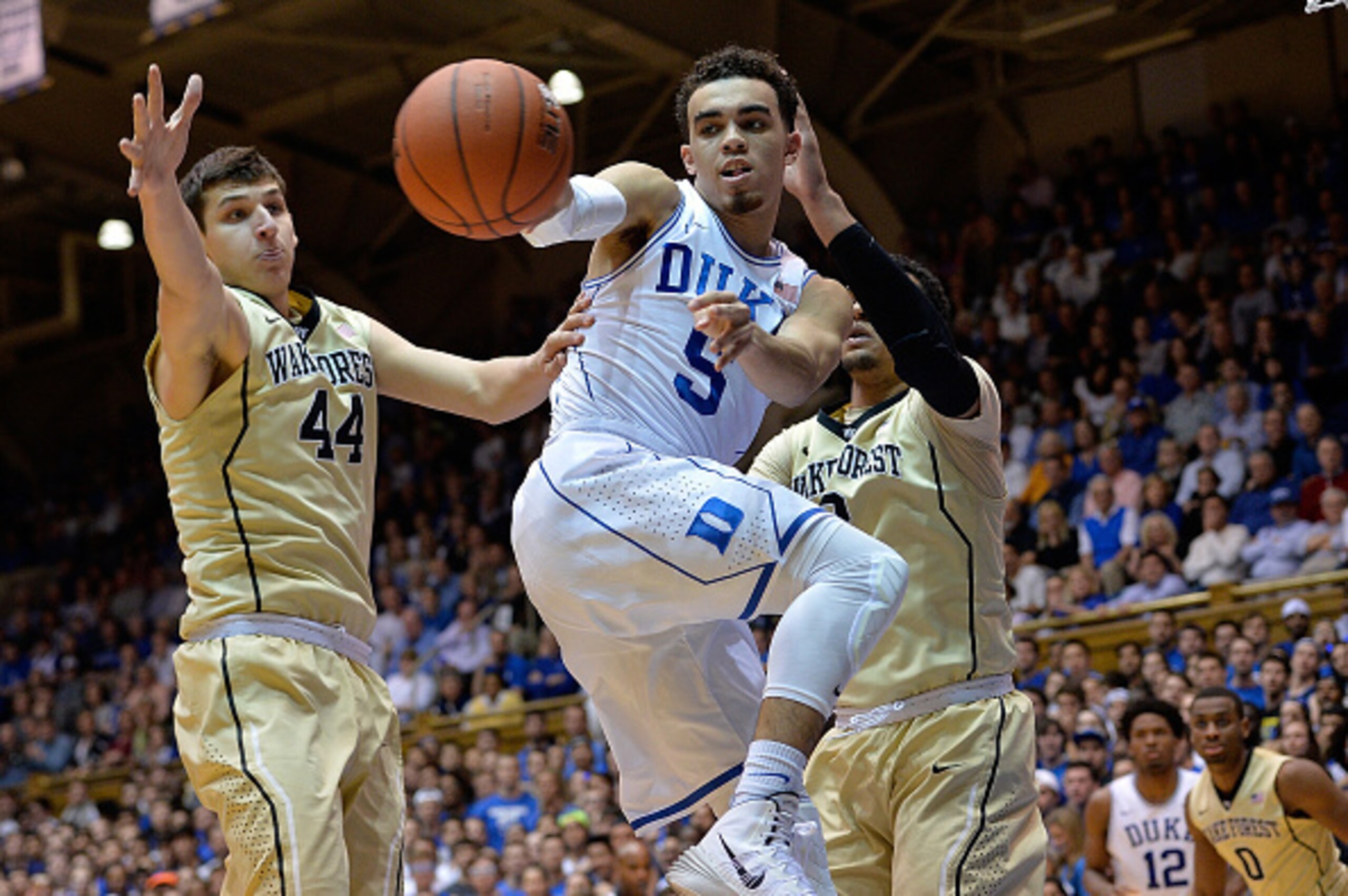
The Memphis Grizzlies might want to target a backup point guard, and though he isn't worth reaching on, Tyus Jones makes sense as a late-round option.
He struggled Friday in Duke's loss to Notre Dame, but he's been fairly consistent throughout the year. Jones sports a strong 5.8-2.1 assist-to-turnover ratio, a tribute to his facilitating instincts and willingness to pass.
Jones is ultimately at his best in transition—46.3 percent of his assists come within the first 10 seconds of a Duke possession. He has excellent vision in the open floor. Jones pushes the ball and finds shooters before the defense can set.
He projects poorly on defense, and without much strength or athleticism, Jones' overall ceiling is limited. But between his passing, ball-handling and shooting ability (38.3 percent from three), his skills are worthy of the NBA.
29. Brooklyn Nets (via Hawks): Robert Upshaw, Washington, 7'0", C, 1994
29 of 60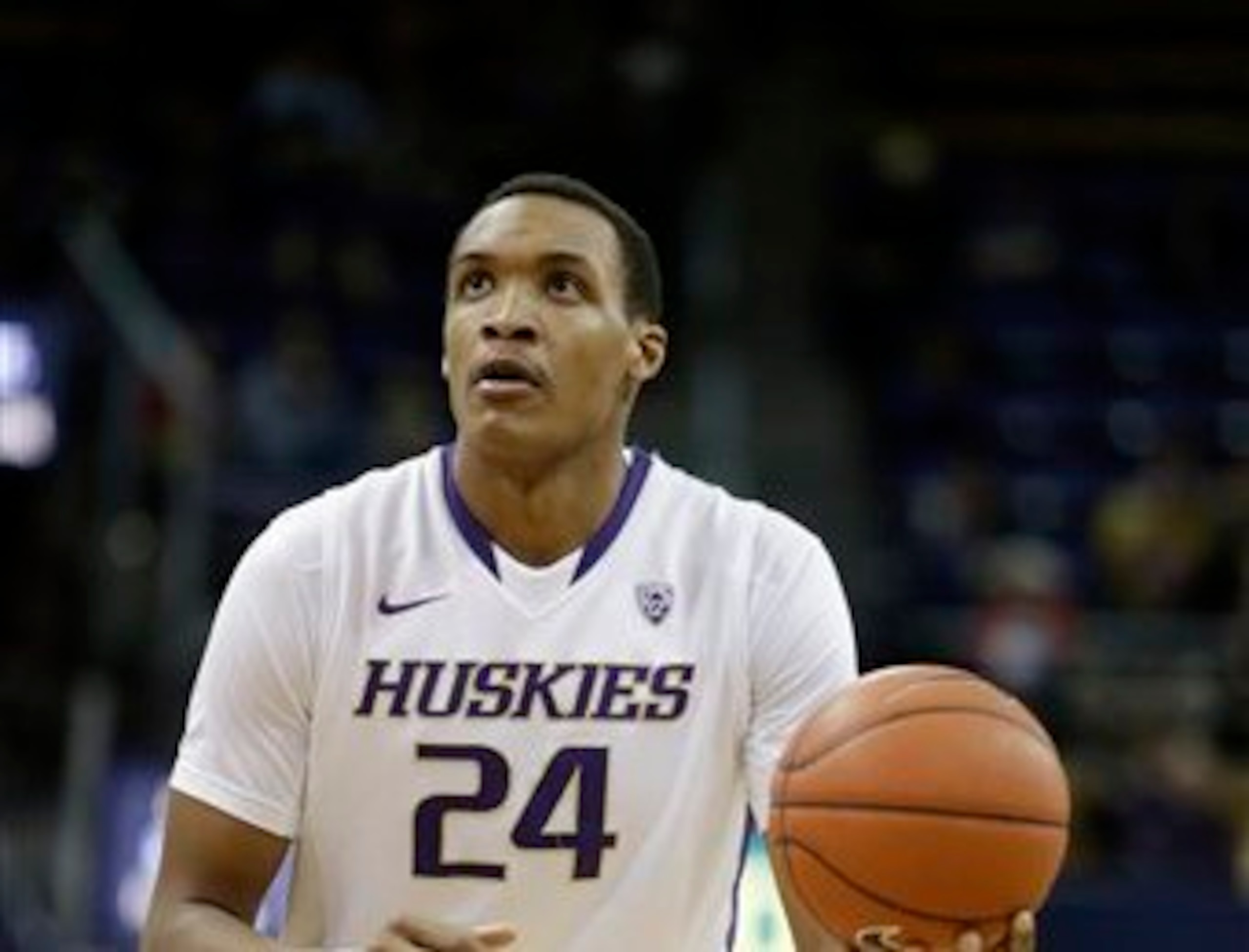
We haven't heard much from Robert Upshaw since he was dismissed from Washington back in January. But as long as he's eligible and ultimately interested in playing pro ball, there's bound to be NBA interest.
"It's possible," one executive told NBA.com's Scott Howard-Cooper with regard to his chance of going in the first round. "He's one of the most talented big guys I saw this year. He can score in the post. He can block shots. He's long. It'll just be do you think you can keep him clean. It's happened twice. ... There's a lot going on with that kid."
Though there are obvious questions concerning his character, there aren't too many regarding his NBA tools and potential. At 7'0, 250 pounds, he was leading the country in blocks before getting the boot.
To put his impact in perspective, once Upshaw was gone, so was the Huskies' season. They lost 10 of their next 12 games.
There is bound to be one desperate general manager willing to overlook immaturity for talent. Billy King would seem like a strong candidate.
30. Golden State Warriors: Justin Anderson, Virginia, 6'6", SF, Junior
30 of 60
Justin Anderson is just trying to get back into the flow after missing eight games due to a broken finger. He's played in two since returning, and he's hasn't recorded a field goal.
But assuming his first 22 games of the year weren't a fluke, Anderson looks to have emerged as a legitimate three-and-D prospect.
Having already entered the year known for his athleticism and defensive motor, Anderson added a lights-out jumper. He's hit a ridiculous 46.9 percent of his threes after making just 29.4 percent of them as a sophomore.
Anderson will ultimately last a long time if he's able to carry this newfound shooting stroke over to the pros.
31. Houston Rockets (via Knicks): Rashad Vaughn, UNLV, 6'6", SG, Freshman
31 of 60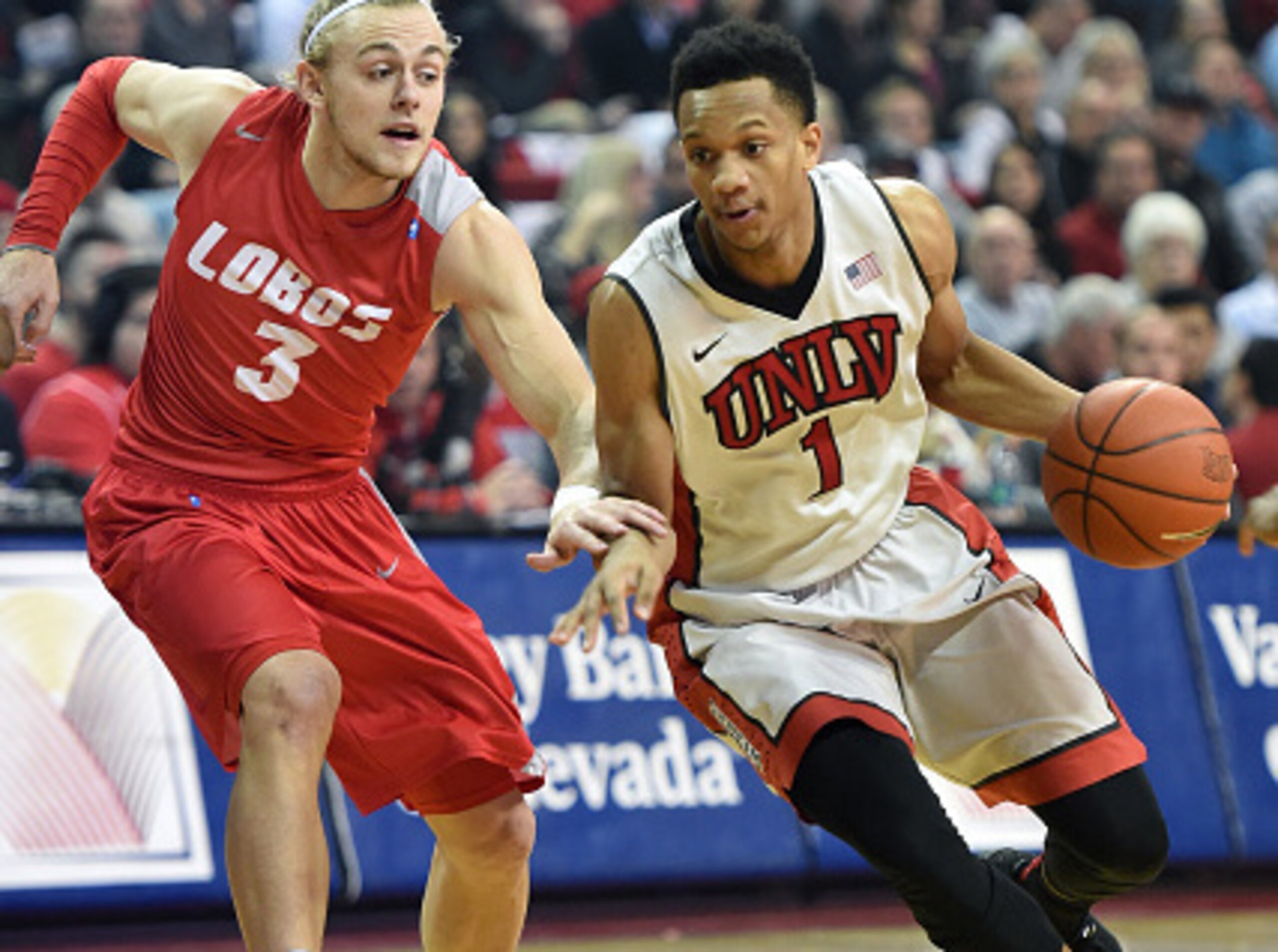
Averaging 17.8 points per game, Rashad Vaughn was the second-leading scorer among freshmen before tearing his meniscus back in February.
Though not known for his shot selection or defense, Vaughn's ability to create and make difficult shots could still hold value off an NBA bench.
He hit the 25-point mark five times in 23 games. Vaughn also went for 21 points in a win over Arizona back on December 23. He's a microwave-type scorer capable of putting up points in bunches.
With UNLV coming off an 8-10 season in the Mountain West, and teammate Christian Wood expected to go pro, it wouldn't be surprising if Vaughn followed.
32. Minnnesota Timberwolves: Anthony Brown, Stanford, 6'6", SF, Senior
32 of 60
There's no mystery as to what drives Anthony Brown's NBA appeal. At 6'6", he's a sniper, having made 70 threes this year at a lights-out 44.6 percent clip.
It's no fluke—Brown shot 45.3 percent from downtown last year as the Pac-12's most improved player.
He'll be turning 23 years old in October, so there isn't any real upside here, but a team that could use another shooter might target Brown as a second-round specialist.
33. Boston Celtics (via 76ers): Cliff Alexander, Kansas, 6'8", PF, Freshman
33 of 60
After averaging 3.7 points over his previous nine games, Cliff Alexander was forced to the sidelines due to questions over his eligibility. And now we're finding out that his freshman year could be over.
Coach Bill Self told ESPN's Andy Katz, via CBS Sports' Sean d'Oliveira, that Alexander will not be eligible to play in the NCAA tournament.
It's a tough blow for Alexander, who really needed another shot to improve his standing with scouts.
However, assuming he slides a bit in the draft, this could make Alexander a value play in the second round, assuming the team that drafts him understands his limitations.
Alexander isn't very skilled, but he's super long and athletic, and he's capable of owning the glass, finishing inside and providing interior activity.
The Celtics' frontcourt could use a little of Alexander's burst and above-the-rim presence.
34. Los Angeles Lakers: Jarell Martin, LSU, 6'10", PF, Sophomore
34 of 60
Jarell Martin had a big year for LSU that only got bigger as the season progressed. He'll be entering the NCAA tournament averaging 22 points and 11 rebounds over LSU's last six games.
Martin is a beast around the basket and a mismatch facing up, where he can attack off the dribble or separate into jumpers in the mid-range.
He improved his shot selection in 2014-15, having taken 30 fewer threes and 107 more free-throw attempts than he did as a freshman. And it's made him a more efficient scorer (51 percent from floor).
Martin ultimately resembles Orlando Magic combo forward Tobias Harris in terms of his body and skill set.
A lack of shooting range and questions over his natural position have kept his stock in check. But Martin's offensive upside is big enough to warrant first-round consideration.
35. Philadelphia 76ers (via Magic): George Lucas, Brazil, 6'5", PG, 1996
35 of 60George Lucas, or George Lucas Alves De Paula, which is his full name, earned himself a key invite to April's Nike Hoop Summit, where he'll have the chance to make an impression in front of dozens of NBA scouts.
The fact that he got the invite to begin with means he's clearly on the radar.
Lucas played for Brazil during the 2014 FIBA Americas Under-18 Championship, where he averaged 13.4 points and 4.2 assists.
At 6'5", he has standout physical tools and some eye-opening playmaking ability.
Lucas' draft-stock needle will likely move following his week in Portland at the Summit. Until then, we'll consider him a second-round option who has room to climb.
36. Minnesota Timberwolves (via Kings): Tyrone Wallace, California, 6'5", PG, Jr
36 of 60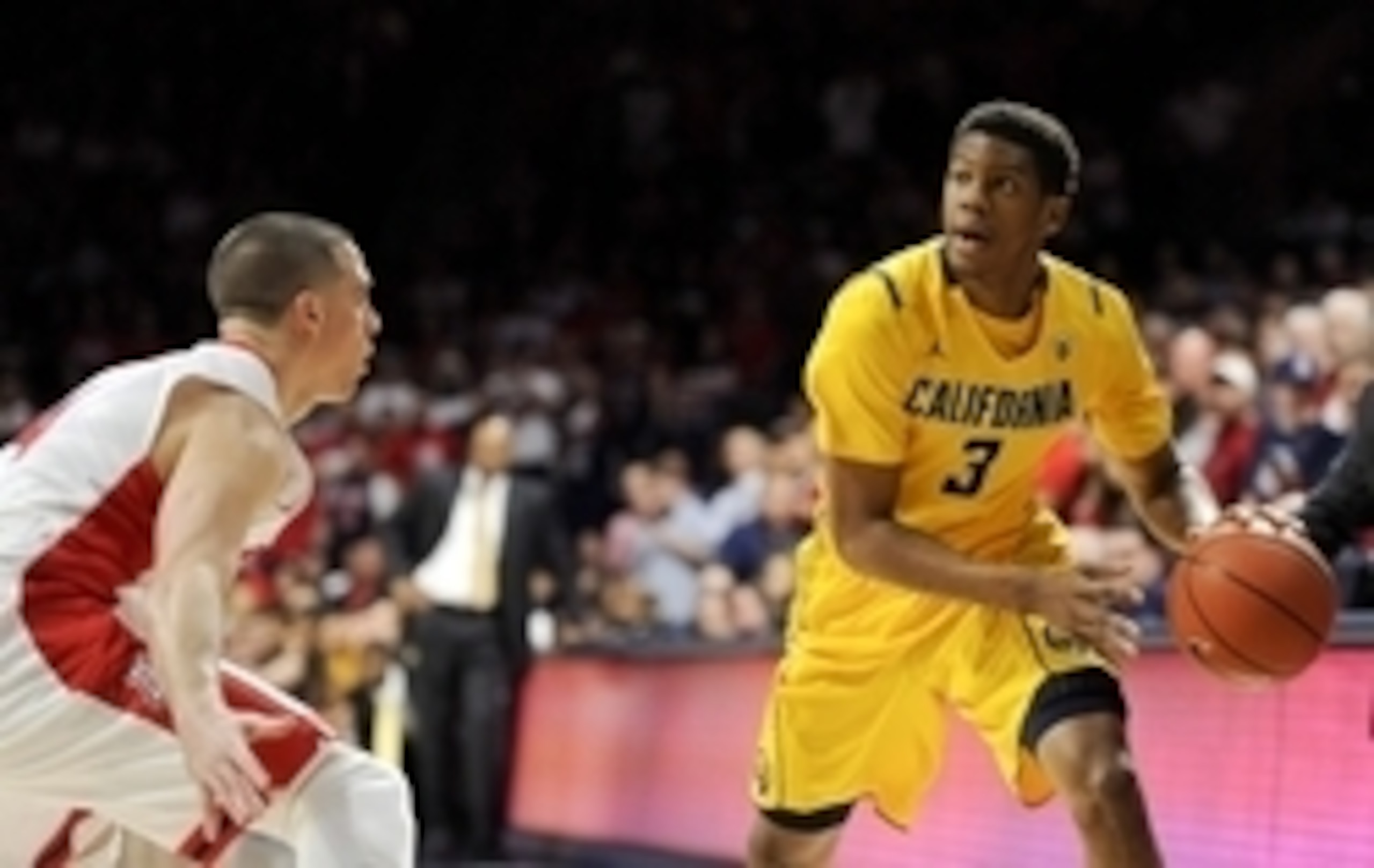
Tyrone Wallace has a number of attractive qualities from an NBA standpoint, starting with his 6'5" size and athleticism for a ball-handler.
Given his quick first step and ability to play over the defense, he's an awfully tough cover for point guards. Wallace averaged career highs of 17.1 points and 4.0 assists per game, showcasing the ability to create and score off the dribble, particularly around the key.
An ugly 48.4 percent true shooting percentage has weighed on his stock and outlook, but if he can ever start knocking down jumpers with a little more consistency, Wallace could be a steal as a second-round pick.
37. Detroit Pistons: Guillermo Hernangomez, Spain, 6'11", C, 1994
37 of 60Guillermo Hernangomez has been on the radar for a few years now, having appeared at Eurocamp and played in Euroleague and the Spanish ACB as an 18-year-old kid.
He's now 20 and having a solid season for Sevilla alongside Kristaps Porzingis.
At 6'11", 255 pounds, Hernangomez has an NBA center's body and strength, along with the instincts and footwork to score around the low block. He can also attack from the elbows and finish as the roll man after setting a screen.
Hernangomez shoots 70.9 percent from the line as well and has shown he can knock down baby jumpers.
He doesn't block many shots and isn't overly athletic, but Hernangomez seems like an ideal draft-and-stash option once all the obvious talent is off the board.
38. Philadelphia 76ers (via Nuggets): Cedi Osman, Macedonia, 6'8", SG/SF, 1995
38 of 60Cedi Osman has gotten some good experience playing with Anadolu Efes, the same team Dario Saric, last year's No. 12 pick, currently plays for.
A versatile offensive guard, Osman has the size of a wing and the ability to handle the ball at the point.
He hasn't shot the ball particularly well this year, but he's capable from downtown, and you get the impression it's something that will improve as his touches and confidence increase.
Osman doesn't offer much upside, but he's generated some nice buzz for himself as a teenager (19) contributing against high-level competition.
39. Brooklyn Nets: Jordan Mickey, LSU, 6'8", PF, Sophomore
39 of 60
If you can ignore the inch or two he lacks in height, Jordan Mickey could potentially offer major second-round value. Though a tweener on paper, standing 6'8" without much of a perimeter game, you can't teach Mickey's instincts, which have translated to 9.8 rebounds and a ridiculous 3.5 blocks per game.
He's also averaging 15.5 points due to some good footwork around the basket and a natural feel for the game. Mickey has looked capable with the mid-range jumper, though becoming consistent would ultimately improve his outlook dramatically.
Either way, this late, Mickey's numbers are just too intriguing to overlook based off a few questionable measurements.
40. Miami Heat: Alex Poythress, Kentucky, 6'8", PF, Junior
40 of 60
Alex Poythress lasted just eight games before tearing his ACL. Some might view him as a risk who doesn't offer enough potential reward to chase. Others may look at this as an opportunity to buy low, like the Detroit Pistons did with Spencer Dinwiddie last year when they drafted the injured guard early in the second round.
At full strength, Poythress' motor and athleticism translate to all sorts of activity around the rim. He finishes plays, keeps them alive and turns missed shots from teammates into second-chance points.
If he can bounce back physically, he'll have a shot at filling an energizer role in the pros.
41. Boston Celtics: Ron Baker, Wichita State, 6'3", PG/SG, Junior
41 of 60
With the ability to shoot, pass and defend, Ron Baker just might have a shot at finding a role as a combo guard reserve.
He's averaging 15.0 points and nailing 2.4 threes per game this year, having stepped up as Wichita State's top gun after Cleanthony Early went pro.
Poised, skilled and intelligent, Baker projects as a role player—a guard who can knock down shots, find the open man and handle the ball in a secondary role.
42. Utah Jazz: Mouhammadou Jaiteh, France, 6'11", C, 1994
42 of 60With previous invites to the Nike Hoop Summit and Eurocamp, Mouhammadou "Mam" Jaiteh is no mystery man to scouts.
At 6'11" with a 7'4" wingspan and 249-pound frame, he has a body built for the NBA's interior. And it came to life in Pro A France this season.
In France's top division, he's averaging 10.0 points and 5.6 rebounds on 59.7 percent shooting in 20.2 minutes per game for JSF Nanterre.
Finish, rebound and defend—that's Jaiteh's game. Though not exactly a go-to scoring option, Jaiteh's physical tools alone should be worth drafting and stashing in the second round.
43: Charlotte Hornets: Norman Powell, UCLA, 6'4", SG, Senior
43 of 60
Despite averaging a career-high 16.4 points, Norman Powell's lockdown defensive potential is still the attribute that holds the most NBA value.
An elite-level athlete with a 6'11" wingspan, Powell is one of those relentless in-your-grill type of ball-stoppers capable of guarding either backcourt position.
However, he's still made strides at the offensive end, where he's explosive attacking the rim, automatic in the open floor (46 buckets at rim in transition, per HoopMath) and capable from outside.
Becoming a little more consistent as a shooter (31.6 percent from three) could go a long way toward his chances at sticking in the pros.
44. Indiana Pacers: Buddy Hield, Oklahoma, 6'4", SG, Junior
44 of 60
There's no mystery as to what Buddy Hield will offer NBA teams. He's a shot-maker, a guard who can knock them down in a variety of different ways from every spot on the floor.
Hield isn't the most threatening one-on-one scorer, but he's dangerous spotting up, running off screens or pulling up in the face of his defender. He's made 86 threes in 32 games.
With passable defensive tools and a sharp basketball IQ, Hield has some promising role-player potential worth looking into anywhere in the 35-50 range.
45. Phoenix Suns: Brice Johnson, North Carolina, 6'9", PF, Junior
45 of 60
Brice Johnson picked a good time to start playing the best ball of his career. He'll be entering the NCAA tournament having scored at least 17 points in five of his last seven games.
A bouncy run-and-jump athlete for a 6'9" forward, Johnson is a weapon at the rim and an improving shot-maker around the key.
He's even shooting 48.2 percent on two-point jumpers after making 43.8 percent as a sophomore and 39.2 percent as a freshman, per HoopMath.
Johnson is more of a second-round talent if he comes out, but his athleticism and instincts in the paint could be enough to land him an interior specialist role.
46. Milwaukee Bucks: Nedim Buza, Bosnia, 6'7", SF, 1995
46 of 60Nedim Buza declared for the draft last year before withdrawing his name. And it looks like he'll be in the mix once again after he received an invite to the Nike Hoop Summit.
At 6'8", he's an athletic wing making 1.6 threes per game over in Bosnia.
A strong week in Portland at the Summit April 11 could solidify his spot in the second round.
47. Philadelphia 76ers (via Pelicans): Aleksandar Vezenkov, Bulgaria, 6'8", SF
47 of 60Aleksandar Vezenkov leads Greece's top league in scoring after leading the Under-20 European championships last summer.
The main appeal to Vezenkov ultimately stems from his 45.5 percent three-point stroke for a combo forward who also pulls in 7.8 rebounds per game.
He isn't much of an athlete, but like Nikola Mirotic, he can put the ball on the floor, attack in line drives and make plays off loose balls around the basket.
If the Sixers want to draft and stash, Vezenkov could be an interesting second-round target for his role-player and stretch 4 potential.
48. Oklahoma City Thunder: Andrew Harrison, Kentucky, 6'6", PG, Sophomore
48 of 60
Though Andrew Harrison lost some of the luster he entered Kentucky with as a freshman, given his 6'6" size and all the wins he's piled up, he's still worth looking into.
You wouldn't know it from his averages, but he's actually made strides as a point guard and decision-maker in 2014-15. Per 40 minutes, Harrison is dishing out nearly one more assist and coughing it up 0.7 fewer times per game.
Unfortunately, he's a below-average athlete for a ball-handler, and it's weighed on his ability to finish in traffic. Harrison shoots just 36.6 percent inside the arc and only 49 percent at the rim, per HoopMath.
Given that lack of explosiveness, he'll need to eventually start making more than 29.3 percent of his two-point jumpers and 38.8 percent of his threes.
But there's enough potential reward tied to him figuring it out for a team to take a second-round flier. Harrison could offer nice value late in the 40s.
49. Washington Wizards: Isaiah Taylor, Texas, 6'1", PG, Sophomore
49 of 60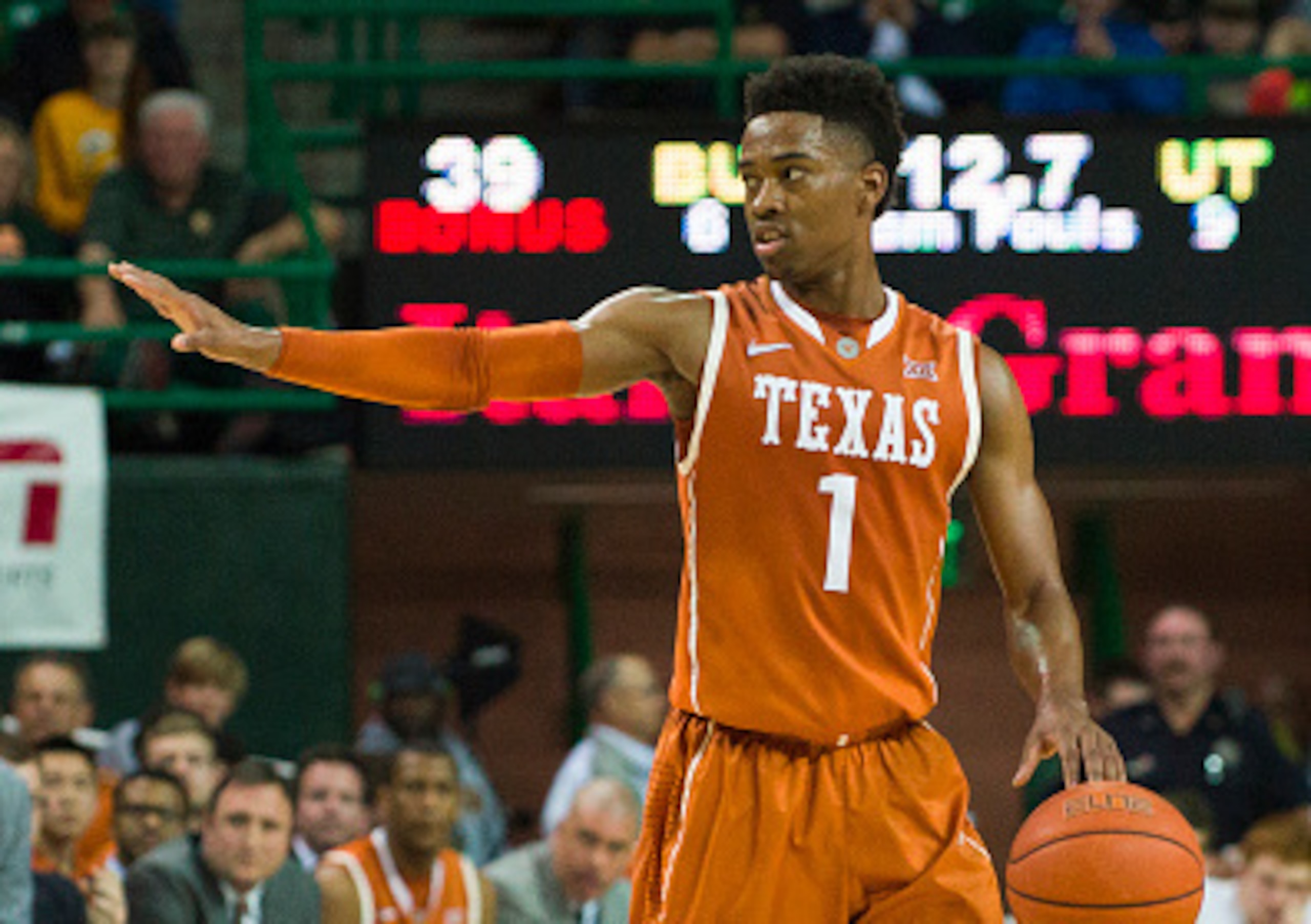
Lightning quick and shifty, Isaiah Taylor is as tough to stay in front of as any guard in the country.
If he's going to stick in the NBA, it's his breakdown ability coaches are likely to value most. Taylor can get into the lane at will, where he scores with the floater and sets the table for finishers and shooters.
A shaky jumper and questionable decision-making have weighed on his stock, but he's an exceptional athlete and flat-out blur off the dribble.
50. Orlando Magic (via Bulls): Rakeem Christmas, Syracuse, 6'9", PF, Senior
50 of 60
If Rakeem Christmas wasn't turning 24 years old next December, chances are he'd go a lot higher. He's arguably the most improved player in the country, having averaged 17.5 points and 9.1 rebounds per game, up from the 5.8 points and 5.1 boards he put up as a junior.
After polishing up his footwork and working on his touch, Christmas has become an awfully tough low-post cover. As a back-to-the-basket scorer, he can turn over either shoulder and finish with both his left and right hand.
Christmas hasn't flashed much of a jumper, and at 6'9", he's a bit undersized for an NBA center. But in a 10-15 minute role, there's no reason why he can't offer a little toughness and athleticism down low.
51. Atlanta Hawks (via Raptors): Dez Wells, Maryland, 6'4", SG, Senior
51 of 60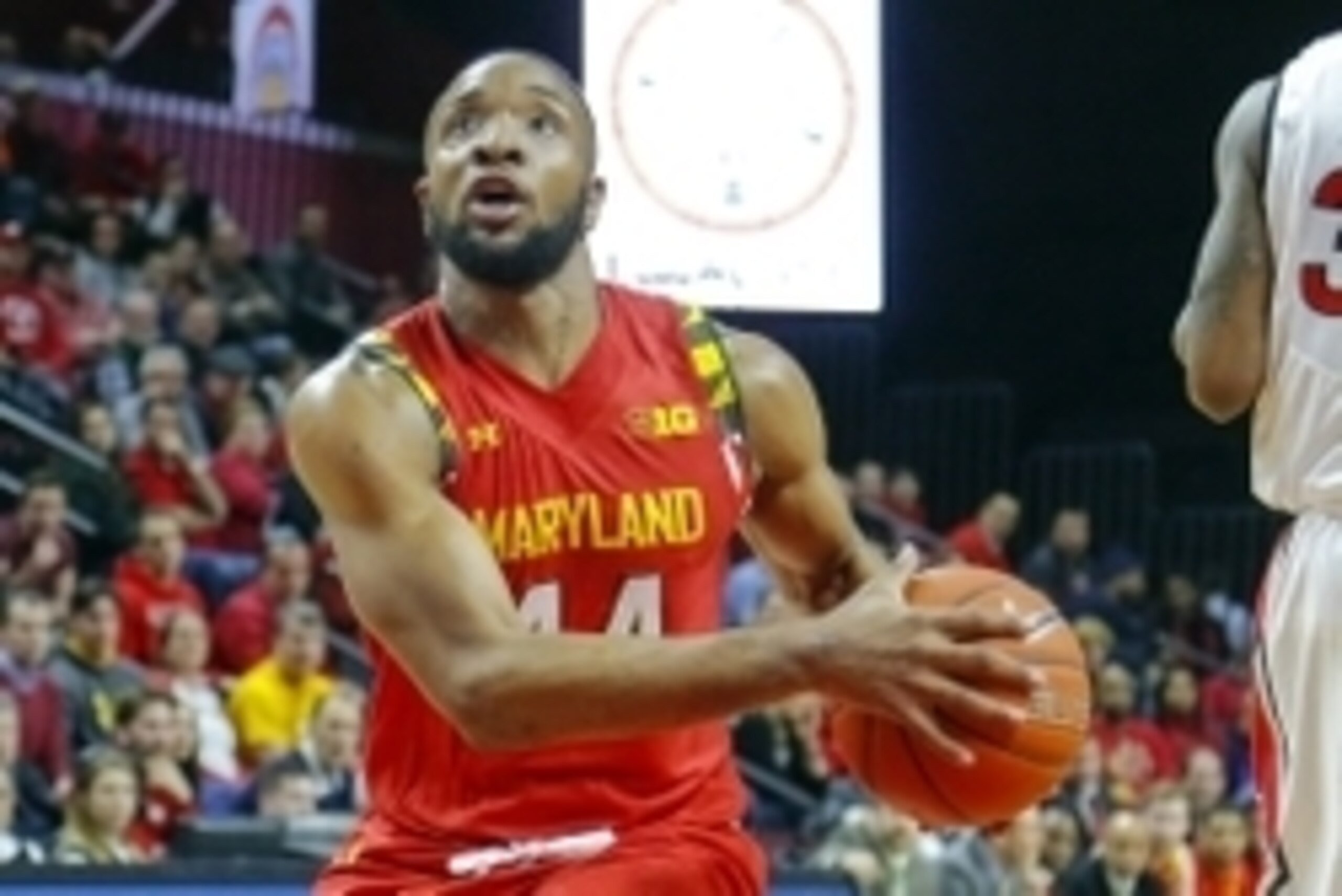
Dez Wells will finish his college career strong, having helped lead Maryland to a Top 10 ranking while averaging 15.4 points and 2.8 assists.
Though undersized at 6'4", Wells blends strength with big-time athleticism. And he can score it in a variety of ways, from drives and pull-ups to post-ups and floaters.
Wells is ultimately at his best attacking the basket or making cuts and slashes off the ball. But he's even made an efficient 23 of 46 threes and shot 80.5 percent from the line.
There could be a role waiting for him in the pros if he's able to continue improving as a spot-up shooter.
52. L.A. Lakers: (via LAC): A.J. Hammons, Purdue, 7'0", C, Junior
52 of 60
A.J. Hammons has been on the radar the past couple of years, but he never really broke through. And though he didn't quite make the big jump many were hoping for as a junior, his 7'0" size, low-post game and rim protection are still worth drafting late.
At 261 pounds, Hammons takes up a ton of space in the paint, where he swats 2.9 shots a game and works with his back to the rim.
He just had a big game against Penn State in the Big Ten tournament, finishing with 23 points, nine boards and four blocks.
Best-case scenario, we're talking about a backup center, but there are a number of teams that could use one this big and overwhelming.
53. Dallas Mavericks: Yogi Ferrell, Indiana, 6'0", PG, Junior
53 of 60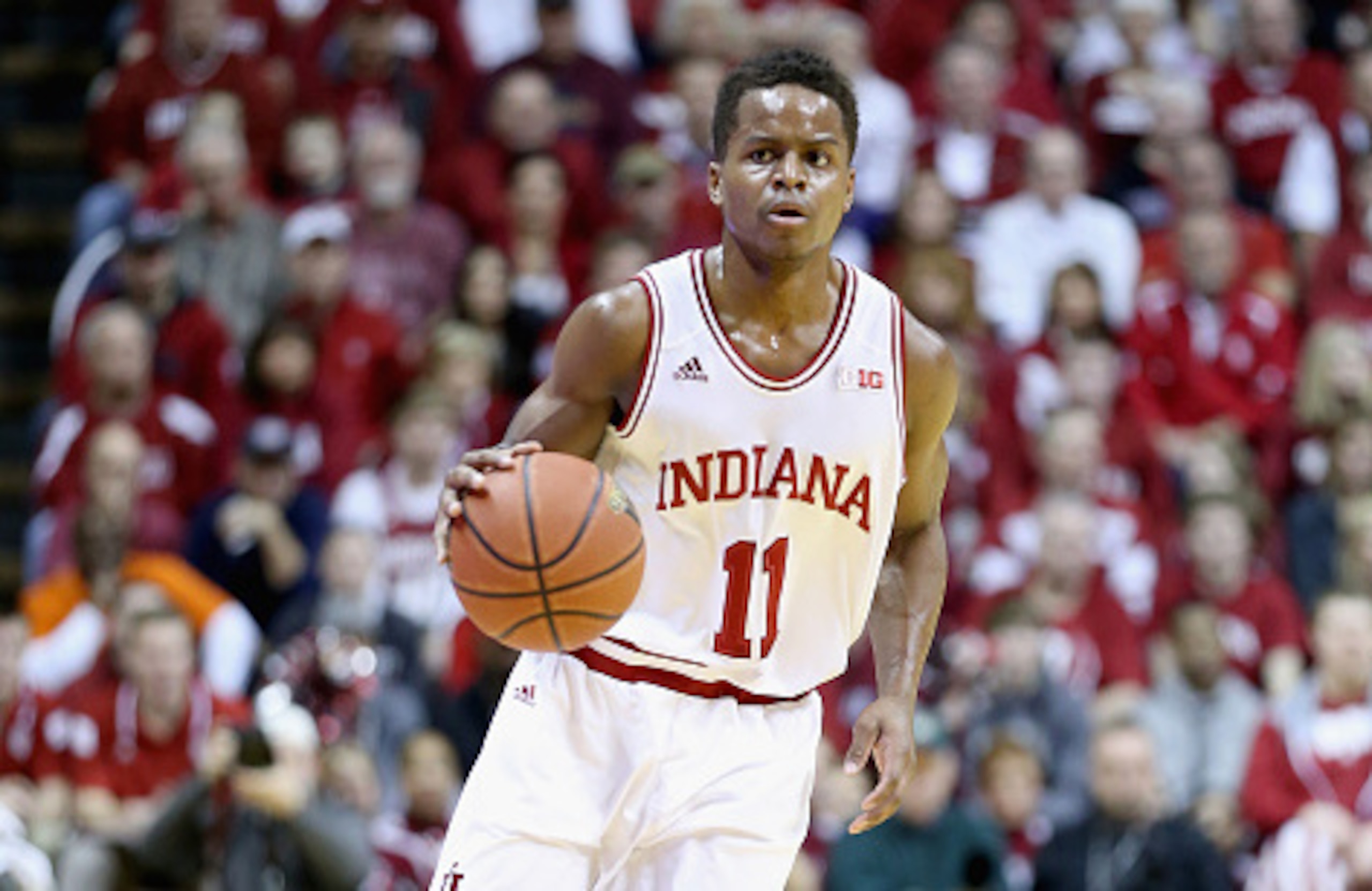
Yogi Ferrell maintained his hot shooting stroke while improving his floor game as a junior, having shot 40.8 percent from three, raised his assist average to 4.9 and turned the ball over 0.7 fewer times per game.
He has to remind you a little bit of Boston Celtics' guard Isaiah Thomas, another extremely quick breakdown scorer who can light it up from outside.
Though he can struggle with decision-making and shot selection, Ferrell's scoring and playmaking ability could ultimately hold value as a spark off Dallas' bench.
54. San Antonio Spurs: Keifer Sykes, Green Bay, 6'0", PG, Senior
54 of 60
A spectacular athlete and big-time leaper, Keifer Sykes had another giant year at Green Bay, averaging 18.8 points and 3.9 assists per game.
His 6'0" size shouldn't be too much of a deterrent for NBA teams seeking out backcourt depth. Sykes makes up for an inch or two in height with terrific hops and a strong floater game around the foul line.
He'll need to start making more jumpers at the pro level, though Sykes did sink a career-high 43 threes as a senior.
He's been tearing up the Horizon League now for three straight years. An ideal option late in the second round, don't be surprised if Sykes puts up big numbers as an NBA D-Leaguer in the near future.
55. Utah Jazz (via Cavaliers): Aaron Harrison, Kentucky, 6'6", SG, Sophomore
55 of 60
Aaron Harrison has all the tools shared by most NBA 2-guards. We're still just waiting for him to put them all together.
At 6'6", he has the body and perimeter-scoring repertoire, which features three-point range and a pull-up game. Harrison has made enough jumpers over his two years at Kentucky to suggest they could eventually start falling more consistently.
And they'll need to, because Harrison isn't much of an off-the-dribble threat.
Still, Harrison should be worth a look late in Round 2 with the hopes his jumper becomes a little more reliable.
56. Philadephia 76ers (via Rockets): Treveon Graham, VCU, 6'6", SG, Senior
56 of 60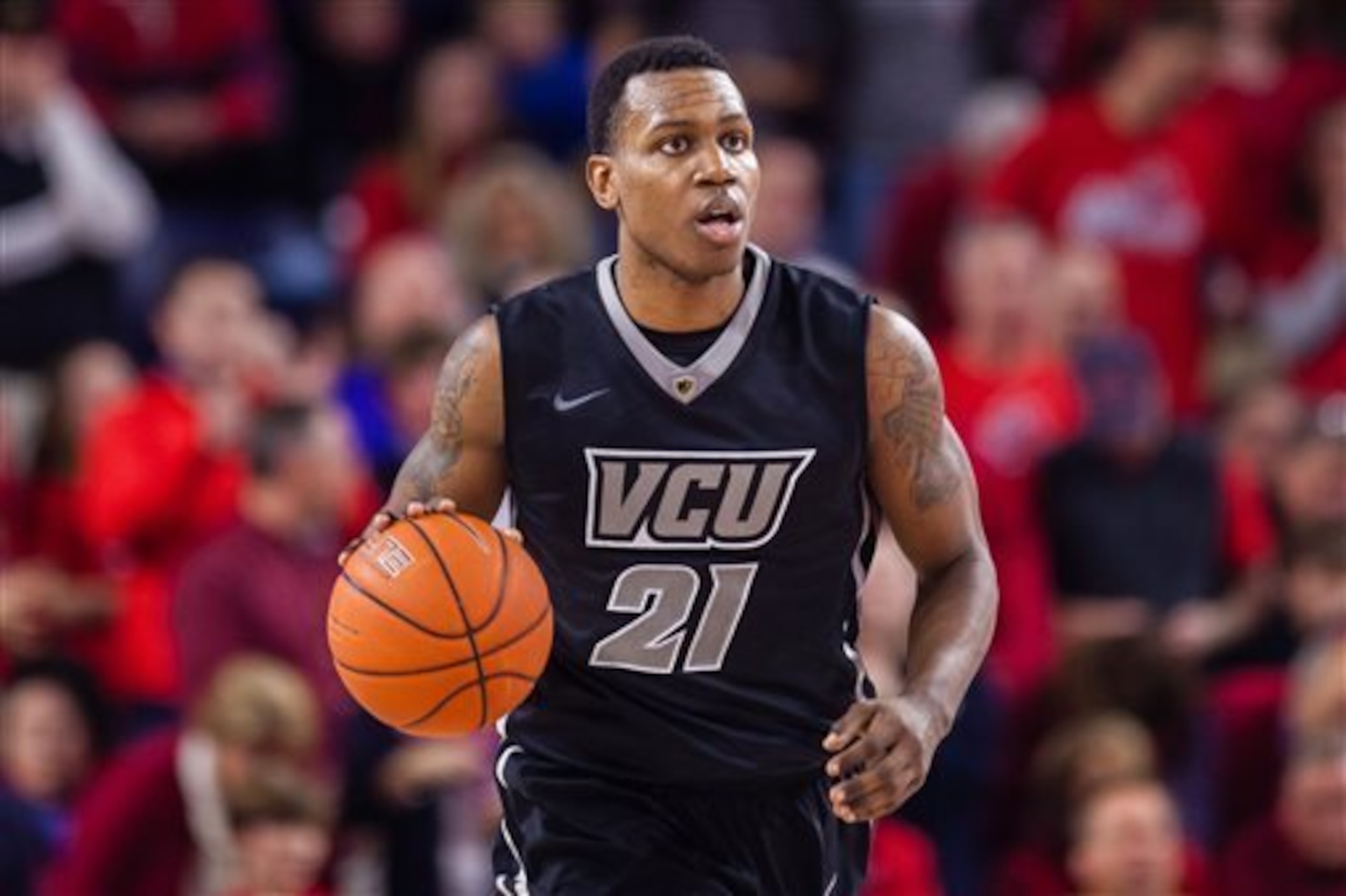
Make that three straight seasons Treveon Graham has averaged at least 15 points and made at least 50 threes.
At 6'6", 220 pounds, he's a strong, confident wing who can create his own jumpers and knock down tough ones. Graham also rebounds well for his position (7.0 per game).
He isn't too light on his feet, whether it's exploding upward or sliding laterally, but Graham's shot-making ability and defensive tools (strong frame, 6'9" wingspan) seem pretty NBA-friendly.
57. Cleveland Cavaliers (via Blazers): Aaron White, Iowa, 6'9", PF, Senior
57 of 60
Aaron White has been on some kind of run lately, having hit the 20-point mark in each of Iowa's five games since February 25.
His best attribute from an NBA standpoint is his ability to score without needing one-on-one dribbles or isolation touches. White picks up buckets off cuts, drives, post-ups, short jumpers, transition opportunities and offensive rebounds.
He's registering an excellent 62.4 percent true shooting percentage, a tribute to his all-around offensive efficiency and shot selection.
With a live motor and tremendous mobility for a 6'9" forward, White has the versatility to handle the ball, bring in 7.5 boards per game and lead the team in scoring.
There is some intriguing glue-guy potential in White for a team like the Cavaliers to look into.
58. New Orleans Pelicans (via Grizzlies): Olivier Hanlan, BC, 6'4", SG, Junior
58 of 60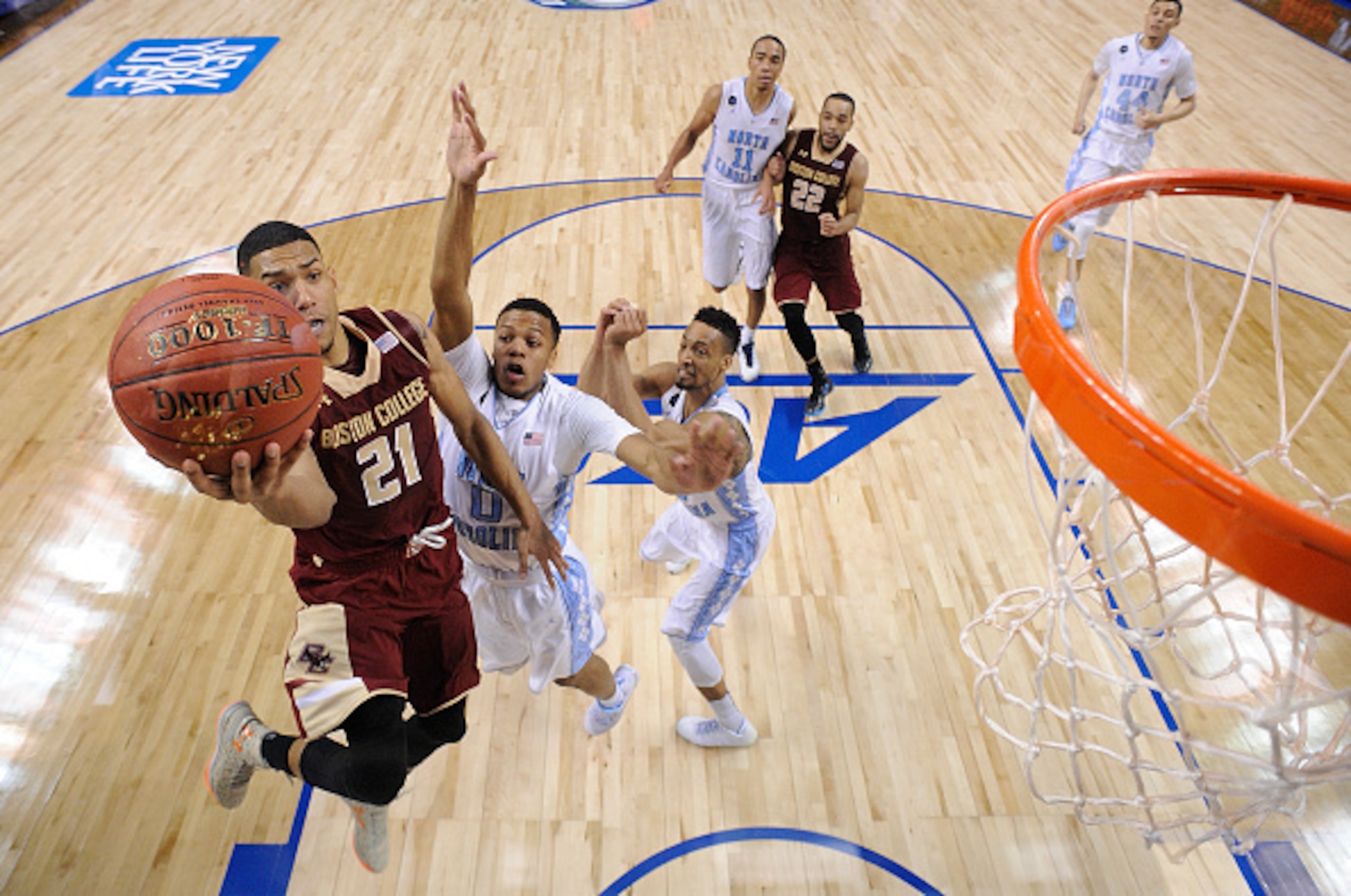
Olivier Hanlan might have played himself into the draft over the past six weeks, having scored 30 against North Carolina, 32 against Miami, 32 against Florida State and 39 against Pittsburgh.
He went for 25 points in the ACC tournament opener in a win over Georgia Tech after nailing the game-winning bucket off a mean step-back jumper.
Hanlan is a skilled offensive guard who can create (career-high 4.2 assists per game) from both backcourt positions.
He's slightly undersized for an NBA 2, but between his first step, handle and shot-making ability, Hanlan is worth looking into as a potential playmaking combo.
59. Milwaukee Bucks (via Hawks): Chasson Randle, Stanford, 6'2", PG, Senior
59 of 60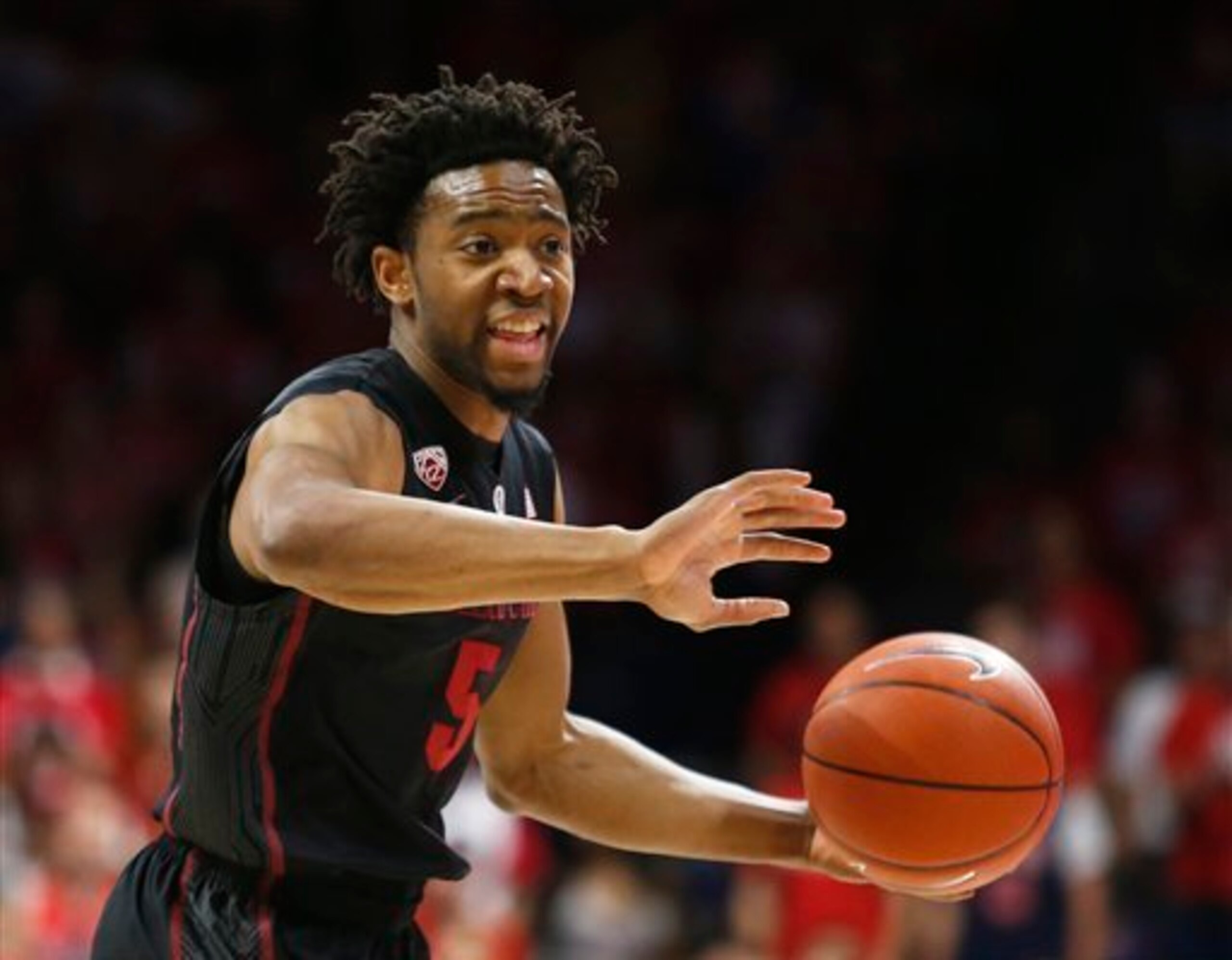
A dangerous perimeter scorer and off-the-dribble weapon, Chasson Randle has averaged at least 18.8 points in each of his past two seasons.
He's knocking down 2.4 threes a game, having shown off some deep range and a threatening pull-up jumper.
Randle also gets to the line (5.7 times per game), where he's made a sensational 163 of 182 free throws (89.6 percent).
Though not a natural facilitator (3.1 assists, 2.1 turnovers), Randle's ability to handle the ball and connect from outside could translate into an offensive specialist role off Milwaukee's bench.
60. Philadelphia 76ers (via GS.): Shawn Long, Louisiana-Lafayette, 6'10", PF, Jr
60 of 60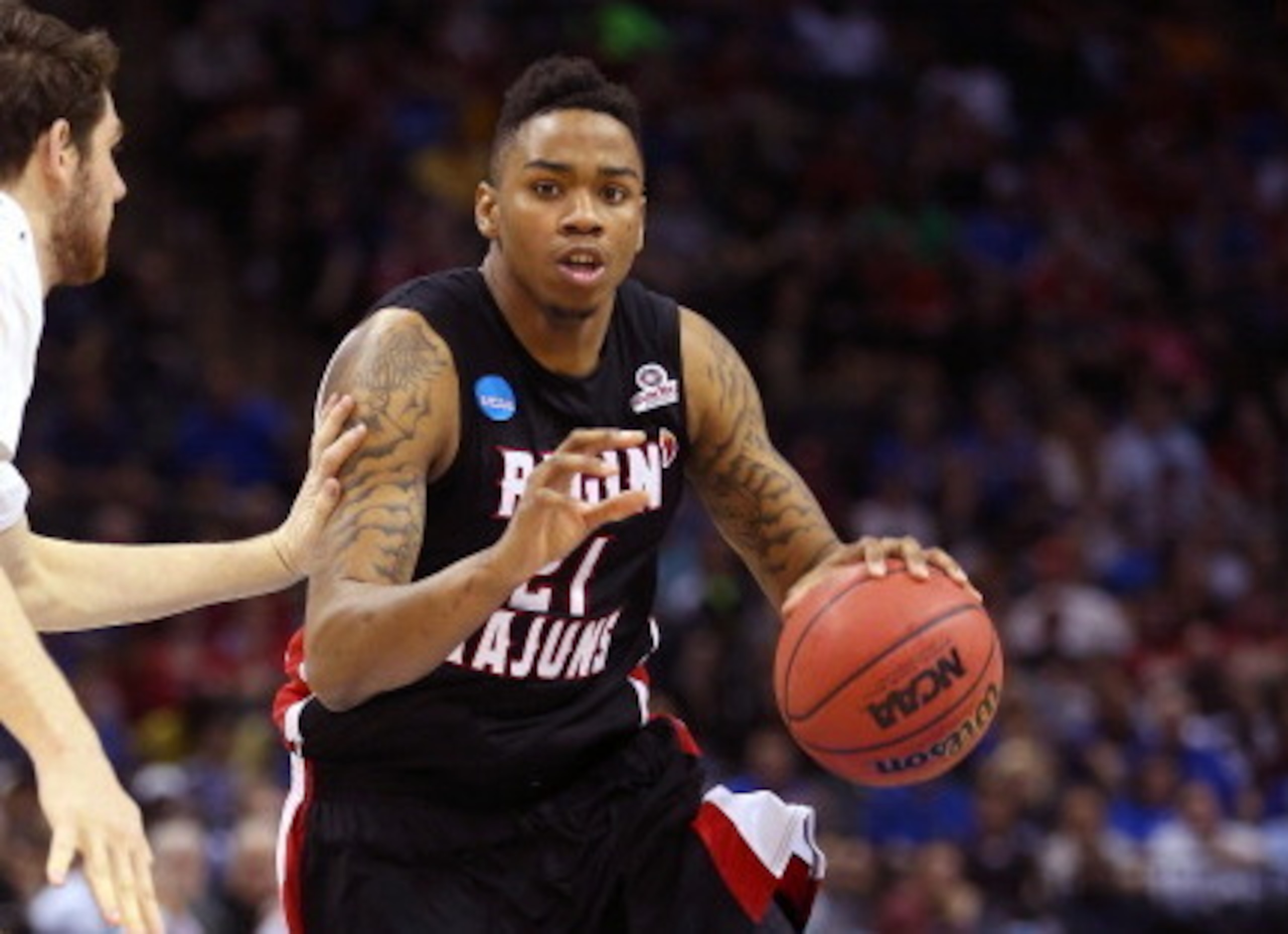
Averaging 16.4 points and 10.3 rebounds, Shawn Long has now put up monster numbers and routine double-doubles in back-to-back years.
This past season, he improved his shot selection, having taken fewer threes and with a better percentage (58.7 percent) of his two-point attempts.
Still, he's hit 92 triples in three years, and though he hasn't been overly consistent, Long still has some pick-and-pop potential.
At 6'9", 245 pounds, he passes the NBA power forward eye test. He'd receive more attention if he were a little more athletic and played competition from the power conferences.
Jonathan Wasserman is the Lead NBA Draft Writer for Bleacher Report. Follow him on Twitter @NBADraftWass


.jpg?w=2560 "Love's Body Already 'Tired'")
.jpg?w=2560 "Tyreek Deal May Come Soon")

.jpg?w=2560 "Ward Nearly Walks Out of Presser ▶️")
.jpg?w=2560 "NFL investigating 2 referees for separate viral exchanges")

