

Even Minus a LeBron, Hawks' Clutch Play Says They Can Make Deep Playoff Run
When the basketball conversations get heated, and an Atlanta Hawks disbeliever seeks to sink a winning parting shot, you should know where that person will go:
You'll hear about the Hawks lacking a go-to guy.
You'll hear that this renders them ill-equipped to advance deep into the playoffs, even if they have home-court advantage, and especially if they encounter a superstar-led squad such as the Cleveland Cavaliers.
TOP NEWS

Buzz: Knicks' KAT Offer Revealed

Buzz: Bron Chopper Part of Deal 🚁

MJ Makes Record-Setting Donation 🙌
You'll hear this even if the Hawks beat the Cavaliers Friday night at Philips Arena, in the last meeting of the teams during this regular season.
You'll hear this if you speak to some inside the Cavaliers organization who, while respectful of what the Hawks have accomplished with an unselfish style, believe that the superiority of their Big Three, and specifically their Big One, will be decisive down the stretch in a series between the squads.
You'll hear it so often that you may begin to accept it instead of challenging it as lazy and flawed analysis, entirely unsupported by recent postseason history.
It is undoubtedly true that the Hawks lack a superstar anywhere approaching LeBron James' ilk—entering Friday's game, James' player efficiency rating of 26.4, while his lowest in eight seasons, still ranks seventh in the NBA, while Al Horford (21.9 for 17th) is the highest-rated Hawk. But the Hawks' Jeff Teague has a higher PER (21.7, 21st) than his point guard counterpart Kyrie Irving (21.3, tied for 25th), and the Hawks' Paul Millsap (19.8, 47th) rates higher than Kevin Love (19.5, tied for 54th).
Yet, even if that weren't so, even if the Hawks' top-talent weren't remotely close to equivalent to that of the Cavaliers, that still wouldn't disqualify Atlanta from seriously competing with Cleveland in the postseason.
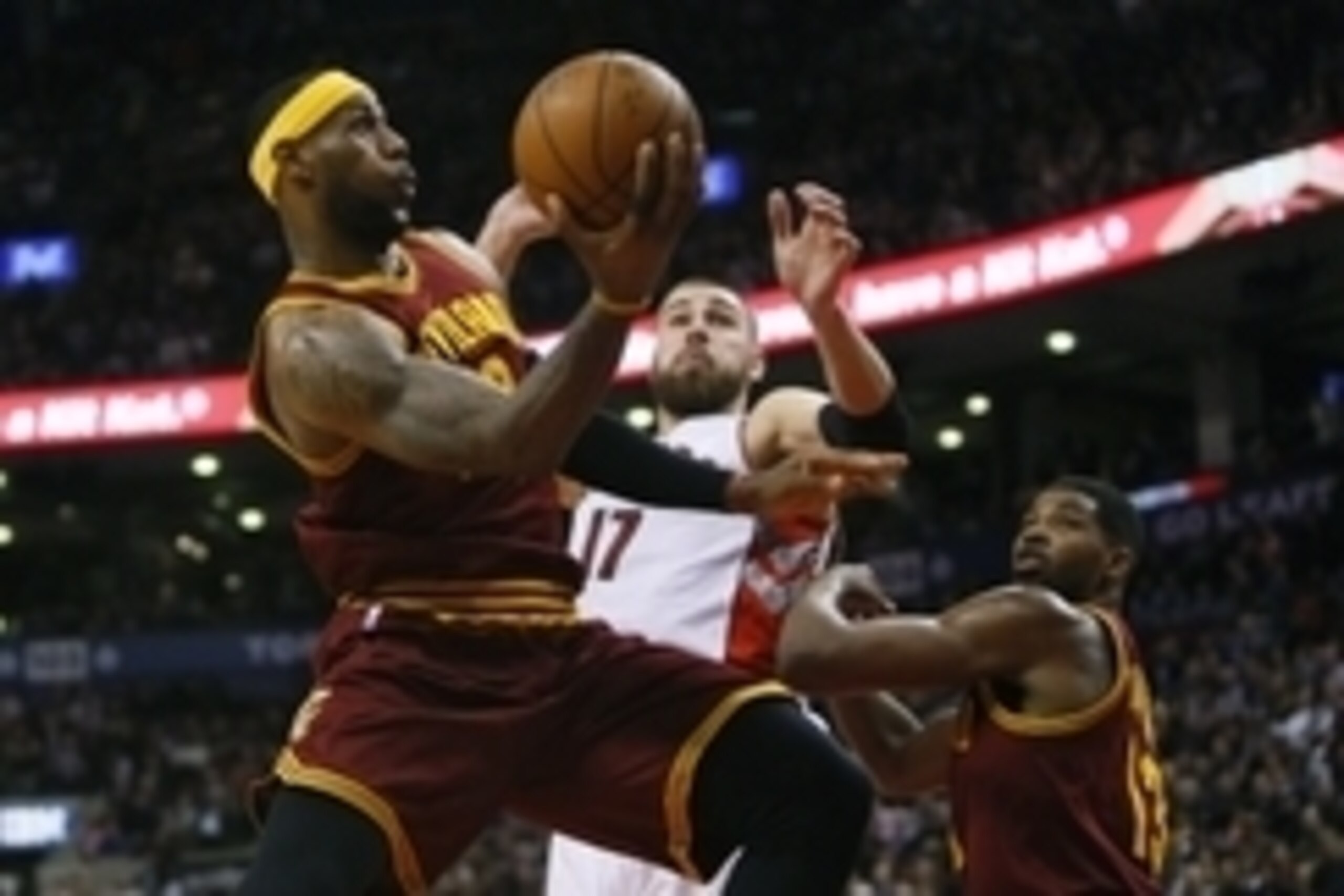
After all, think of the primary reason typically cited for needing a go-to guy: to excel in the clutch. The narrative goes that a team needs to know who can get a basket, whether in the post or off the dribble, when the score is tight and time is short. You hear that wisdom all the time from former players turned analysts, though not nearly as much from working scouts, who tend to see the benefit in diversity, in unpredictability, in precision over isolation, in running clever sets to completion.
The Hawks have done the latter this season, over and over and over, more than any other team, building habits that, for opponents, are hard to handle.
And they have done something, during this regular season, that tends to correlate directly with postseason success:
They have absolutely killed it in the clutch.
According to NBA.com's official stats site, and defined as games with margins of five or fewer points with five or fewer minutes remaining, the Hawks have the highest winning percentage (24-8 for .750) in games that have required "clutch" play, just ahead of Memphis (25-9, .735). The Cavaliers in such games are just 14-12, including 12-7 in the games James has played.
The Hawks are first in field-goal percentage, at 49.7 percent, while the Cavaliers are 16th at 39.9. The Hawks are second in offensive rating (121.6 points per 100 possessions), just behind the Mavericks (123.9). And while the Cavaliers are fourth (117.3), the difference in the teams defensively (Hawks sixth, Cavaliers 24th) separates them significantly in terms of net rating (Hawks are third at plus-27.2 and Cavaliers are eighth at plus-6.4).
And, of course, defense matters if the teams are playing each other; facing Atlanta in the clutch would likely make it somewhat more difficult for Cleveland, while facing Cleveland would conceivably make it slightly easier for Atlanta.
How have the Hawks done this?
As you'd expect. Collectively.
Check out the Cavaliers: James has scored 86 points in 19 clutch appearances on a healthy 47.1 percent shooting. Irving is next with 48 points in 22 appearances on more sickly 32.5 percent shooting, followed by Love with just 23 points in 21 appearances (compared to 21 points in 13 appearances for Timofey Mozgov) on 31.6 percent shooting.
Meanwhile, the Hawks' four All-Stars have scored 39 (Millsap), 41 (Horford), 52 (Korver) and 64 (Teague) points in those situations, taking between 16 and 40 shots—compared to James having 51 in many fewer games—all while getting 50-of-54 free-throw shooting from the combination of Korver and Teague.
The Hawks spread the wealth, protect the ball (no Atlanta player has more than five turnovers in the clutch) and knock down their shots, whether from the line or from deep, with Korver making 8-of-13 from three-point range.
That's proven a winning formula in the regular season.
What about the playoffs?
Recent history suggests they will enjoy similar success.
Last regular season, the ball movement-based Spurs were first in clutch winning percentage (.733), first in clutch offensive rating (123.5) and second in net rating (19.1 to Memphis' 26.1), significantly superior to the James-reliant Heat (.558 win percentage) in those categories. As it turned out, they routed the Heat in the final three games of the NBA Finals, so they didn't need to call much upon their crunch-time acumen. Yet, they likely would have executed better than they did down the stretch of the 2013 Finals, when they were coming off a solid clutch season (28-15, .651) but were beaten by a Heat team that had been devastating in the clutch (league-best 32-8 record and .800 winning percentage, league-best 120.2 offensive rating, league-best 33.0 net rating).
Truth be told, clutch play isn't a perfect indicator of success. The Lakers were the best clutch team during the 2011-12 regular season (31-12 record, 117.8 offensive rating, 22.5 net rating) and didn't get past the second round, losing to a Thunder team that was 18-14 with an 11th-best 5.0 net rating in the regular season.

But the best recent parallel to this Hawks team would be the 2010-11 Dallas Mavericks, who weren't widely viewed as a serious threat after finishing third in the West, but certainly should have been. They had a front-line star in Dirk Nowitzki but, otherwise, a lot of their regular-season clutch numbers resembled those of 2014-15 Atlanta: 34-16 record, first in offensive rating (124.7), runaway first in net rating (29.5). By comparison, their eventual Finals opponent, James' Heat, was second in the NBA in clutch offensive rating (118.2) but just ninth in net rating (8.5) and 22-20 in those games.
Could the Mavericks, with Nowitzki at the forefront but using Rick Carlisle's motion offense to get others quality shots, sustain their success in the postseason?
They did more than that.
They won 11 of 16 playoff games that required clutch minutes, with a 141.4 offensive rating, 70.2 defensive rating and 71.1 net rating.
To put it more simply, they scored 137 points and allowed just 66.
Atlanta, during this regular season, has scored 255 points and allowed just 172, while Cleveland has scored 215 and allowed 185.
So yes, the Cavaliers have a go-to guy.

But they have had him before, and it hasn't been enough to get out of the East. They had the best net ratings (26.4, 39.9, 24.2) and best three-year record (92-44) in the clutch in James' last three seasons with them, and didn't get to the NBA Finals in any of the corresponding postseasons.
They might this time, even while struggling more so far down the stretch than they did then.
They might even overcome Atlanta.
Even so, we need to move past some faulty assumptions about what the Hawks cannot do, especially when we've been seeing them do it, just fine, all season.
The go-to thing has gone too far.
Ethan Skolnick covers the NBA for Bleacher Report. Follow him on Twitter @EthanJSkolnick.




.jpg?w=2560 "Love's Body Already 'Tired'")

.jpg?w=2560 "Tyreek Deal May Come Soon")

.jpg?w=2560 "Ward Nearly Walks Out of Presser ▶️")