

New York Rangers Going All-in for This Season with Trade for Keith Yandle
Four years from now, the New York Rangers will almost certainly regret this trade.
All that matters to the Rangers, however, is how they feel about the trade four months from now.
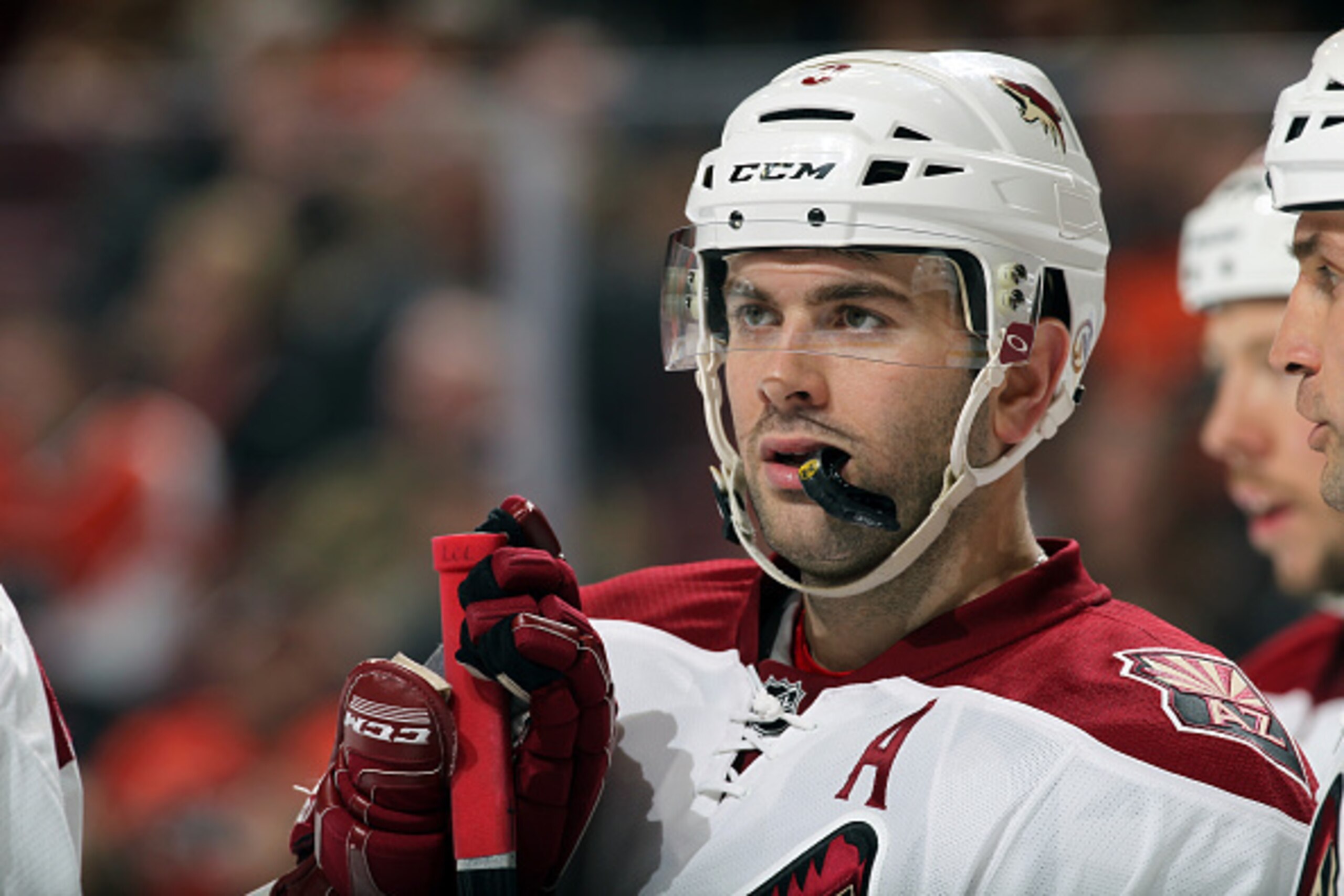
According to Nick Kypreos of Sportsnet, the Rangers, who were already an all-in team, took out a line of credit with the casino Sunday, acquiring offensive defenseman Keith Yandle and a 2015 fourth-round pick from the Arizona Coyotes in exchange for Anthony Duclair, John Moore, a 2016 first-round pick and a 2015 second-round pick. The Coyotes will pick up half of Yandle's contract, which has a $5.25 million cap hit through 2015-16.
In a way, the Rangers have been shoving chips into the middle of the table since the 2011-12 offseason, when they acquired Rick Nash from the Columbus Blue Jackets after reaching the Eastern Conference Final. Since that move, they swapped Ryan Callahan for Martin St. Louis and allowed Anton Stralman to leave in favor of Dan Boyle, and now they've added Yandle, who is just 28 years old, in place of Moore and Duclair.
The draft is now an afterthought in New York, as they have traded their first-round picks in 2013, 2014, 2015 and 2016.
In May 2012, the Rangers' average age was 26.0, second-youngest in the league; before this trade, they had the fourth-oldest team at 28.0, according to NHL Numbers.
Anthony Duclair is a 20- to 25-goal power forward waiting to happen, and Moore could develop with consistent playing time with the Coyotes. The Rangers are living in the now, like your cool uncle who doesn't have a permanent address because he's backpacking through Europe and sleeping in hostels.
Does Yandle make the Rangers better? Sure. Does Yandle make the Rangers, who fell inches short of a Stanley Cup last season, a championship team?
Probably not. At least, not without another move between now and Monday's trade deadline.
The Rangers are 38-17-6 with 82 points in 61 games, good for second place in the Metropolitan and third in the East. Based on points percentage, the Rangers (.672) have the fifth-best mark in the league. Through 61 games last season, the Rangers were 33-25-3 with 69 points, a nice number, but not as good as 82 points.
So this year's Rangers team is better, right?
Maybe not.
Thanks to the lovely, search-friendly features at War-on-Ice, here's a comparison of the Rangers' first 61 games over the past two seasons.
| 2013-14 | 52.0 | 99.4 | 6.6 | 92.8 |
| 2014-15 | 50.5 | 101.8 | 9.1 | 92.7 |
Even with Henrik Lundqvist out with a injury stemming from absorbing a wrist shot in the throat, the team's even-strength save percentage with Cam Talbot in net hasn't suffered all that much. Despite the team not doing anywhere near as well in the shot-attempt battle this season, they are flourishing with an unreasonably high shooting percentage.
The 2014-15 Rangers have been winning of late—8-1-1 in their past 10 games, all without Lundqvist—even though they've been playing a shaky, uneven brand of hockey.
The Rangers' PDO over the past 10 games is 103.9, and they have allowed 31 shots per game over that time. They've been defensively porous but have a five-on-five shooting percentage of 11.7 over that time, which largely accounts for their surge up the standings.
Yandle, at least to some extent, should help steady the Rangers on the back end.
The biggest problem the Rangers have had on defense this season, aside from injuries, is the lack of a sixth defenseman, as Moore and Matt Hunwick have rotated in and out of the lineup. Moore and Hunwick have quality underlying numbers in this role, but they were prone to the catastrophic mistake that either led to a bailout by Lundqvist or a goal.
Yandle arrives in New York with a 48.9 percent Fenwick, slightly better than the Coyotes' overall number (48.7) this season. He played big minutes (23:54) in Arizona, but generally wasn't a No. 1 defenseman in the sense of his matchups, which usually involved second-tier opponents, not a steady diet of top lines. The ice time should dip in New York, but his role shouldn't change.
Here's the Rangers' blue line with Yandle in the fold, and it's pretty good.
| Ryan McDonagh | Dan Girardi |
| Keith Yandle | Kevin Klein |
| Marc Staal | Dan Boyle |
| Matt Hunwick |
There are few defensemen as offensively gifted as Yandle, who is tied for 10th in defensemen scoring this season with 41 points (four goals), but only 14 have come at five-on-five, which is tied for 44th among defensemen with Brayden McNabb of the Los Angeles Kings and Jason Demers of the Dallas Stars.
Since 2009-10, according to Hockey-Reference, only Erik Karlsson, Duncan Keith and Shea Weber have more points among defensemen than Yandle.
Yandle's true impact should come on the power play, as he leads all defensemen with 23 five-on-four points.
Then again, the Rangers' power play was already good enough.
Some may portray the addition of Yandle as an indictment of Dan Boyle, but he's averaging a power-play point every 17 minutes with the Rangers after averaging a point every 16 minutes with the Sharks last season. The Rangers' power play has gone from 15th (18.2 percent) to 11th (18.8 percent) with Boyle missing about one-third of the season with injuries.
If the Rangers are to get back to the Stanley Cup Final, they need to get better at five-on-five. Adding Yandle helps, but it's probably not enough unless the Rangers bolster their bottom-six (i.e., a third-line center, someone other than Tanner Glass on the fourth line) and get another outstanding two-month playoff performance from Lundqvist.
(Update: The Rangers have already bolstered their bottom-six with a likely Glass replacement, acquiring James Sheppard from the Sharks for a fourth-round pick, according to TSN's Bob McKenzie.)
All statistics via NHL.com and Stats.HockeyAnalysis.com. Cap information via Spotrac.
.jpg?w=2560 "NHL Trade Grades Connor Hellebuyck")
.jpg?w=2560 "Mahomes Told Teammate to Leave Meeting")
.jpg?w=2560 "🚨 Week 8 AP Top 25 Poll")

.jpg?w=2560 "Baker Gets Glove From Rays 🧤")
.jpg?w=2560 "5 Teams Eyeing Jonathan Taylor")

.jpg?w=2560 "Steelers Roll Saints in Paris")
.jpg?w=2560 "NFL investigating Eagles")
