

Solving the Percy Harvin Riddle Isn't Worth the Jets' Time or Money
New York Jets wide receiver Percy Harvin is everything—and often all at once. He’s also nothing all at once, too.
Harvin has many football titles attached to his name. They include kick returner, receiver and sometimes running back. He’s the eldest member of a small group: hybrid offensive weapons who are confusing and exciting, and explosive then frustrating.
There’s a magnetic pull from the NFL’s Harvins, and especially the leader himself. Harvin’s 87-yard return touchdown to open the second half of Super Bowl XLVIII is still fresh, and there are fond, warm memories of his 773 total yards from scrimmage over only nine games in 2012 during an injury-shortened season.
.jpg?w=2560 "Rams Raiders Football")

.jpg?w=2560 "Steelers Saints Football")
His younger, space-craving disciples are the Vikings’ Cordarrelle Patterson and the Rams’ Tavon Austin. All three have wrestled with the great explosive-exasperating divide. Belief in the former quality is what led to the Seattle Seahawks' giving Harvin a six-year contract worth $67 million, per Pro Football Talk's Mike Florio.
That contract inherited by the Jets is now set to account for a cap hit of $10.5 million in 2015, per Spotrac, the eighth-highest among wide receivers. Go ahead and get your laughs out, because Harvin's being in the top 10 after recording only 685 total yards split between the Jets and Seahawks in 2014 deserves a hearty chuckle.
The Jets are facing a familiar riddle with Harvin, one the Seahawks dealt with by making their injury-prone cap anchor another team’s problem. What’s the solution when versatility doesn’t lead to consistent effectiveness?
We don’t have one yet for Harvin, which is why he’ll likely need to find his fourth team in four years.
The Jets aren’t short on cap space and currently have enough of it to purchase as many Percy Harvins as they desire. New general manager Mike Maccagnan has roughly $45.5 million to work with, according to Spotrac.
But the basic principle of salary-cap management is making sure every slice of the budget is allocated smartly to maximize returns. And sitting idly by while drastically overpaying for Harvin does the exact opposite.
Harvin has four years and a weep-inducing $41.5 million left on his contract. But for Maccagnan, relieving himself of a massive money boulder comes with no penalty. There’s zero dead money attached to Harvin that will clog the Jets’ budget if he's released.
Restructuring would only delay the inevitable. Instead, having even more cap space freed by Harvin’s departure would allow the Jets to aggressively attack during an upcoming free agency period that will be rich with wide receiver talent.
There’s also added draft incentive for the Jets to move on from Harvin. As ESPN.com’s Rich Cimini notes, the deadline to make a Harvin decision is effectively March 19, when the Jets would have to give Seattle a fourth-round pick if he’s still on the roster. Alternatively, if he’s cut, that pick becomes a sixth-rounder.
For the Seahawks, any compensation is better than what Harvin contributed.
The likely ending here is one that could greet Patterson and Austin in the future: giving up when hope turns into too much frustration.
To their credit, the Jets and former offensive coordinator Marty Mornhinweg tried to utilize Harvin in space. The 26-year-old was targeted 22 times over just his first two games with the Jets. That focus led to 129 yards on 11 receptions during a Week 9 loss to the Kansas City Chiefs.
The old and now nearly vintage Harvin we saw with the Minnesota Vikings returned briefly, and not because of sheer volume. No, Harvin collected yardage through location and the depth of his targets.
Unlike in Seattle, there was a dedicated effort made to give Harvin intermediate looks and an opportunity to break free after the catch. A crossing route during the fourth quarter against the Chiefs was a prime example.
Jets quarterback Matt Simms lined up in shotgun with four receivers spread out. Harvin waited in the slot to his left, and after the snap, he ran a shallow crossing route about four yards deep.
Meanwhile, the two receivers who were to Simms’ right ran vertically against man coverage, clearing out plenty of wide open green grass for Harvin.

Harvin caught a pass in full stride while gliding across the middle. That’s the goal with Harvin and any receiver wired with the same circuitry wherever football players are manufactured: Get him in an area where he can transform into a punt returner.
Which is exactly what he did on this play, making one defender miss and then accelerating forward for a gain of 22 yards.
The difficulty with hybrid receivers is that while the end game may often lead to a lot of excited fist-pumping and table-pounding, getting there with any sort of consistency is challenging. Sure, Harvin excels in space, but engineering an entire offense around the unique needs of a single player can become a one-dimensional existence.
Which is why, again to their credit, the Jets attempted to release Harvin deep a little more often too.
Over five games with the Seahawks, he wasn’t targeted once on a ball that traveled 20-plus yards through the air. Then during eight games, he received nine such targets from the Jets, per Pro Football Focus.
Going back to the Chiefs loss once more, one of those deep heaves relied on Harvin to fight through traffic and quality coverage to secure a highly contested ball. He did that and then still kept his feet in bounds for a 42-yard gain.
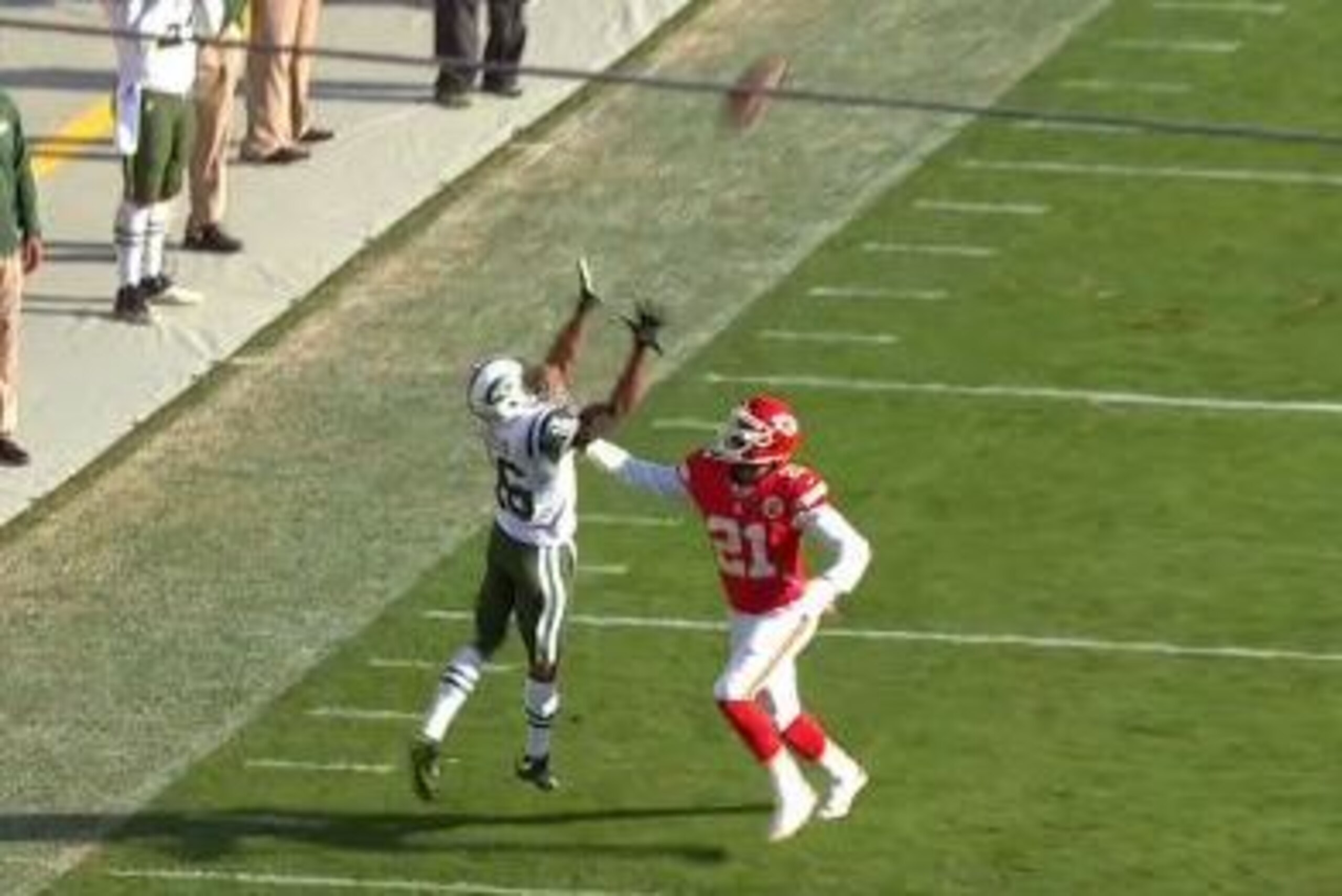
Another challenge with Harvin is that his slight frame (5’11” and 184 lbs) isn't suited for winning those grappling battles regularly. He needs to win cleanly with his speed, or he won’t win at all. Which is why space becomes a necessity.
Once again we return to the limitations that come with trying to intricately plug one receiver into a specific environment often. A tightly structured offense is also a limited offense, which we’ve seen during the Patterson experiment in Minnesota.
When Norv Turner was first hired as the Vikings’ new offensive coordinator, he practically slobbered on himself while saying 10 plays would be installed for Patterson immediately, per Gregg Rosenthal of NFL.com. Patterson quickly went boom in Week 1 with 109 rushing yards, highlighted by a 67-yard touchdown.
Then Patterson’s poor route running and status as more athlete than receiver led to a grand total of 392 yards after Week 1 and eventually a late-season benching.
In St. Louis, the Rams are still trying to figure out how to use the even more diminutive Austin (5’8” and 176 lbs).
His 4.34 speed in the 40-yard dash prompted to an unhealthy infatuation with Austin’s burst, which becomes useless without a dedication to creating space. Austin floundered in his second season, averaging a tiny 7.8 receiving yards per game as former Rams offensive coordinator Brian Schottenheimer’s imagination reached new lowly depths. He featured Austin in only 57.4 percent of the Rams’ offensive snaps, according to Pro Football Focus.
But the problem lies more with scheming for a very specific brand of talent than with the offensive approaches that have failed Harvin, Austin and Patterson in separate locations and under separate coaching staffs.
The riddle of Harvin’s career continues to be booming and busting, with no predictable order to the madness. His presence took the Seahawks away from a powerful read-option rushing attack that forms their offensive identity.
And with the Jets there was excitement followed by misery.
| Week 9 (@KC) | 137 |
| Week 14 (@MIN) | 127 |
| All other six Jets games combined | 196 |
The key for any future Harvin employer if he is indeed released will be to replicate his two years of peak form with the Vikings—or something close to it.
Between 2011 and 2012, Harvin totaled 2,085 yards from scrimmage at a pace of 9.3 per touch. That stretch also included 12 touchdowns, and it came in an offense that didn’t lean heavily on read-option running as its backbone.
Harvin will enter his age 27 season in 2015, though, unofficially his body may be a little older after an endless struggle to stay in one working piece. The open market will reduce his paycheck to a more tolerable level with a cap hit that isn’t comically above the likes of A.J. Green and Julio Jones, as it is now.
That’s when Harvin will become an acceptable risk for another team. Beyond just his cost, too, with a gamble on his brittle body easier to justify after he’s missed 25 games over the past three seasons.
For the Seahawks, he was an inconvenience, and for the Jets, brief promise was sprinkled throughout the 2014 season. But eventually regret should prevail, with another team deciding that finding a rare fit for a rare talent is too difficult.
.jpg?w=2560 "Cowboys Packers Football")




.jpg?w=2560 "🚨 Week 8 AP Top 25 Poll")
.jpg?w=2560 "Fantasy Waiver Wire Stars 🤩")