

Why Real Madrid Boss Carlo Ancelotti Should Ditch the 4-3-3 in Big Games
Carlo Ancelotti was unable to provide much of a defence for Real Madrid’s performance during their heavy 4-0 defeat to city rivals Atletico Madrid on Saturday afternoon.
Indeed, he admitted in his post-match press conference, as per AS, that Atletico had triumphed over his side in every department.
"Fight, intensity, play, everything. ... We are very sorry. We clearly have to change this attitude. ... We failed in everything. We were second to every ball. We did not get into the match. There wasn’t one player who had a good game.
"
Yet, while it would be fair to say that Atletico were superior in all of the aspects of the game Ancelotti mentioned, he refused to acknowledge that his decision to field three forwards had played a part in Madrid’s downfall.
TOP NEWS

Final Men's Ballon d'Or Rankings 📊
Highlights and Viral Moments 🍿

J-Dub Suffers Gruesome Injury
There has been much debate in recent weeks about whether a 4-4-2 or a 4-3-3, with Cristiano Ronaldo, Gareth Bale and Karim Benzema up front, represents Madrid’s best formation.
AS authors Marco Ruiz and Carlos Forjanes co-penned an article in the build-up to the derby extolling the benefits of the 4-4-2, noting that Madrid enjoyed better control of the ball, took more shots at goal and scored more often when utilising that formation in comparison to the 4-3-3.
Per Diego Torres of El Pais (in Spanish), Sergio Ramos admitted after the win at home to Rayo Vallecano last November that the 4-4-2 formation provides Madrid with better defensive cover and more control of possession.
And Saturday’s performance certainly suggested that in matches against high-quality opposition, the 4-3-3 may not be the best option for Ancelotti.
Madrid were of course missing some key players—Pepe, Sergio Ramos, James Rodriguez, Marcelo and Luka Modric—and it always pays to be wary of making snap judgements based on a single match. But this isn’t the first time Ancelotti’s side have been defeated by Atletico this season. Nor was it the first time an opposition team has taken advantage of the weaknesses of the 4-3-3.

From the first day of the season, teams have looked to exploit the space down the Madrid flanks that opens up due to the wide forwards' reluctance to track back.
Ronaldo was awful on Saturday, but his generally outstanding goal contribution warrants him being largely excused of defensive duties. It is, though, very hard to form a well-balanced team when you have a player on the other flank, in Bale, also providing little cover for his full-back.
The victory away to Villarreal in late September should have acted as a warning sign. Villarreal were superb during the first half, regularly getting themselves into good positions out wide against Madrid’s outnumbered and overworked full-backs.
It was only a mix of solid defensive work from Ramos and Raphael Varane and some wasteful finishing from their hosts that enabled Madrid to escape without conceding.
Valencia employed similar tactics in their 2-1 win at home to Madrid at the start of January. And on Saturday, Atletico ruthlessly took advantage of this deficiency, with their two forwards frequently pulling out to the flanks to create overloads in wide areas.

Per ESPN FC, Simeone highlighted the excellent combination play of Antoine Griezmann, Arda Turan and Juanfran down the Atletico right in his post-match press conference. But they also made regular progress down the other side of the pitch, with Mario Mandzukic linking well with Saul Niguez and the left-back Guilherme Siqueira.
All four of Atletico’s goals came from crosses into the area following neat interchanges that had advanced one of their players in behind the Madrid defence out wide.
At the other end of the pitch, Ancelotti’s side mustered just a single shot on target, per FourFourTwo Stats Zone.
Valencia and Atletico both took slightly different approaches to doing so but were both able to largely subdue Madrid in their two league defeats since the turn of the year.
Valencia focused their attention on Madrid’s forwards, with their wide centre-backs man-to-man marking while Nicolas Otamendi and defensive midfielder Enzo Perez patrolled the centre. Atletico, in contrast, shut down the midfield area, doing a superb job of starving Madrid’s front three of regular service.
The end result was the same on both occasions: Madrid were made to look like a broken team.
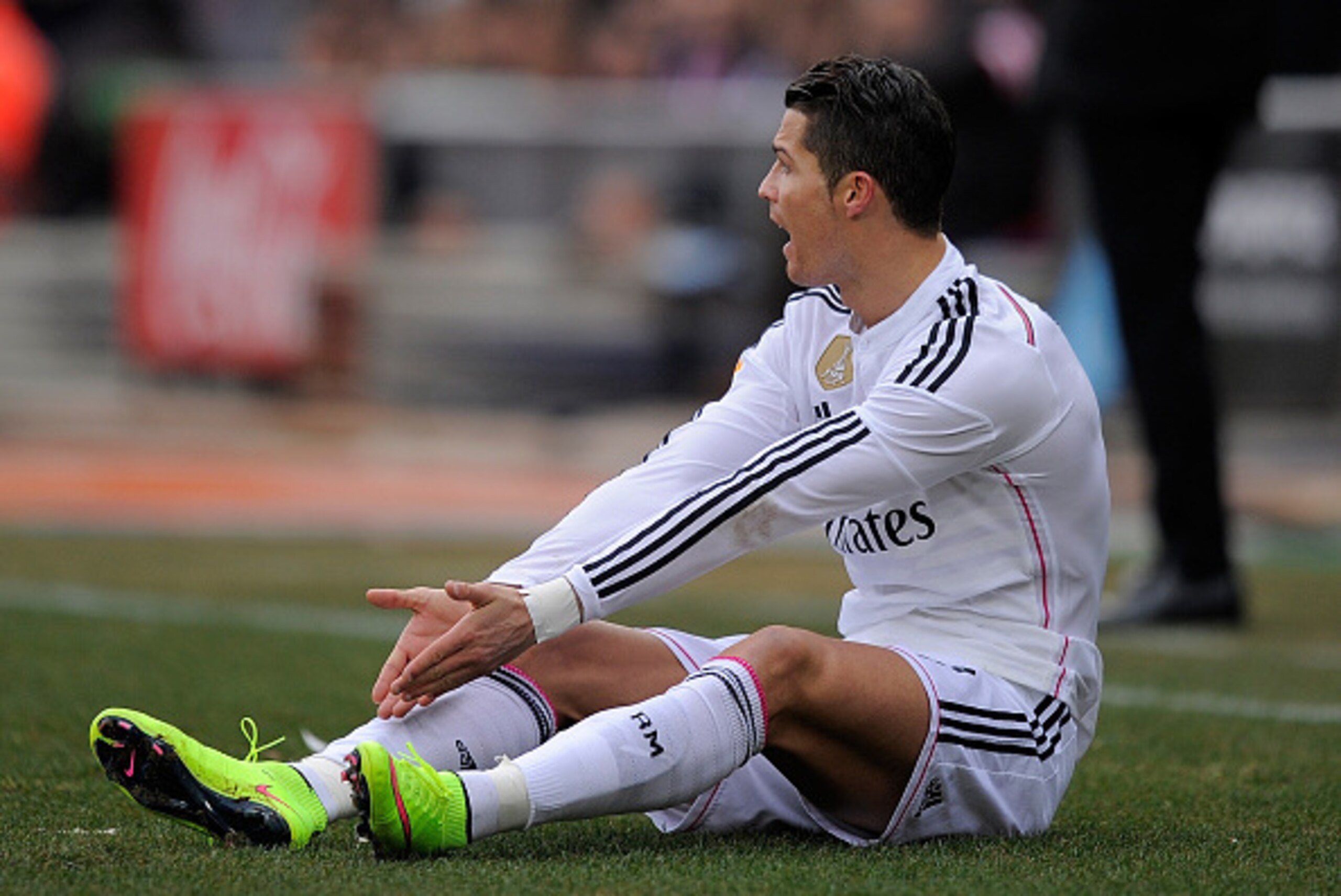
It may work sufficiently against the majority of their Liga opponents, but in the big matches, the 4-3-3 provides Madrid with control of neither the ball nor space.
Contrast the smart and assured performances in their impressive back-to-back victories away to Liverpool and at home to Barcelona earlier this season—matches in which they used a 4-4-2 formation—with the chaotic and fraught defeats to Valencia and Atletico in the early part of 2015.
If you are well organised, strong and attentive in your defending and work the ball forward quickly and intelligently to take advantage of their defensive weak points, it is possible to get the better of this Madrid side.
Ancelotti’s hands were somewhat tied on Saturday. With neither Modric nor Rodriguez at his disposal, it would have been hard for him to form a midfield four with similar attributes to the Rodriguez-Modric-Isco-Toni Kroos quartet that was so impressive earlier this season.
With a number of his regular starters unavailable, he could also argue that it would have made little sense to leave one of Bale, Benzema or Ronaldo sitting on the bench.
Yet, in the most difficult matches to come, both domestically and in Europe, between now and the end of the season, Ancelotti needs to be brave enough to consign one of them to a watching brief. The 4-4-2 looks to offer far better balance and control against high-quality opposition.

.jpg?w=2560 "Rams Raiders Football")




.jpg?w=2560 "Rodgers Iced Out on Plane 💎")

.jpg?w=2560 "🚨 Week 8 AP Top 25 Poll")