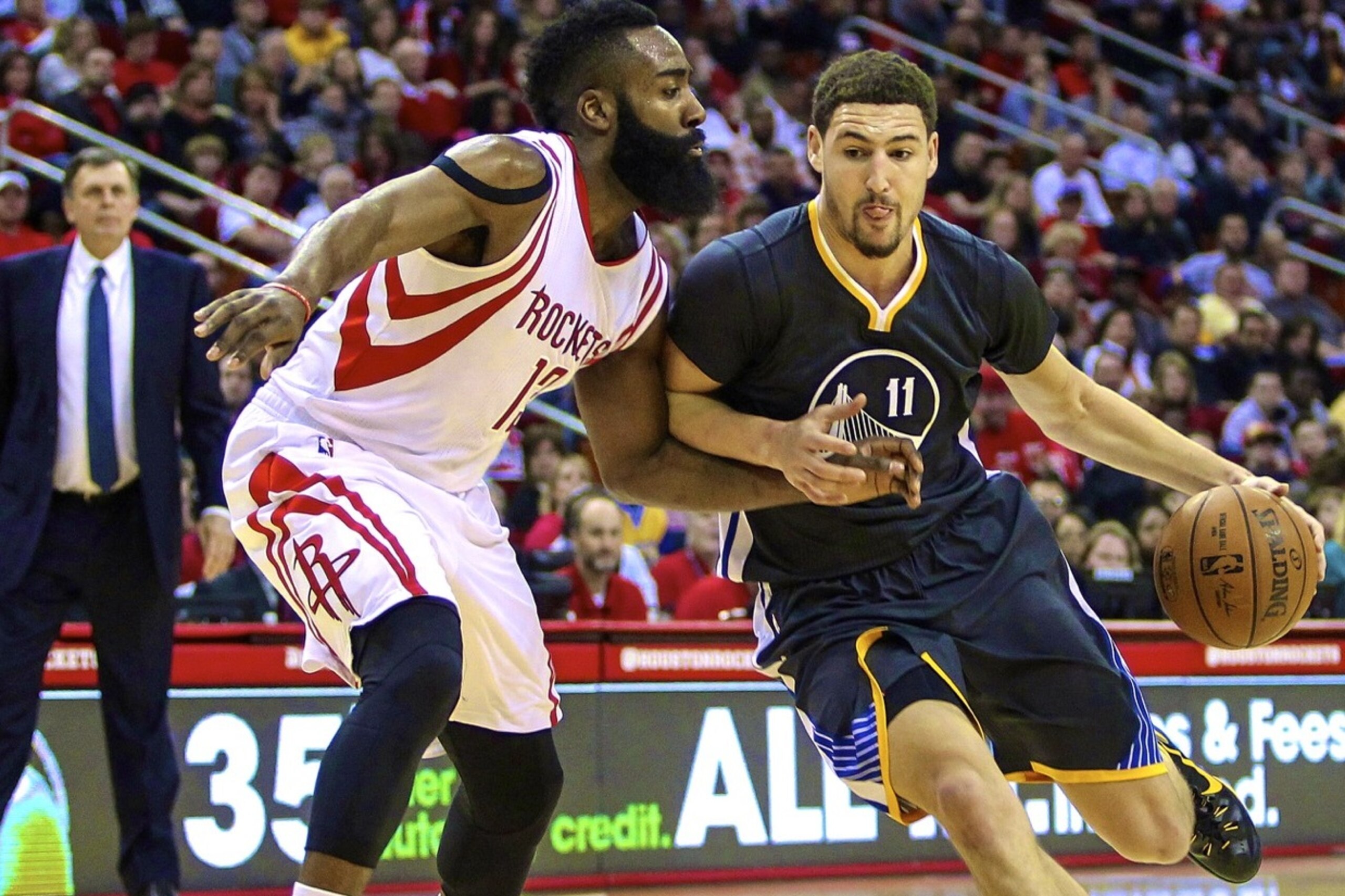

Who Will Replace Kobe Bryant as All-Star Starter: James Harden or Klay Thompson?
Kobe Bryant's torn rotator cuff has opened the door for one of the Western Conference's most esteemed scorers to replace him as a starter when the NBA All-Star Game tips off Feb. 15 at Madison Square Garden.
The question is: Will it be James Harden or Klay Thompson who winds up filling the Mamba's shoes alongside Stephen Curry in the Western Conference backcourt?
While Harden's pieced together an MVP-caliber campaign thus far, Thompson's claim as one of the league's most polished scorers has been reinforced of late—thanks in part to a 52-point showing against the Sacramento Kings that included an NBA record 37-point third quarter.
TOP NEWS

LeBron's Special Helicopter Deal

MJ Makes Record-Setting Donation 🙌
Shams: KAT, Hart Could Be Trade Names
| James Harden | 27.0 | 5.6 | 6.8 | 45.2 | 38.4 | 27.2 |
| Klay Thompson | 22.7 | 3.6 | 3.0 | 48.3 | 44.8 | 22.3 |
Since it's nearly impossible to make an assessment based off of those basic numbers, Golden State Warriors and Western Conference All-Star head coach Steve Kerr had another idea, according to the Bay Area News Group's Diamond Leung:
"Steve Kerr to KNBR on Klay Thompson/James Harden starting All-Star game: "How 'bout they shoot for it?"
— Diamond Leung (@diamond83) January 26, 2015"
So with the race too close to call, it's time to examine each players's resume and break down the reasons why Thompson and Harden should start in place of the 36-year-old icon.
The Case for James Harden
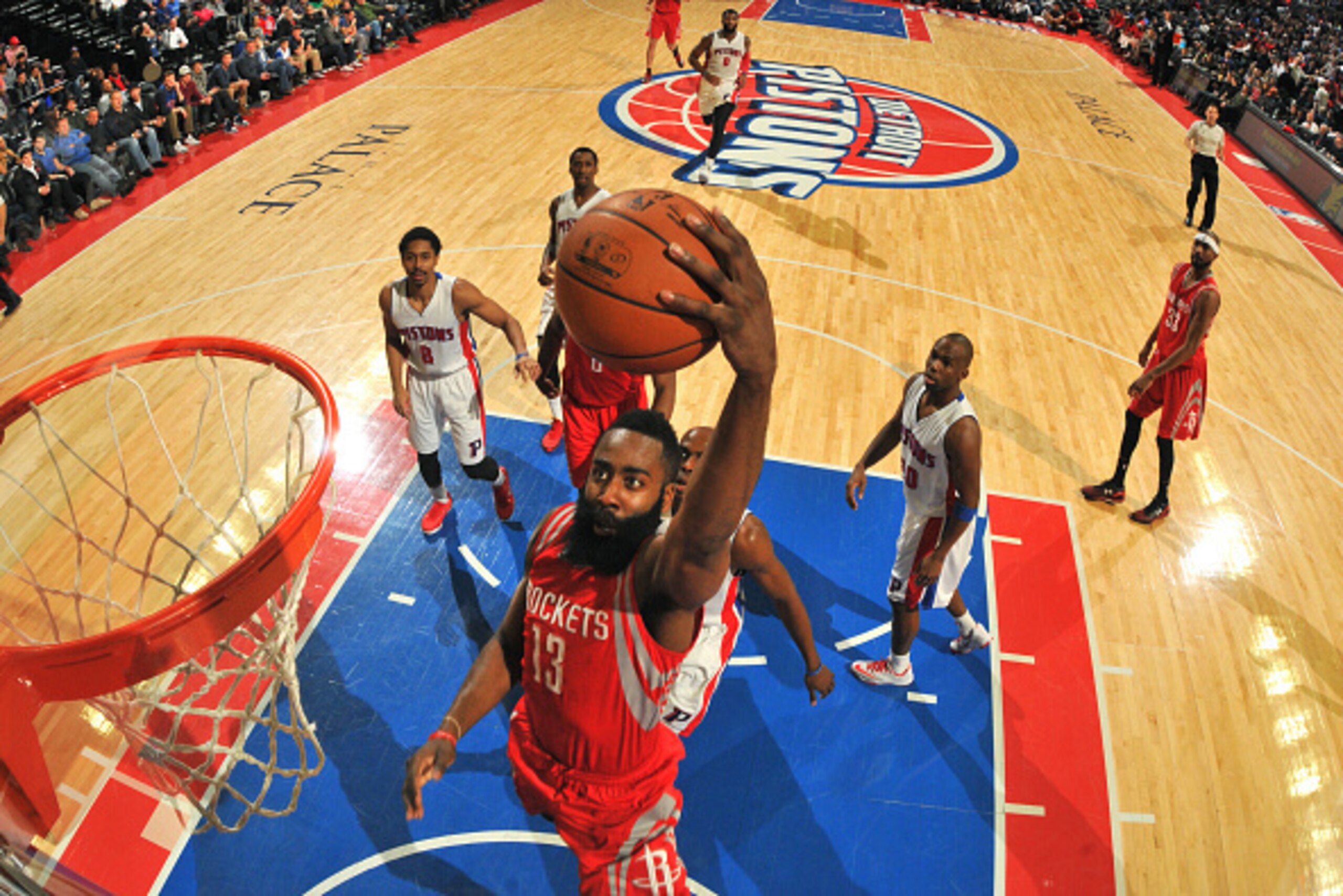
Outside of Curry, Harden's arguably the most unique scorer the NBA has to offer.
En route to averaging a league-leading 27 points per game, the Bearded Wonder has peppered opponents with 6.9 three-point attempts and 8.9 free-throw attempts a night. Additionally, Harden chooses to avoid all two-point shots outside of the paint like a small child pretending the floor is hot lava.
Here's an innovative look at that approach, courtesy of NBASavant.com:
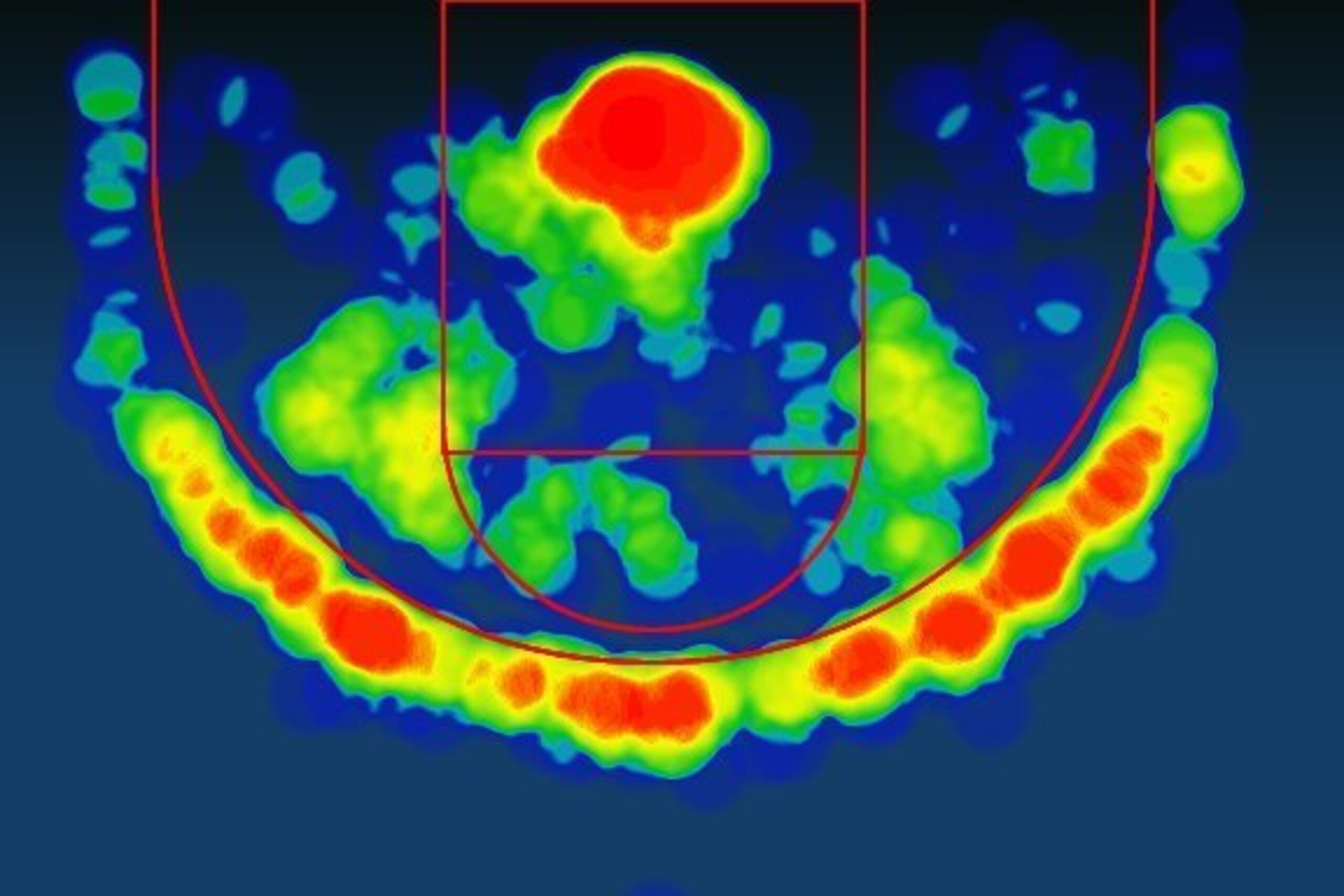
Harden's unquestionably the most artificially engineered efficient scorer the league has ever seen. He shoots a shade over 45 percent from the field and still ranks No. 4 overall in PER and tops among all guards with a mark of 27.28, according to ESPN.com. He also tops the VORP charts at 7.9, a metric that measures the value of a given contributor over that of a replacement-level player, according to Basketball-Reference.com.
With those numbers in mind, it's no wonder Harden's former teammate and Southwest Division rival Chandler Parsons named him the midseason MVP.
"For sure. He's the best player in basketball right now," Parsons said, according to ESPN Dallas' Tim MacMahon. "The things he's doing are incredible. The scouting report is focused in on stopping him and you see he's still getting 30 a game. It's impressive."
The thing is, that remarkable efficiency doesn't translate to aesthetically pleasing results. While Harden can shred opponents by initiating contact with a full head of steam upon driving into the lane, his style of play isn't conducive to many "wow" moments night after night.
His step-back jumper remains one of the most lethal isolation weapons the league has to offer, but with spot-up shooting and free-throw proficiency dominating his arsenal, Harden's preferred mode of operation is hardly the most elegant.
The Case for Klay Thompson

Thompson's advanced numbers aren't nearly as impressive, to be sure.
Although he ranks No. 3 overall among shooting guards in PER (22.36), that tally sits nearly five full points back of Harden's top-ranked total. And while his VORP rating clocks in at a more paltry 3.8—No. 20 overall—Thompson's arguably emerged as the more versatile scorer.
While he does rank No. 3 overall in catch-and-shoot three-point field-goal percentage (46.4), per SportVU player-tracking data, pigeonholing Thompson as merely a three-point marksman is unacceptable.
With the ball in his hands, Thompson's displayed no fear operating off the bounce—numbers that are reinforced by his strong pull-up percentages.
Examining another batch of SportVU data, Thompson is knocking down 44.1 percent of his pull-up jumpers. Harden's hitting on just 39.2 percent of his. Step back a few feet, and Thompson's drilling 45.5 percent of his pull-up threes—eight points better than Harden's 37.1 percent conversion rate.
Bleacher Report's Zach Buckley recently outlined the strides Thompson has made with the ball in his hands:
"With more freedom to create plays inside the arc under first-year coach Steve Kerr, Thompson has flashed an aggressive dribble-penetration game few knew he possessed. He had never spent this much time near the basket (18.5 percent of his field-goal attempts have come from within three feet) nor shown this type of accuracy on those shots (70.8 percent).
Yet he has managed to increase his involvement around the rim without sacrificing his prolific perimeter game. Despite playing fewer minutes than he has since his rookie year (32.3) and penetrating the paint more when he does, he's actually on pace to set career marks in threes per game (3.0) and long-range efficiency (44.6 percent).
"
Like Curry, Thompson is finding ways to leverage the threat of his wicked three-point stroke into open opportunities off the bounce. As defenders continue to try to suffocate him beyond the arc, look for Thompson to continue honing an arsenal that's quickly emerging as one of the Association's most deadly.
Who Should Start

There's no wrong answer here. In the end, it's truly a matter of splitting hairs.
“That’s out of my hands, out of my control,” Harden said, according to the Houston Chronicle's Jonathan Feigen. “I’m just going to do what I can control."
The finest statistical minutiae considered, Harden's tremendous value to the Rockets pushes him over the top.
Get this: When Harden's on the floor, the Rockets generate 107.2 points per 100 possessions. That would be good for the NBA's sixth-ranked offense—nearly four points better than the team's overall mark of 103.3.
When Harden's off the floor, Houston sputters to the tune of 91.6 points per 100 possessions. That's 0.2 points better than the Philadelphia 76ers' futile attack that's on pace to grade out as one of the least efficient offenses in league history.
Thompson's production is imperative to the spacing Golden State implements to seek and destroy defenses, and the Warriors' offense is plus-9.7 points better per 100 possessions with him on the floor. Still, that pales in comparison to the 13.4 points Harden accounts for when he's busting his way into the lane.
Who Will Start

It's ultimately Kerr's choice, so there are a few points to consider here.
For one, Kerr is likely partial to his star shooting guard. Thompson helped put Kerr in the position to make this decision, and it would be tough to ignore Bay Area loyalty on such a grand stage.
Furthermore, Harden previously called out the Warriors, saying "they ain't even that good" before Golden State capped off a sweep of the season series with two decisive victories. Surely the Warriors' first-year head coach has heard that sound bite by now.
Thompson's inclusion in the starting five would also allow him to saddle up next to Curry, which would be appropriate considering they're just the 20th backcourt pairing to make the All-Star Game in the same season, according to ESPN Insider's Tom Haberstroh.
His stock is also surging in a positive direction following two January Player of the Week awards. Given the what-have-you-done-for-me-lately nature of the NBA's narrative machine, that's not insignificant.
It may be the unpopular decision given all Harden's accomplished this season as an MVP candidate, but Thompson's ability to create synergistic magic with Curry and captivate fans from the opening tip is an opportunity that's too good for Kerr to pass up.
All statistics current as of Feb. 1 and courtesy of NBA.com unless noted otherwise.

.jpg?w=2560 "Grading WWE Raw 🔠")

.jpg?w=2560 "Bijan's INSANE 1st Half 🤩")
.jpg?w=2560 "Viral Rams Coach Vid 🖕")
.jpg?w=2560 "Injury-stricken Seahawks signing veteran RB")

.jpg?w=2560 "2 NFL Officials Suspended")