


In this high-tech era of football pitch development, the world's elite venues are typically well prepared to cope with inclement weather.
For example, Arsenal's shiny Emirates Stadium in London uses 12 lighting rigs with enormous sunlamps to produce a surface that, to the naked eye, can look like a billiard table. And like countless other arenas, the stadium utilises under-soil heating to maintain optimal growth and to help the grass deal with moisture build-up—something it does with ease.
Similar systems can be found at Barcelona's Camp Nou and Real Madrid's Santiago Bernabeu. In Basque country, the region where Eibar hosted Atletico Madrid on Saturday, Athletic Bilbao's new San Mames is just as sophisticated, too.



But other clubs and their venues—well, a select few really in Europe's elite leagues—have to do it a bit differently when the rain falls heavily. The resources don't stretch quite that far.
At Eibar?
A tarpaulin is put out.
"Eibar pitch getting watered pretty heavily ahead of Atletico Madrid visit tomorrow #LigaBBVA #Atleti pic.twitter.com/YaHWv3tGhC
— Nicholas Rigg (@nicholasrigg) January 30, 2015"
The above image, like so many other things connected to tiny Eibar, just puts a smile on your face. The club's 5,200-seat Ipurua Municipal Stadium is a backyard shed when compared with the Bernabeu or the Vicente Calderon, but it gave us a delightful throwback afternoon for Atletico Madrid's visit on Saturday.
It was like you were watching an old tape from northern England or Scotland in the 1970s. The pitch was a bog. The six-yard boxes looked like they'd been a pathway for the mares at a country race track.
Diego Simeone—who's normally seen with slicked back hair and dressed in a black suit, black shirt and black tie—wore a club jacket and a beanie. The crowd had little protection from the elements. And the players' boots and socks were all the same colour—brown.
The resulting contest wasn't a pretty one; it certainly won't make any highlight reels. There was little sumptuous skill on display.
But that misses the point. As a rare—almost a one-off—occasion in this high-tech era, it was just blissful to watch. It was nostalgic. Your elders would likely have told you it reminded them of a simpler time.
Jose Gimenez went in to contest a ball in dispute and ended up face first in the mud. As an exuberant 20-year-old, it didn't bother him in the slightest. He got straight back up and charged back to his position. Koke, with parts of the ravaged surface across his face and through his hair, looked like a young boy in a Sunday youth team.
For one afternoon in Basque country, you could cease lamenting all the inequalities that exist in football and simply enjoy watching two sides (two extremely contrasting sides) hoof the ball up and down the pitch in the most rudimentary fashion.
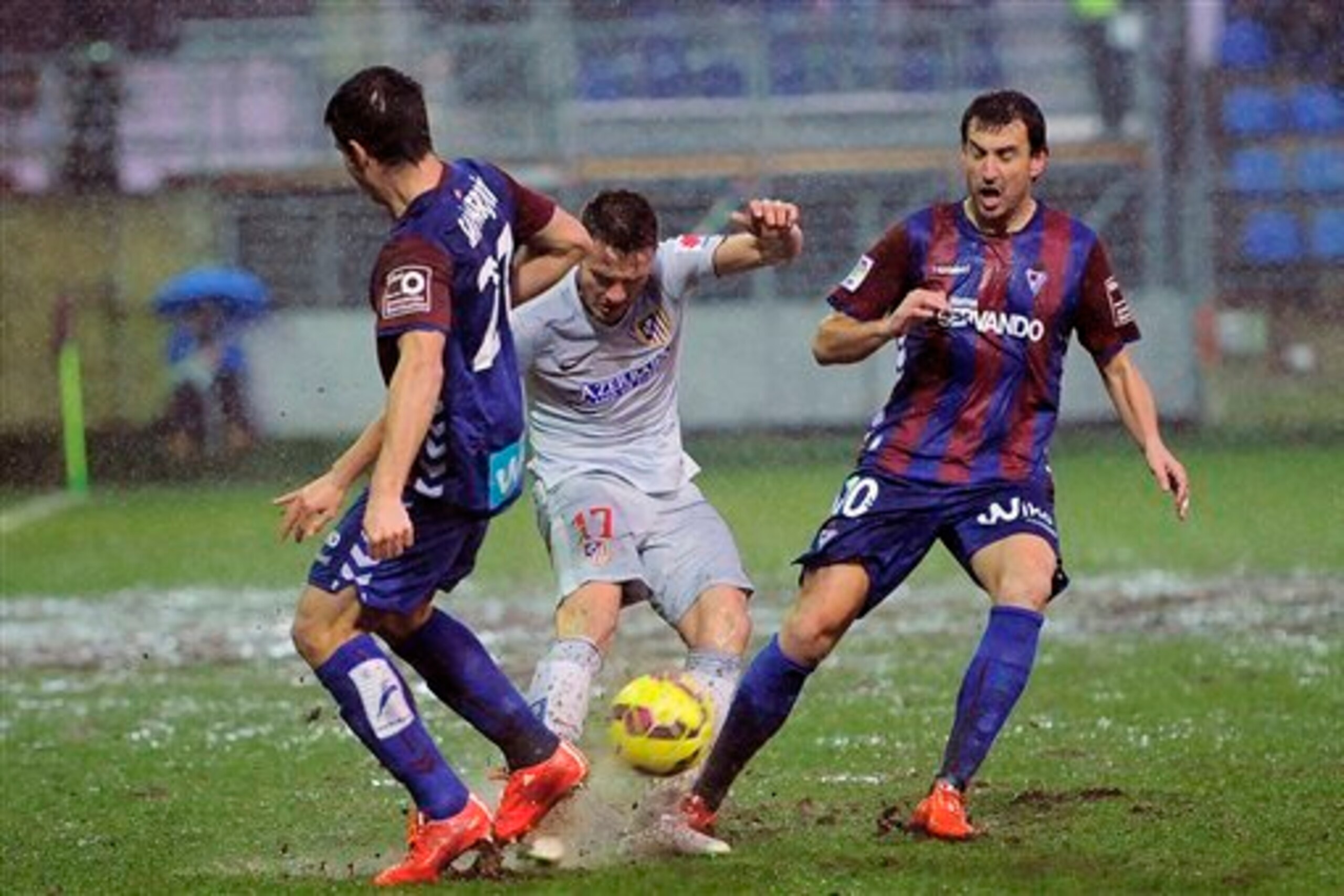
Of course, it was Atletico Madrid who predictably triumphed to keep Simeone's men within striking distance of Spain's top two. When Los Colchoneros broke the deadlock, it was Antoine Griezmann who was responsible. When the visitors doubled and then tripled that lead, it was Mario Mandzukic who provided the telling contributions.
In the summer transfer window of 2014, that pair cost Atletico €52 million.
Eibar's most expensive pair of summer acquisitions cost €143,000.
The club's annual budget, according to the Guardian's Phil Ball, is €3.5 million—for everything, to run a whole football club. It's capital value is just €422,000.
That the Basques were even on the same pitch—a muddy pitch—as Atletico is remarkable just in itself. And while Atletico might be the minnows when compared with their title rivals in Real Madrid and Barcelona, Eibar are the minnows in comparison with practically everyone.

It's why the club's story, its ascension to La Liga, is such a pleasing one. And Saturday's contest against Atletico in extraordinary conditions just made you smile about it more. Because they're just not conditions you could get anywhere else.
At one point, the hoofing battle saw the ball sail into the construction area beside the pitch. At any other ground, the ball would have been in the hands of a spectator. At Eibar, it wasn't far from bouncing down the road out the back.
It felt like grassroots stuff—the stuff where our love for the game all started. It was an afternoon you couldn't help but appreciate.
When Atletico travel home, they'll return to the 55,000-seat Vicente Calderon. Soon they'll upgrade and move into a new, 70,000-seat arena.
One of Eibar's more recent upgrades was to add four rows of seats to the north terrace of the Ipurua. And the whole city's population of 27,000 could only fill half of Atletico's comparatively colossal home.
But it means that when 5,000 head to the ground on matchday, almost one in every five people from Eibar are at the football club.
On Saturday, that group were afforded the chance to catch one of Europe's best outfits up close. For the rest of us, we were afforded the chance to revel in a rare and rather nostalgic afternoon.



.jpg?w=2560 "Chiefs, Steelers Eye WR Trades")
.jpg?w=2560 "Cowboys Handle Eagles on MNF 🤠")


.jpg?w=2560 "WWE Raw Live Grades 🔠")
.jpg?w=2560 "Jay-Z Headlining Super Bowl")