


Kawhi Leonard has spent more than three years playing in the shadow cast by the San Antonio Spurs' storied Big Three. Even by San Antonio's self-effacing standards, even after being named the NBA Finals' MVP, Leonard's importance has been marginalized, his standing cheapened by this notion that he's the future.
Midway through 2014-15, the poker-faced Leonard is tacitly—and unmistakably—imparting a newer notion: His time is now.
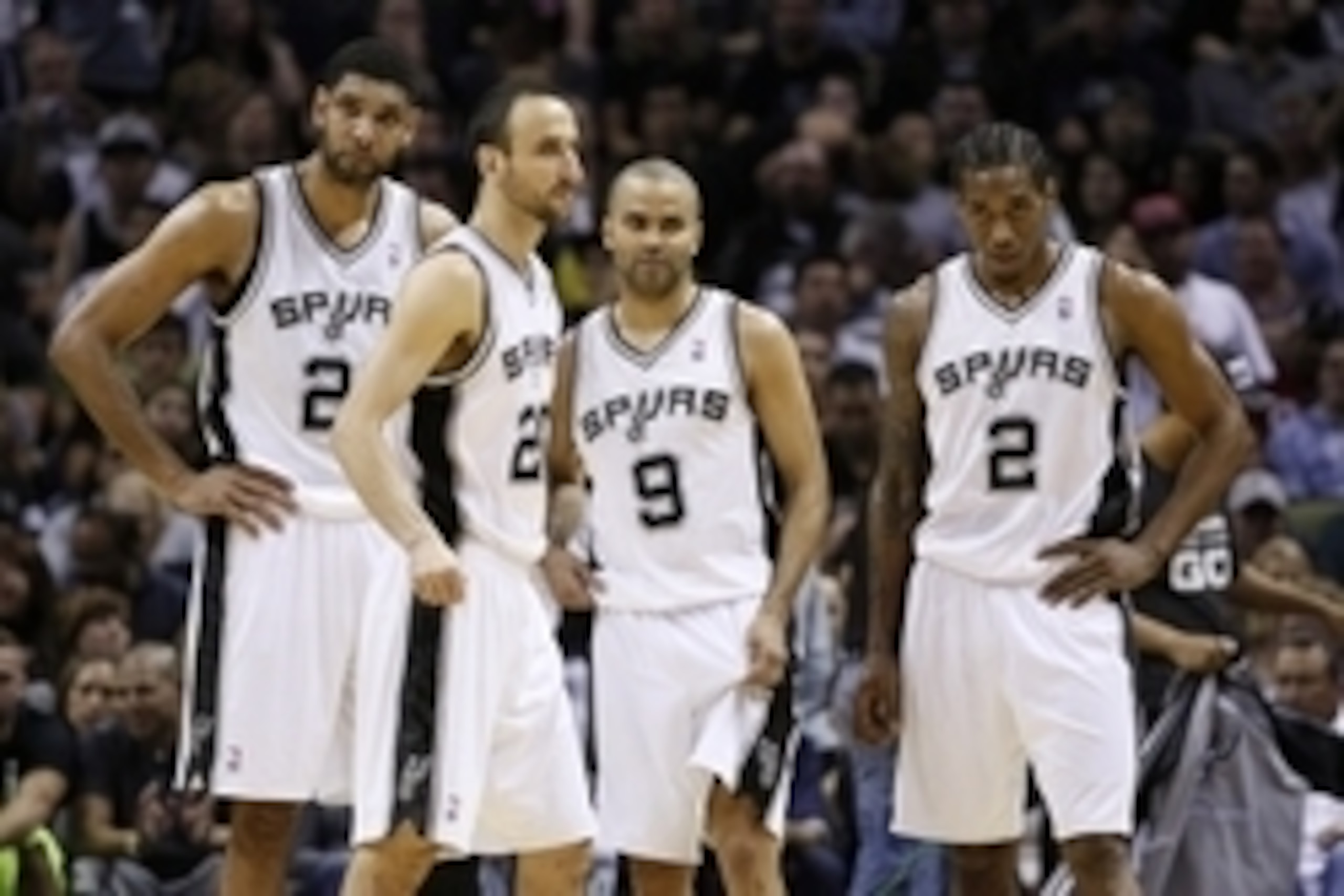
This has been a difficult concept to grasp, even for the proven and perceptive Spurs. They have three future Hall of Famers on the roster in Tim Duncan, Manu Ginobili and Tony Parker, and it's only natural they feature them.
It's this core that's still humming. It's this group of players who piloted the Spurs to three championships before Leonard came along. It's Duncan who nabbed four titles before then.
Leonard has been a "victim" of this talent abundance more than anything. Coach Gregg Popovich monitors player minutes like a scowling vulture, and the Spurs always have other capable hands to deploy.
Individual potential is often lost within that dynamic. Leonard ranked seventh on the team in usage rate among players who appeared in at least 50 games last season. He finished sixth in the postseason.
To their credit, the Spurs have never once refuted this. Popovich readily copped to it after Leonard was named MVP of the 2014 NBA Finals, per Alex Kennedy of BasketballInsiders.com:
All of which is fine under the circumstances. The Spurs have remained Western Conference powerhouses and won a championship while using Leonard as a tertiary offensive weapon. The 23-year-old has also managed to distinguish himself while assuming a usually unheralded place on San Antonio's totem pole.
Just seven players under the age of 23 have ever averaged at least 12.5 points, 6.0 rebounds, 2.0 assists and 1.5 steals on 50 percent shooting for an entire season: Charles Barkley, Terry Cummings, Marques Johnson, Clark Kellogg, Magic Johnson, Michael Jordan and Leonard himself.
That's company he joined last season. Not since Barkley in 1985-86 had a 22-year-old eclipsed those benchmarks for an entire campaign, so it's not like Leonard hasn't been thriving in San Antonio. Toss in the Spurs having the league's best record since he joined the team, and there's nothing to see here.
When it works, it works.
Question nothing.
Unless things change.
Like they have now.
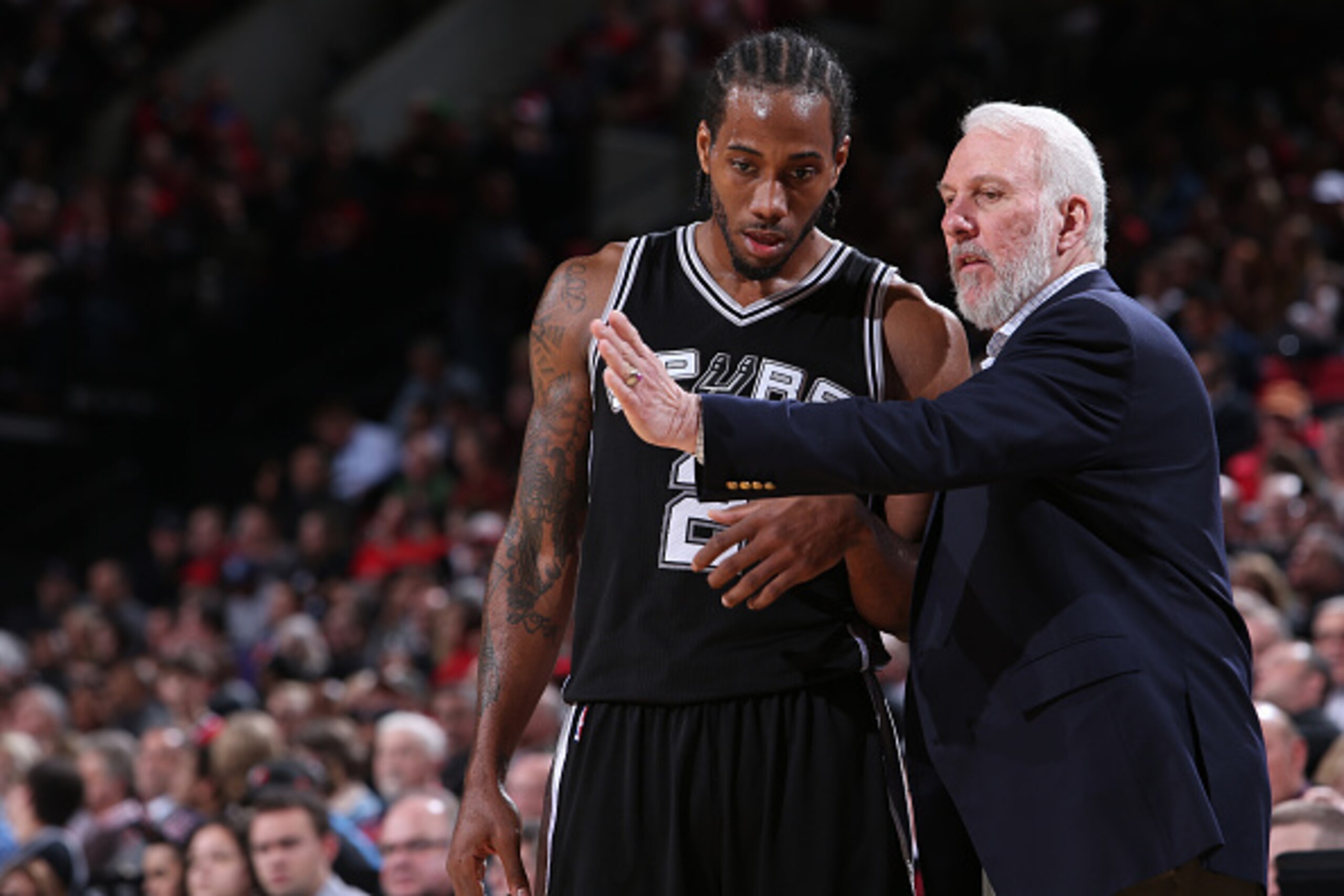
Only recently has Leonard's role undergone a transformative change in function. He's missed 18 games this season, and the Spurs have struggled in his absence—struggled in the sense that a 9-9 record without him isn't good enough. And, in the callously constructed Western Conference, it's not.
"It also dovetails nicely with what we can see with our own eyes, both on the court and in the standings," writes the San Antonio Express-News' Dan McCarney. "Kawhi Leonard is pretty important to the San Antonio Spurs."
Pretty important is an understatement.
Wins and losses aren't the only criteria by which Leonard should be measured. This season isn't especially out of the ordinary on that front. The Spurs are 115-34 with Leonard since he entered the league, compared to 32-26 without him, per McCarney.
They've just been a different team without him this season.
An inferior team:
| With Leonard | 799 | 107.8 | 5 | 94.5 | 1 | 13.3 | 2 |
| Without Leonard | 1310 | 102.6 | 17 | 103.0 | 13 | -0.4 | 15 |
Bear in mind, the Spurs outscored opponents by 6.6 points per 100 possessions when Leonard wasn't on the floor in 2013-14, so their minus-0.4 without him now is a big deal.
Expanding on this, Bleacher Report's Adam Fromal created FATS (factor adjusted team similarities), a metric that uses historical comparisons to generate predicted win-loss records for how squads fare with and without any given player. And when it comes to FATS, Leonard proves indispensable yet again:
In truth, it's not like this a groundbreaking discovery. The Spurs? Better with one of their best players on the floor? Worse with him off? That's...perfectly normal.
There is indeed a certain "duh" effect that comes into play here. But it's not so much the success the Spurs are having with Leonard. It's the way they're using him to achieve that success. He is no longer seen as an ancillary offensive device. He is now a featured option, because they need him to be a featured option.
As Popovich said ahead of the new year, per The Washington Post's Michael Lee:
"We’re trying to loosen up a bit and give him more of a green light. He’s getting more license. When you’re a young kid, you’re going to defer to Timmy and Manu and [Tony]. Now it’s like, ‘To heck with those guys. The Big Three, they’re older than dirt. To hell with them. You’re the Big One. You’ve got to go do your deal.’ So, we’re trying to get him to be more demonstrative in that regard.
"
Twenty-five appearances into his fourth season, Leonard's role is barely recognizable from any one part he's previously played. His minutes have never been higher, his usage rate is through the roof (22.7) and he's hoisting nearly four shots (12.5) above his career average (8.9).
The upshot here is Leonard's usage still trails that of Duncan, Parker and Ginobili. But the latter two are unavoidable. Parker is a point guard and Ginobili functions as a makeshift floor general for both second-unit and crunch-time lineups; Leonard, like Duncan, is bound to be featured less than them.
Besides, he's already eating up nearly 25 percent more plays than last season. His usage rate has climbed even higher, past Duncan, to 23.9, over the last three games.
If his current marks hold, Leonard will become just the third player under the age of 24 to simultaneously average at least 15.0 points, 7.5 rebounds, 2.0 assists and 2.0 steals, joining the ranks of Johnson and Barkley.
Noteworthy still, Leonard has more 20-point performances through 25 appearances this season (six) than he did in 66 for 2013-14 (three). The Spurs are 5-1 in those games. He's totaled 15 or more points on 13 occasions in 2014-15. The Spurs are 10-3 in those instances. This matters.
Playing .500 basketball, as they were without Leonard, would put the Spurs on the outskirts of postseason play for the first time since 1997. Their 18-7 showing with him has essentially saved the season and, when extrapolated, would be the equivalent of the West's third-best record.
Most importantly, their performance with Leonard and the manner in which they rely on him finally dispels this belief that he's the future.
He is not just the future anymore.
Leonard is the present-day difference between the Spurs contending for championships and devolving into just another team.
Stats courtesy of Basketball-Reference.com and NBA.com and are accurate as of games played Jan. 20, 2015 unless otherwise cited.
.jpg?w=2560 "NFLPA Makes Hurts Statement")
.jpg?w=2560 "Rams to Sign New Kicker")
.jpg?w=2560 "A.J.'s Message to Hurts 🙏")