San Jose Sharks: Doug Wilson Must Save the Sharks' Season and Trade Antti Niemi
There is a philosophical scene in the movie Moneyball, in which Oakland A’s general manager Billy Beane decides to take drastic measures in order to turn around his team’s spiraling season. Frustrated with his manager Art Howe’s stubborn refusal to implement any changes to his ineffective lineup, Beane trades away his team’s everyday first basemen, Carlos Pena, leaving Howe with no choice but to play the uniquely talented Scott Hatteberg at the position.
Though the A’s didn’t end up winning the World Series at the film’s conclusion, the move worked. The team won 103 games during the regular season—at one point reeling off 20 straight victories—despite a payroll of only $200 million. In rubles.
.jpg?w=2560 "Golden Knights Blues Hockey")

At the midway point of the hockey season, Doug Wilson finds himself in eerily similar circumstances. His Sharks are struggling and losing to teams with poor records. Injuries are mounting. Nobody knows the identity of the team, which is sending one of its worst defensive players to the All-Star Game.
Wilson also has his own version of Scott Hatteberg in Alex Stalock, someone Todd McLellan isn’t very keen on playing, and judging from what we saw on Monday, someone the Sharks don’t really want to play for.
A lot more on that later. First, let’s start with the premise.
The San Jose Sharks will not win the Stanley Cup with Antti Niemi as their starting goaltender. It won’t happen. Ever.
The last four years of Sharks playoff hockey is enough to make that assertion, and seeing that this team goes into each season hoping to win a championship—only to fail like the Coyote and fall harder off the cliff after every try—logic dictates that a change must happen, and happen very soon.
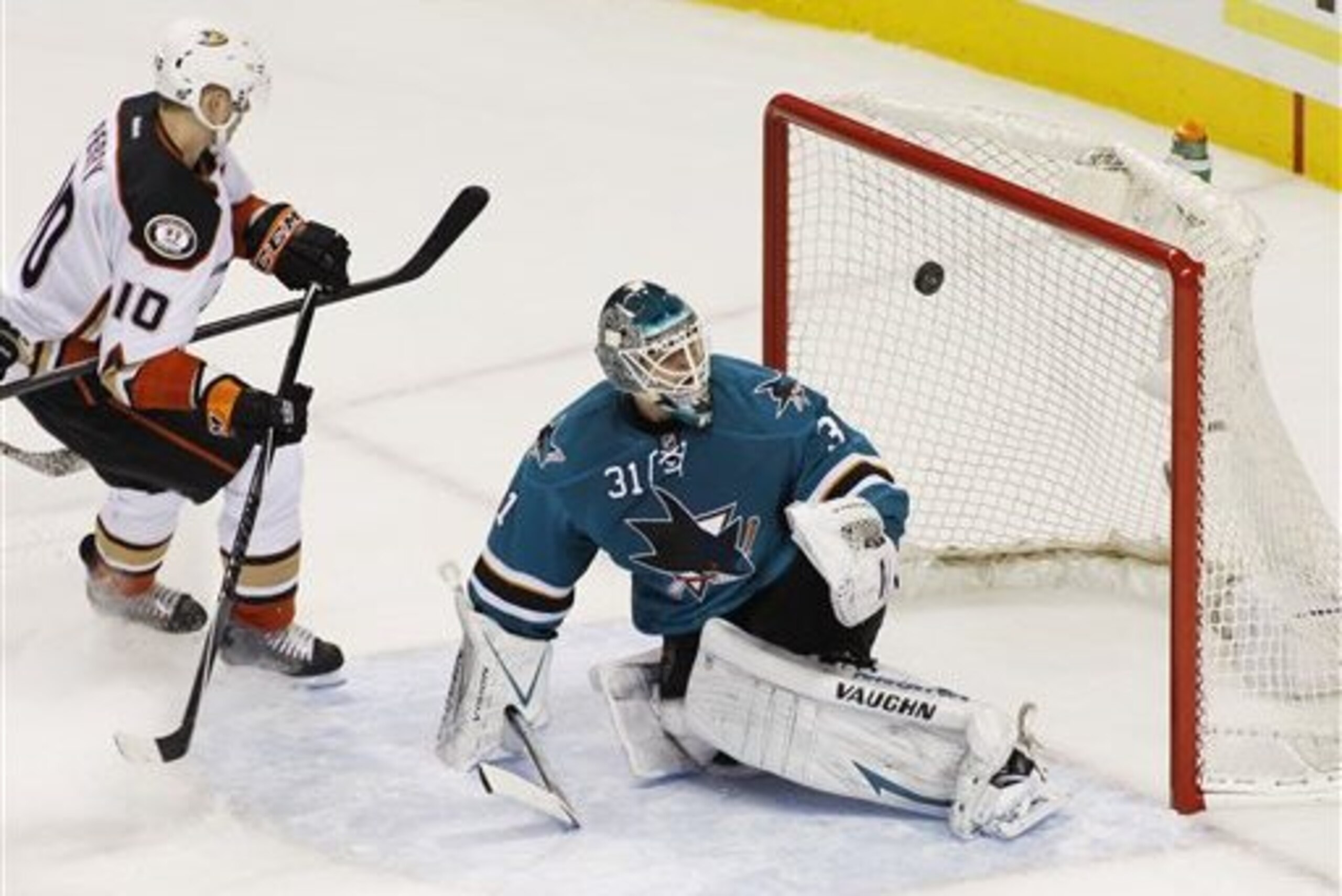
That change looked to be assured a few weeks ago after a pair of very bad losses to the St. Louis Blues. The identical 7-2 scores aren’t a misprint, even though both games had something big in common: floating pucks that evaded Niemi’s glove like a fly dodging a sledgehammer. When the goal lamp lit up behind him for the sixth time, Todd McLellan had seen enough. So did the fans.
Official complaints were filed on social media. Pleas were made to give the starting nod to Stalock, who has been impressive as the Sharks’ No. 2 netminder.
But it won’t happen. Not while Todd McLellan remains the bench general. For as wobbly and inconsistent as Niemi has been over the last year and a half, McLellan is firmly resolved to sticking with his goalie day in and day out, even when a dynamic backup occasionally teases greater visions of success.
It’s frustrating for hockey fans in the Bay Area who have suffered watching their team try to get over that unconquerable hill in their path. Like Sisyphus, every effort takes its toll and no end appears to be in sight.
Or is there?
Failure is part of what is conducive to winning. It inures teams and players to the brutal obstacles that stand between them and the finish line and works in sports much like a scientific experiment. When the first 20 attempts blow up in your face, you make the necessary adjustments. Switch to another catalyst. Add a different solution. Trade for a better player.
Wilson knew this after last year’s playoff collapse. He talked of a big rebuild during the offseason, of changing the attitude and mindset of the players that continued to underachieve when it mattered most. But his words were as empty as the seats at a Panthers home game. Any chance of blowing up the Sharks core evaporated after Wilson signed Joe Thornton and Patrick Marleau to hefty contract extensions during last season.
When both players refused to budge from their no-movement clauses, the talk of a rebuild suddenly changed to a restructuring of culture and hierarchy. The Sharks were a championship team, see, they just had to get rid of the internal politics and build more character for the postseason.
No, that isn’t the solution. This same group of players isn’t going to do any better in the playoffs because Thornton lost the “C” on his jersey or because of a new Nespresso machine in the locker room. Palpable changes are needed. A Jonathan Toews-esque player suffocating opposing centers. Someone like Justin Williams scoring walk-off goals in Game 7. Perhaps a fortress in net like Tim Thomas.
To be sure, trading Niemi and making Alex Stalock the starting goalie won’t solve all of the Sharks’ problems, but it’s the kind of full-measure approach that hasn’t been seen once during the team’s long string of playoff failures.
Making his NHL debut after recovering from a devastating leg injury in the minors, Stalock did a few things as the Sharks’ backup goaltender. He made 38 saves in his first start to earn the win. He set a team record for total minutes without allowing a goal (178:55). He stopped a ludicrous 12 straight shootout attempts. Whoa.
A full two inches shorter than Niemi, Stalock relied on his lateral quickness and agility instead of using his size to block shots. His frantic style of play in the crease enabled him to rob shooters on breakaways and odd-man rushes, at times twisting and lunging with more elasticity than Mr. Fantastic.
Stalock finished the year with decisively better numbers than Niemi, who had his worst season statistically with the Sharks, posting a .913 save percentage and a 2.39 GAA. As a superior passer and puck-stopper, Stalock seemed primed to take the baton that Niemi had dropped in every playoff track race.
It wasn’t meant to be. McLellan instead decided to go with the goalie who won a championship four years ago with the Chicago Blackhawks.
But these Sharks were not the 2010 Chicago Blackhawks, a team so deep and so talented that they could have won the Stanley Cup with a garden gnome protecting the net. In fact, there was only one series that Niemi played well in during the Blackhawks’ Stanley Cup run, and it came against the Sharks. If there’s anything life has taught us, it’s that irony can really, really suck.
McLellan’s folly of starting Niemi initially had little impact due to the incredible display of offense his team demonstrated in the first three games of the playoffs.
This strategy was a poor one, however, because the law of averages applies to everything in life, including hockey. Once the Sharks stopped scoring seven goals a game, Niemi had to be spectacular for his team to win.
He wasn’t. He wasn’t even average, compiling a pathetic .884 save percentage and being pulled twice against the worst scoring offense in the league. He played his worst when the Sharks needed him to play his best, and in all likelihood, his best probably wouldn’t have been enough by a long shot.
If there was anything positive that could come out of the Sharks blowing a 3-0 series lead, it was closure. Niemi would not be the starting goalie next year. But here we are.
Here we are.
Todd McLellan is not a man who learns from his mistakes. Even as Stalock has consistently outperformed Niemi throughout all of last season, the playoffs and most of this year, McLellan has refused to give him more starts. And from the looks of things, he fully intends to continue starting Niemi until the season ends and the Sharks are eliminated in the first round again.
Doug Wilson is the only one who can stop this madness. He needs to be the GM if McLellan can’t be the coach. The last team to win a Stanley Cup with a bad goaltender was the Chicago Blackhawks. Yes, Niemi was their goalie then. No, history will not repeat itself.
Niemi wasn’t good enough for the Blackhawks because they weren’t a team that settled for mediocrity. And in a conference teeming with quality goaltenders—Pekka Rinne, Jonathan Quick, Corey Crawford, Brian Elliott—mediocrity can’t be overcome.
It must be eliminated.
Stalock is still a question mark at this point. His numbers aren’t anywhere near where they were last year, and there’s a reason for that. He doesn’t have a team playing in front of him.
What happened on Monday night was rage-inducing for any goaltender trying his best to keep the puck out of the net. Seriously, every one of the Sharks’ costly miscues could have been answered by a bell ring from the crazy uncle in Breaking Bad. Five shots on goal with four Sharks standing around the puck. Ding. Turnover by Brenden Dillon behind the net. Ding. Matt Irwin deflecting the puck past his own goaltender. Ding. Missed rebound following a breakaway attempt. Ding. Botched defensive assignment on a power play. DINGDINGDINGDINGDINGDINGDINGDINGDINGDING.

The Sharks were outshot 29-18 through two periods, but they only trailed by one because of Stalock. That probably won’t be remembered as much as the five goals he gave up, which is one of the consequences for playing one of the most brutal positions in sports. In baseball, errors are blamed on the fielder. In football, touchdowns are blamed on the defense. In hockey, goals are scored because goalies let them in.
Stalock played a lot better than he looked on the stat sheet, but that won’t stop McLellan from limiting his starts until Niemi is traded or permanently benched after reaching his goals-allowed mileage, which appears to be set at ad infinitum.
Underusing Stalock isn’t just bad because it leaves a weaker alternative on the ice, but also because it deprives the Sharks’ potential starter of the necessary grind it takes to crystallize as an NHL goaltender. Before his lengthy layoff, Stalock had a sparkling .924 save percentage and a 2.12 GAA. Over his last three starts, he has an .880 save percentage and a 3.60 GAA.
This is another reason why Stalock should have been pegged as the starter for last year’s playoffs. In addition to being the better option on paper, it was crucial for him to get acclimated to the brutal atmosphere of a long postseason. Game 1s are the safest bet for rookies because they’re able to make their opening statement when the stakes aren’t as high.
Instead, Stalock was thrust into Game 6, when the Sharks were reeling after two lopsided defeats. He turned out an impressive effort, but it wasn’t enough to overcome questionable officiating and the usual troubled effort from his teammates.
Now, with the Sharks sitting sixth in the Western Conference, and their chances of a championship run looking less likely than a second season of Firefly, the time to launch Niemi and insert Stalock is nigh.
The most logical course of action would be to give Stalock more starts before the trading deadline. If he falters, Wilson will have a better idea of his team’s goaltending situation before making any moves.
But, as McLellan has no plans to bench his goalie, it’s up to Wilson to be the win-at-all-costs GM that usurped his manager in Moneyball. For anyone worried that trading Niemi is too risky, here’s some black-and-white perspective: With Stalock in goal, the Sharks are a conundrum. With Niemi in goal, the Sharks are a guaranteed playoff exit.
The Sharks have been trying to win a Stanley Cup with the same team year after year. They kept believing that they were good enough, that all of their past failures meant that the hockey gods would one day smile upon them. What they need to realize is they control their own destiny, just as the Kings, the Blackhawks and every team that won a Stanley Cup before them.
There’s no curse, no deflated hockey pucks, no subatomic particle that’s causing the Sharks to turn into horror show every April. They just need to play better. To do that, they need better players, and it starts with the anomaly between the pipes.
Stalock makes the most sense because he's a goalie that can make “the big save.”
Definition of “big save” in hockey nomenclature: The save that is usually the difference between a win and a loss.
It’s up to Doug Wilson to make this happen. Once he does, maybe he can start finding players that score big goals.

.jpg?w=2560 "Chiefs, Steelers Eye WR Trades")