
Tracing the Evolution of Pro Wrestling's Submission Holds
Twisting an opponent's limbs and bending their body in torturous positions has long been a pro wrestling tradition.
How grapplers have gone about issuing that damage has changed over the course of the industry's history. Moves have been modified and made anew but often not made to go extinct. One still sees many of the mat game's earliest holds as part of today's battles.
The evolution from what men such as George Hackenschmidt were doing to their enemies in the early 20th century to what we see in rings today is largely about the addition of flash.
TOP NEWS
WWE and AEW's Mount Rushmore for Today's Era ⛰️

Latest Wrestling Rumors
Predictions on Road to Survivor Series
Submission holds didn't become more painful over time; they became more showy. A simple toe hold could leave a man unable to walk. More intricate moves took over, though, as wrestling as a whole moved into more theatrical territory.
Still, while power moves and high-flying have created a vast distance between pro wrestling's origins and the present, the submission side of the game hasn't strayed all that far from its past.
Today, Samoa Joe chokes his foes from behind and slips his sizable legs around their torso. That move is one with roots in a time before WWE's inception and the dawn of television, when wrestling was still more Greco-Roman than violent circus.
The Pioneers and Their Impact
Evan "Strangler" Lewis got his nickname for his signature chokehold, one that sent his opponents into the land of dreams.
In the 1880s and 1890s, Lewis captured several catch wrestling championships and became known, as Nat Fleischer wrote in From Milo to Londos, "a cruel and dangerous athlete." All this despite him being just 5'9".
His breath-stealing weapon helped even the odds against bigger men.
As Jonathan Snowden writes of Lewis in Shooters: The Toughest Men in Professional Wrestling: "In 1885, he debuted his famed stranglehold, described by a reporter on the scene as a 'peculiar neck-lock.'"
The move would later be seen in a tamer form as a sleeper hold. Roddy Piper and Dolph Ziggler are among those who have since adopted that variation of Lewis' trademark.
Rather than trying to choke out their opponents, Piper and company were putting on a show. They relaxed the leverage arm, placing it on the foe's forehead rather than the back of the head.
Lewis will be happy to know that his hold is regularly used in MMA today, a submission's specialist's ticket to victory now known as a rear-naked choke.
Hackenschmidt debuted just a few years before Lewis hung up his boots. Known as the "Russian Lion," the man built like a Greek statue added a weapon to wrestling's toolbox as well.
He employed a move named after another animal: the bearhug.
Like Lewis' stranglehold, this was simple. He would cinch his arms tight around his opponent's torso and squeeze.
Wrestlers today still use the bearhug, though not as a finishing move as Hackenschimidt did. It's a setup hold, one that beastly men such as Mark Henry use to wear down a foe.
Hackenschmidt's greatest rival was also an inventor of between-the-ropes sadism. Frank Gotch gave wrestling the toehold.
On Gotch, the Chicago Tribune's Tony Trowbridge writes: "The American champion used speed, defense and a toehold, a bone-crushing leverage move he is credited with creating."
The toehold sounds innocuous. It was far from it. Gotch would grab his foe's foot and twist it sideways, threatening hyperextension or worse.
Hackenschmidt knew the danger of it firsthand. He sent a letter to The Daily Mail to complain about Gotch's hold, as reported in The New York Times (subscription required), writing: "Gotch grabbed my big toe and tried to sprain it, with the object of crippling me by breaking the bone. Throughout the match he kept pulling and wrenching my toe, and I saw that it was not a wrestling, but a butchery match."
Dressing up the move many years later, first Dory Funk and then his sons added a spinning motion to it. It was less realistic, but grander, something fans could see more obviously from further away.
Ken Shamrock, who arrived to WWE from a UFC still in its infancy, had his own take on Gotch's signature move. He held his opponent's leg in the air and swiveled their ankle the wrong way. Kurt Angle and Jack Swagger later borrowed Shamrock's ankle lock.
While Gotch looked to tear a man down by ripping at his legs, Joe Stecher used his legs to inflict the punishment.
The Nebraska farm boy debuted in 1912. It wasn't long before the grapplers of that time were suffering the same fate as some of the animals around the Stecher farm.
Stecher used the body scissors, crushing a foe's ribs between his muscular legs. He first practiced the move on livestock.
He would use a mule as a sparring partner, for example. Mark S. Hewitt writes in Catch Wrestling, "Stecher would climb onto the hapless animal's back, clamp on his scissors and squeeze until the mule dropped to its knees."
This was a time for great change in wrestling. Showmanship bred new moves.
Toots Mondt helped shift wrestling into a new dawn. A key goal for him was to not just maim and overpower but to entertain.
David Shoemaker writes in The Squared Circle: "Mondt created submission holds—some seemingly from thin air, many of which are used today—that were meant to project out to an audience member thirty rows back. Moves, in other words, that were meant as much to impress onlookers as to inflict agony on opponents."
Wrestling in general slowly became more fun, more freewheeling. That led to more elaborate submissions and mat-workers' arsenals expanding.
Dallas, Mexico and Elsewhere
In the '30s, not only did a star emerge but a trailblazer changed how wrestlers meted out punishment forever. Lou Thesz, a four-time NWA world champion, had a Greco-Roman background and apparently a knack for formulating new wrestling moves.
One of the many he created became John Cena and Masahiro Chono's go-to holds.
As noted by WWE.com, Thesz is responsible for bringing the STF to wrestling, along with powermoves such as the powerbomb. It wasn't enough to pull on one part of the body; Thesz's STF saw him use his thighs to bend back one of his opponent's as he pulled back on their head with his arms.
Chono built much of his offense around that hold, adding variations of it that included a sleeper hold. Cena still uses an STF as his submission finisher, an ongoing homage to Thesz.
While Thesz tossed his opponents around, another innovative grappler excelled in Mexico. In the '40s, Gory Guerrero rose to stardom, eventually as the legendary El Santo's tag team partner.
Guerrero made his foes suffer in new ways.
As his late son Eddie wrote in Cheating Death, Stealing Life: The Eddie Guerrero Story: "My dad truly was an innovator. He originated two of the most famous wrestling moves—the Camel Clutch and a back-to-back backbreaker submission hold called the Gory Special."
Eddie also wrote of how El Santo admired the Camel Clutch and asked Gory if he could use it himself. Guerrero agreed and El Santo, Lucha Libre's biggest star, made it his signature weapon.
Others followed El Santo's lead. The Sheik adopted the Camel Clutch, as did The Iron Sheik after him.
Guerrero's invention still has life today. Rusev is among those who sits atop his foe's spine and bends them backwards in search of victory.
A Mexican wrestler who would spend the majority of his career in Texas added the Surfboard to wrestling's supply of submissions. Guerrero had the Guerrero Special; Romero had the Surfboard, later dubbed the Romero Special.
This was not a move that Stecher or Lewis would have performed. It's too complicated, more show than fighting tool.
The attacker rolls backward while lifting, holding onto his or her foe's arms. When it's done, Romero and those who have followed his lead stretched out their foes, pulling on their arms and shoving their boots into the back of their thighs.
In the '50s, Buddy Rogers began to use a move that, while not as complicated as Romero's, was certainly not something one would use in a real fight: the figure-four leglock.
As noted on WWE.com: "Rogers was credited with the creation of the Figure-Four."
Twisting one's legs until it resembled the number four, the original Nature Boy then held the lock in place with his own legs. In a way, it was the descendant of both Stecher's body scissors and Gotch's toehold.
Few submission holds have been adopted by so many practitioners of pain. Greg Valentine, Tito Santana and the Destroyer all wielded Rogers' weapon. The move, however, became most famous as the way that Ric Flair did his opponents in.
At this point, when one clamps that hold on, it serves as a tribute to Flair. Fans don't scream out "Rogers!" when someone such as the Miz uses the figure-four, they shout "Woo!"
After Flair, Bret Hart took hold of the move and added the effect of gravity and the rigidity of steel. He sometimes executed a ring-post version of the figure-four.
In Amarillo, the Funks concocted the Texas Cloverleaf; in Dallas, the Fritz family used the Iron Claw to win and wow in the process.
Dory Funk Jr., as WWE.com notes, "is credited with the invention of the Texas Cloverleaf." With this hold, he crisscrossed his opponent's legs and bent them backwards. Like the figure-four, there is too much setup involved for it to be something anyone would bring into MMA, but it had something that is vital in pro wrestling—it looked great.
A toehold was an old bare-boned black-and-white movie; the Texas Cloverleaf was a blockbuster with special effects.
It is a hold that stuck. Dean Malenko and Sheamus, among others, later borrowed it.
Some 300-plus miles away from the Funk's home base, Fritz Von Erich had his own pain-inducing method. He would simply place his large hand onto his foe's head and squeeze down. The Iron Claw was the kind of move Hackenschmidt could appreciate in terms of its effectiveness and simplicity.
Von Erich ruled the Dallas area in the '60s and '70s, with the Iron Claw the centerpiece of his moveset.
Many of his sons would go on to follow him into the mat game. They adopted the claw hold as well. The move became the submission hold of choice for heels, with Baron von Raschke and Blackjack Mulligan among the men to utilize it.
Killer Kowalski performed his own version. He attacked a man's torso with the claw, his bear-like paws acting like vices. To strengthen his hands, he would often squeeze a tennis ball while traveling.
He told Esquire: "After a couple of months, I had a tremendous grip. I'd put my thumb in the guy's solar plexus, and he'd scream in agony."
The claw is a rare sight today, gone the way of the airplane spin. That's also true for Bob Backlund's Crossface Chicken Wing and a move believed to be something invented by Stu Hart in the famous Hart Family dungeon.
The Sugar Hold, the variant of the full nelson—a move that Olympian Bob Roop hurt many a man with—has faded from prominence. Who birthed it is unknown. Zack Linder and Bobby Malok say as much in an article on submission maneuvers on WWE.com writing: "The Sugar Hold's origins are unclear. It might have been invented by the Hart patriarch himself."
Regardless of who dreamed it up, it's the type of grinding hold that has given way to flashier offerings. That includes some of what Japanese wrestlers have cooked up over the years.
Japanese Innovation
When wrestling traveled to Mexico, it morphed into a more colorful, more flight-filled enterprise. When it made its way to Japan, it trimmed down some of the dramatic elements and traded them for martial arts-influenced strikes and more of a shoot-fight feel.
One can see that in some of the nastier, joint-wrenching holds produced there.
Antonio Inoki began his career in the 1960s. His move set included a number of armbars, including one that is much like the cross armbreaker Alberto Del Rio employs today.
He borrowed from the past in taking a page out of Stecher's book with a choke sleeper. Inoki also implemented the octopus stretch, a bizarre rendition of the abdominal stretch. This was not Inoki's baby, but he popularized it.
Years later, wrestlers like Tajiri, Itsuki Yamazaki and Shinya Ishikawa would take Inoki's lead with the octopus-inspired move. AJ Lee carries on the tradition today.
Few exemplified Japanese "strong style" like Yoshiaki Fujiwara. Inoki and Karl Gotch's influence showed up in his ring work, and he worked in a number of realistic submissions from the triangle choke to the heel hook. Not satisfied with other men's weapons, he forged his own.
He cranked back his foe's arm like he was trying to tear a root from the ground.
This became known as the Fujiwara Armbar, bearing his name even when wrestlers long after him, such as Bobby Roode, put it on someone. Fujiwara is also credited with the dragon sleeper, an inverted facelock that gets worse as the attacker then bends back the recipient's neck.
The Ultimo Dragon later popularized the move, slapping it on his opponents during his stops in WCW, Mexico and Japan.
It's since become a favorite on the independent circuit, one of a wrestler's many options to grind down an opponent. Other Japanese stars provided more painful tools to pull from the box.
The Great Muta decided to twist his opponents' legs, lean backward on them and, while curling himself into an arch, grab hold of his foe's head. As his WWE.com profile notes, Muta created what came to be known as the Muta Lock.
It's not a commonly used hold, but several grapplers have implemented it. Melina used it during her WWE tenure and Emma employs it today. AJ Styles, MsChif and CM Punk are among the many who have tipped their hat to Muta by using his trademark move.
Riki Choshu's invention spread more widely across the wrestling world.
Choshu came up with what is now known as the Sharpshooter or the Scorpion Death Lock if your name is Sting. As explained on WWE.com: "Choshu dubbed the submission 'Sasori-gatame' when he invented it, which loosely translates to 'Scorpion Hold.'"
Bret Hart went on to famously make it his finisher, but he's far from alone.
Chris Benoit, Natalya, Tyson Kidd and the Rock all followed the Hitman's lead. Edge used his own version but added more torque, dubbing it the Edgecator. The standard Sharpshooter is now associated with Bret and the Hart family in general, but it is a commonly seen move.
Had Choshu not dreamed up the leg-twisting hold, Hart and others would have had to turn elsewhere for signature moves.
Christopher Daniel and Sami Zayn owe a similar debt to Koji Kanemoto. The man who was the third to portray the Tiger Mask character wrestled throughout the '90s and '00s adopted many of the original Tiger Mask's high-flying moves.
He also added a painful-looking hold, the Koji Clutch.
The move often follows the attacker driving his opponent face-first to the mat. Kanemoto would then slip both his arms around his foe's neck, pressing the back of one of his legs against their throat for good measure.
It's a move that blends the flash of the pro wrestling world with realism. It has the larger-than-life quality that makes it work in a wrestling ring but is dangerous enough to find a home in a shoot fight.
Coty Shannon brought the Koji Clutch over to MMA in his second pro fight, choking out his opponent a la Kanemoto.
The Octagon's Influence
MMA offered pro wrestling inspiration several times over. It was only fair, as some consider Antonio Inoki's famous battle with Muhammad Ali a precursor to the sport.
After a stint with UFC, Brock Lesnar returned with a new toy—the Kimura. A simple move, the arm hold bends an arm the wrong way, putting stress on joints.
Even a subdued, pro wrestling version looks horrific in the hands of someone as powerful as Lesnar.
The influence MMA has had on recent submissions goes beyond Lesnar carrying a keepsake out of the cage.
The Crippler Crossface, the Yes! Lock and the Batista Bite are all cousins. They sprouted from the same omoplata evolutionary tree.
A fighter administers the omoplata by isolating the opponent's arm between their legs and applying pressure to the shoulder. Pro wrestlers brought their own versions of this out of the cage and into the ring.
Dean Malenko, known for an array of ways to pretzel his opponent, earned the nickname the "Man of 1,000 Holds." The crossface was one of the 1,000. It became more famous, though, as Chris Benoit's finishing move, the Canadian inserting his "Crippler" nickname into the move's moniker.
Benoit held his foes arms back with his legs and squeezed his massive arms around their face.
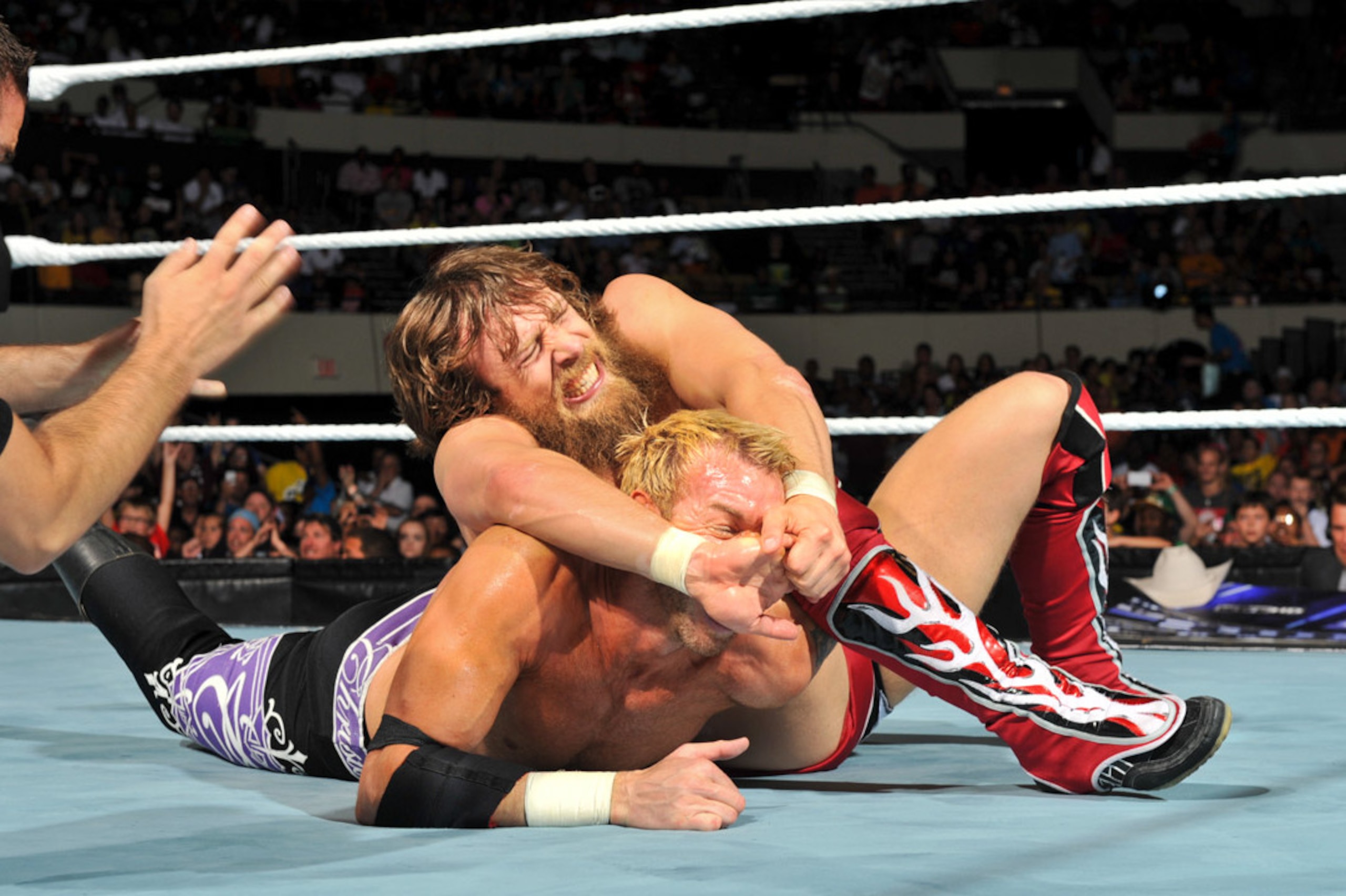
Daniel Bryan's Yes! Lock looks a lot like Benoit's hold. Bryan's version, though, puts more torque on the arm. His opponents can thank a respected judoka for that. Gene LeBell, a martial arts expert, taught the man who would eventually teach Bryan the move.
As a nod to him, Bryan originally called it the LeBell Lock. Speaking on the hold, LeBell told WWE.com: "It's a necklock. If you hook the arm and go in deep, you got a shoulderlock and an elbowlock. It's a hell of a thing."
Undertaker borrowed from the judo world as well.
In 2008, the future Hall of Famer must have decided that it wasn't enough to just Tombstone piledrive his opponents. He had to choke them out as well. He began using Hell's Gate, a modified version of the gogoplata that MMA fans see often.
On the gogoplata, Ray Hui writes for MMAFighting.com: "It's a move that appears to have originated in Judo as the 'Kagato-jime.' In Brazilian jiu-jitsu, it is most commonly seen transitioning around the omoplata and was coined 'gogoplata' because the word 'gogo' in Portuguese is slang for the Adam's apple."
Undertaker didn't press his shin into a man's said Adam's apple as MMA fighters would. His move only had to look dangerous, not actually force a man to quit.
The same goes for pro wrestling's version of the arm triangle. Hiroyoshi Tenzan, a Japanese wrestler whose career began in the '90s, brought that hold into the squared circle. It is now known as the Anaconda Vise.
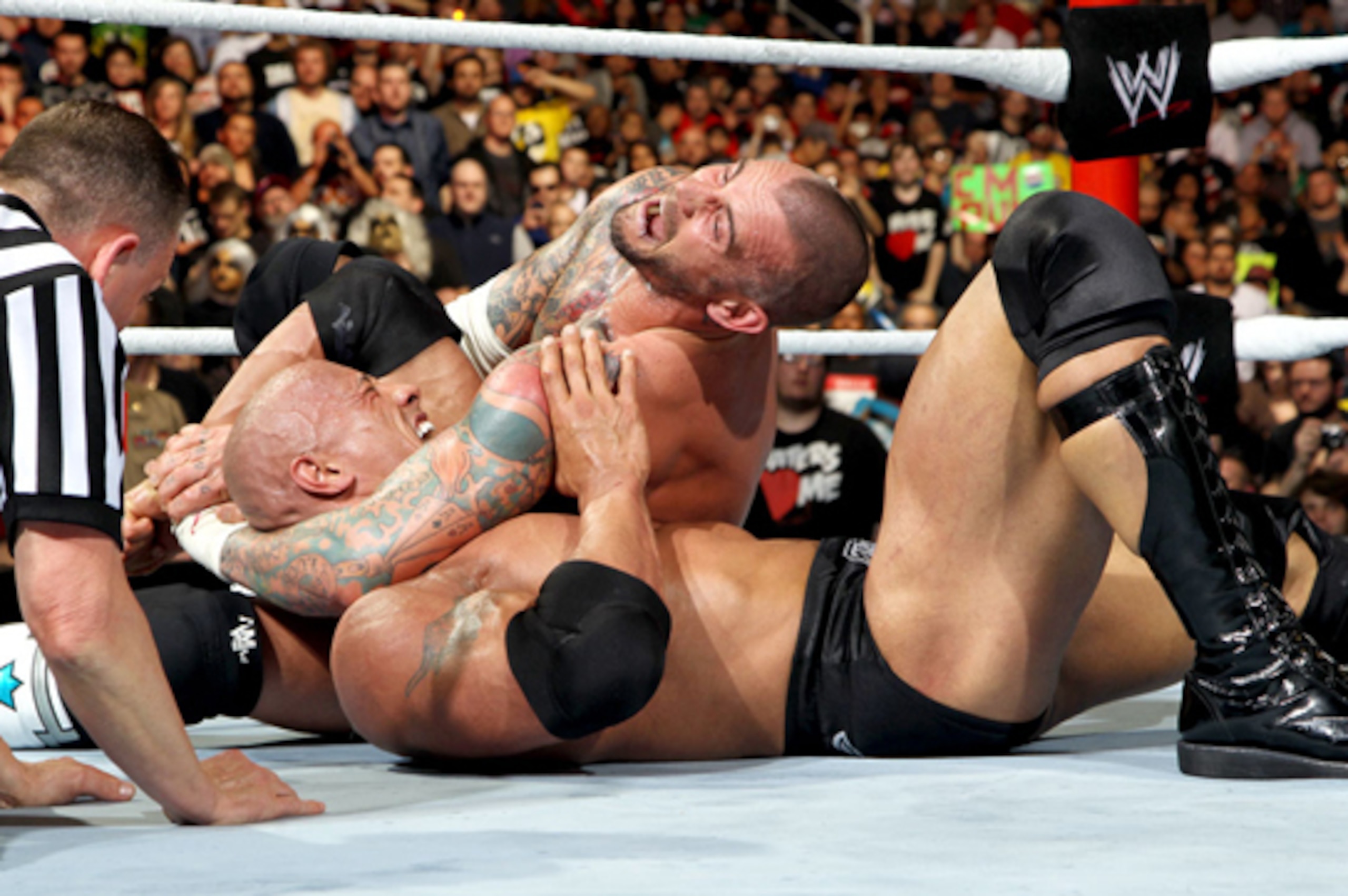
CM Punk popularized it in the U.S., using it during his WWE career. WWE.com's James Wortman writes: "Punk gravitated toward the hold, an arm triangle used in Brazilian jiu-jitsu and judo, while studying martial arts as a teenager."
Punk has since moved onto UFC, where if he gets a chance to crank it on someone, he will do so full force, as he moves from show fights to shoot fights.
Tazz brought a judo flavor to ECW before Punk and Bryan did the same to WWE. His Tazzmission finisher is essentially a Katahajime or single-arm choke.
His choice of signature hold was a move toward realism. It was simpler than the Texas Cloverleaf or the Gory Special and a hearkening back to wrestling's roots.
Other wrestlers have gone this route as well. Samoa Joe, the Samoan Submission Machine, approaches offense much like Tazz did—simply and in suffocating fashion.
Joe's Coquina Clutch is a throwback, a sign that wrestling, at least in terms of submissions, is circling back to where it began. If he's looking down at Joe take a foe down, emulating a boa constrictor, "Strangler" Lewis has to be proud.
This is the second part of a three-part series. Read part one, "Tracing the Evolution of Pro Wrestling's High-Flying Moves," here.
.jpg?w=2560 "Chiefs, Steelers Eye WR Trades")