

New York Jets' Offseason To-Do List Before Free Agency
No matter who the New York Jets wind up hiring as their general manager, some moves need to be made before free agency regardless of who is making them.
Before the league year even starts, the Jets have a ton of work to do on their own roster between locking some of their (few) defensive stars or cutting ties with dead veteran weight.
Here are some moves the next general manager must make this winter before the start of free agency.
Bring Back David Harris
1 of 6
At first glance, the rebuilding Jets may seem like an odd fit for the soon-to-be 31-year-old—but the Jets may find themselves in a pickle if they let David Harris walk in free agency.
A mainstay in the Jets defense since 2007, Harris' days as a dominant linebacker are behind him, but he is still more than a competent player. Known for his play against the run, he has actually been an even better coverage linebacker as of late, ranking 17th at his position in this area by Pro Football Focus (subscription required).
Not only is Harris still an above-average starter, but the Jets are in a particularly precarious situation given their lack of depth behind him. Backup Nick Bellore is set to hit free agency, while fifth-round pick Jeremiah George was claimed by the Jacksonville Jaguars.
Of course, the Jets have to be mindful about investing in an aging player like Harris—but they have a lot more incentive to keep him than meets the eye.
Cut Percy Harvin
2 of 6
Cutting ties with one of the most explosive players on offense may not be the most popular move a new GM would make, but it would be the responsible move.
With Percy Harvin set to make $10.5 million next year, there is no way the Jets can invest such an outrageous amount of money in a player who has played just one 16-game season in his career. He even missed time in his limited tenure with the Jets, giving them a peek of what they would be getting if they made him a part of their long-term plans.
Plus, Harvin is a unique player who may not fit into the plans of every offensive coordinator. After all, his lack of ideal size (5'11", 184 lbs) is one reason why the Seattle Seahawks were willing to trade him for such little compensation in return.
Unless Harvin is willing to take a bargain deal to stay in New York (where he is apparently "at peace" for the first time in his career), the Jets are better off re-investing their money in a more reliable, prototypical wide receiver to line up opposite Eric Decker.
Lock Up Muhammad Wilkerson
3 of 6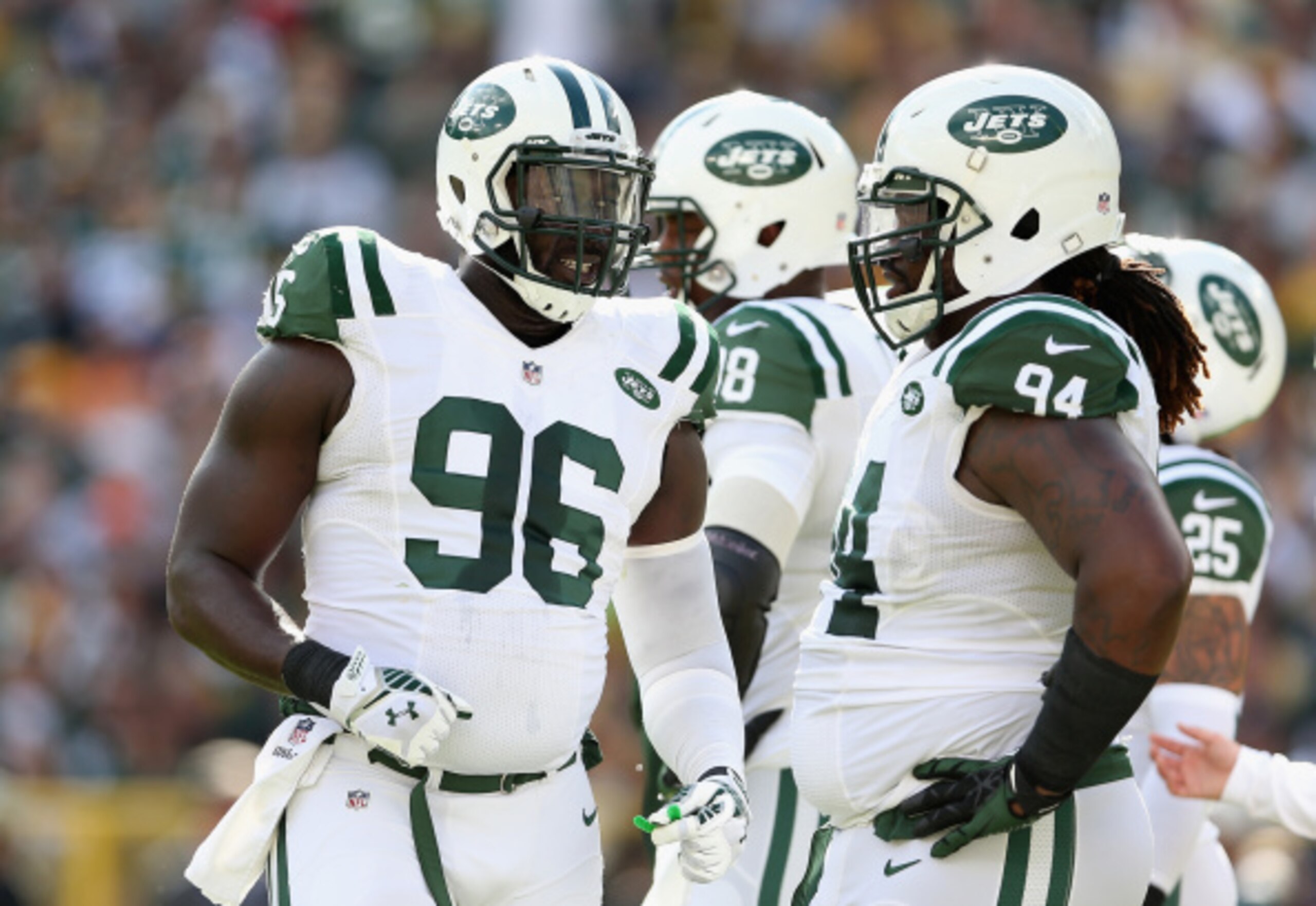
By the numbers, the Jets have little incentive to hand Muhammad Wilkerson a new contract. He is already locked up for 2015 under an option in his contract (that was included in all 2011 first-round picks), and they can even keep him in 2016 by using the franchise tag.
Even though the Jets can effectively keep Wilkerson on the roster for two more seasons without investing in him long term, they need to lock up their 2013 team MVP before this turns into another Darrelle Revis situation.
Plenty of other defensive stars from the 2011 draft have received extensions from their teams, including Patrick Peterson (Arizona Cardinals) and J.J. Watt (Houston Texans). Why should Wilkerson, who has been near the top of his position over the past three seasons, wait for his big-time deal?
There is no better way for a new administration to give this franchise a jolt of energy and positive vibes than by locking up one of the team's few superstars and leaders. It may not be the most economically driven move, but this franchise needs to show that it is willing to reward its top players and commit to a direction.
If New York lets Wilkerson's contract situation linger, a holdout situation may foster to dampen morale while it is already near an all-time low.
.jpg?w=2560 "Seahawks Chiefs Football")

Give Damon Harrison a One-Year Tender
4 of 6
Unlike Wilkerson and Harvin, handling restricted free agent Damon Harrison has an easy solution.
As a restricted free agent, he is subject to a one-year tender; the team could sign him to a one-year contract that only allows Harrison to sign with another team if said team gives draft pick compensation in return.
Since he is one of the top defensive tackles in the game over the past two seasons, the Jets have no room to be cheap when it comes to assigning a value on Harrison's tender. Giving him anything less than a first-round designation—worth a deal that will be somewhere north of $3.1 million based on the 2014 number—would be downright foolish.
In truth, locking up a player of Harrison's caliber for a whole season for just over $3 million is a bargain. The Jets will eventually have to give him a long-term deal he deserves, but with so many other situations to take care of first, it make little sense for the Jets to pass on such a bargain opportunity.
Cut Chris Johnson
5 of 6
On paper, adding a player who has a reputation for generating explosive plays seemed like a no-brainer for the Jets last offseason.
However, as it turns out, the Jets' overly simplistic reasoning for signing Johnson was heavily flawed. While he did break out an occasional long run, he was an inferior down-by-down runner. Even with his long runs factored in, he matched the per-carry average of Bilal Powell (4.3).
Powell is better both as a runner and in the passing game, so the Jets would be much wiser to invest in the younger and more versatile player over Johnson.
According to OverTheCap.com, the Jets would save $3.5 million against the cap if the new administration deems Johnson expendable. While they have plenty of cap space to work with, re-investing their dead weight into more promising and dependable veterans will expedite the rebuilding process.
Extend Bilal Powell
6 of 6
Cutting Chris Johnson would save the Jets a bunch of money and free them of an overrated free agent, but doing so does carry some risk, given that the man behind him on the depth chart, Bilal Powell, is a pending free agent.
If the Jets do plan on cutting Johnson, they sure better have plans to keep Powell in the fold, or they'll wind up in a suddenly desperation situation at running back.
The good news is that Powell's value is at an all-time low after he had such a massive dip in production. Thanks to Johnson's presence, Powell put up just 141 rushing yards on the season—giving him very little leverage on the open market.
The Jets, however, know that Powell is more than a capable runner, as he averaged 4.3 yards per carry on the season. As long as they can bring back him for less than Johnson's $3.5 million number (a virtual certainty), their money will be well-spent.
Advanced statistics provided by ProFootballFocus.com (subscription required).

.jpg?w=2560 "Raiders Saints Football")



