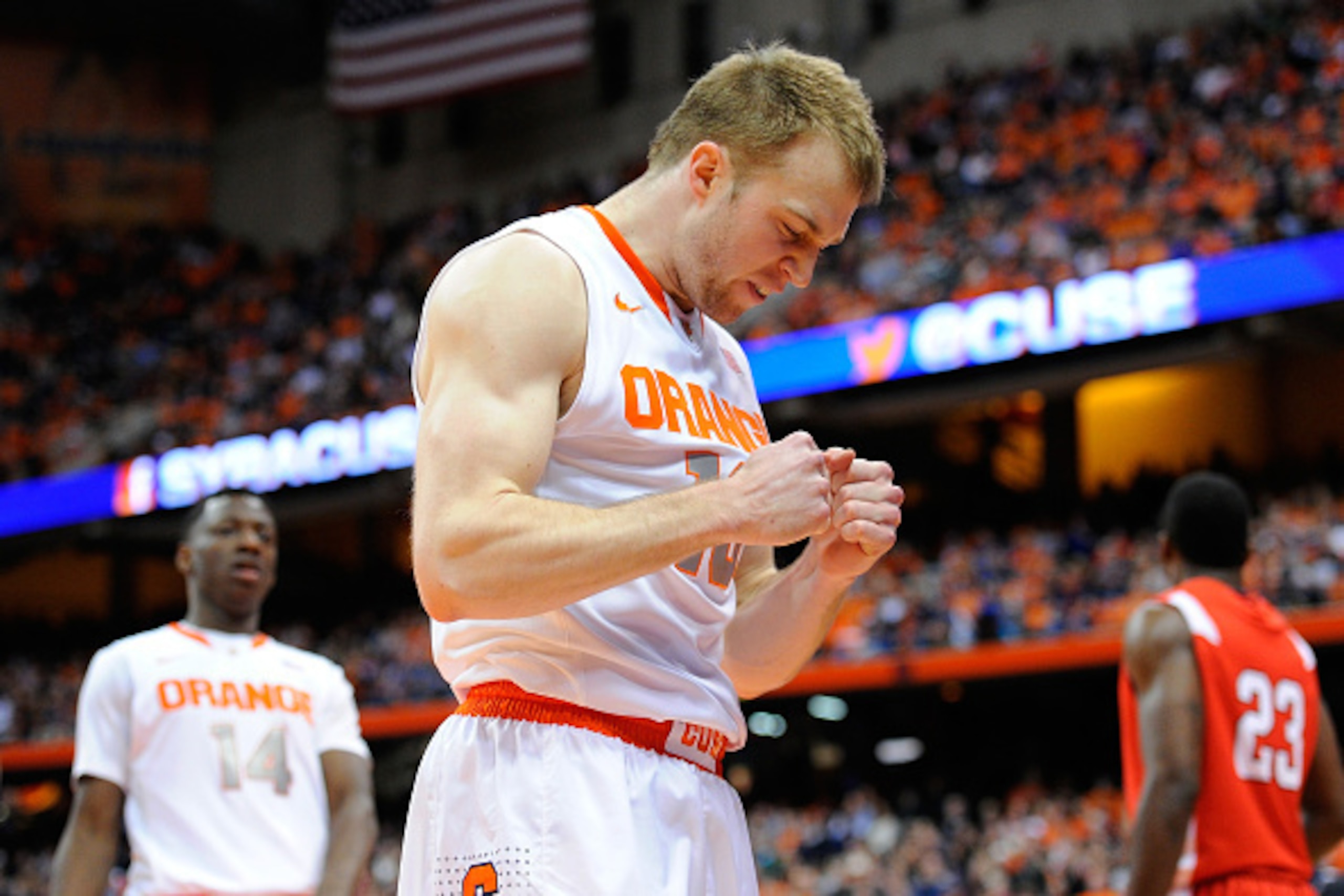

Syracuse Basketball: 5 Things Orange Must Prove in Conference Play
The Syracuse Orange men’s basketball team let out a sigh of relief last Saturday after escaping Blacksburg, Virginia, with a 68-66 win over Virginia Tech to open conference play.
Syracuse (10-4, 1-0 ACC) led by 22 late in the first half and went into the midway break ahead 42-33, but the Hokies (8-6, 0-1) battled back to cut the lead to two with 6:34 left on the clock. The Orange once again expanded the lead with an 8-1 run, but the Buzz Williams-led Hokies once again cut the lead to two points with 4.3 seconds on the clock and Syracuse’s Ron Patterson shooting two free throws.
Patterson missed both shots, giving Virginia Tech an opportunity to tie the game or go ahead, but Malik Muller’s three-pointer missed and the Orange came away with a hard-fought win.
The Orange's season has been a grind, with losses to Cal, Michigan, St. John’s and Villanova. However, the overtime loss to Villanova on Dec. 20 seemed to inspire the Orange, and the team has now won four in a row with an opportunity to string together a few more wins before the ACC schedule gets insanely difficult.
Syracuse has Georgia Tech, Florida State, Wake Forest, Clemson, Boston College and Miami on the schedule before playing its first ranked opponent in the conference, No. 18 North Carolina. No conference game is easy, but each of those games is winnable for the Orange if they continue to grow.
And growth is the key.
Turnovers, poor free-throw shooting, matador defense and a myriad of other problems have plagued the Orange. Slowly but surely, though, they are starting to clean up areas of their game that might have saved them from a few early losses.
But even if they clean up every aspect of their game, the Orange are still on the outside of the tournament bubble, looking in. They have no signature wins and will have to impress in conference play to get a bid to the Big Dance.
With that in mind, here are five things the Orange must prove in conference play to have a chance at the making the postseason.
Prove They Can Take Better Care of the Ball
1 of 5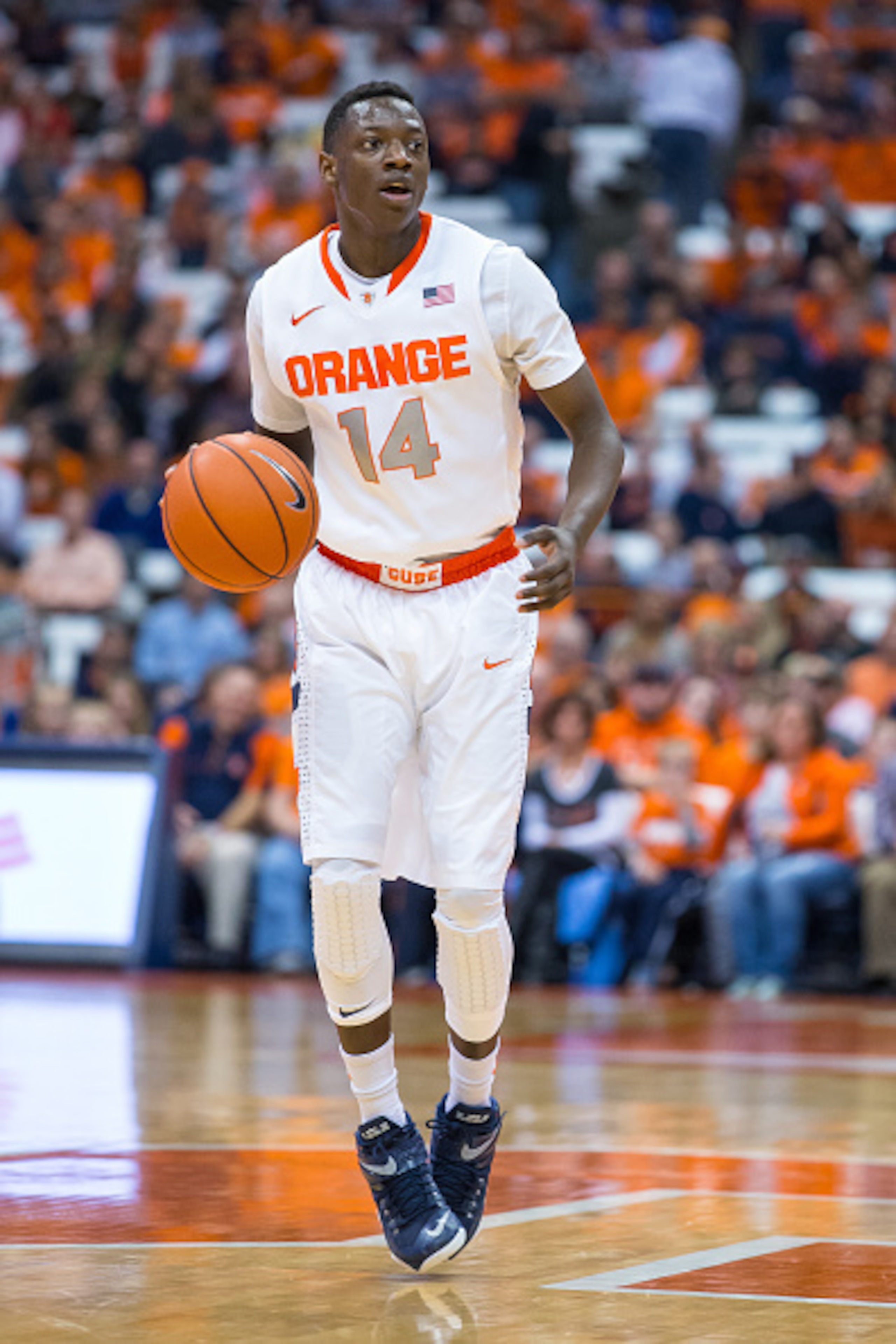
Freshman point guard Kaleb Joseph had big shoes to fill when he stepped onto campus after the departure of Tyler Ennis for the NBA.
Ennis was a confident ball-handler who could pass, limit his turnovers and dictate the tempo of the game. It would be unfair to expect Joseph to be at the skill level of Ennis, but Syracuse fans had high hopes.
Joseph is a bit of a shaky dribbler, his defense needs a lot of work and he’s turning the ball over 3.1 times per game. His issues are understandable, as he’s only a freshman, but Orange fans have been spoiled with point guard talent over the past few years thanks to Ennis and Michael Carter-Williams.
Carter-Williams also turned the ball over and wasn't always the cleanest dribbler, but the other aspects of his game far outshone his turnovers. He could score, pass and defend.
What Ennis and Carter-Williams also shared was the feeling that they were in control of the game. Both were confident and unflappable where Joseph looks lost at times and can string bad plays together at the worst moments.
Again, he’s a freshman, so he deserves a great deal of patience. Additionally, Joseph isn't the only one turning the ball over as the team has found ways to fritter away leads, but he is the most visible.
But all is not dark. During its four-game win streak, Syracuse has only turned the ball over 10.2 times per game. In its four losses, the Orange turned the ball over 15.5 times per game.
It would seem that a maturation process is occurring. Syracuse is a team that traditionally thrives on points off of turnovers and tends to limit its own mistakes. The continuation of this trend is critical if the Orange are to succeed in conference play.
Prove They Can Win Close Games
2 of 5
While Syracuse’s offense may struggle at times, the team's ultimate weapon is its 2-3 zone, which should keep games close when shots aren't falling.
Keeping games close, however, is useless if the Orange can’t capitalize. In its last three losses, Syracuse has struggled to take advantage of close games.
On Dec. 2 against Michigan, Syracuse held a two-point lead but trailed most of the second half. The Orange battled back and tied the game at 63 with a Rakeem Christmas layup, but Spike Albrecht’s three-pointer mixed in with a few costly turnovers sealed the Orange's fate, a three-point loss.
Four days later, Syracuse was down by four at the half against its former Big East rival, St. John’s, but the team scraped and clawed its way to a three-point lead with just over four minutes left in the game. A three-point barrage by Phil Greene IV doomed the Orange, who ended up losing by 12.
In Philadelphia on Dec. 20, the Orange led then-No. 7 Villanova by 12 at the half and never trailed in regulation. With four seconds left on the clock, JayVaughn Pinkston completed Villanova’s frenzied comeback with a reverse layup that sent the game into overtime, where Villanova took its first lead and never gave it up.
Syracuse’s fortunes changed on Saturday with a much-needed win against Virginia Tech.
The Orange led by 19 at the half but allowed the Hokies to get back into the game by going cold from the field. Syracuse overcame several missed free throws and held on for a two-point victory, which could have been more luck than skill, but the win was a welcome change to the Orange’s late-game woes.
With the Orange able to get a conference win on the road, there may be a glimmer of hope that this team is improving, as illustrated by just eight turnovers for Syracuse. Capitalizing on close games is another big step in that process.
Prove That Tyler Roberson Is the Answer to Dajuan Coleman's Absence
3 of 5
Dajuan Coleman’s season was recently put to a halt after the decision to redshirt the Syracuse big man, who has not fully recovered from knee surgery. Coleman hasn't played since Jan. 7, 2014, but thought he might be able to see game action this season.
Now that the Orange know Coleman is not an option, and may not ever be, it’s time to develop his potential replacement. That could come in the form of Tyler Roberson.
Roberson’s numbers don’t jump off the stat sheet, but the 6’8” sophomore has shown flashes of brilliance.
Against Louisiana Tech and Virginia Tech, both two-point wins for Syracuse, Roberson earned double-doubles by scoring 14 and 11 points, respectively, and pulling down a career-high 17 rebounds in both games.
With Coleman out and Chris McCullough struggling for the past month, Roberson’s aggressiveness and nose for the ball could be the medicine Syracuse needs. The pressure on Rakeem Christmas is immense with the lack of scoring options combined with Syracuse’s dependence on him not getting into foul trouble.
Roberson’s emergence could relieve much of that pressure and make Syracuse an impossible team to rebound against.

.jpg?w=2560 "Seahawks Chiefs Football")
Prove the Freshmen Can Carry the Load
4 of 5
Freshman phenom Chris McCullough burst onto the scene with an impressive opening to his season.
The athletic forward scored 14.4 points and grabbed 8.8 rebounds per game in his first eight games. He achieved double figures in scoring in each of those games, with three double-doubles along the way. He played 34.5 minutes per game during that stretch, never playing less than 29.
In the six games since, it’s been a different story.
In those six games, his playing time has drastically decreased to 23.7 minutes per game. He's scored only 4.5 points per game (bringing his season average down to 10.1 points per game), and his rebounds have dropped to 5.8 per game during that stretch.
It could be the NBA talk getting to his head, coach Jim Boeheim’s ever-shortening leash or any number of mental mistakes, but McCullough’s first stanza is a tale of two players.
As previously stated, McCullough’s classmate Kaleb Joseph has had a rough go of it at times as well, on both offense and defense, but he has done a good job adjusting to his role as the Orange's court general. Over the past four games, he’s had better shot selection, only had six turnovers and finally stopped shooting threes, as he’s only had one attempt from beyond the arc during that stretch.
Both players are integral for the Syracuse offense and defense to thrive. Ignoring the speculation that McCullough will leave for the NBA after this season, both should also be the drive shaft of the Orange next year.
To succeed in the conference, both must elevate their play and shake off their freshman growing pains. They’re young, but time, discipline and listening to their coach are likely all it will take for these green players to thrive.
Prove Trevor Cooney Can Shoot
5 of 5
Trevor Cooney started the first half of last season shooting 50 percent from long range and was one of the best shooters in the country. As the season wore on, defenses keyed in on Cooney, and running through countless screens to create shots for himself took its toll.
His shooting percentage from outside dipped to 37.5 percent by season’s end, and questions circulated as to which was the real Trevor Cooney.
This season, his percentage is roughly the same, his scoring has increased from 12.1 points per game to 13.5 points per game and he’s been a great player when he doesn't force his shots.
In his last six games, he’s made 20 of his 45 three-point attempts and averaged just over 18 points per game. With him as the only legit three-point threat, Cooney has embraced his role as a team leader.
Without Cooney making shots from the perimeter, Syracuse is completely one-dimensional, with Rakeem Christmas left as the only consistent scoring option. Michael Gbinije and Tyler Roberson could emerge as dependable scorers, but for right now, the only two consistent offensive weapons are Cooney and Christmas.
The big men and Cooney have a true symbiotic relationship. Without scoring on the block, Cooney will always have a shadow, and without Cooney scoring, the big men will never be free.
The good news for the Orange is that Cooney seems to be ready to shine.

.jpg?w=2560 "WWE Raw Live Grades 🔠")
.jpg?w=2560 "Multiple NFL Trades Predicted")


