Vikings vs. Dolphins: Breaking Down Minnesota's Game Plan
The Minnesota Vikings will hit the road for the final time in 2014 for a Week 16 showdown with the Miami Dolphins.
Both teams are looking to get back in the win column following recent losses. Minnesota dropped a 16-14 result in Detroit, losing in disappointing fashion late in the fourth quarter. Miami on the other hand got waxed by the New England Patriots, falling 41-13 in a complete second-half collapse.
Neither team holds onto playoff hopes. Minnesota had a steep hill to climb from more than a month back and failed, while Miami eliminated itself with its Week 15 loss. Whether or not the fire stays lit for either team as the season closes will heavily impact this week’s outcome.
.jpg?w=2560 "Commanders 49ers Football")
.jpg?w=2560 "Colts Football")
.jpg?w=2560 "DOLPHINS-AIKMAN")
For the Vikings, staying the course is the goal. The plan implemented against the Detroit Lions last week was effective, and they would win this week if they play the same way.
Minnesota and Miami are a similar statistical team. Let’s take a look at how the two teams compare and then go into how the Vikings can get back to winning ways.
Pass to set up the run
Forget establishing the run. The Vikings struggle to run. To ignite some kind of offensive success, Norv Turner needs to rely on his rookie quarterback and use the ground game as a complement, just like he did against the Lions a week ago.
Minnesota ran five first-down plays on its first two offensive drives. Both possessions ended in short order.
Turner quickly scrapped the plan. On the next two drives, seven of nine first-down plays were passes. In what was not at all a coincidence, both of those drives ended in touchdowns, accumulating 159 combined yards and eight first downs in 17 plays.
Minnesota’s newfound strategy nudged Matt Asiata to a quicker start as well, as Master Tesfatsion of the Star Tribune pointed out:
"#Vikings have done a good job using the pass to open run so far against a tough #Lions front four. Asiata 4 carries for 17 yds (4.3 avg)
— Master Tesfatsion (@MasterStrib) December 14, 2014"
A little more explosiveness and a lot more power were the results of lessening Asiata’s load. He ran harder last week against one of the league’s stoutest run defenses than he had at any other point in the season.
Using the pass to set up the run also capitalized on Teddy Bridgewater’s efficiency on early downs, sparking numerous lengthy drives and keeping the Detroit offense off the field.
The numbers from first-down passes point to the reward the Vikings reaped.
| Comp/Att | 12/15 |
| Yards | 124 |
| Sacks | 1 |
Bridgewater’s ability to complete first-down passes at a high rate is something Minnesota can bank on in its play-calling. The rookie finds ways to take gains and put the offense in better positions on second and third down. His sack rate was lower on first-down throws than all others as well.
On top of all that, the first-down passes can ease the load on the offensive line, one going up against Cameron Wake, Olivier Vernon and Jared Odrick this week.
Keep creating space
The biggest adjustment Norv Turner implemented in Week 15, and one that should carry over to the Miami game, was the usage of five-wide sets to create space offensively.
Instead of substituting in extra receivers and allowing Detroit to match it, though, Minnesota often split out a back and a tight end. With two linebackers on the field, the Lions were forced to tip their hand in coverage. If a linebacker were to track a RB to the sideline, man coverage followed. If a cornerback stayed put and left a LB over top of a WR, that pointed to zone coverage.
Bridgewater was able to locate mismatches quickly before the snap and take advantage.

On this particular play, Detroit left linebacker DeAndre Levy over Jarius Wright. Bridgewater took advantage with a big gain over the middle, picking on the overmatched defender.
Bridgewater was comfortable operating from the spread sets. Turner combined five-wide sets with three-step drops for quick throws that pierced Detroit’s coverage, especially over the middle of the field. Wright, Charles Johnson and Kyle Rudolph all caught balls in the middle of the field as a result of the created space.
The empty backfield sets were specifically put in place to find a way to beat Detroit’s coverage, but they can also be applied against Miami, whose DVOA ratings point to where the Vikings can have success.
| Offense's left | 5 |
| Middle | 24 |
| Offense's right | 14 |
Minnesota should feature its tight ends in Week 16. Kyle Rudolph looks healthier and more effective every week, and Rhett Ellison has even been a reliable receiver of late. Turner can isolate Miami linebackers by spreading the field, which lets Bridgewater attack through the defense’s middle.
The increased usage of three and five-step drops also neutralized Detroit’s defensive line a week ago. More spacing and more quick throws will help Bridgewater and his offensive line sustain success moving forward.
Understand assignments and execute
The Vikings’ task in run defense differs against Miami from most of what they have seen from opposing offenses thus far. With a mobile Ryan Tannehill at quarterback, Miami utilizes read-option run plays every so often.
A type of read option utilized by the Dolphins last week even included a third option for a bubble screen.

The unblocked end on the front side is where Tannehill makes his read. If the end collapses on the back, Tannehill keeps. If the end freezes, Tannehill gives to the back. When Miami has a pass built into the play, Tannehill can throw the screen as he scrambles to the perimeter.
While read-option plays are no longer completely foreign to NFL defenses, an understanding of assignments and ability to execute is a must.
Chris B. Brown of Grantland goes into great detail on how defenses commonly defend read option. One effective way to counteract the read option is to use a schematic technique coined “gap exchange.” Defenses traditionally try to control each gap along an offensive front with an individual player, as shown here:
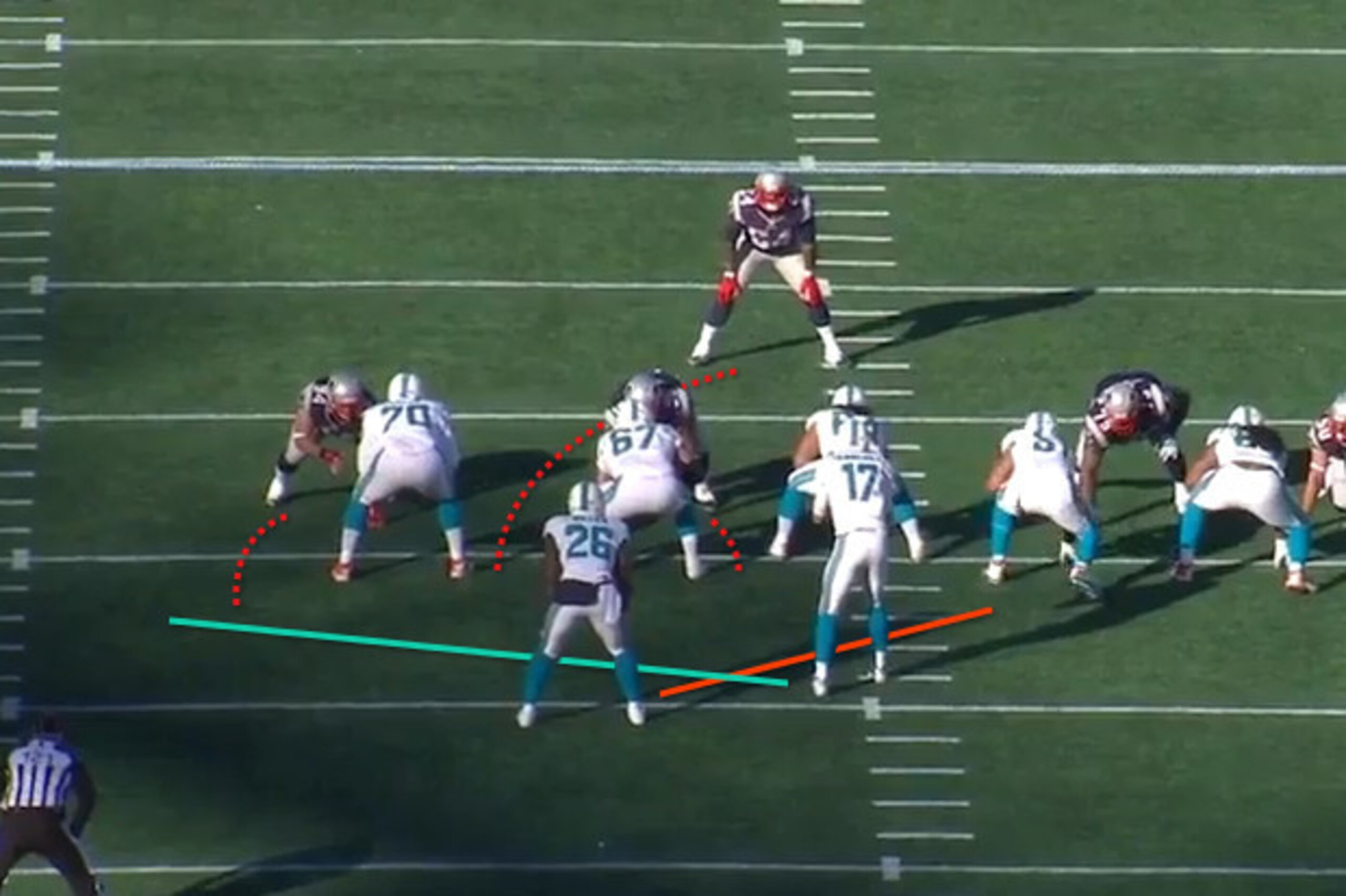
Some teams will give players two gaps to control instead of one, but the initial point remains.
This method gives defenses fits against read option, however. When the offense leaves the end free, the left tackle releases to the inside linebacker with a second-level run block, and the offense maintains its advantage by reading the end’s move. The defense is not in a position to take away everything.
Exchanging gaps means that the end and linebacker swap responsibilities to more effectively put one defender on the running back and one on the quarterback as opposed to controlling specified gaps.

The play-side end now makes a beeline for the back, crashing inside once he diagnoses read option as the tackle leaves him free. The linebacker scrapes over top of the left tackle’s block and has quarterback responsibility on the perimeter. If the QB pulls the ball as he should, the linebacker flowing to the perimeter should be waiting for him.
To handle the screen option, the onus falls on cornerbacks to effectively set a perimeter from the outside and get off blocks. Honesty from safeties is also important to protect against pop passes where an outside receiver releases up the sideline after Tannehill keeps.
This laundry list of duties can be properly executed if defenders understand how to diagnose read option and are drilled in on their responsibilities defending it.
Miami’s run game goes well beyond read-option plays. Lamar Miller is an underrated back in the league and the type of runner who can make defenses pay for lapses in a hurry. Schematically, though, the Vikings must give extra attention to read-option responsibilities in order to be fully prepared for what Miami has to offer.
Home in on tendencies
Tannehill has a favorite receiver in rookie Jarvis Landry, whose impressive rookie season has flown under-the-radar. Daniel Jeremiah of NFL.com points out just how much Miami has gone through Landry in its passing game, which is uncommon for rookies:
"Odell Beckham Jr & Jarvis Landry lead all rookies with 71 catches. @NFL #LSU
— Daniel Jeremiah (@MoveTheSticks) December 15, 2014"
A security blanket is the best description for Landry. He is far from the largest or most athletic receiver around, and yet he is a highly reliable target. Tannehill has taken notice, because Landry is his go-to receiver in tight situations.
Out of Landry’s 22 targets over the last three weeks, 10 of them are on third downs. Tannehill completed eight of 10 on those targets for five third-down conversions, a jump from Miami’s 38.5 percent conversion rate on the season. Landry is an effective third-down receiver, and Tannehill is more than aware of it.
Miami uses the rookie receiver in a fitting way, playing him from the slot for 81.3 percent of routes over the course of the season, per Pro Football Focus premium (subscription required).
With offensive coordinator Bill Lazor’s reliance on three-receiver sets, Minnesota will be in its nickel package more often than not. That places responsibility on the shoulders of Captain Munnerlyn in situations when the Vikings can get Miami’s offense off the field. Using aggression in coverage and locating the ball are important in order to keep Landry from picking apart coverage over the middle.
Another tendency Miami has shown comes using blazing receiver Mike Wallace.
Predictably, he is Tannehill’s favorite deep target. Of 35 deep passes in 2014, 22 of those have targeted Wallace, by far the largest share of deep passes in Miami, also via Pro Football Focus premium.
The tendencies go a bit further. Tannehill prefers to target Wallace on early downs, and his logic makes sense. Wallace is a splash-play receiver, the type who can unlock a defense over the top just as easily as he can drop a pass that hits him between the numbers.
From first down on, Wallace’s share of the targets slides.
| Down | Share |
| 1st | 27% |
| 2nd | 20% |
| 3rd | 16% |
On first and second downs especially, Minnesota must respect the deep threat from Wallace. If the receiver flanks to the offense’s right to match up with Josh Robinson, extra care should follow, assuming Zimmer chooses not to shadow Wallace with Xavier Rhodes. Rhodes’ size and strength should be a problem for Wallace, so safety help can be applied less frequently in that case.
Specifically for cornerbacks, having a quick trigger out of a backpedal helps against go routes and deep posts from Wallace. His speed requires an adjusted understanding of the type of cushion necessary before turning to run. Minnesota may also choose to play Wallace with more aggression, challenging the lean receiver at the line of scrimmage.
Understanding Miami’s tendencies in the passing game will give Minnesota’s coverage an edge.
The Dolphins have failed to score more than 16 points in each of their last three games. If Minnesota is prepared for read option, limits Lamar Miller's big-gainers and can lock in on the different receivers Miami has to offer, the defense can find more success in Week 16.
Young players have two more games to state their case for increased roles in 2014, while veteran players have two more games to prove they belong in future plans. The Vikings still have something to show over these last two weeks.
Statistics via ESPN.com unless noted otherwise.
.jpg?w=2560)
.jpg?w=2560 "NFL Paris Football")

.jpg?w=2560 "Malik Beasley Negotiating Plea Deal (AP)")