Scoring against Arizona this season is going to be tougher than watching SEC basketball.
Michigan found that out the hard way, as the Wildcats smothered the opposition to the tune of an 80-53 win. After some close calls earlier in the year, everything was clicking for the home team to earn a dominant victory against a talented opponent.
Wolverines coach John Beilein was pretty impressed with what he saw, via Zack Rosenblatt of the Arizona Daily Star:
TOP NEWS
Ole Miss Men's CBB Punished for Violations

Malachi Toney Sets ANOTHER Record
.jpg?w=2560 "NBA Gambling Charges")
Malik Beasley Negotiating Plea Deal (AP)
While everything seemed to go Arizona's way in this game, it was all started by the excellent defense. This team is a favorite to win the Pac-12 and is a top contender to bring home a national title this year, thanks to its ability to keep teams off the scoreboard.
The amazing thing is there isn't just one reason this defense is so great. Multiple factors work together to help make this one of the best units in the nation. Here is a breakdown of what allows the entire system to work.
On-Ball Pressure

There are many keys to success in a man defense, but no one can survive without first being able to guard the person in front of you. Arizona goes above and beyond in this category by pressuring the ball at every step.
This all starts with T.J. McConnell, who is often referred to as little more than just a veteran game manager, but the truth is he is so much more. He especially excels at going after an opponent's point guard and forcing him into mistakes throughout a game.
He currently leads the Pac-12 with 2.4 steals per game, a mark that is likely to remain throughout the year.
Meanwhile, Arizona has a not-so-secret weapon in Rondae Hollis-Jefferson, whom head coach Sean Miller recently called "one of the nation’s great defenders."
The 6'7" wing can guard almost any position on the floor, impressing ESPN's Seth Greenberg during the win over Gonzaga:
With the willingness from these players and others to play aggressive defense, opponents are forced into mistakes or, at the most, very difficult shot attempts. This means it shouldn't have been a surprise when Michigan could make only 35.2 percent of field goals Saturday.
Length and Athleticism
Some things you simply can't teach, but you certainly can recruit.
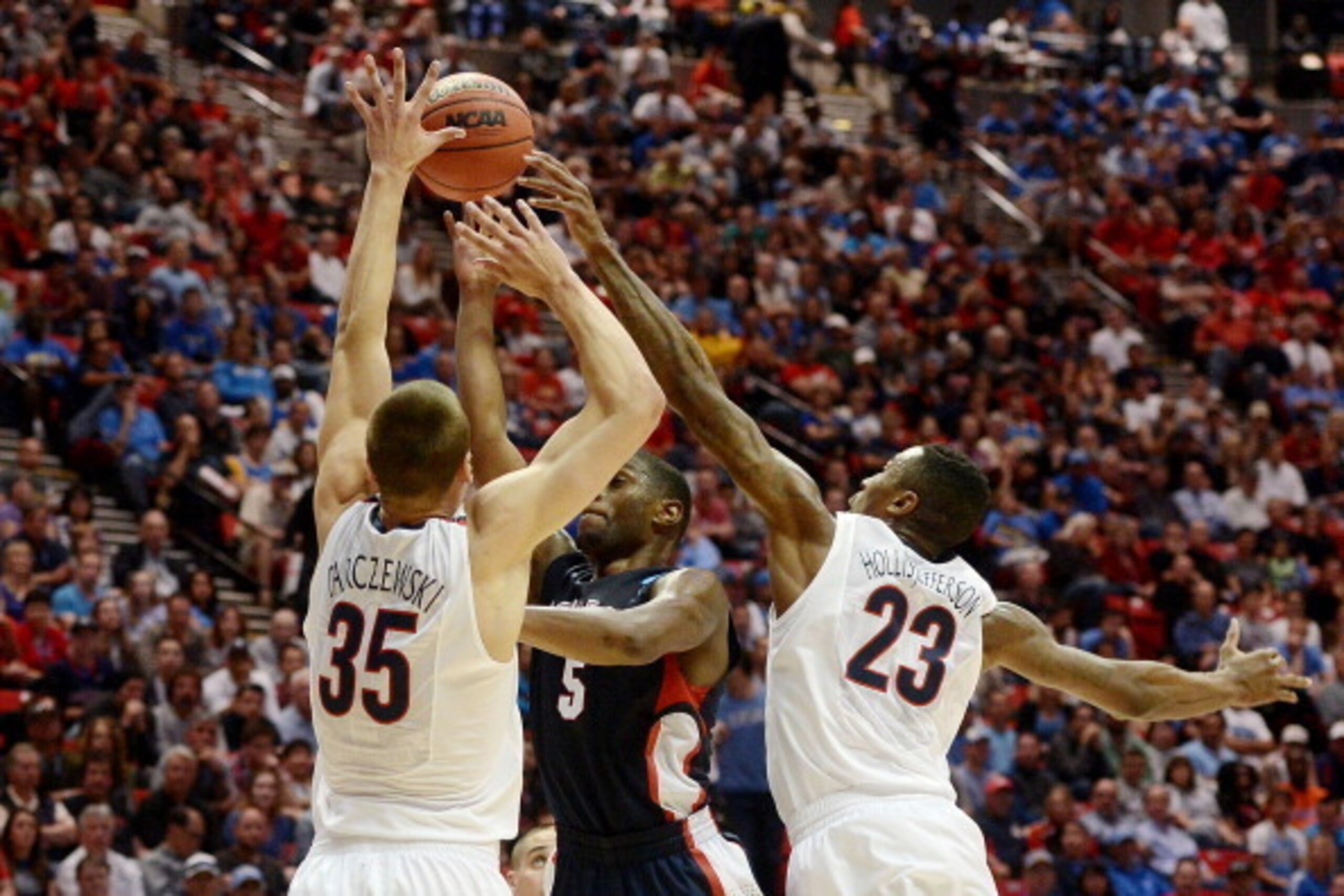
No matter where you are trying to shoot against Arizona, there will likely be a long arm in your face closing quickly. The most common lineup for the Wildcats features the 6'6" Stanley Johnson at shooting guard, 6'7" Hollis-Jefferson at small forward, 6'8" Brandon Ashley at power forward and 7'0" Kaleb Tarczewski at center.
Even when Tarczewski comes out, fellow seven-footer Dusan Ristic comes in to help defend the rim.
Although none of these players can be considered true shot-blockers, they can alter shots by just getting their hands in the air. Scoring inside is especially difficult, and it requires either a lot of toughness or some serious body control to get around the towers in the paint.
At the same time, the Wildcats use their athleticism on the perimeter to close quickly in rotations. Even when an opposing player sees a little bit of daylight, it disappears in a hurry.
Miller has scouted and recruited the perfect players to put into his system, and it seems to be working so far.
One-and-Done
This doesn't refer to Johnson's likely plans for college life before going into the NBA. Instead, this is about what opposing offenses have to deal with every time down the court.
Some of the easiest points you will get in basketball come on a putback when the defense doesn't box out. A missed shot often leads to a wide-open layup or dunk when you crash hard on the weak-side glass.
While Arizona is weaker on the offensive glass this season, it has done an excellent job at securing defensive rebounds. According to TeamRankings.com, the Wildcats lead the nation by grabbing 82 percent of opportunities on opponent's missed shots.
This incredible number was actually bested in the win over Michigan. Arizona had 31 defensive rebounds compared to just six offensive boards for the Wolverines. This means that after one (probably bad) shot, Michigan was done for the possession and had to go back on defense.
Stanford, Utah, UCLA and others will attempt to cause problems in the Pac-12 with the ability to get offensive rebounds and get second-chance points. However, the Wildcats can virtually shut down these offenses by limiting each possession to one shot.
Continuity

The team came into the year having to make up for the losses of Aaron Gordon and Nick Johnson, two extremely talented players who were valuable on both ends of the court. However, the majority of the rotation returned this season, and it gave the team a decent amount of experience.
To make things even better, Arizona has a short rotation that actually works to its favor. Six players have represented the team's core, as McConnell, Johnson, Hollis-Jefferson, Ashley and Tarczewski account for 80.5 percent of the team's minutes this season.
All except for Johnson have been playing together in Miller's system for over a year.
Ristic, Elliott Pitts and Parker Jackson-Cartwright have played in every game this year, but none of them average more than 15 minutes per game.
What this does is create plenty of continuity defensively to help create an even more fluid system. The players know where everyone is going to be on the floor and how to play off each other. A perimeter defender can be more aggressive going for a steal because he trusts his teammate to have his back if needed.
Everyone on the team works together to help create the No. 9 most efficient defense in the nation, according to KenPom. Based on the way the squad is playing, it wouldn't be surprising to see this number move even higher by the end of the year.
Offense might sell tickets, but this defense is what's going to keep Arizona in the national title discussion all year long.
Follow Rob Goldberg on Twitter for the latest breaking news and analysis.

.jpg?w=2560 "Aikman Blasts Cowboys WR 🫣")

.jpg?w=2560 "Jonathan Taylor Landing Spots")