Liverpool Academy Exclusive Q&A: Andy O'Boyle, Head of Fitness
It's Inside Liverpool FC Academy week here on Bleacher Report, and we're speaking with a host of individuals, players and staff to find out more about their roles at the club and how one of England's biggest sides gets the best out of its youngsters.


Day 3—Interview with Academy director Alex Inglethorpe and Picking an All-Time Homegrown Liverpool XI.
This time we're speaking to Andy O'Boyle, the head of fitness at the club's academy in Kirkby, to find out how the side maintains different ages of youth players in peak condition.
BLEACHER REPORT: From which age does the club offer sports science support and nutritional advice?
ANDY O'BOYLE: The club provides sports science support throughout the three development phases of foundation (u7-11), youth development (u12-16) and the professional development (u17-21) phase. From a sports science perspective, we monitor and assess our players by various means and provide an athletic development model whereby the priorities change as the players develop through maturation.
We work on fitness, conditioning and strength and power development in the gym, as well as recovery modalities and nutritional strategies to underpin our work.
We try to educate players and parents of the role and value of nutrition in various forms such as parent and guardian workshops, player workshops, food diary dietary analysis and individual consultations in order to help them understand their nutritional needs.
B/R: How closely do the fitness, physiotherapy and other medical departments work within the Academy?
AO: Each morning the medical and sports science staff meet prior to the players arriving for training to discuss player availability and readiness to train for that day on the pitch and in the gym. Clinical assessments, objective and subjective data are then used in the decision-making process for planning the players' workloads.
Depending on the players' training status, modifications can then be advised. The medical and sports science staff will then work together on injury reduction strategies and return-to-play protocols for those players who have been injured. GPS and heart-rate monitoring is used to quantify, support and evaluate the rehab process and fitness conditioning work to integrate the player back into training and match play.
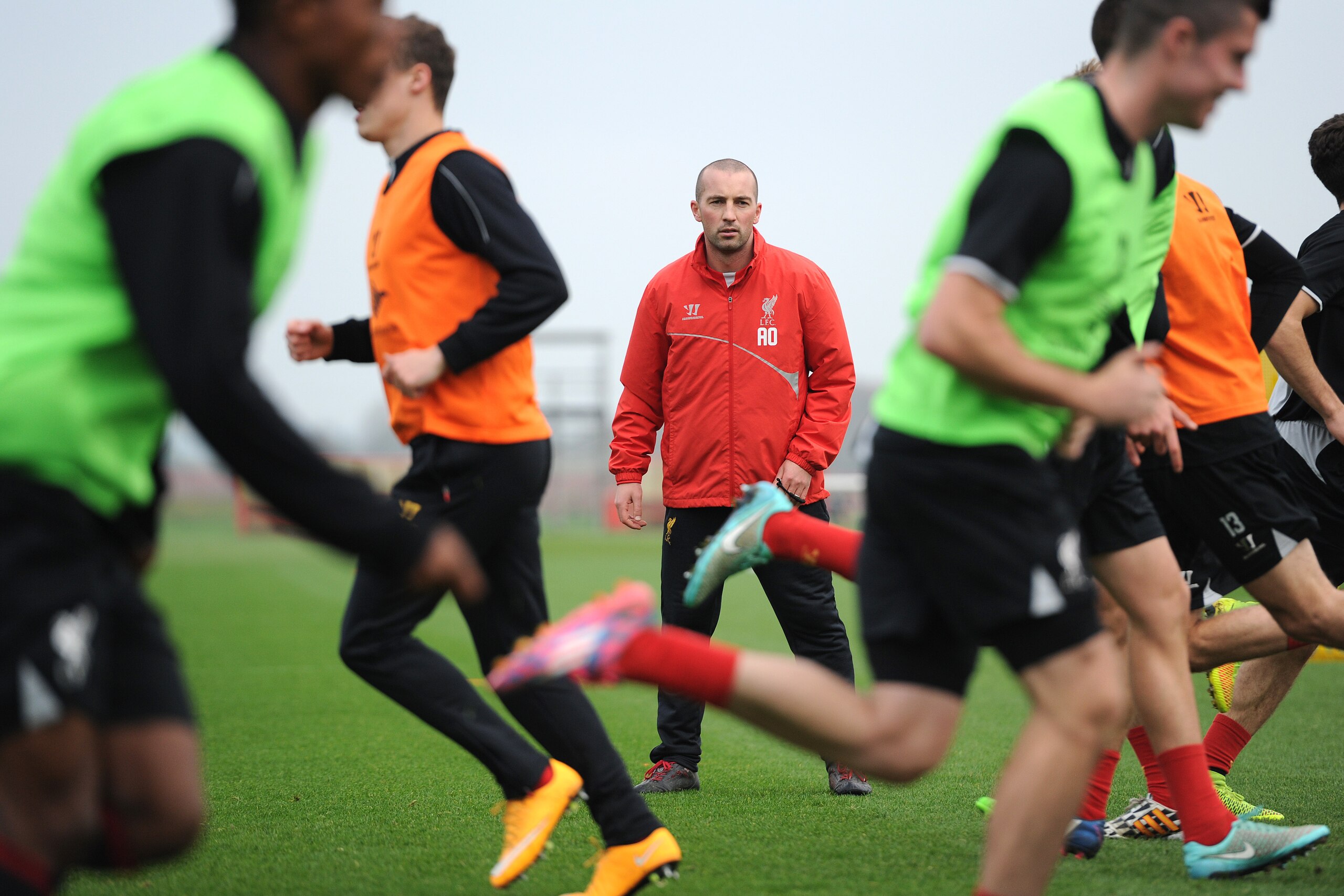
B/R: Is there a big difference in how a youth player might prepare with the U18s or U21s and then when they are called up to the first team?
AO: At Liverpool, we have a global training methodology that integrates technical, tactical, physical and mental capacities of players simultaneously in a football-specific way. This methodology is adapted throughout the club for each development phase so training is broadly similar across the age groups.
The physical conditioning stimulus of each day differs depending upon the game schedule; however, preparation is generally geared towards individual player development needs at U18 and U21 level.
B/R: What kind of work is done to develop physical traits at U21 level compared to say at U15s?
AO: With the U15s, most of the players have gone through their growth spurt (peak height velocity), so a lot of our athletic development work consists of improving and enhancing movement efficiency and embedding foundations for future strength and power development, as well as identifying any potential deficiencies they may have and putting interventions in place in order to counteract this.
At U21 level, the players are generally skeletally mature and thus more emphasis is placed on individualising their physical profile based on their assessments and what they may need within their positional demands and tactical requirements.
B/R: Are there examples in the first team of players who you tell the younger players to look up to in terms of managing their bodies and preparing well?
AO: For the academy players going to train with the first team, it's a great opportunity to see the preparation and attitude of the players firsthand. For example, how they prepare prior to training in the gym, how they apply themselves in the session and their conditioning work, how they recover from training and the strength and conditioning work they perform, their nutritional and lifestyle choices. It allows the academy players to look at the first-team players who are playing in their position and strive to work harder.

.jpg?w=2560 "NBA Gambling Charges")
.jpg?w=2560 "Aikman Blasts Cowboys WR 🫣")

.jpg?w=2560 "Jonathan Taylor Landing Spots")