Why the Charlotte Hornets Are the Most Disappointing Team in the NBA
No team in the NBA is further below its preseason expectations than the Charlotte Hornets.
The most disappointing team in basketball by a wide margin, the Hornets were losers of 10 straight games prior to Friday night's 103-102 win over the Knicks, in a game where they were leading by 18 in the fourth quarter and needed a buzzer-beater from Kemba Walker to survive at home.
The Hornets are one of three teams in the entire league feebly scraping by with a bottom-10 offense and a bottom-10 defense. Last year, Charlotte was the NBA’s little engine that could. Its stout defense carried the franchise all the way to the playoffs for just the second time since 2002.
TOP NEWS

Duren Calls Out 'False' Rumors

Pic of LeBron's Helicopter Commute 🚁

NBA Power Rankings Entering Preseason 🔢
This summer, the front office decided to up the ante, throwing a max-offer sheet at Gordon Hayward (which was matched by the Utah Jazz), signing Lance Stephenson to a cool three-year, $27.5 million contract (with a valuable team option in the third year), grabbing Marvin Williams for a lamentable $14 million and officially making Kemba Walker the franchise point guard.
It’s not even Christmas, but so far none of those decisions look promising. Stephenson’s shooting numbers could very well inspire a Rob Zombie movie (.385/.167/.674), birthing reports that the team may be looking to trade him sooner rather than later. Williams has four free-throw attempts in over 400 minutes, and Walker still makes scoring in the paint look more strenuous than deciphering the end of Interstellar.
Here's Grantland’s Zach Lowe with some insight into Charlotte’s difficult situation:
"The Hornets are searching for upgrades on the wing and at power forward, and they are willing to talk turkey on basically anyone other than Kemba Walker and Al Jefferson. Free agents signed this past offseason can’t be traded until Dec. 15, and few would be surprised if the Hornets make and take calls on Lance Stephenson ahead of that trigger date.
"
Stephenson is an irksome player, known for stealing rebounds from teammates (he’s averaging a career-high 7.6 rebounds per game, but only 17.1 percent of them are contested—meaning a defender is within 3.5 feet—which is comical), over-dribbling into pointless turnovers and, most disturbing, failing to consistently exert maximum effort on the defensive end.
Here's Stephenson trying to take what isn't his, followed by a firm "thanks, but no thanks" from Al Jefferson:

Moments before the clip seen below happened, Stephenson turned the ball over. His man, Jimmy Butler, proceeds to put back an easy offensive rebound. Why was it so easy? Stephenson jogged back for no explicable reason:

Charlotte’s main problem, though, is its inability to space the floor. Only the Philadelphia 76ers are less accurate from deep.
Gerald Henderson is 8-of-26 (but can sometimes threaten defenses with timely cuts from the weak side), Walker is 22-of-82 (a horrendous 26.8 percent) and Brian Roberts and P.J. Hairston aren’t much better (though Hairston has serious "flames emoji" potential).
Williams, the free-agent stretch-4 savior, isn’t stretching anything except Michael Jordan’s checking account. The only player making more than 39 percent of his threes is Gary Neal, who recently injured his shoulder.
Jefferson is the Hornets’ best player by a mile. He's a seasoned blacksmith in the low post who commands help from guards who drop down to dig whenever his back is to the basket. With no shooters on the perimeter, this is problematic for Jefferson, which makes it problematic for Charlotte’s offense as a whole.

Beyond the spacing issues, Charlotte is dead last in fast-break points, with only 7.5 percent of its offense coming in transition. It's also incapable of extracting valuable points off turnovers. Both of these areas were issues last season, too, but they’ve gotten a smidge worse. With no ability to space defenses out in the half court, these are a couple of areas where the Hornets could stand to boost their attack.
Aside from an occasional ankle-disintegrating crossover, that help probably won’t come from their point guard. Fresh into a four-year, $48 million contract, Walker is really struggling. It appears finishing at the rim will always be a major issue for him; if he isn't hitting outside shots, his status as a lead guard could be in doubt.

Defensively, Charlotte has lost its way. This is partly due to Michael Kidd-Gilchrist's lingering foot injury. The former second overall pick has been sidelined since Veteran's Day. He's a spiderweb on the perimeter, and not having him defend the opposition's top scorer every night puts more pressure on everyone else to rotate correctly and to help when a teammate gets beat off the dribble.
It's worth noting the Hornets are giving up about the same number of threes per game as they did last season, and opponents are knocking them down at about the same clip. But Kidd-Gilchrist's injury forces Charlotte to lean on smaller lineups that generally make life harder. And having no rim protection only compounds the problem.
According to SportVU, no group is worse when it comes to contesting shots at the rim; teams are filleting Charlotte where it hurts the most, making 57.7 percent of these shots. Conversely, the Hornets do as good a job as any team of limiting attempts that occur so close to pay dirt, but this is sort of like stopping traffic with a speed bump instead of a giant cinder block.
Jefferson is the primary culprit. He's on the floor about 33 minutes a night, and of all the players who defend at least seven shots at the rim per game, only Kevin Love and Paul Millsap allow a higher percentage. He's physically slow, has a poor reaction time and too often puts himself in an awkward position.

Alas, all in the land of teal and purple is not a sad, inescapable nightmare. Hornets head coach Steve Clifford—a serious contender for Coach of the Year just one season ago—finally shook up his starting lineup last week, sticking with Cody Zeller after Williams missed a few games due to injury.
The former fourth overall draft pick is actually having a pretty strong season. His size (7'0", 240 lbs) makes him an undoubtable upgrade on the defensive end, and numbers give this theory some weight. The Hornets score 8.3 more points per 100 possessions and allow 4.3 fewer points with Zeller on the floor instead of Williams. He has steady hands, improving outside touch and feral athleticism.
What's really interesting is the Hornets never see more success than when Zeller shares the floor with Bismack Biyombo—a net rating of plus-15 points per 100 possessions is far and away the best among any two-man combinations that have logged at least 100 minutes.
Biyombo’s mutation into a shot-blocking menace who wreaks havoc on the perimeter, and makes three-point shooters pee their pants, is nearly complete. His athleticism is freaky, and the Hornets allow just 102.2 points per 100 possessions when he’s on the floor (a figure that nearly passes as a top-10 defense).
Biyombo’s "collection" of post moves barely hold a candle to Jefferson’s blazing sun, but he’s somewhat effective rushing the rim after a high screen. He currently has the team's second-highest PER.
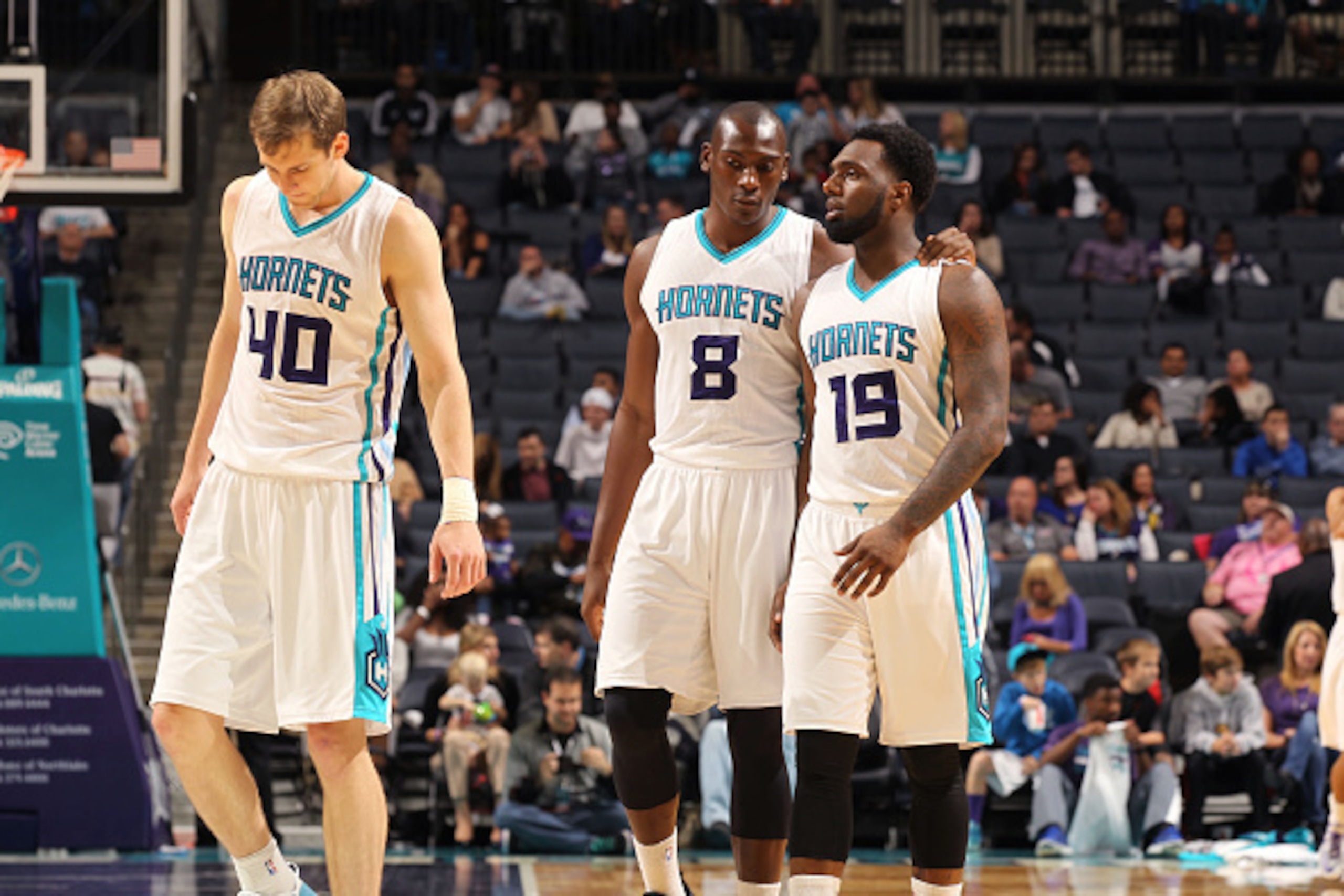
These two aren't a game-changing presence by themselves, but they're at least something to smile about. Some more positivity: The Hornets don’t turn the ball over, are one of the best defensive rebounding teams in the league (which is cool, since they’re terrible on the other end), have faced one of the toughest schedules in the league and could get Kidd-Gilchrist back in the lineup by next Wednesday.
All that's good news...but the Hornets still aren't a very good team. Their two biggest problems (spacing and rim protection) are not fixable with the players they have. A trade is possible, but mortgaging the future to "fix" a roster that’s not doing anything anyway would be a big mistake.
No team wants to stink it up as a pseudo-laughingstock, but instead of being soundly dismissed in a first-round sweep, Charlotte may be better off scooping a high draft pick in this summer's draft, then targeting some real outside shooters in free agency on the open market.
All statistics are courtesy of Basketball-Reference.com or NBA.com, unless otherwise noted.
Michael Pina is an NBA writer who's been published at Bleacher Report, Sports on Earth, Fox Sports, Grantland and a few other very special places. Follow him on Twitter @MichaelVPina.
.jpg?w=2560 "NFL investigating referee after viral exchange with player")
.jpg?w=2560 "OBJ Calls Out Giants After Release")