Washington Redskins Not Learning Winning Habits Under Jay Gruden
Winning habits in the NFL aren't the that tough to define. It's not like trying to work out the plot to The Tree of Life, or wondering why anyone would sit through an episode of American Idol.
The tip sheet for winning at the pro level is pretty simple. If you wanted to construct a checklist, it'd probably involve the following: Create Turnovers, score off turnovers, protect the football and minimize penalties.
If a team can do all those things, it will probably win regardless of talent. Not doing those things explains why Jay Gruden's Washington Redskins can't win.
TOP NEWS
.jpg?w=2560 "Titans Giants Football")
OBJ Calls Out Giants After Release
Lamar Jackson Day-to-Day

Live Live: Updates from every NFL game
Since he took over this offseason, Gruden has failed to do the one thing every coach trying to turn around a losing roster must do. He hasn't taught his team not to beat itself.
Instead, the 2013, Gruden-led Redskins have become masters at finding ways to make games more difficult, ways to lose. That's been most obvious during the last two weeks.
Washington has lost consecutive road games to the San Francisco 49ers and Indianapolis Colts, respectively. The scores in each game were 17-13 and 49-27.
Despite the disparity against the Colts, the Redskins had their chances to win in Indy, just as they did in the Bay Area. But winning in the NFL, particularly against playoff contenders, demands following the winning checklist and doing the basics.
Washington certainly didn't do that when its defense forced two early turnovers from Colts quarterback Andrew Luck. Thanks to a stuttering offense, those takeaways yielded just three points.
In total, the Redskins forced three turnovers in Indianapolis and had only a 25-yard Kai Forbath field goal to show for them. It was the same against the 49ers, when a pair of fumbles from Frank Gore and Carlos Hyde and a Colin Kaepernick interception translated to a mere three points.
That's six turnovers producing the same number of points. That's not winning football. That's not how a struggling team gives itself a chance to win on the road.
Almost hand-in-hand with the takeaways, winning the field-position battle is crucial. But creating a short field for your offense and a long one for your defense is just the start of it.
A team must maximize its field-position advantage. The Redskins were dire in this area against the Colts, on both sides of the ball.
Offensively, that meant turning four drives that started in Indianapolis territory into just a pair of field goals. Poor pass protection, penalties and issues handling the football all contributed.
The first of two examples where all of these woes converged occurred near the end of the opening quarter. The Redskins started with excellent field position at their own 47-yard line.
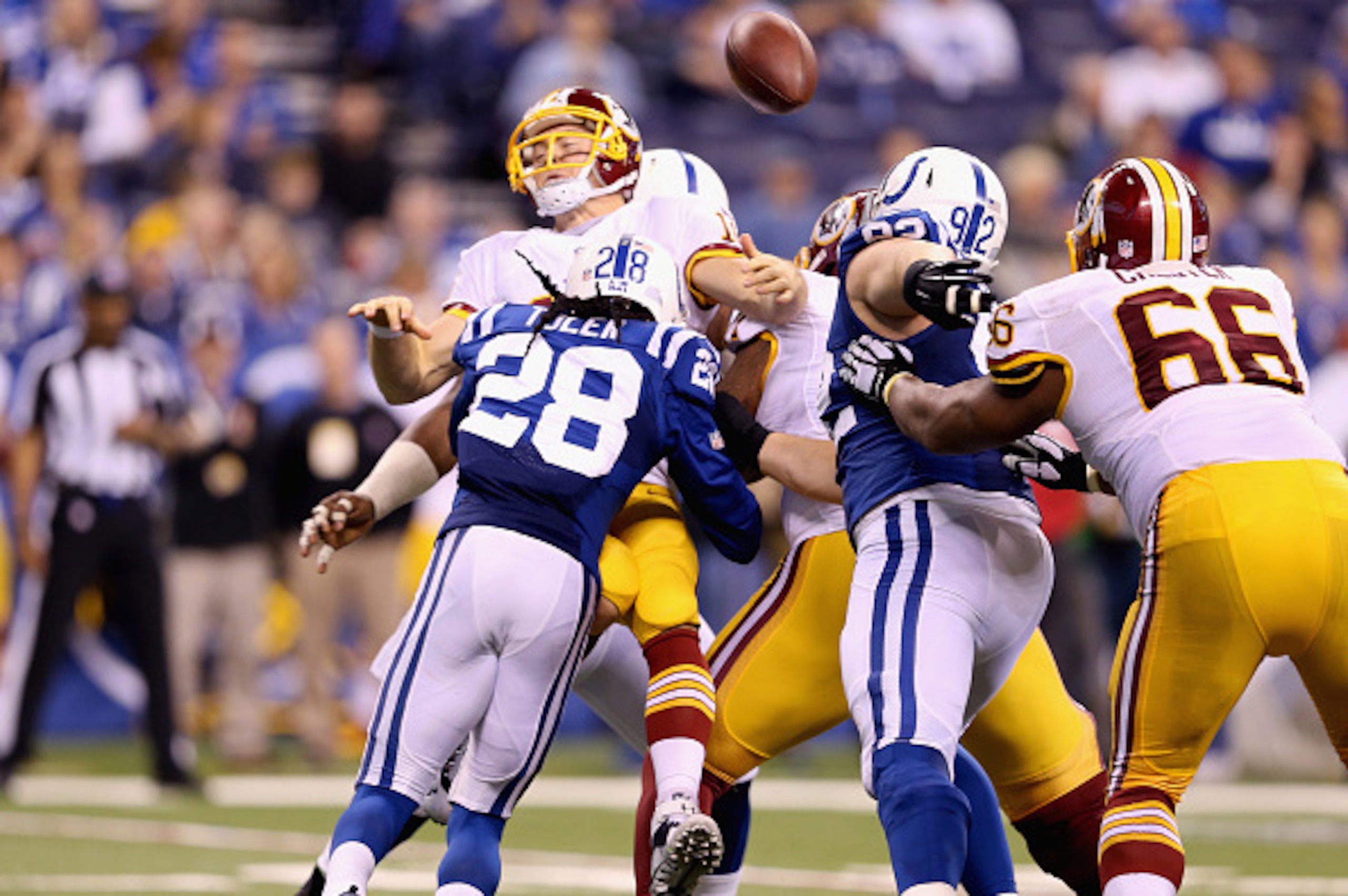
On first down, running back Alfred Morris fumbled a toss from quarterback Colt McCoy. Washington recovered but lost a yard. On the next play, feeble protection caved in, leading to a sack for a loss of nine. The O-line wasn't helped by McCoy channeling his inner Robert Griffin III and holding onto the ball for an eternity.
What started out as great field position while trailing just 7-3 took just two plays to unravel. That's how teams lose on a weekly basis.
If you needed further proof, Washington's offense provided it with 10 minutes left in the fourth quarter. The Redskins faced 2nd-and-8, but soon turned that into 3rd-and-27.
Mike Jones of The Washington Post detailed how they did it:
That two-play sequence of calamity, followed by Jones' justified exasperation, could sum up the Gruden-led Redskins, particularly the catastrophic offense.
No unit will produce the points needed to win a game when it creates its own negative plays via penalties and can't protect its quarterback. Washington was flagged 10 times for 78 yards against the Colts, with five being drawn by the offense. McCoy was also sacked six times.
As for the defense, struggles just getting lined up, the inability to tackle and general confusion led to allowing touchdown passes of 30, 48, 73 and 79 yards, as well as a 49-yard scoring run.
ESPN.com Redskins reporter John Keim highlighted the uncertainty in the secondary as a particularly obvious issue:
If you can't give yourself an edge with takeaways and field position, at least keep games close via good fundamentals. A defense that can't line up or tackle is only going to do one thing: Surrender more big plays than it creates.
Rebuilding teams need to observe the basics and create winning habits in order to go from losing to contending. Washington's Week 13 opponent proved that.
The Colts were 2-14 in 2011, but 11-5 in 2012. That was the same year the Redskins went from 5-11 to 10-6. They did it behind an efficient offense that protected the ball and produced big plays. That unit was complemented by an opportunistic defense.
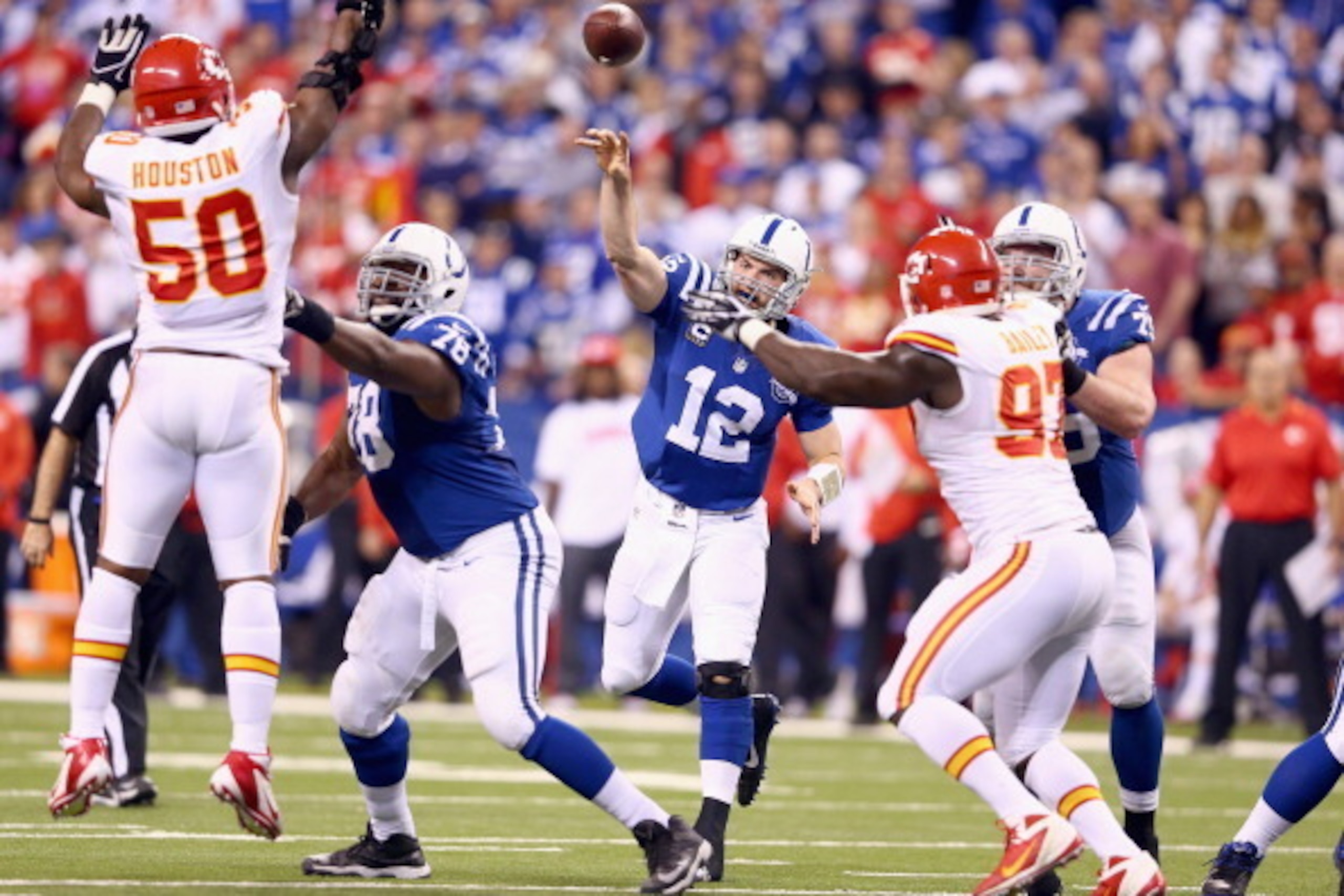
While the Redskins and Colts were rejoining the playoff mix, it was the Kansas City Chiefs' turn to go 2-14. That record soon became 11-5 in 2013, thanks to an offense that protected the ball, a defense that binged on turnovers and a special teams unit that turned big plays into an art form.
In a modern NFL defined by its parity, the formula for turning around a losing program need never be confused with rocket science. All that's required is stressing the importance of consistently doing the simple things well until that becomes a winning habit.
The first job of any coach rebuilding a losing team has to be teaching sound fundamentals and winning habits. But instead, Gruden's team could teach seminars on how to create losing situations.
Perhaps they could host a course in Arizona, the site of this year's Super Bowl. Because that's the only way this franchise will get close to a Lombardi Trophy with this coaching staff.
All statistics via NFL.com.



.jpg?w=2560 "Saquon Out for Game")