Eric LeGrand Discusses HBO's State of Play in Bleacher Report Exclusive
On Oct. 16, 2010, Eric LeGrand's life changed forever. A promising defensive lineman at Rutgers, LeGrand was serving on the kick coverage team when he attempted to make a seemingly innocuous tackle on Army return man Malcolm Brown.
Lowering his head as he had so many times, LeGrand connected with Brown's shoulder and sent him spinning to the ground. It would be his last collegiate tackle.
The torque of the hit caused LeGrand to suffer fractures to his C3-C4 vertebrae, paralyzing him from the neck down. Doctors gave him almost no chance he'd walk again, and for most of his early hospital stay he was forced to breathe from a ventilator.
.jpg?w=2560)

.jpg?w=2560 "Election 2024 Julie Pace Column")
More than four years removed from his life-changing injury, LeGrand now serves as inspiration for millions. Through arduous rehabilitation and the support of family, friends and former teammates, LeGrand regained movement in his shoulders and sensation through his entire body. In his recovery he's become a renowned sports figure, a spokesperson for multinational brands and one of the leaders working on a cure for paralysis.
In 2012, he was awarded the Jimmy V Award for Perseverance, signed an honorary contract with the Tampa Bay Buccaneers and was named the most influential person in New Jersey sports by The Star-Ledger. In 2013, his No. 52 was retired by Rutgers University—the first number ever retired by the program. He's started a charity, written a book and began a broadcasting career all by the age of 24.
Now LeGrand can add documentary subject to his ever-growing list of accomplishments.
LeGrand is one of two focuses in State of Play: Broken, which debuts Tuesday night (10 p.m. ET) on HBO. The second part of a four-documentary series, Broken tells the stories of LeGrand and mountain biker Steve Shope, a childhood friend of director Peter Berg who was paralyzed while riding.
The film seeks to get a better understanding of their respective lives, how they deal with their paralysis on a day-to-day basis and the effect their injuries have had on the people closest to them. LeGrand discussed State of Play, his charity work and more in a one-on-one interview with Bleacher Report on Monday.
B/R: I wanted to start off talking a little bit about the film. Can you give a brief synopsis on how the story unfolds from your perspective, and what made you want to get involved with the project?

Eric LeGrand: It started when I met Peter Berg on the Lower East Side about two years ago. He told me he wanted to do a documentary with one of his buddies [Steve Shope] and I about how people are living with paralysis. And it’s not just the positive stories, he wants to see the insides of it—the things people don’t see behind the scenes.
When you see the film, you’re going to see the struggles of this injury and what people go through. You can see how someone’s life can change on the drop of the dime. Like Steve, he’s older than me, married with kids. Then there’s me, a younger kid with my dreams of going to the NFL. It doesn’t discriminate—it can happen to anybody at any time.
I wanted to get that out there and have people see and have a feel for [the realities of paralysis]. And to not look at people in a wheelchair and see them as sickly or diseased from an injury.
B/R: So, you wanted to give them a look at the downsides, instead of what they see on television? At a behind-the-scenes look at the realities?
EL: Yeah, when you see my story on TV it’s all the positive, inspirational stuff. It’s great, but I want people to see the behind-the-scenes stuff. How do I live with this injury on a day-to-day basis? How do I go about my life? Who are the people that are helping me that you don’t see? What kind of struggles do I go through on the night? Like waking up my mom to come scratch for me. Or when my mom needs a break, who is bringing me around?
Seeing how a community comes together—this injury really shows the behind-the-scenes stuff that people never get to see. They’re usually the pieces that get left out.
B/R: Peter Berg, who collaborated with HBO on this project, has done extensive work in sports—most notably with Friday Night Lights and ESPN’s 30 for 30. Did his resume play any factor in you getting involved?
EL: I’m not gonna lie to you, I didn’t know who Peter Berg was when I first met him. He came up to me at a pizzeria on the Lower East Side and was like, "Hey, are you Eric LeGrand?" And I’m thinking maybe he’s one of my supporters or fans who just wanted to say hello. Then my friend goes, "You’re the director of Friday Night Lights?" And I was like "Wait, what?" [laughs]
After that, we stayed in touch and became close friends. Then he came up with this idea and I was all for it.
B/R: A lot of people know your story, but I don’t think nearly as many are aware of Steve Shope’s. Did you know of Steve before filming began? And how well did you get to know him throughout the process?
EL: I had no idea who Steve was. He was one of Berg’s high school friends. He had this paralyzing injury too—it just shows you how it goes with this injury. It can happen to anybody, and it changes people’s lives.
I had no idea who Steve Shope was before I got to meet him working with Peter Berg. We consider ourselves a family you don’t want to be a part of. Once you’re in it, you’re in it. You have each other’s backs and reach out whenever you need support.
B/R: So filming was a bonding experience?
EL: It was. You get to see different sides of how people go through paralysis. He had a career, he had a daughter and son in college, a wife—and then he has to handle that now. Then you look at myself, a college kid in my junior year working hard to get to the NFL and my life instantly changes.
Two totally different sides, and you get to see the similarities and differences of the injury from people’s lives.
Q: In the aftermath of your injury, you went through countless hours of rehabilitation. Stuff that most people couldn’t even imagine. How did you make your way through and keep battling? Was there anyone or anything in particular who helped push you?
EL: My support system has been tremendous. They’ve guided me and pushed me through this whole thing. All the people I’ve been able to touch by just being the person I am keeps me motivated. It makes me take this as a responsibility. I gotta get better, I can’t let all these people down, I can’t give up on them.
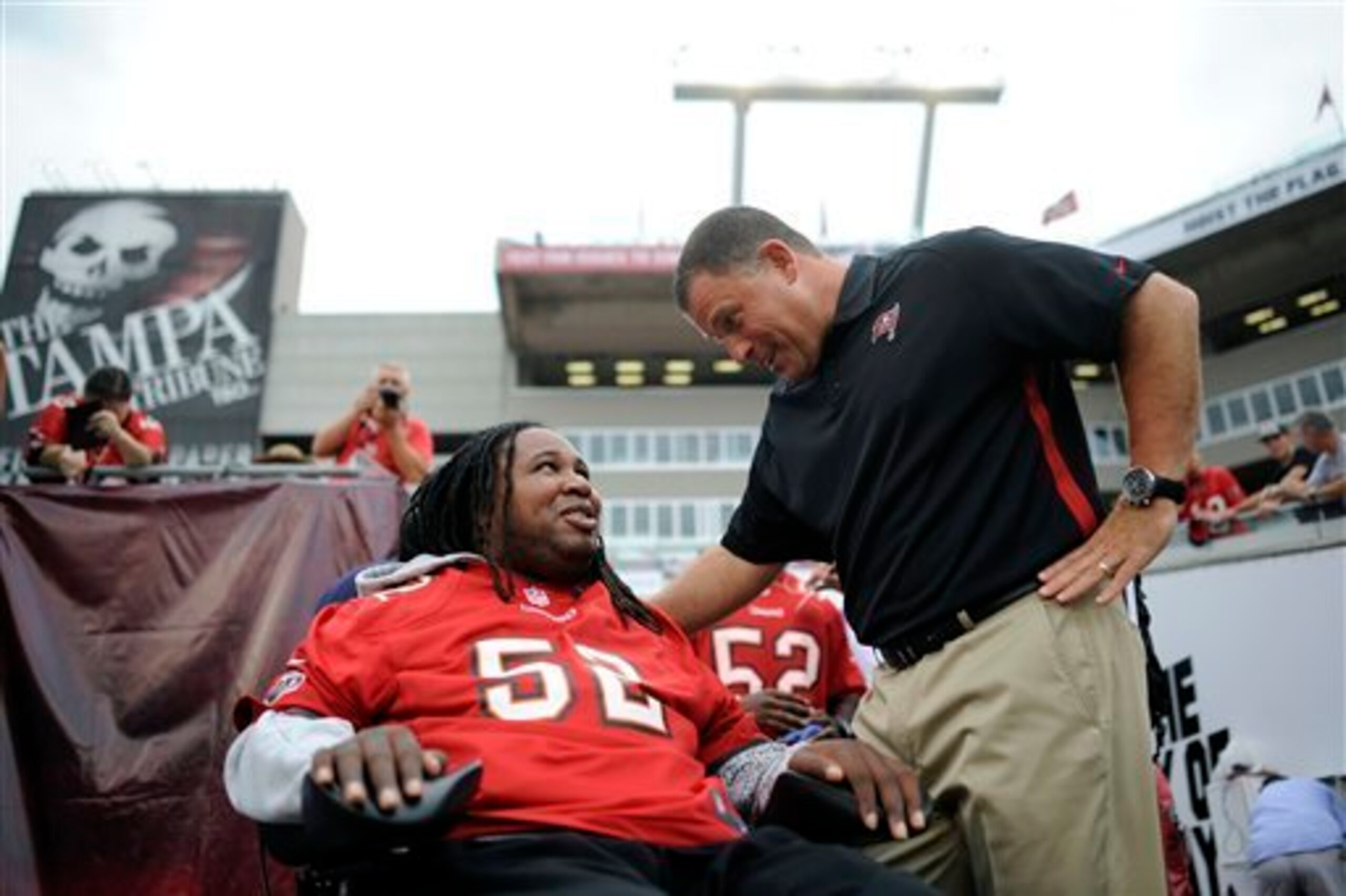
B/R: I know you and Coach (Greg) Schiano have a special relationship. You (symbolically) signed a contract with the Buccaneers when he was with the team in 2012. What was the best moment of that whirlwind?
EL: That day I got to sign the contract was incredible, but it was the first time I actually got to do down there and address the team in the locker room. I got people like Dallas Clark, who I watched catch passes from Peyton Manning my whole life who’s now on my favorite team, and he’s sitting in the front row smiling listening to my story. Then talking to Gerald McCoy down there.
They brought me in like I was part of the family. I felt like one of the players like I was at Rutgers. I felt that about the team in Tampa Bay too. All these guys I’ve seen play before and been looking up to, and I get to share my story with them? And they want to hear every part of it. You could hear a pin drop in there.
That was probably the most amazing part.
B/R: It was probably a relief to be treated like part of the team again.
EL: Exactly. Exchanging numbers with them, joking around with locker room talk, sharing stories from when I was in college, from when they were in college. It was incredible.
B/R: One of the things I like about the State of Play series is that it takes micro stories and applies them to macro issues. Yours and Steve’s stories can be applicable to anyone fighting through a rough time in their life. How do you approach being a role model to so many—does it ever get rough?
EL: It comes with the territory. That’s the best thing about it. I’m just living the life the only way I know how to, and if people look up to me that’s even better because it helps them. Sometimes people think I need to put on a show for everyone, but no. I’m not going to put on a show for anyone. This is who I am. I’m happy, and if you look up to me that’s great.
B/R: I’m sure people come up to you all the time with stories of their travails. Are there any of them that stick out in your mind at all?
EL: There are a bunch of stories that I’ve gotten over the years. But I was actually just talking about [this story].
I do radio shows here on Monday nights. It was early in the season, and I was talking about Alabama—talking down about them, like they’re not the old Alabama team. Right after that, we get a call from Alabama. I’m just thinking, "Oh, someone’s about to really rip me. Someone’s about to go in on me." [Laughs]
It was actually someone who comes on the line and goes, "Mr. Eric, I have two kids who are six and seven now—I want to tell you a story about my wife who had a cancerous tumor on her head." He said [his family] was praying for me through this whole injury process and they read my book. Then his wife found a cancerous tumor on her brain, and from there she started having seizures before she eventually had a stroke.
Throughout this whole year period, her kids were telling her, "You gotta work hard like Mr. Eric, does. Eric wouldn’t give up, Mom. You can’t give up."
Now she’s living cancer free. She’s learned how to walk again, not having seizures anymore. I’m like, “Wow.” It shows I’m really making a difference in this world. Some people from a small town in Alabama calling me up and telling me that story. I have no idea who these people are, but they’re following my story.
I had no idea. It made me think I must be doing something right. It’s an amazing story.
B/R: I also wanted to touch on another macro issue: safety in football. One of the later State of Play episodes will examine whether football leagues are doing enough to keep their players safe. Berg wrote a piece in Time in September saying he will no longer allow his son to play football. Do you have any thoughts on that, and do you think enough safety precautions are being taken in football?
EL: I think they’re doing a great job with the safety precautions. Football is a dangerous game. Every person who straps up his helmet knows the risk he takes. It’s unfortunate when an injury happens, but we all know the risks.
I believe they’re doing a great job. Changing the game up, making different rules and penalties. I can’t commend them any more about it—and this is coming from someone who’s been paralyzed from the game. I knew the risks I was taking going out there.
You can’t change the game of football too much. It’s a violent game. You have big bodies flying around at full speed making full contact with each other. They’re doing a great job already, and I think they’re going to continue to.
B/R: What will State of Play show about Eric LeGrand that people wouldn’t necessarily know before watching?
EL: Mainly working with Team LeGrand and the Christopher & Dana Reeve Foundation. How we’re trying to raise money to find a cure for paralysis and how we help people with their quality of life.
You’ll see me in the movie walking on the NeuroRecovery Network treadmill, which we want to get into more rehab centers across the country so that people can get the same benefits that I have. [Editor’s note: The NeuroRecovery Network treadmill is a system that “re-teaches the body how to walk using manual assistance by specially-trained physical therapists,” according to Team LeGrand’s website.]
You’ll get to see a whole aspect on how I work with my foundation, but also how I live my life outside when I’m working for the foundation or in therapy or in broadcasting. How I enjoy myself and go out to the club with my friends. Or I go to a football game.
You’re going to see the fun side of Eric, too. I’m excited to get it out there.
Follow Tyler Conway (@tylerconway22) on Twitter

.jpg?w=2560)



.jpg?w=2560 "Reported Details of Seahawks-K9 Split ⛓️💥")