How 49ers Offense Can Overcome Stacked Defensive Boxes
Opposing teams must have taken a look at what the St. Louis Rams did defensively to the San Francisco 49ers in their 13-10 win in Week 9: They stacked the box and took away the 49ers' running game.
It is an approach that if successful can throw a fragile 49ers offense off its rhythm, further subjecting it to the plethora of problems San Francisco has endured this season.
St. Louis had little choice but to do this. Through Week 12, the Rams have allowed 1,274 rushing yards on the year—the 12th-highest in the NFL. The New York Giants—ranked No. 2 in the same category (1,569)—attempted a similar approach against San Francisco in Week 11.
TOP NEWS
Bears' Santos Wanted to Kick 58-Yarder
Picking Each NFL Division Winner 🔮
.jpg?w=2560 "Chargers Chiefs Football")
Reported Details of Seahawks-K9 Split ⛓️💥
Teams like the Rams and Giants recognized their own defensive weaknesses. They also understood that taking away an essential 49ers element—the running game—could prove beneficial.
The Washington Redskins also attempted to follow this trend in Week 12.
All three of these teams rank, at least on paper, far below San Francisco from a defensive standpoint. Yet St. Louis, New York and Washington all held the 49ers to less than 17 points in each respective contest.

Now San Francisco will have to contend with the Seattle Seahawks in Week 13—a team that is perfectly capable of limiting the run with or without a loaded defensive front.
How can the 49ers overcome this? Is there a way in which San Francisco's offense can figure out how to maintain balance against tougher defenses that will look to make it one-dimensional?
Let's try to answer that.

Breaking Down the Numbers
Stuffing the box has been an effective strategy that has upended the 49ers' offensive abilities in recent weeks.
San Francisco's combined 43 points in three of the last four contests against inferior teams are not particularly inspiring.
The 49ers offense is struggling—an aspect that is further illustrated by the video below. But let's dive a little deeper first.
When teams sell out to stop the run, San Francisco's offense is forced to make adjustments. How successful have the 49ers been in these aforementioned contests? This chart breaks down some of the numbers:
| Week 9 | vs. St. Louis Rams | L, 13-10 | 80 | 183 | 263 | 8 |
| Week 11 | @ New York Giants | W, 16-10 | 148 | 185 | 333 | 1 |
| Week 12 | vs. Washington Redskins | W, 17-13 | 66 | 246 | 312 | 2 |
In Week 9, the Rams held the 49ers to just 80 yards on the ground. San Francisco attempted to move the ball through the air—much like it did against St. Louis in Week 6—but with far worse results. The passing offense gained just 183 yards, and the offensive line allowed eight sacks to a Rams team that entered the contest with just six on the year.
San Francisco shored up its pass-protection issues to an extent in Weeks 11 and 12, allowing one and two sacks, respectively.

But the 49ers are still tied for second in the league with 34 sacks allowed. Only the 1-10 Jacksonville Jaguars have given up more (43).
It is easy to claim that San Francisco is vulnerable when forced to rely solely on its passing game.
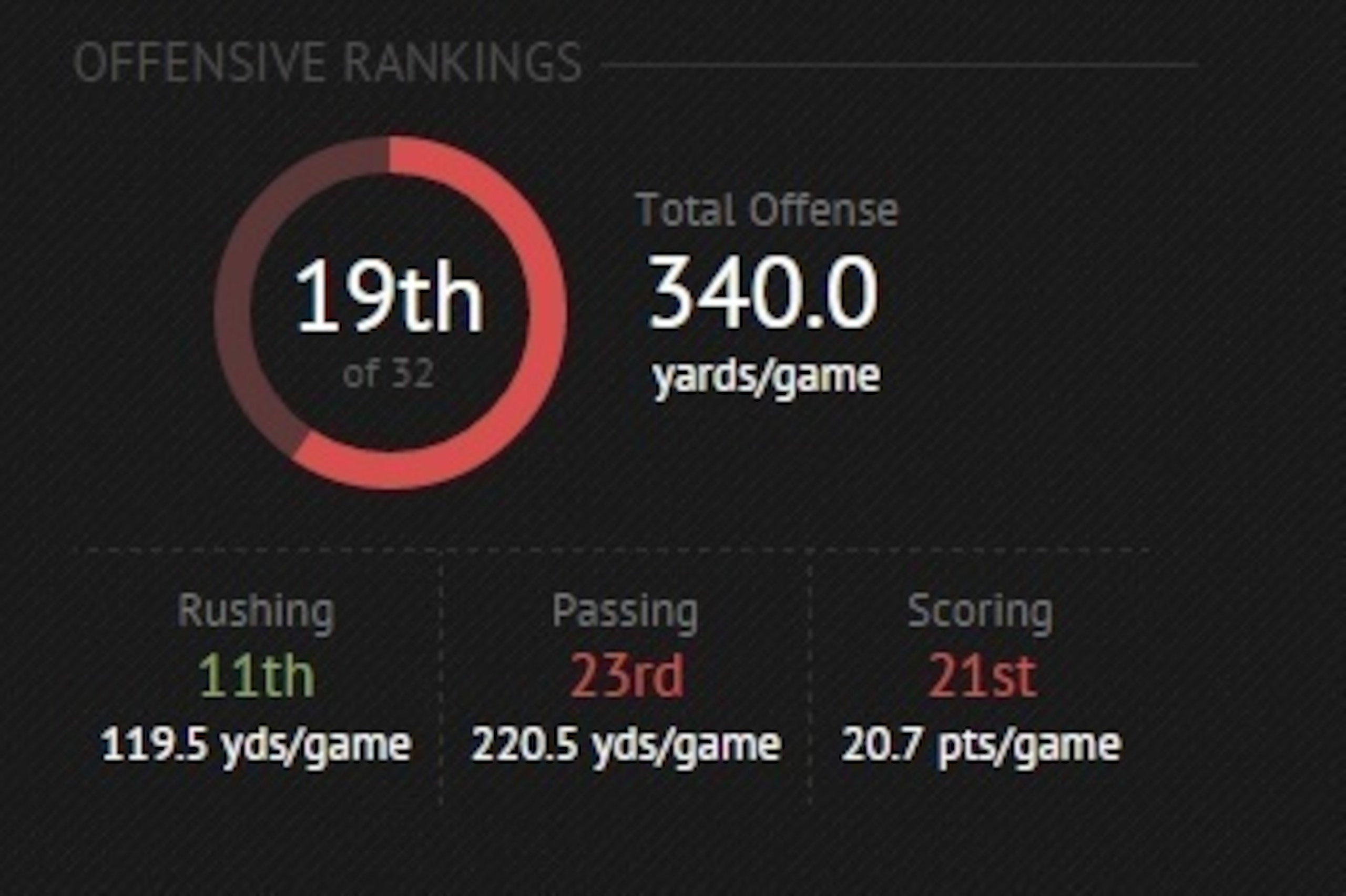
The blame can be widespread. We can call out quarterback Colin Kaepernick for not recognizing pressure. Offensive coordinator Greg Roman's play-calling is at issue. The offensive line needs to do a better job in one-on-one matchups. Kaepernick's receivers need to be better at getting open and running the correct routes.
It's a complicated issue, and one that won't get any easier when the 49ers take on elite defenses such as those of Seattle and the Arizona Cardinals in the coming weeks.

Breaking Down the Film
It's easy to overcome defenses that stack the box, right?
One might think so, but the vast array of elements that play into this equation make this assumption more difficult to support.
First, there is the play-calling. This encompasses not only the right approach and game plan but the correct implementation and execution on the field. Such can be said when teams sell out to stop the run as well as in instances where the 49ers are attempting to move the ball through the air.
Let's start with a run-first approach.
The first play in question will be San Francisco's game-winning touchdown against Washington in Week 12—a four-yard rush from running back Carlos Hyde at the 2:59 mark of the fourth quarter.
Hyde (circled with yellow arrow) will receive the handoff. The 49ers O-line will pull to its left, moving away from Washington's edge-rusher in a seven-man defensive front.
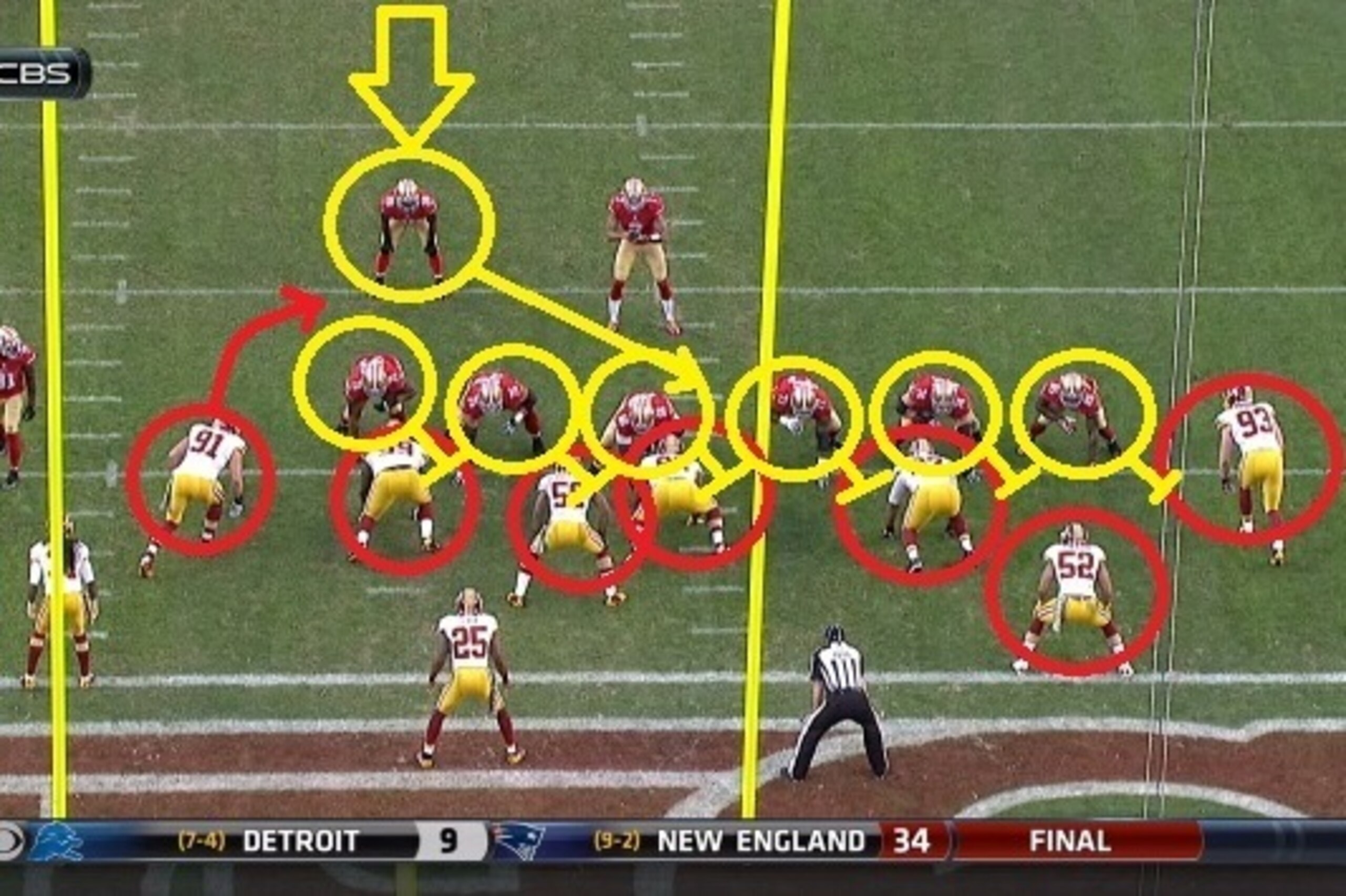
No. 25 attempts to plug the exploited gap in the Redskins' line. Hyde will attempt to evade this tackle by shifting slightly to his left. Note that the remaining San Francisco blockers are playing their necessary parts in winning the vital one-on-one matchups.
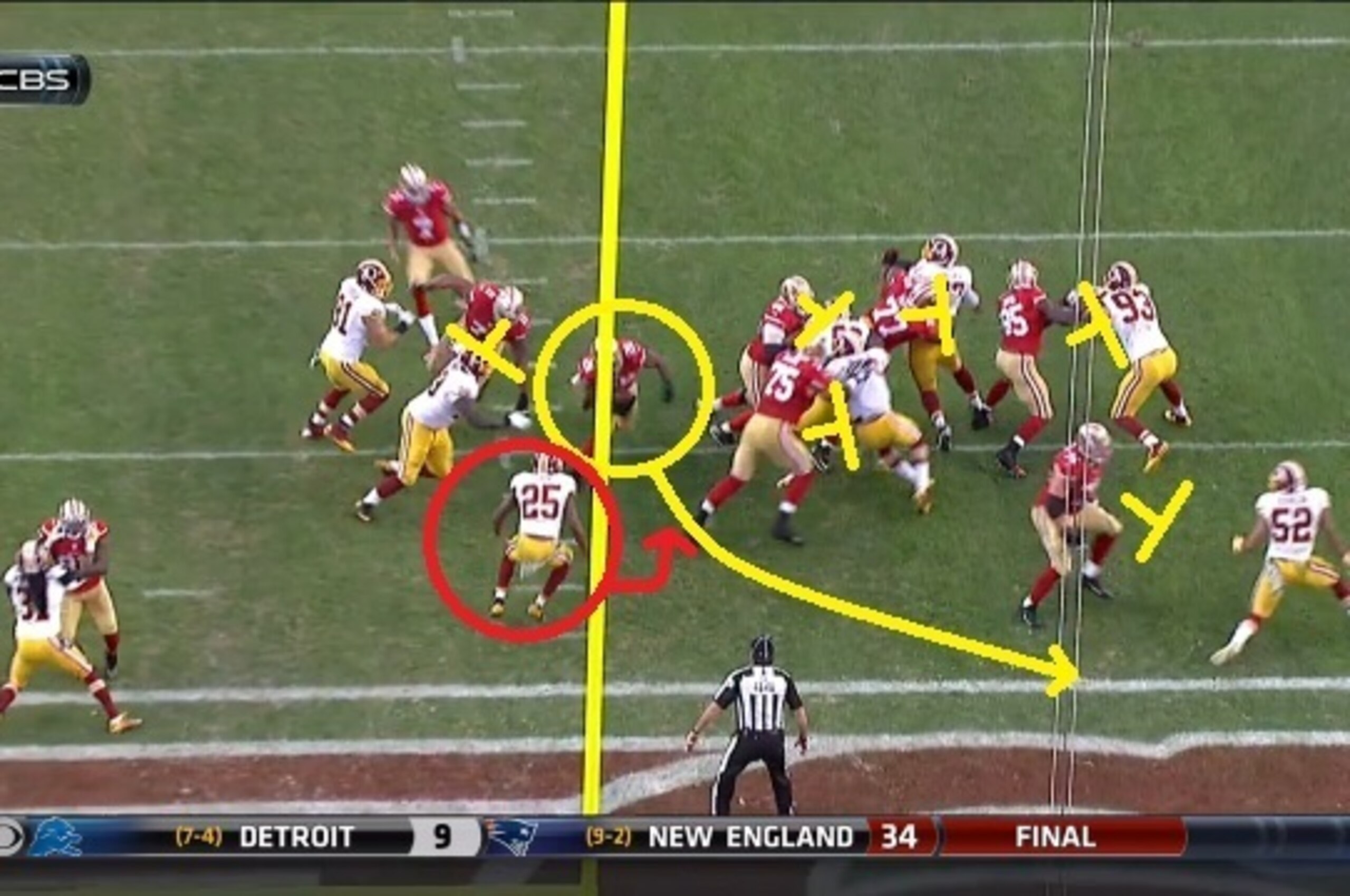
Hyde breaks the tackle and is through for this crucial score.
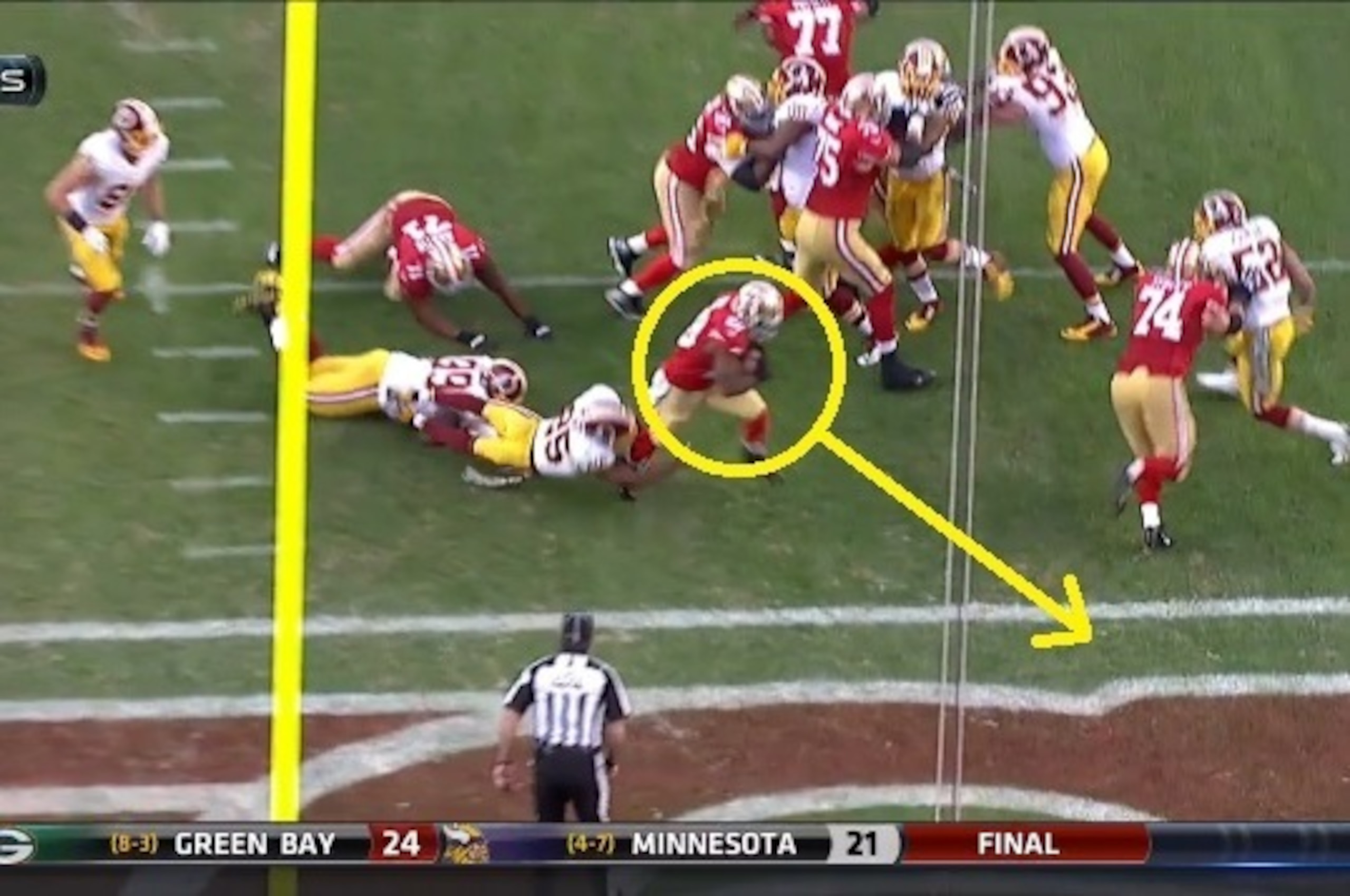
It's possible to deduce a number of things from this play. With four yards to go, the play-calling didn't get too tricky in an attempt to force a pass or a run to the outside. But the formation also didn't give away a clear up-the-gut rushing play either.
Additionally, the 49ers benefited from a critical aspect: execution. The O-line held its blocks adequately enough to prevent Washington from blowing it up on this goal-line stand. Hyde's breaking a last-ditch tackle also made the difference.
See, the 49ers red-zone offense doesn't have to be as bad if it can find the right combination of play-calling and execution.
What about situations in which San Francisco will be forced to pass? A loaded box can force pressure on Kaepernick, and the numbers don't always play into the 49ers' favor.
Slant plays could be difference-makers here. Slants often give quarterbacks under pressure a quick read with receivers using underneath technique. There is little need for a play to develop for three-plus seconds while the quarterback is waiting within a collapsing pocket.
Plus, the added bonus is that a loaded box will take away some of the coverage, which leaves a number of one-on-one matchups in the short and intermediate areas of the secondary.
Wide receiver Michael Crabtree's 48-yard touchdown reception against the Giants in Week 11 provides some insight.
The Giants defense puts five men into the box on this particular play, leaving its linebackers in a position to either blitz or pick up coverage. Crabtree (yellow arrow at bottom) will be the beneficiary as he executes a slant pattern toward the center of the field. The top New York defender will show blitz before breaking back into coverage.
Fullback Bruce Miller is the quick dump-off option in case the coverage bottles up Crabtree and/or the pass rush converges on Kaepernick quickly.
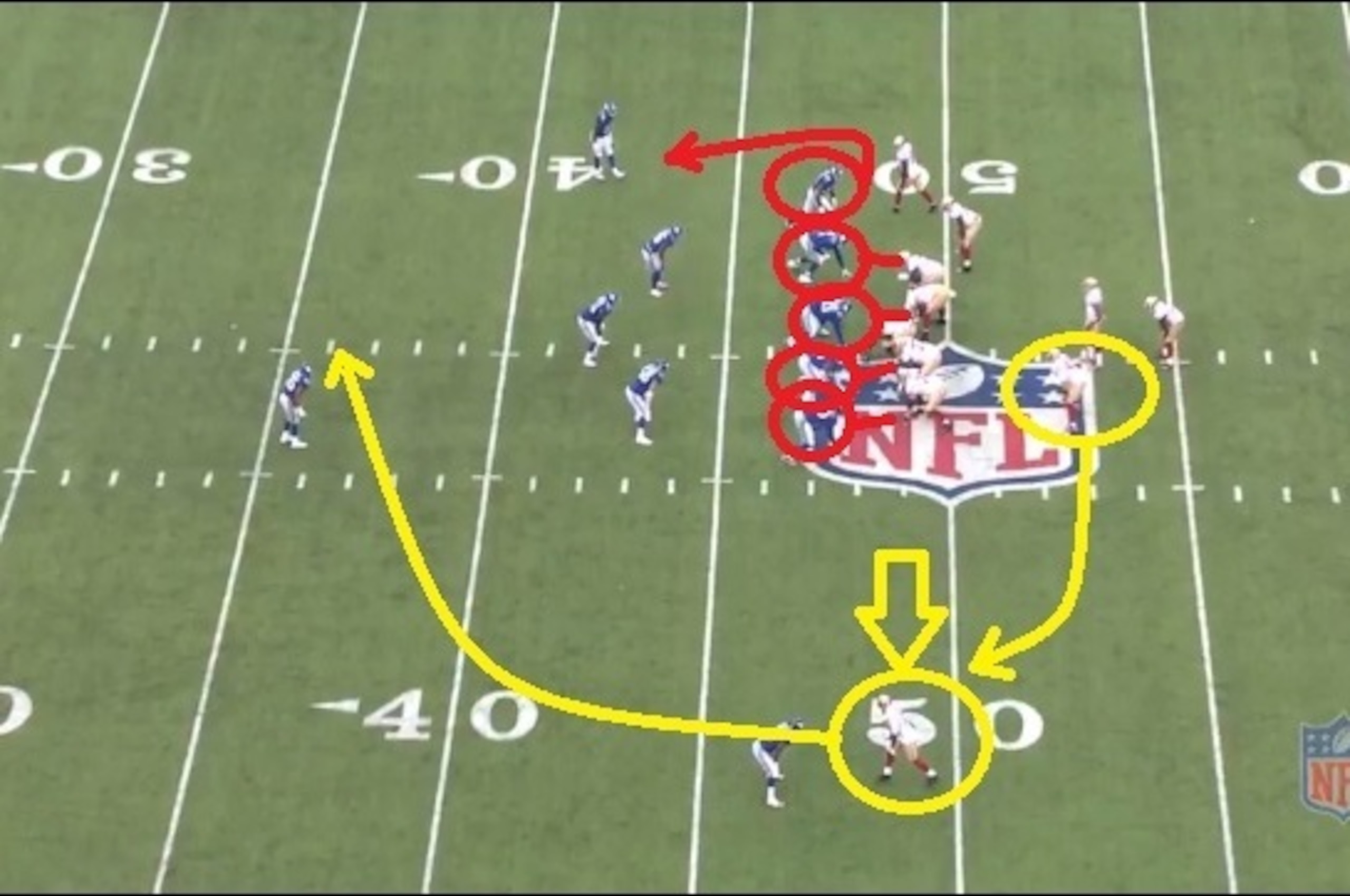
As the play develops, we can see the Giants linebackers drop into coverage. Had they been further up in the box, an even wider window would have been open for this particular slant pattern. Even so, the bottom linebacker is forced to respect Miller (yellow arrow), whose presence keeps him from covering Crabtree on the inside.
Note the lone safety to the far left of the screen.
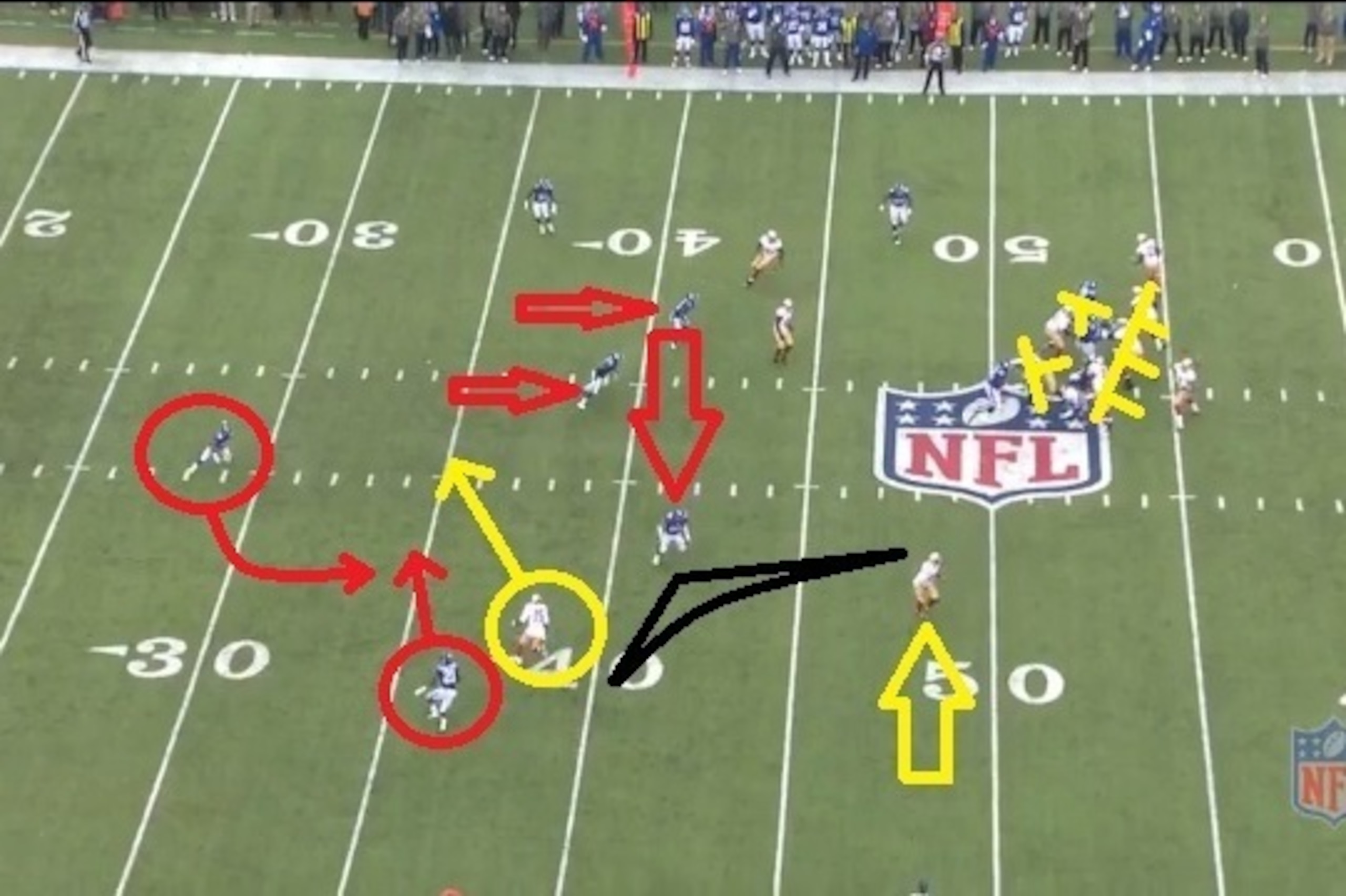
This safety works his way out of position, which allows Crabtree enough space to break the late tackle and work his way into the end zone. Essentially, he was the lone man to beat after Crabtree had already broken off from coverage on this inside route.
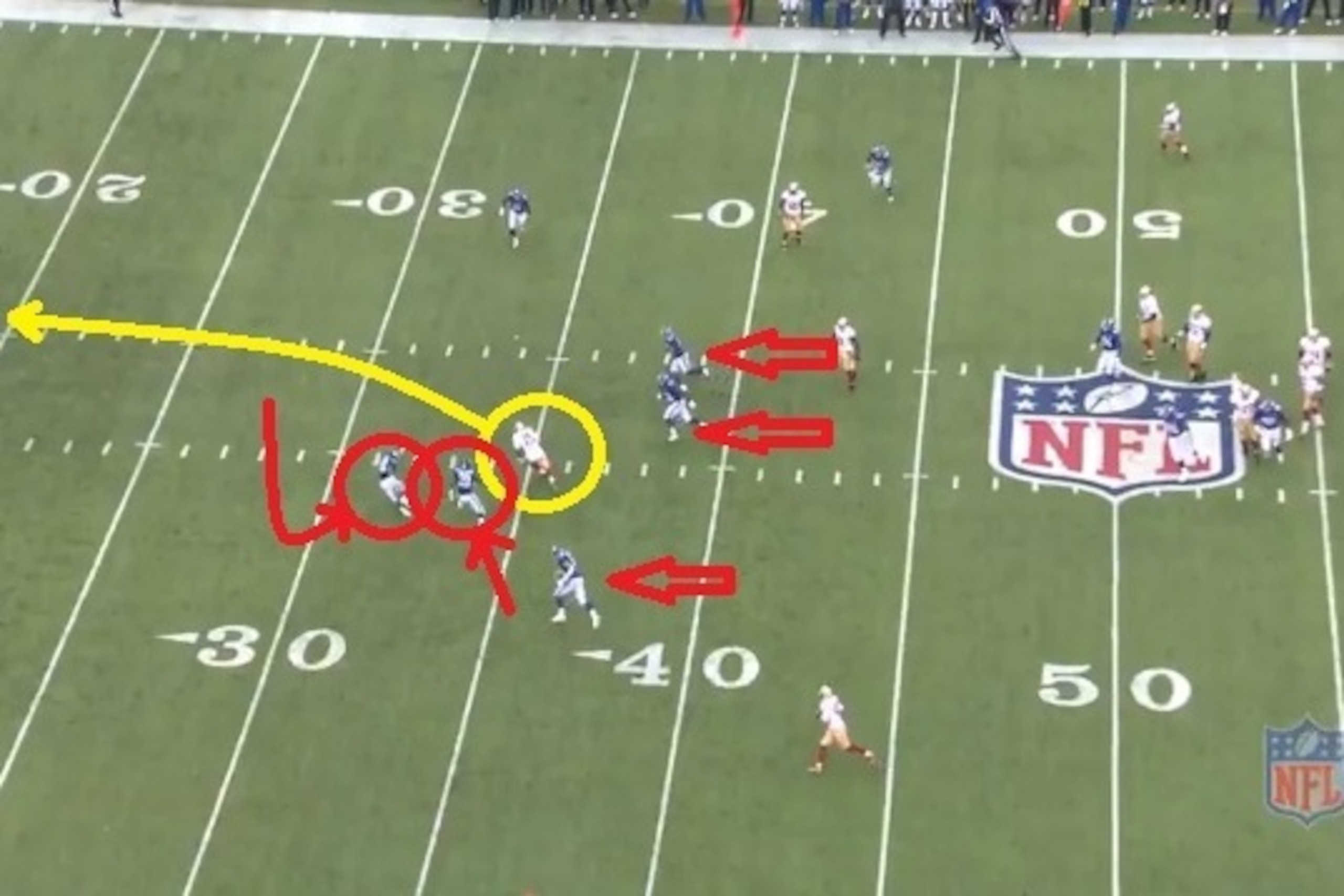
Take a look at how out of position the linebackers are on this play. Imagine what the window of opportunity would have been had they been pressed further into the box.
Quick slants can be game-changers.
Applying this to Seattle and Beyond
Well-executed runs and quick slants won't always work. Other forms of creativity and execution are needed.
The Seahawks rank No. 6 in the league in fewest rushing yards against (972) and have given up the fourth-fewest passing yards on the season (2,293).
Moving the ball against this team will be a much tougher challenge than what the 49ers encountered against St. Louis, New York and Washington. But the Kansas City Chiefs were able to do this to good effect when they squared off against Seattle in Week 11.
The Chiefs gained 190 rushing yards against one of the best run defenses in the league during that contest. One of the highlights came on a four-yard, fourth-quarter rush by running back Knile Davis that put Kansas City on top for good.
Sound familiar? Hint: Carlos Hyde.
Seattle's 4-3 defense lines up expecting a run at the 4-yard line. After the Chiefs' tight end motions to the right side of the line, a Kansas City receiver will motion to the left just prior to quarterback Alex Smith executing the snap.
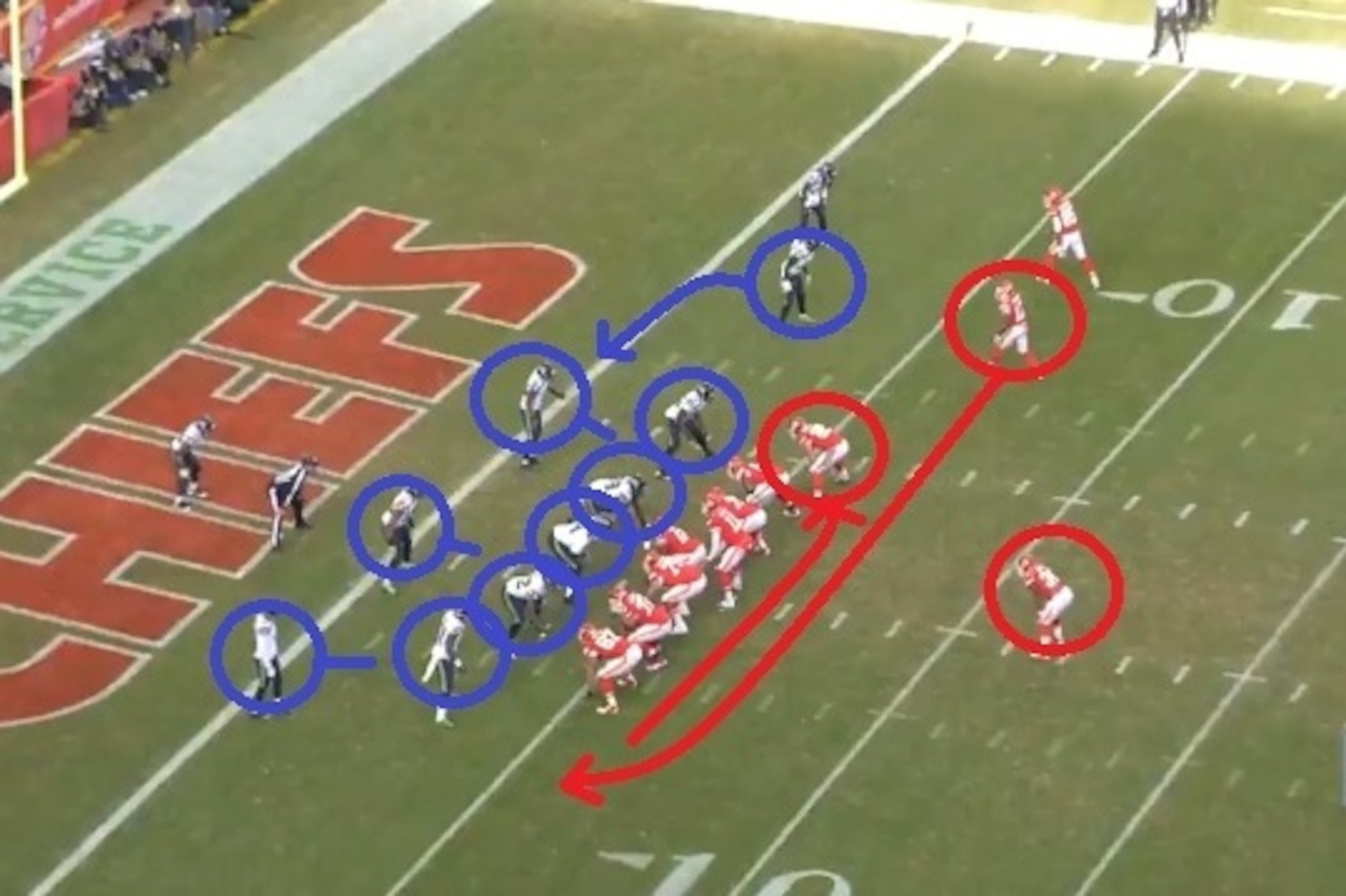
Smith fakes the handoff on the end-around runner, which forces Seattle's defense to respect that possible approach. But the actual recipient will be running back Knile Davis at the right of the screen.
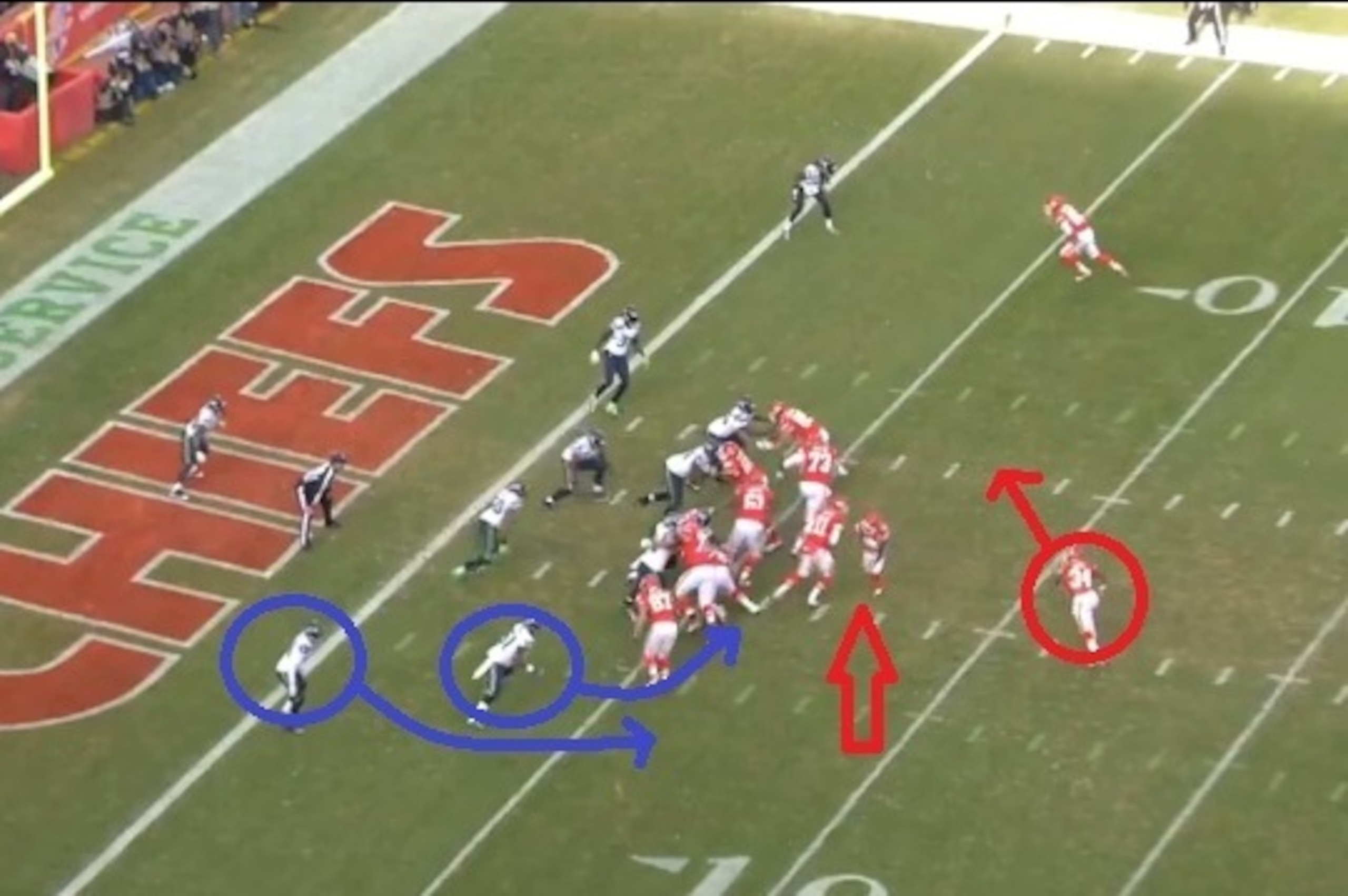
Davis receives the handoff and, thanks to excellent perimeter blocking, is able to scoot around the right side and into the end zone.

Seattle's defense shifted to cover the fake. The tight end motion also gave Kansas City a much-needed blocker in the direction to which the play developed. While Frank Gore isn't necessarily an outside-route runner, Hyde is. This particular play could fit right into Hyde's rushing strengths.
Can the Seahawks, or any stacked-interior defense for that matter, be beaten by dialing up plays like these?
The film suggests so.
Of course, Kansas City benefited from adequate one-on-one blocks. San Francisco will have to do the same. As easy as it is to blame play-calling, the reality is that the players must execute to the desired level in order to obtain the needed success.
Both play-calling and execution have been called into question. Yet San Francisco's offensive woes can be erased if it is able to combine these critical elements into a worthy force.
It won't be an easy task considering some of the remaining 49ers opponents, but it is one that will need to be accomplished if San Francisco hopes for another playoff berth in 2014.
All statistics, records and accolades courtesy of Pro-Football-Reference and ESPN.com unless otherwise indicated.
Peter Panacy is a featured columnist for Bleacher Report, covering the San Francisco 49ers. Be sure to check out his entire archive on 49ers' news, insight and analysis.
Follow him @PeterPanacy on Twitter.
.jpg?w=2560)
.jpg?w=2560 "Texans Jaguars Football")