Redskins at a Crossroads with RG3 After Yet Another Lackluster Performance
If the rest of the 2014 NFL season is going to be about evaluating Robert Griffin III, then Week 12 was more like an induction lecture for the Washington Redskins. You know the kind, the one where the broad strokes of your subject are defined, the stuff you already know.
Head coach Jay Gruden and his staff didn't learn anything during Washington's 17-13 loss to the San Francisco 49ers they didn't already know about why Griffin is struggling.
They saw a quarterback ponderous when it comes to making reads, one who holds onto the ball too long. A quarterback who often doesn't see open receivers.
TOP NEWS
.jpg?w=2560 "Chargers Mack")
Every Trade's Best Trade Asset 🔁
.jpg?w=2560 "Green Bay Steelers Football")
Insiders: Cowboys Overpaid for Porter
.jpg?w=2560 "Seahawks Cardinals Football")
MHJ's Potential Trade Value 📉
Gruden spent all week talking about how Griffin needs to deliver. But the truth is the Redskins are exactly where they were seven days ago with their supposed franchise quarterback. Namely, no closer to finding out if he'll ever deliver.
Washington is at a crossroads with Griffin. It's the same crossroads they've been at since his leg gave way against the Seattle Seahawks in the 2012 playoffs and the read-option-based advantage he had went with it.

Ever since Griffin wilted to the turf that night, the Redskins have been set the challenge of molding a quarterback totally at odds with the NFL prototype into a pro-level passer.
The journey started out tough and remains just as arduous. It's claimed casualties along the way. The Shanahan regime went first, and either Gruden or even Griffin himself will soon follow.
There are two divergent ways out of this footballing purgatory. On one side of the road is quickly ditching the player this team mortgaged its immediate future to trade for in 2012.
That will be a decision based on deciding that Griffin will never make the grade, will never be more than a brittle, dual-threat quarterback too raw for the nuances of the pro game.
Washington got a glimpse of that future in San Francisco. Griffin suffered through five sacks, lost a fumble and threw for just 106 yards.

No wonder Gruden lamented the passing game, per Chelsea Janes of The Washington Post:
"We got some turnovers defensively, we had a great opportunity to win the game, we just didn’t do a good enough job in the passing game with our protection when we had to.
...
We’ve got a rookie left tackle playing his first game with significant time on the road. So we didn’t air it out, wanted to try to get the running game going. We had positive field position and didn’t want to take any chances down the field. This wasn’t a good day in the passing game.
"
The line was certainly at fault throughout the game. But as much as Griffin wasn't helped by the men in front of him, he also wasted opportunities to maximize his talented supporting cast.
Those wasted opportunities mostly took the form of missed throws, or not spotting open receivers. Mike Jones of The Washington Post lamented an example of the former folly:
Meanwhile, ESPN 980 reporter Chris Russell referenced how Griffin's lack of downfield vision is harming this offense:
Of course, this is far from the first time Griffin has struggled to make accurate throws at key moments, or simply overlooked open reads. They are part of the very poor basic mechanics that blight his game and make his development such a tall order for Gruden and this franchise.
The true disappointment is how often these failings repeat themselves. Amid all the sacks and hits Griffin took because of poor blocking in the Bay Area, he'll still know some of his wounds were self-inflicted.
They were self-inflicted by his seemingly unshakable habit of holding on to the ball until this offensive line morphs into the Hogs of 1982, '87 or '91. It's a problem borne out of struggling to decipher defenses, as well as elementary failings with footwork.
ESPN Redskins.com reporter John Keim focused on the latter:
The depressingly familiar dynamic of an un-nuanced quarterback playing behind an overwhelmed O-line doesn't appear to be ending anytime soon. In that sense, as Griffin's problems continued, Gruden and the Redskins got a glimpse of one possible future with this quarterback.
The forecast looks bleak.
However, maybe that doesn't have to be the way this script ends. Maybe somewhere amid the carnage that took place in gold-rush country, there was a nugget of hope that things can still work out with Griffin. At least to a point.
If one turn off this crossroads leads to a quarterback who never develops and keeps losing until the franchise pulls the trigger, the other path leads to a passer who can direct a very particular, limited, but workable offense.
Meet Robert Griffin III, game manager.
This is the version of 2012's second-overall pick akin to what the Kansas City Chiefs have in 2005 first-overall pick Alex Smith. Nobody's ever going to confuse Smith and the Chiefs for "The Greatest Show on Turf." How could they?
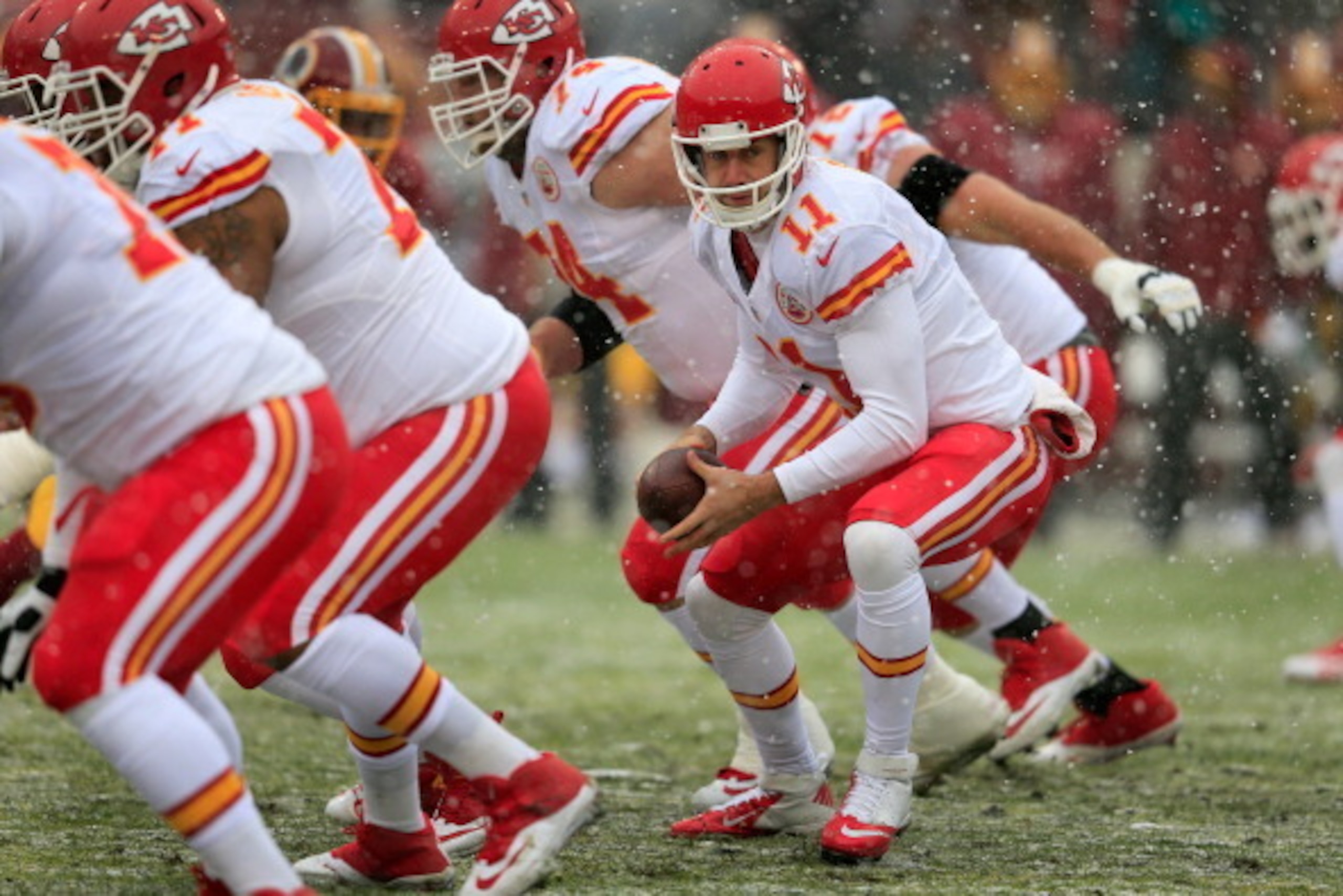
After all, Kansas City's passing game ranks 31st in football. Yet the Chiefs are 7-4 this season and 18-9 since 2013 behind a quarterback most would view as far from elite.
This is only possible because the Chiefs let Smith be a quarterback who complements, rather than hinders, their talented supporting cast. It's a supporting cast defined by a wicked pass rush and a dynamic running game.
If that sounds familiar, it should, after seeing the Washington D swarm on Colin Kaepernick and the 49ers offense, while Alfred Morris rushed for 125 yards against a rugged San Fran defense.
The Chiefs usually get similar production from a Jamaal Charles-led ground attack alongside a ferocious pressure defense. The difference is Kansas City's coaches add efficiency at the quarterback position by scheming plays perfectly suited to what Smith does best.
Usually that means quick-hit, short-range slant patterns that target receivers on the run and in space. It also means creative screens to again allow Smith to release the ball quickly, and also maximize Charles' talent as a receiver.
Throw in some read-option stuff to incorporate Smith's collegiate experience with that scheme, along with his natural mobility. Then add an occasional deep ball to surprise a defense and keep coverage honest.
There's a recipe for a competent offense that won't lose games and can even win a few. Build a strong defense and special teams around that, and you have a consistent playoff contender.

The Redskins could easily emulate this formula. There were even hints of it against the 49ers.
With Morris running effectively, Gruden was able to call concepts that suit Griffin's natural game. Those concepts included moving pockets and throws to target quick-breaking crossing patterns underneath, or short-range receivers in the flats.
It represented a baby step, but one that instantly made the offense better. The unit was better because its quarterback was actually making decisions and thinking about the defense, as Russell noted:
As much as Morris posing a threat helped, smart designs were aiding every facet of Griffin's game. Keim even noted how Griffin began to read coverage, albeit briefly:
Two plays, two reads and one progression. What's next, getting rid of the ball quickly? Well, as a matter of fact:
Of course, these plays are merely drops in the ocean, especially when put up against the bottom line of only 13 points and an eighth defeat of the season. But a more positive slant also suggests they are indicators of what could be done with Griffin.
It may be close to the vest offense or so-called "small ball," but it just might work for this quarterback and, more importantly, this team. Using a basic formula designed to make the game easier let the Redskins go on the road and seriously compete against a team that's been a conference powerhouse in recent seasons.
Yes, better production through the air may well have won this game. But for all the criticism of Griffin, merited though it may be, remember the 49ers boast the second-toughest defense in the NFL.
Gruden has to start somewhere with Griffin. Creating an offense around these basic concepts seems like the right place.
The coach is aware of his responsibility to craft a system his quarterback can actually execute, per NFL.com Media reporter Albert Breer:
"We gotta play better around him. And the biggest thing for us as play-callers, and for him, we just have to come together and jell with plays he's comfortable with. That takes time. But we don't have a lot of time.
"
Living up to those mantras requires including more of what Griffin can do and less of what he can't, even if it means junking Gruden's own preferences. In an ESPN report, Keim identified one thing there should be more of in this passing game:
"The play-action should have been a bigger part of the game considering how well Alfred Morris ran the ball. But the only times it really hurt San Francisco were on Griffin’s two longest pass plays of the day: a 24-yarder to Garcon and a 32-yarder to DeSean Jackson. In both cases, the linebackers were sucked up and the middle was wide open. Garcon was especially helped because the linebacker tried to get back to that spot. With Jackson, he created space by drawing safety help to the outside, then running a post. Beyond that, there really wasn’t anything else worth writing about in the pass game.
"
An offense crafted specifically for Griffin has to be given a full audition before thinking about turning to Colt McCoy. At 3-8, the Redskins are fast approaching the point where it makes little difference, a losing season will still be a losing season.
McCoy earning a few wins will merely be semantics. He's never going to be the future. If the franchise wants an answer to its Griffin dilemma, it won't come from the bench.
Choosing between writing Griffin off or using him as a glorified game manager will represent the lesser of two evils to many. But perhaps that's the reality check both the player and this franchise need.
In the choice between molding Griffin into a perfect fusion of Michael Vick and Joe Montana in their peak years, or declaring him a bust, there might just be a middle ground.
It's up to Gruden to try to reach that compromise.
All statistics via NFL.com.
.jpg?w=2560 "Giants Football")