New York Knicks' Most Surprising Players of the Early Season
The New York Knicks have had a slow start to the 2014-15 season, but this was to be expected given that this is the first year of a rebuilding project.
Many of these players won't be here for very long, and there had to be one eye on the future before the season even began.
Beyond the win-loss column, there have been a few positive surprises for the Knicks in terms of individual performances, which may bode well for the future as the team continues to analyse who is and isn't worth bringing back.
TOP NEWS
Jaylen Brown Calls Out Tatum 🧢
LeBron on President Trump's Criticism
Knicks Staff Didn't Get Rings 🤔
Iman Shumpert
To many, seeing Iman Shumpert produce at a high level isn't a surprise at all. He's shown flashes these past three years, and finally, after an offseason without needing rehab and with a new regime behind him, it makes sense that he's having a career year.
What is surprising, however, is that Shumpert has stepped up so early in 2014-15. Struggles adjusting to the triangle have been expected for the whole team, especially younger players, but instead he's been the first player to fully grasp his role and has done so from day one.
Playing at either guard spot, Shumpert has been fantastic in comparison with his worryingly bad 2012-13 campaign. He's averaging an efficient 12.3 points per game along with 3.9 rebounds and 3.4 assists and is shooting at a ridiculous 53 percent clip from beyond the arc.
These aren't numbers inflated by one or two games, either. Outside of two off nights against the Chicago Bulls and Minnesota Timberwolves, Shumpert has been very consistent.

Beyond his health and the fresh start under Jackson's presidency, Shumpert may also be stepping up in the knowledge that this is a contract year, as the Knicks didn't offer him an extension before the deadline on October 31. While we can assume they did this primarily to retain financial flexibility next summer, there is a motivational aspect to the decision, intentional or not.
Potentially, the move could backfire on the Knicks, as Shumpert's value is likely to increase a lot before the summer. Fortunately he is just a restricted free agent for whom the Knicks have Bird rights.
If the Knicks want to take advantage of that, however, they will have to add his cap hold (of roughly $6.5 million) to the books and will probably require his cooperation in making sure he doesn't sign any offer sheets until after they've done their business in free agency (because they will be allowed to go over the cap to sign him).
That will allow them to sign off on a deal greater than $6.5 million—he'll almost certainly get more than that from the Knicks or elsewhere—without having the extra money cut into the rest of their spending.
Shumpert's increased production hasn't come out of the blue by any means. There are plenty of factors playing into his performance, but nonetheless it has been a pleasant surprise to see things come together for him so early into the season.
If he keeps it up, he'll certainly re-establish himself as one of the Knicks' key building blocks—arguably the most important beyond Carmelo Anthony.
Jason Smith
Outside of bringing back Melo, the Knicks had a fairly quiet free-agency period. It was understood that they had virtually no flexibility and had to look exclusively at low-cost options. The Tyson Chandler trade with the Dallas Mavericks also ended up filling plenty of roster spots.
As a result, there was a chance the Knicks wouldn't even bother spending their mid-level exception, and when they did eventually bring in Jason Smith to round out the roster it went under the radar.
Smith wasn't a bad player before 2014-15 by any means. He'd performed well during his four-year stint with the New Orleans Pelicans, but injuries kept him off the court a lot of the time, making it hard to build a reputation for himself in the NBA.
In New York, Smith has emerged as one of the Knicks' better bigs (in part because outside of Amar'e Stoudemire, they don't really have anyone above replacement level), looking particularly impressive on the offensive end.
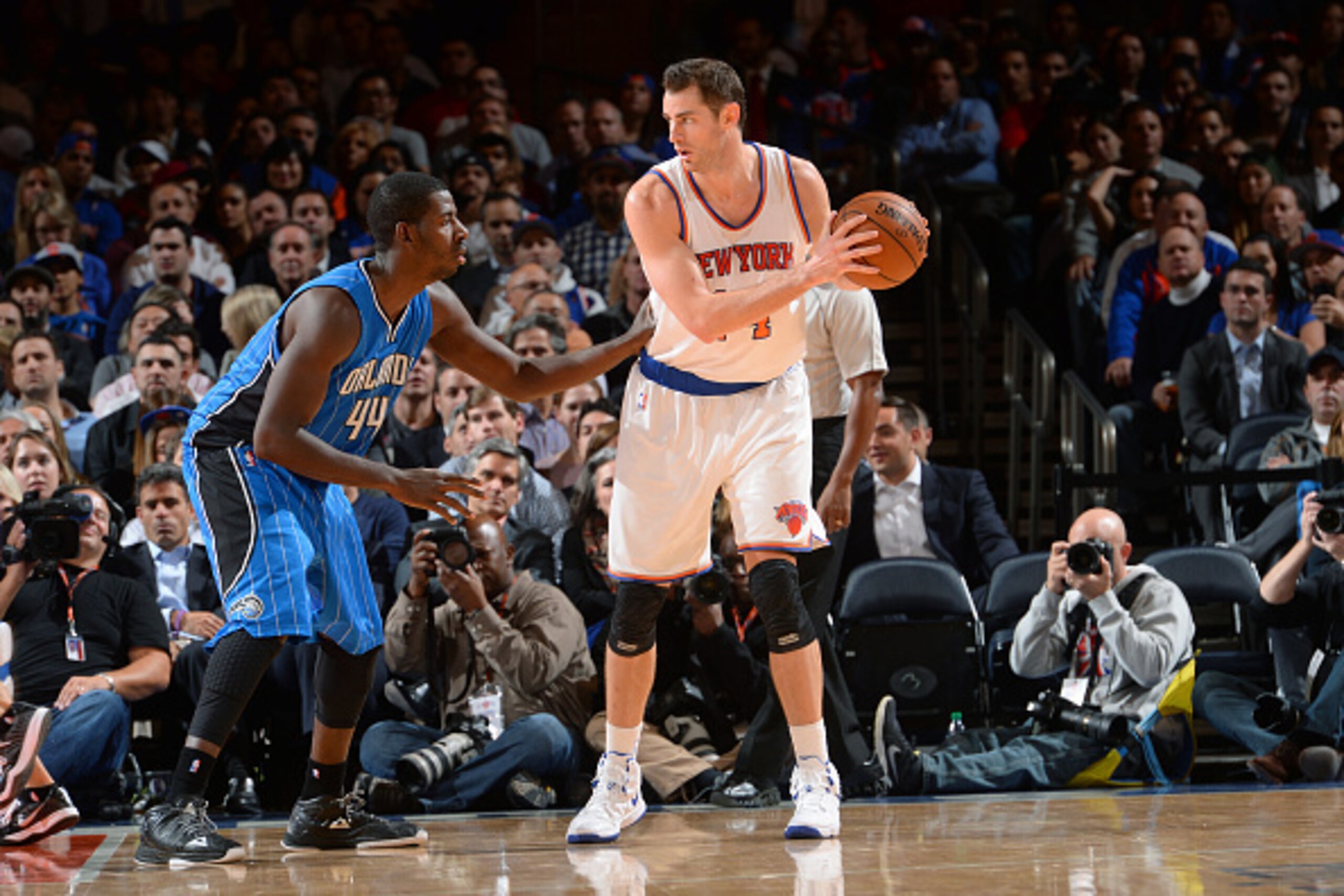
Averaging 15.5 points per 36 minutes on 49 percent from the field, Smith has been effective from the mid-range on offense, altough defensively he's nothing to write home about.
The real surprise, more than anything, is that the Knicks are spending almost $40 million combined on Stoudemire, Samuel Dalembert and Andrea Bargnani, but instead it's the late, cheap offseason signing who has represented the best value for money. He's also not too far behind Stoudemire in being the team's best big, period.
This isn't a case of Smith emerging as an essential long-term piece, but at age 28, he's in his prime and at a similar price and is probably worth keeping for the future.
Shane Larkin
After opening the season strong starting in place of the injured Jose Calderon, the grace period has ended for Shane Larkin. We've been reminded by both his production and the team's performance that he simply isn't ready to start at the NBA level.
Still, there are plenty of reasons to be impressed with Larkin and to be hopeful for his potential as a bench player when Calderon returns—which is much more than you could have said based on his rookie year with the Mavs.
Larkin was essentially a throw-in as part of the Chandler trade. Getting two starters (Calderon and Dalembert) in return for what was essentially an expiring deal was impressive in itself. Any additional pieces, including Larkin, were a bonus.
From a statistical standpoint, Larkin's numbers are indicative of a player in over his head. He's averaging just 5.5 points and 2.7 assists per game and is shooting 38 percent from the field—the worst among any player who has started a game for the Knicks this season.
Instead, it's the eye test we should be focusing on with Larkin. He plays confidently, is the fastest player on the team and hasn't been too bad defensively considering he's both undersized and playing at the league's most stacked position.

Larkin also understands his limitations. He's not a shooter, so he rarely shoots. Unfortunately, the Knicks offense could benefit a lot from a point guard like Calderon who can spread the floor. Meanwhile, Larkin's skills in running the fast break, being a pest (although not necessarily a stopper) on defense and providing a rush of energy are better suited to a bench role.
Ultimately, Larkin is unlikely to end up being an NBA starter, especially considering the position he plays. He has definitely shown signs of being a good backup, though, which isn't too shabby for a player who had played just 489 career minutes before this year.
It's frustrating to watch a team struggle collectively, especially just two years removed from a 54-win campaign, but that is where the Knicks are at right now.
This is the first step in a process that will take a few years to complete, and while the team's play shouldn't be this bad, it's inevitable that many of the positives this season have been and will be based on the individual showings of the few players the Knicks are likely to keep.