What Barry Cofield's Return Means for the Washington Redskins Defense
Barry Cofield's return from injury provides a major boost for the Washington Redskins' inconsistent defense. The veteran nose tackle will add the mass over center this team's 3-4 base front needs to function effectively. Cofield will also be another useful interior pass-rusher.
The 30-year-old has been out of action since Week 1's 17-6 loss to the Houston Texans. But now the Redskins are bringing him off injured reserve in time for Week 11's meeting with the Tampa Bay Buccaneers, per Mike Jones of The Washington Post.
The first thing Cofield's return will do is help those around him. Specifically, a player such as Chris Baker, who has been deputizing at nose tackle, can slide out to his more natural end position.
.jpg?w=2560 "Chargers Mack")
.jpg?w=2560 "Green Bay Steelers Football")
.jpg?w=2560 "Giants Football")
That's something that will please Washington's coaches, according to ESPN.com Redskins reporter John Keim:
"For now, the Redskins are anxious to welcome back Cofield. They've started Chris Baker at nose tackle in in his absence. But when the season began, they liked the pairing of Cofield at nose and Baker at end. Cofield dealt with a groin injury earlier this season that hindered his performance this summer.
"
Having Baker back out at end is certainly good news for coordinator Jim Haslett's defensive front. Baker certainly has ample size to stay over the center. Yet the 6'2", 325-pounder can be more disruptive when allowed to split the guard-tackle gaps, as well as collapse the edges of a blocking scheme.

Baker certainly gives this defense a more dynamic player on the outside than bulky 2011 second-rounder Jarvis Jenkins or dependable utility man Kedric Golston. In tandem with Jason Hatcher, Baker can give Haslett a pair of ends who can thrive with more license to attack single gaps.
Both players should benefit from Cofield's ability to draw and absorb double-teams. Let's take a look at how the Cofield-Baker one-two punch can work.
Going back to the opening week, the Texans faced a 3rd-and-1 and loaded up with heavy personnel. They deployed an extra offensive lineman, as well as 6'1", 256-pound fullback Jay Prosch.
The Redskins responded with narrower splits between their D-linemen. Cofield and Baker aligned closer together, toward the strength of Houston's formation:
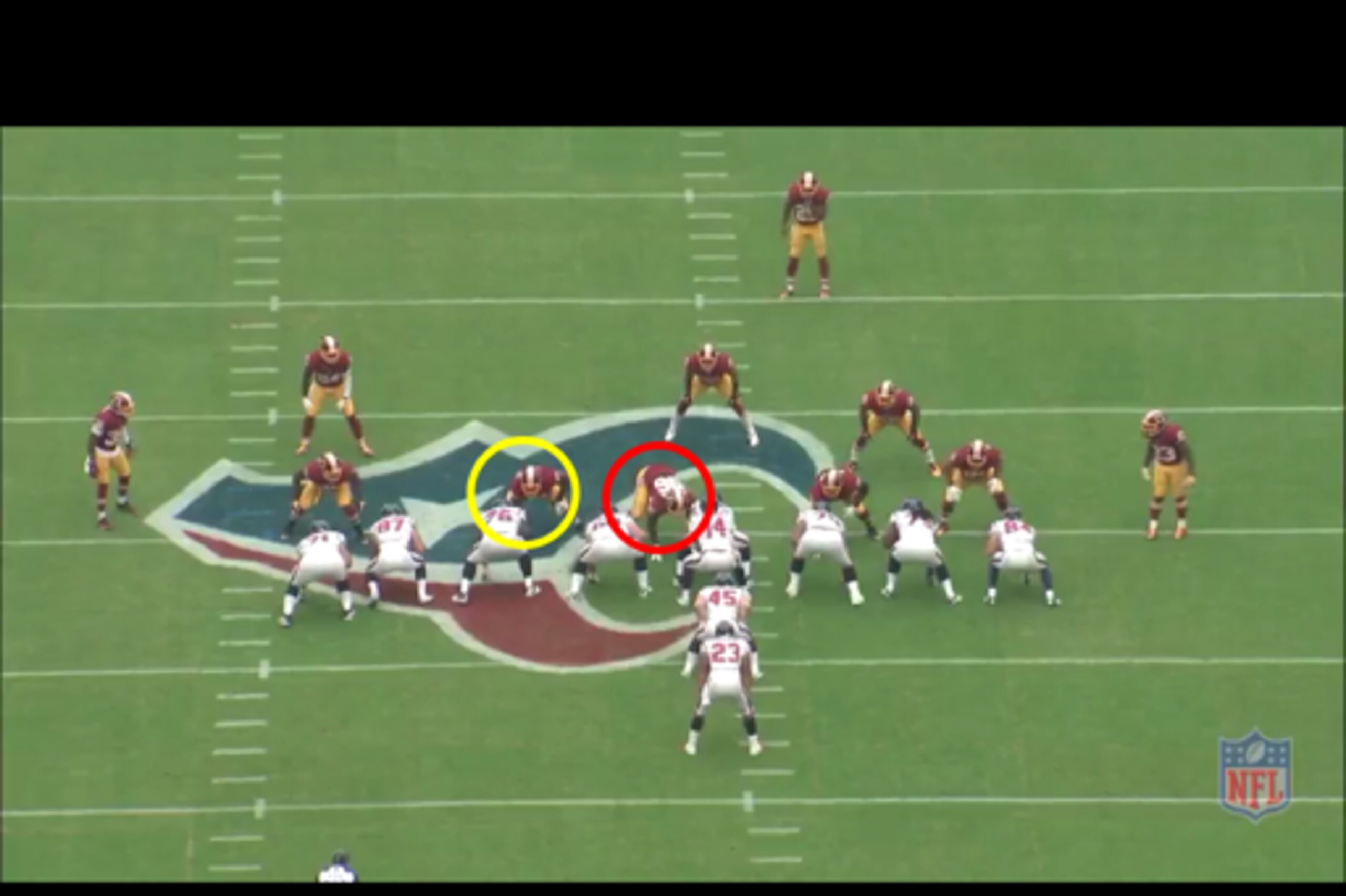
Notice how both Baker and Cofield (red circle), were positioned to attack single gaps. This gave them a quicker route to the backfield and a more natural angle to occupy two blockers.
Before Texans quarterback Ryan Fitzpatrick even completed the handoff to running back Arian Foster, Cofield had shoved center Chris Myers back into the runner's face:

Looking at another angle, you can see just how far Cofield moved Myers. He practically dumped him in the middle of the quarterback-running back exchange:
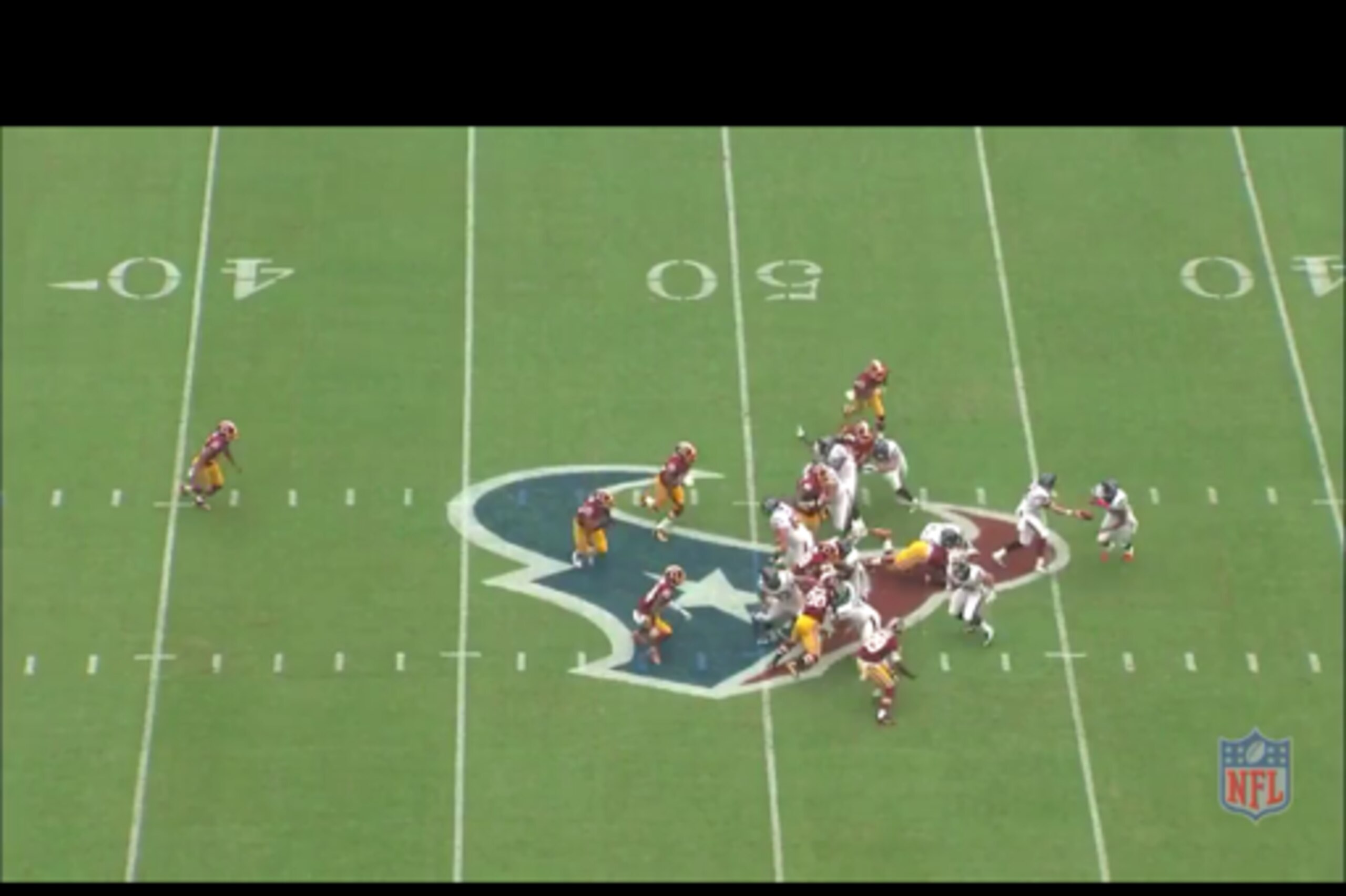
This immediately made Foster slow down and alter track. That allowed Baker to make the play, dumping Foster for a one-yard loss:
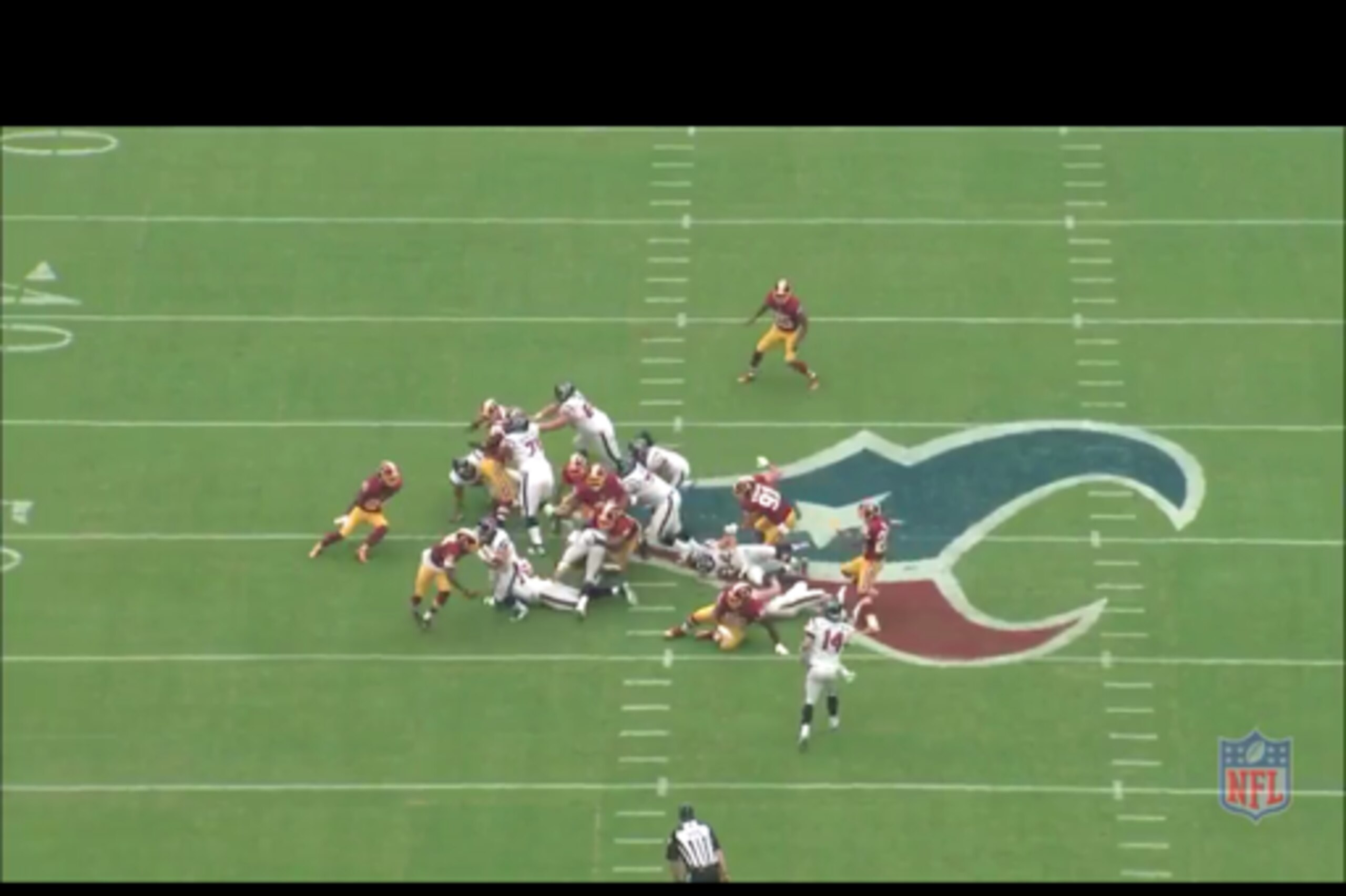
Cofield didn't get credit for the tackle, but he was the one who really destroyed this run before it got started. His work allowed Baker to make the play and get the statistic.
That's just how a competent 3-4 nose tackle is supposed to do it. He's there to occupy and disrupt blockers, keeping his teammates clean to make the play.
Aside from Baker and Hatcher, inside linebackers Keenan Robinson and Perry Riley Jr. are the two players who should most directly benefit from Cofield's return.

Keeping blockers away from the middle linebackers, allowing them to run free and chase down plays, is a fundamental principle of the 3-4. That's not something the Washington D-line has done particularly well at times this season.
Week 9's 29-26 loss to the Minnesota Vikings serves as a prime example of this failing. It was a game in which the Redskins D surrendered 100 yards and three touchdowns on the ground.
That was mostly due to linemen not being able to keep Riley and Robinson clean. On this 1st-and-10 play in the third quarter, Minnesota ran Jerick McKinnon on a draw from a shotgun look.
Washington had end Jenkins and nose tackle Baker initially covering Robinson and Riley. The only blocker who could get to them was right guard Joe Berger (blue circle):
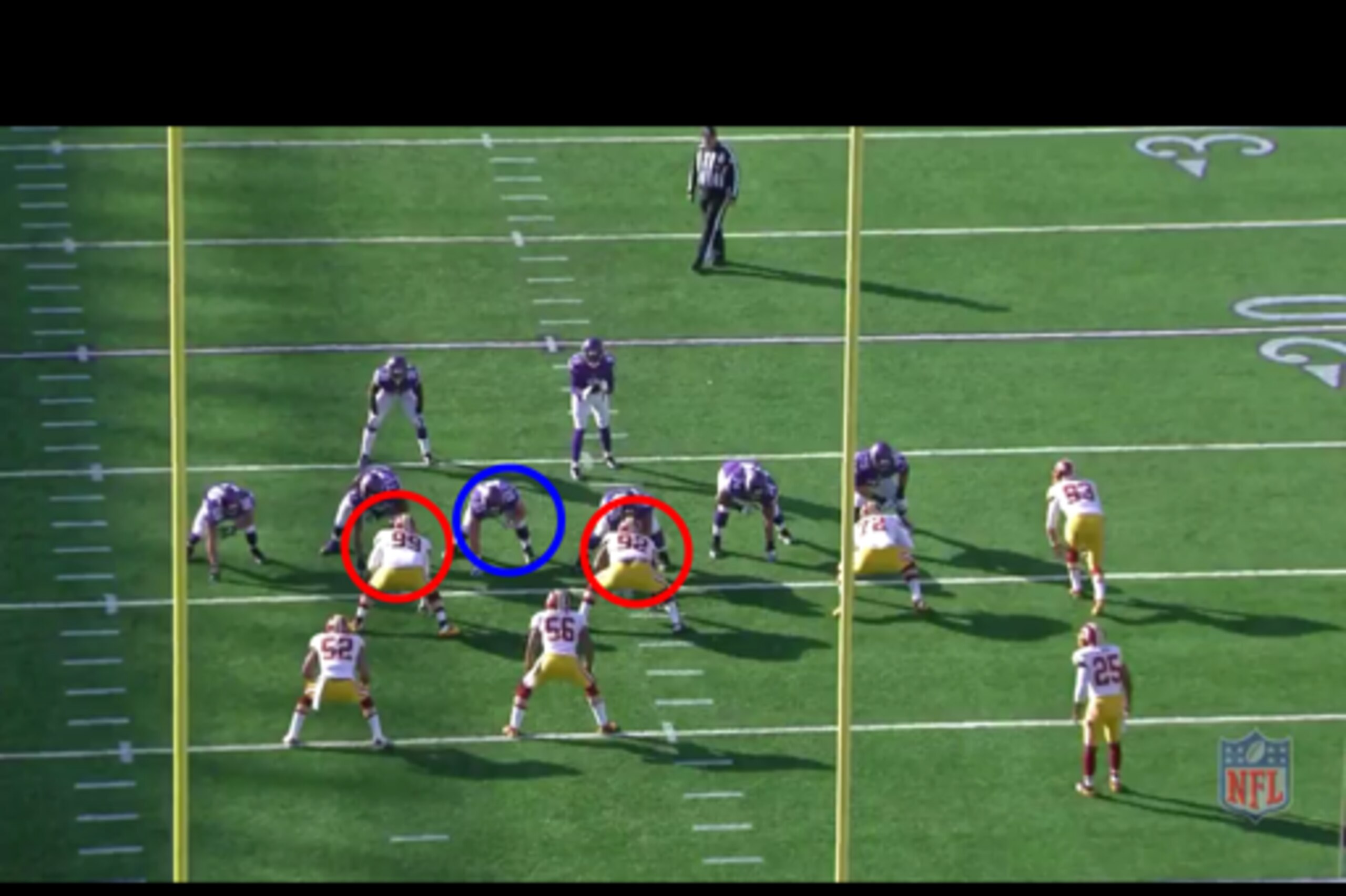
That meant that one of Jenkins or Baker had to draw a double-team to prevent Berger from reaching the linebacker level.
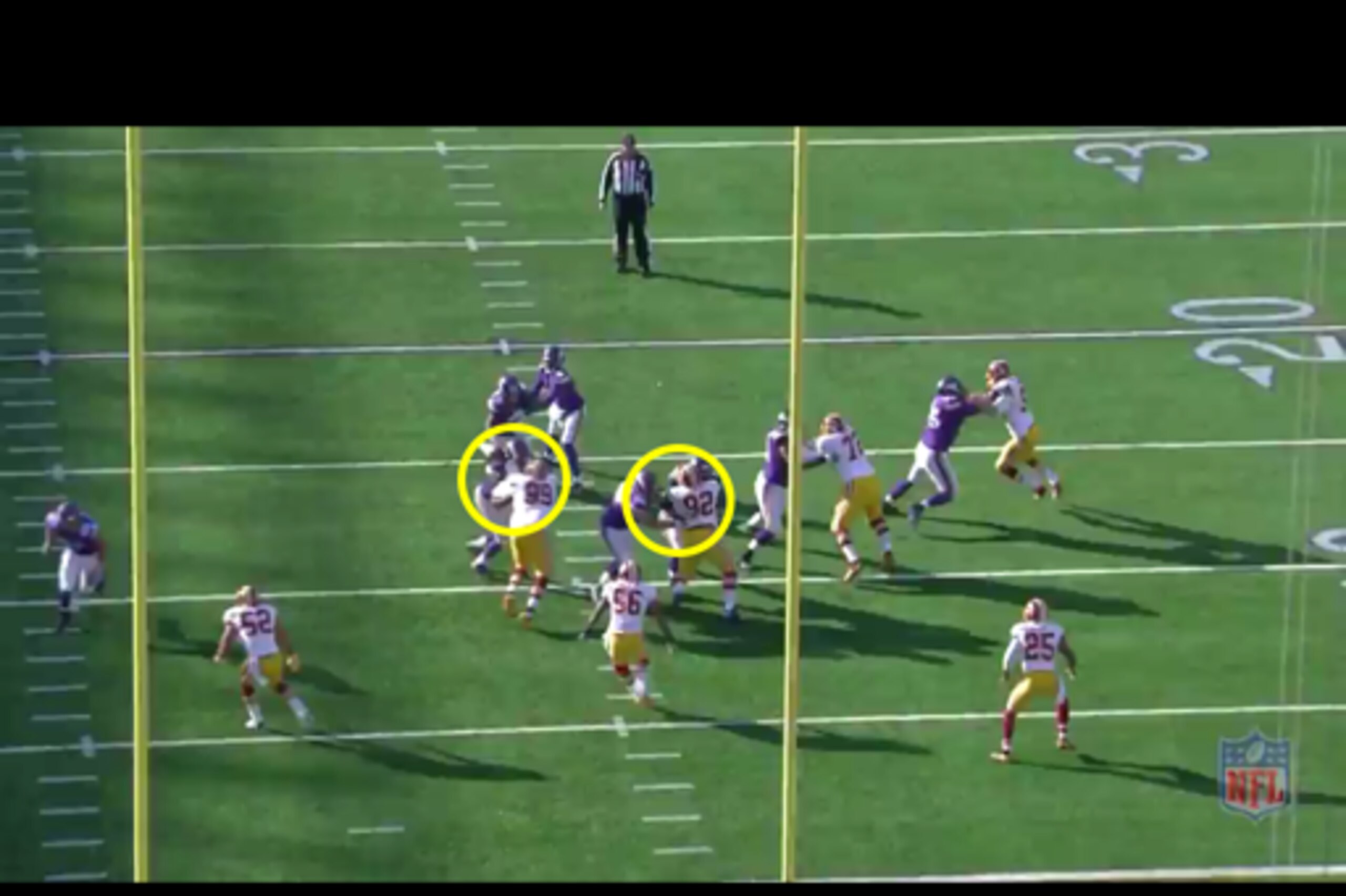
Sadly, neither managed to absorb two blockers. Baker initially drew the attention of the center and Berger. But he couldn't hold the double-team. You can see Berger already moving off the block:
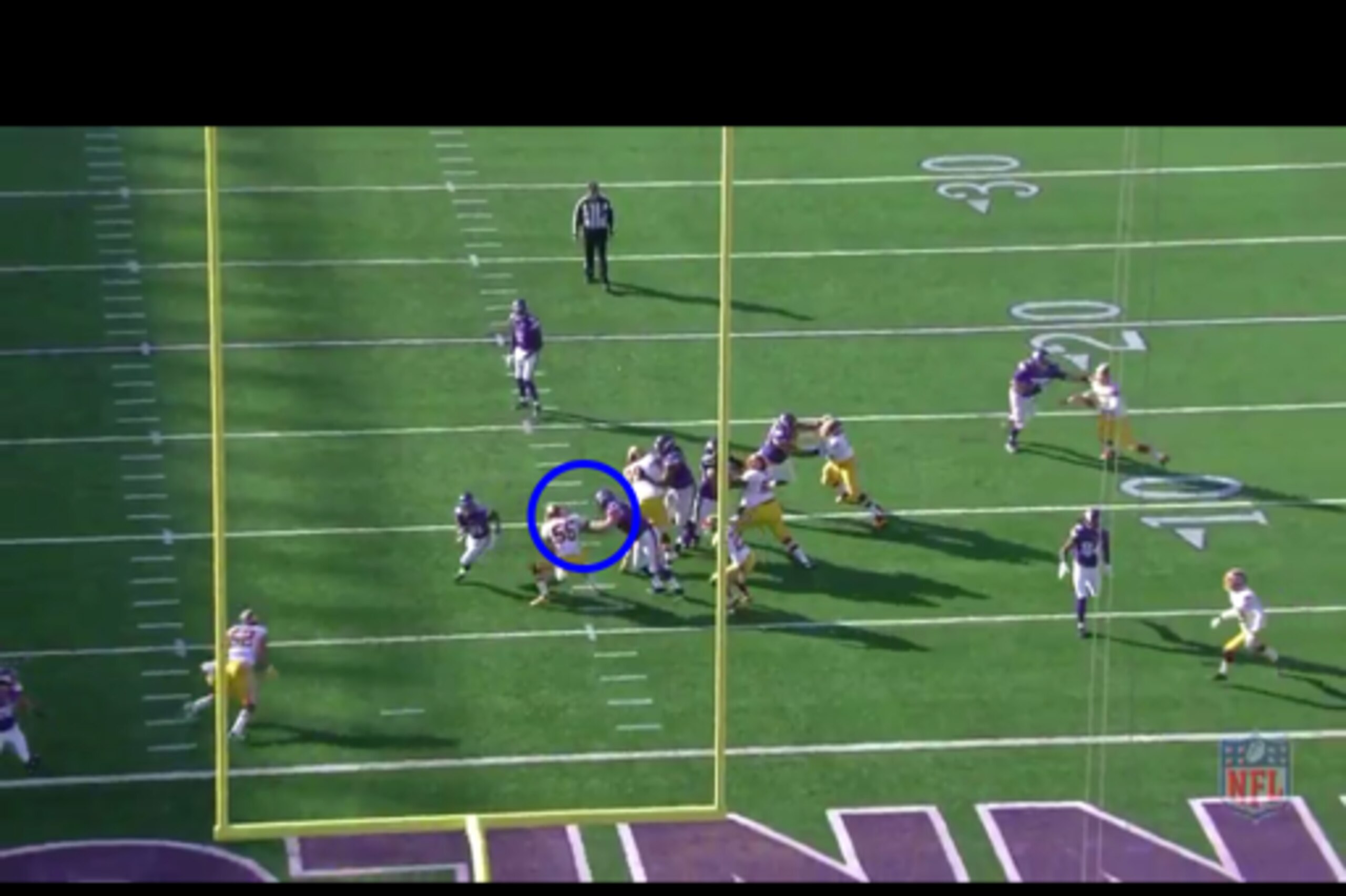
He was able to escape Baker's grasp and nudge Riley off balance. That let McKinnon complete a nine-yard scamper that finished just short of the end zone:
Fullback Matt Asiata crashed over on the next play for one of his three scores. But it was his seven-yard touchdown plunge in the fourth quarter that really served as a condemnation of the Washington D-line.
Again, the Vikings aligned in a shotgun look. Baker (red circle) needed to make sure Riley (yellow circle) was kept clean:
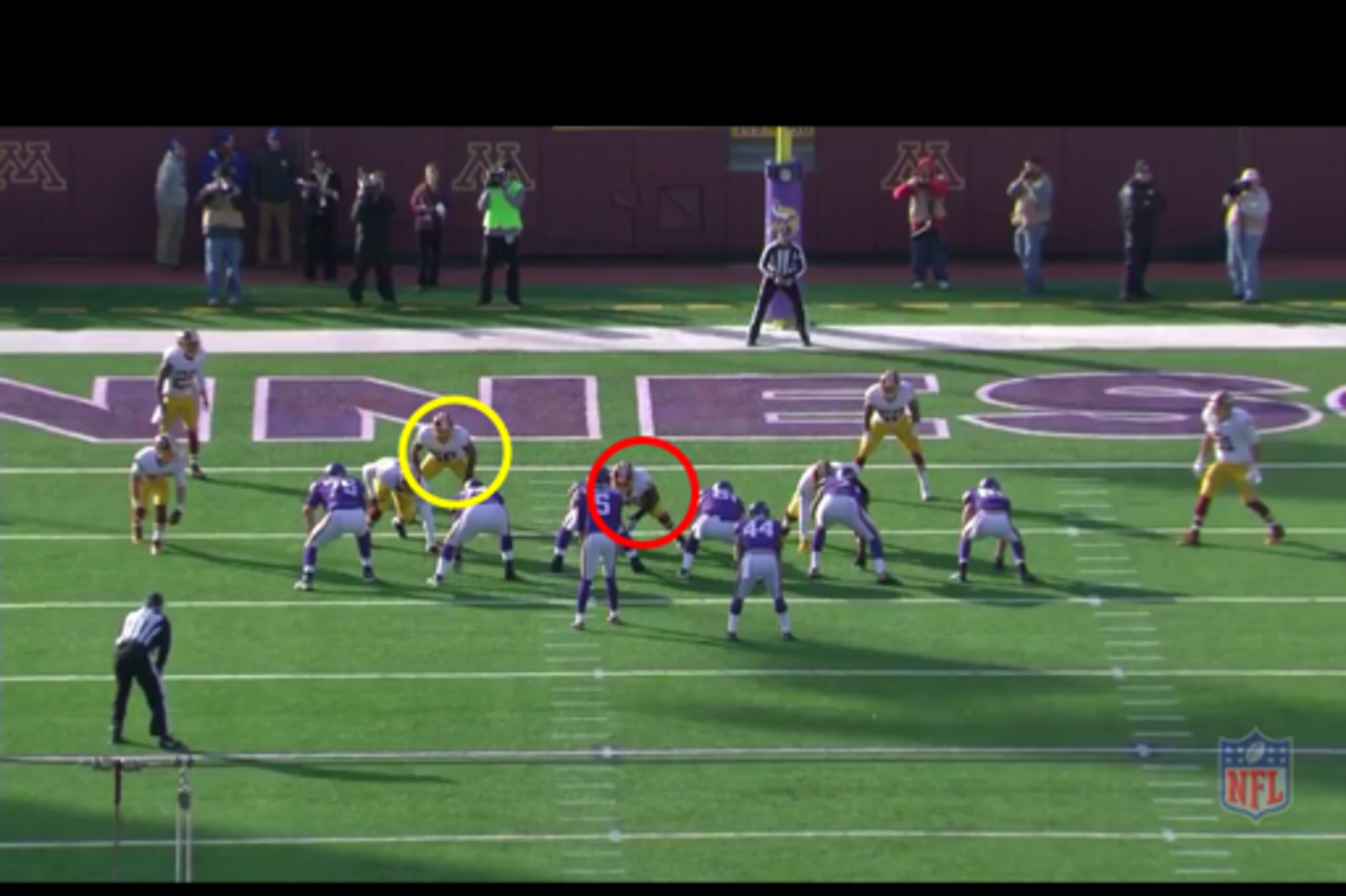
Unfortunately, Baker allowed himself to be cleanly blocked by Berger. This let center John Sullivan come off the line and absorb Riley:
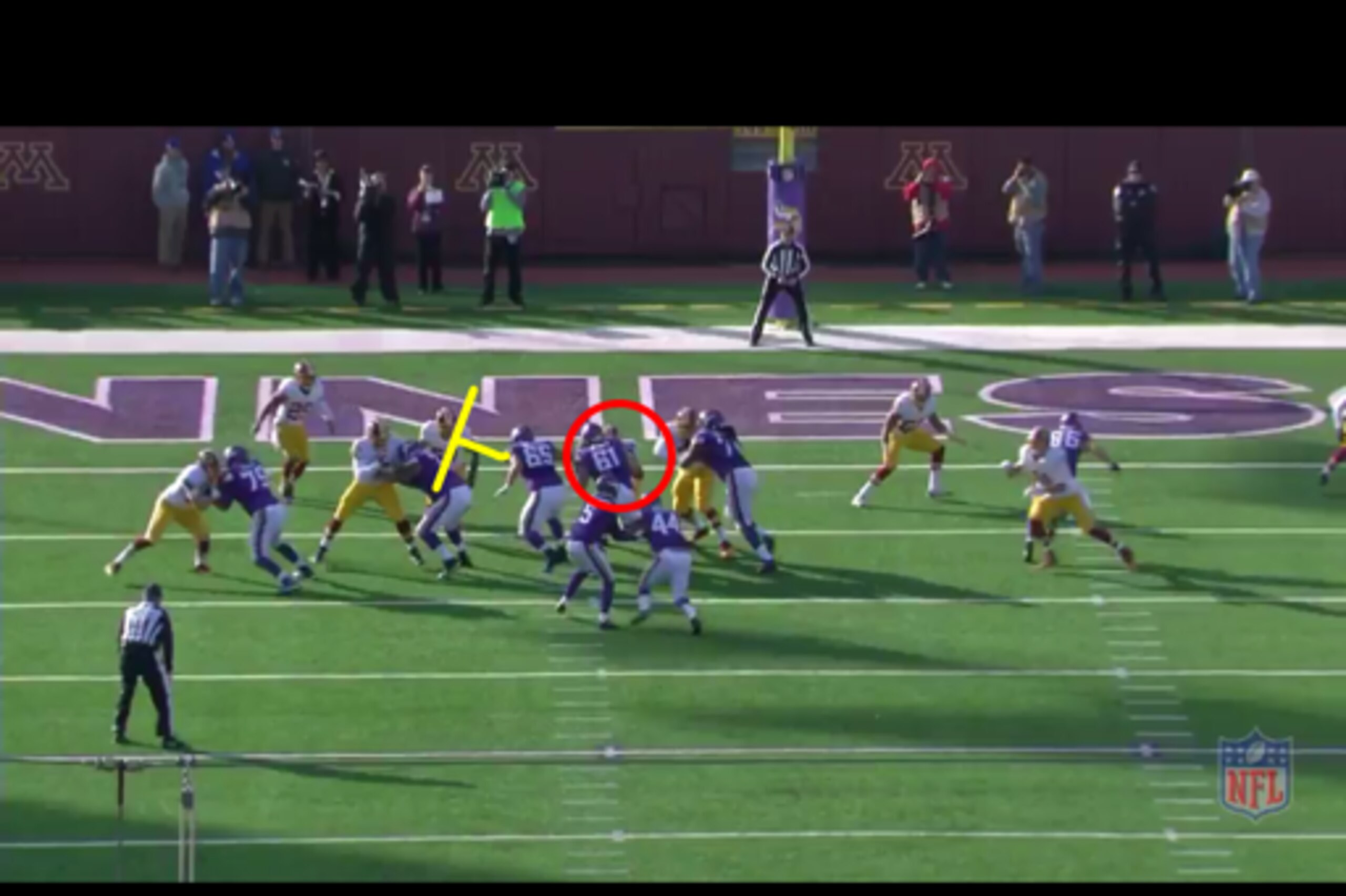
With Baker shifted off his spot and Riley unable to pursue laterally, Asiata had a clear cutback lane to exploit through the middle:

He ran in almost untouched to complete an easy score:

Baker and his fellow linemen's inability to draw and hold double-teams, as well as get off blocks, was fatal for the defense on both of these plays. A 3-4 defense can't stand up to the run unless the man in the middle can routinely occupy two blockers.
Cofield is certainly the most adept lineman Washington possesses in this vital area. His return can mean a tougher run defense, something that's a factor when looking at the schedule.
The Redskins still have games against Frank Gore and the San Francisco 49ers, as well as return meetings with DeMarco Murray and the Dallas Cowboys, along with LeSean McCoy and the Philadelphia Eagles.
A stout run front will be critical if this team is going to successfully navigate any of those games.

But Cofield's impact won't just be limited to the running game. The former New York Giants starter is also a surprisingly capable pass-rusher.
Sure, he's only logged eight sacks in his previous three seasons in Washington, but those are solid numbers for a nose tackle. More important, Cofield has a knack for crushing the pocket from the inside on pass plays.
That can play a major role in keeping quarterbacks in a crumbling pocket by giving them no lane of escape from outside pressure. If a quarterback is forced to turn away from the middle, he'll usually run into edge-rushers such as Ryan Kerrigan, Brian Orakpo or rookie Trent Murphy.
That's exactly how the Washington pass rush is supposed to work. Let's take a look at Cofield helping put the theory into practice.
The play is from the third quarter of Washington's loss to the Giants in Week 13 of the 2013 NFL season. It was 3rd-and-10 and Washington aligned in a 4-2-5 nickel with Cofield (yellow circle) and Baker on the inside, while Kerrigan and Orakpo lined up on the edges:
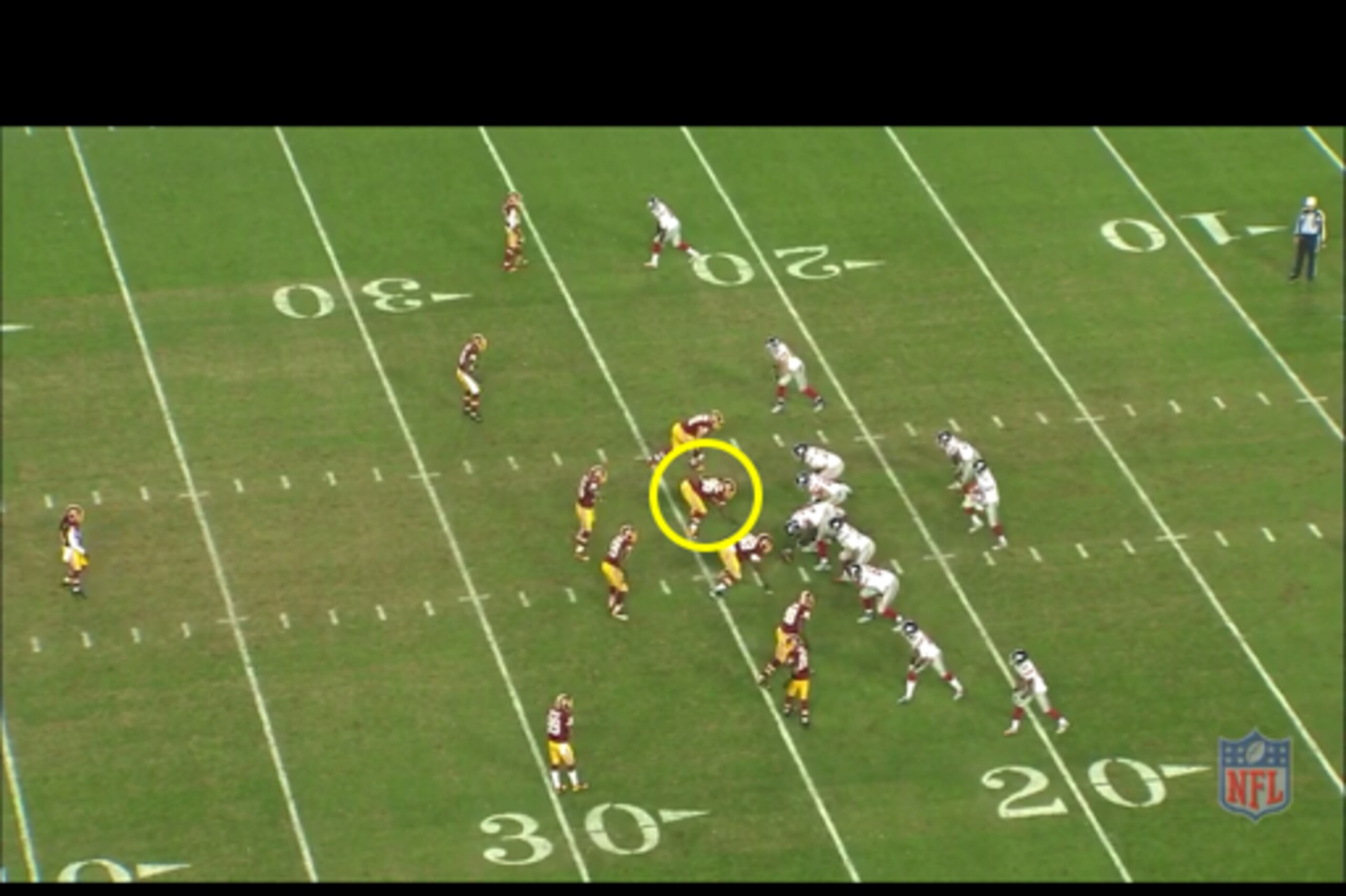
Cofield got an awesome push on the right guard, driving him straight back into quarterback Eli Manning:
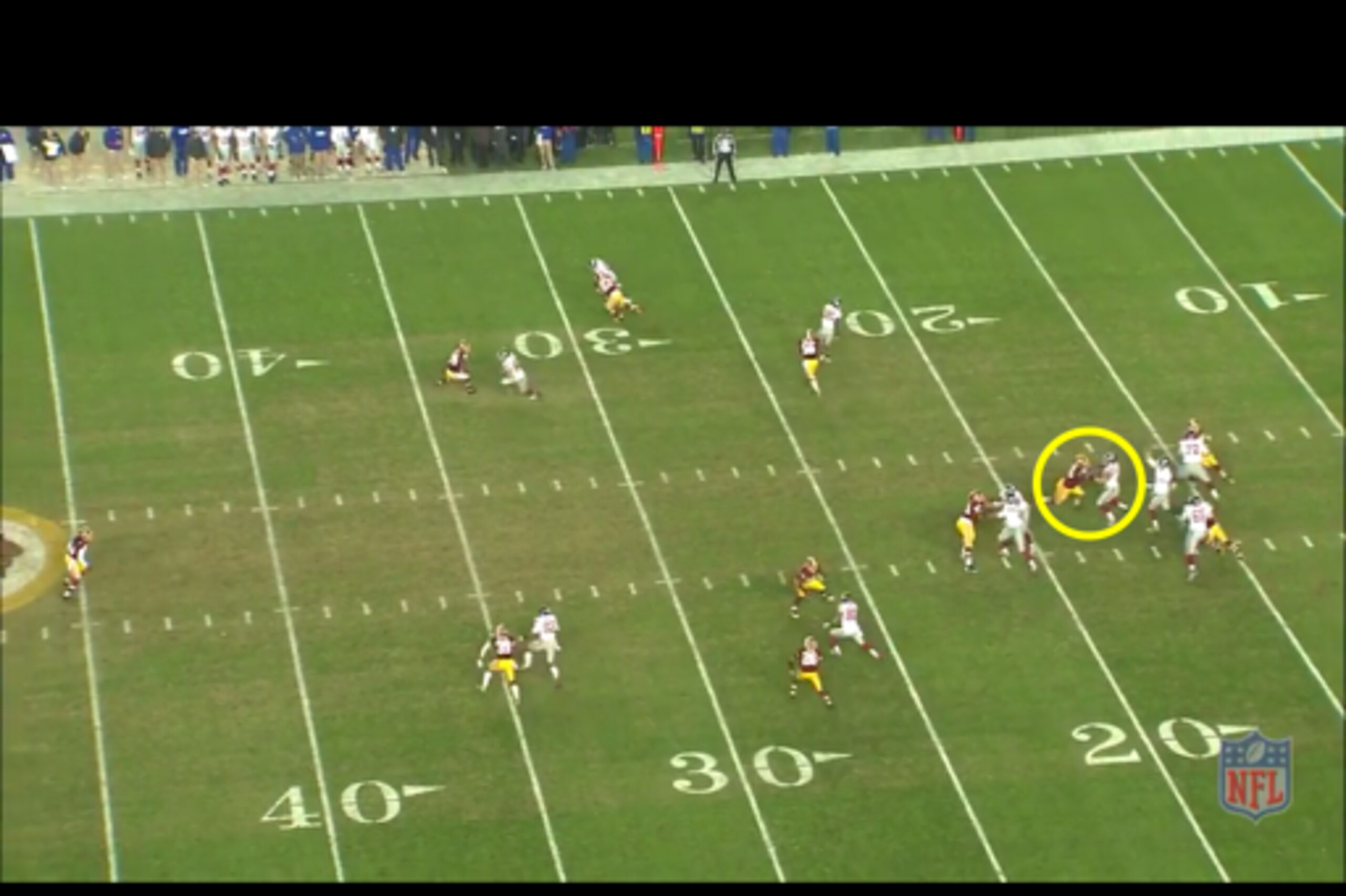
This pressure meant Manning couldn't step up into his throw for a stronger, more accurate delivery. But the Big Blue passer also couldn't retreat from Cofield's rush because he would have run right into Kerrigan or Orakpo, both of whom were closing in from the edges.
A look at another angle of the play shows how Cofield helped the Redskins create the classic collapsing pocket around a boxed in and helpless quarterback:
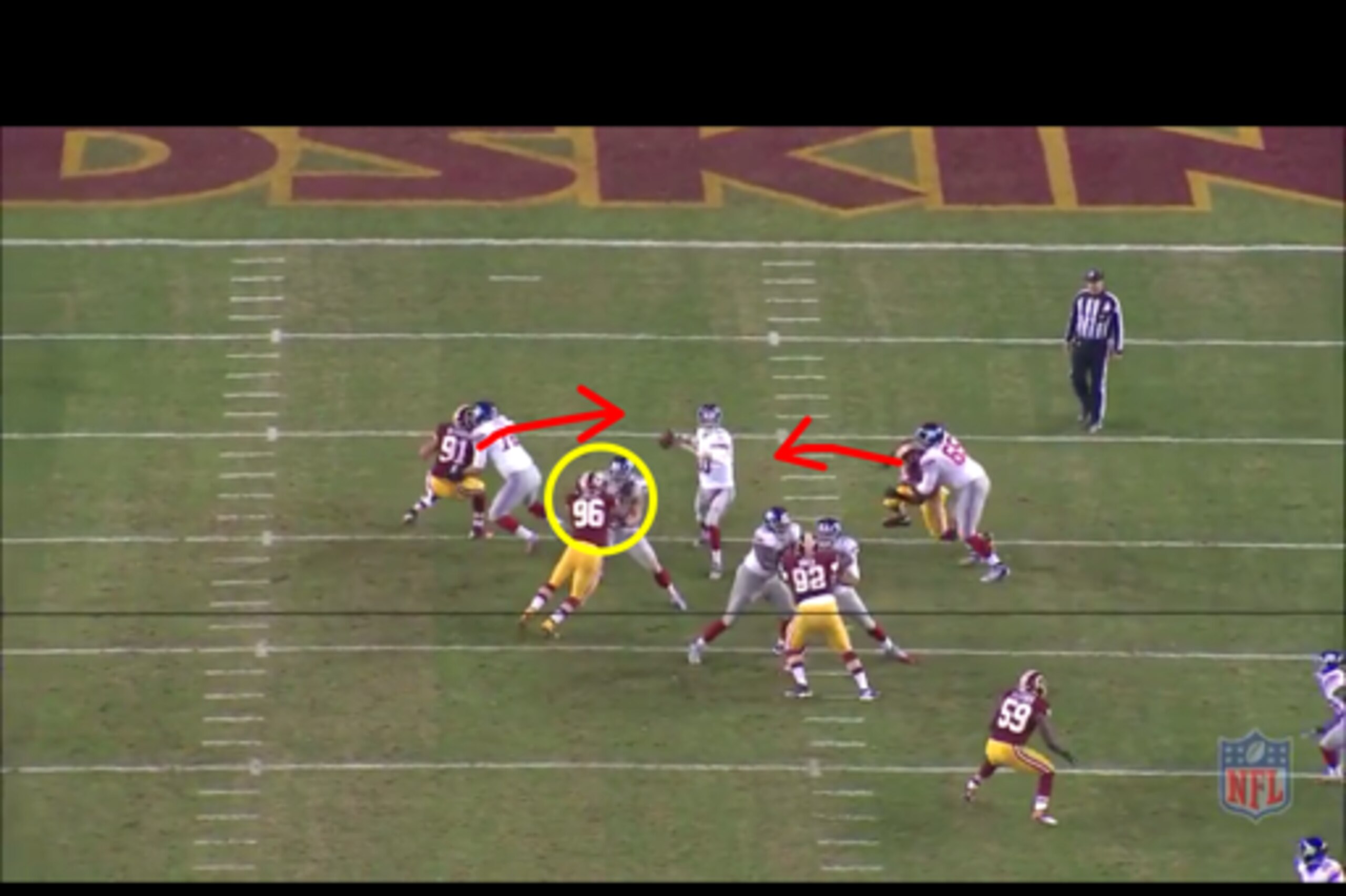
With Baker's double-team helping ensure single matchups for Washington's top three pass-rushers, the trio tightened the net around Manning. Cofield and Orakpo combined to hit him as he threw:
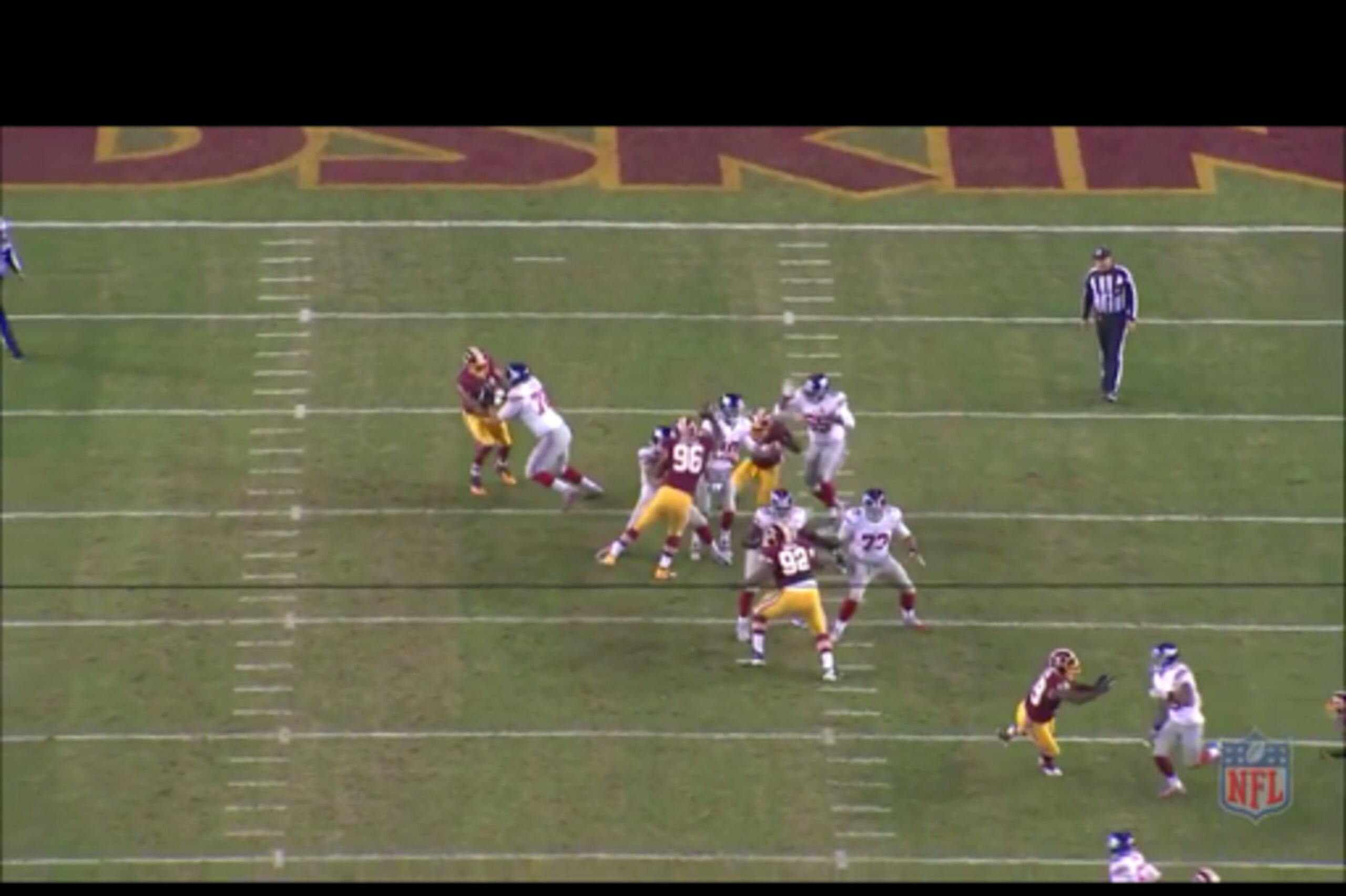
Manning was forced to throw with Cofield in his face. That pressure created an errant overthrow that safety Brandon Meriweather gratefully intercepted.
This is the kind of impact a force in the middle like Cofield can create. As a skilled interior pass-rusher, Cofield can partner either Jason Hatcher, Baker, Jenkins or Stephen Bowen and help this defense create more pressure through the middle.
Impact is just what the Washington defense can expect from Cofield. He'll create plenty of push on the pass pocket, as well as fill lanes and absorb blockers to create plays for others against the run.
Cofield hasn't been close to full health for the last two seasons. But at his best, he's a highly effective nose tackle.
The Redskins are welcoming back a true playmaker at the most important position on their defense.
All statistics via NFL.com.
All screen shots courtesy of Fox Sports, NBC Sports and NFL.com Game Pass.
.jpg?w=2560 "Seahawks Cardinals Football")
.jpg?w=2560 "Commanders Cowboys Football")