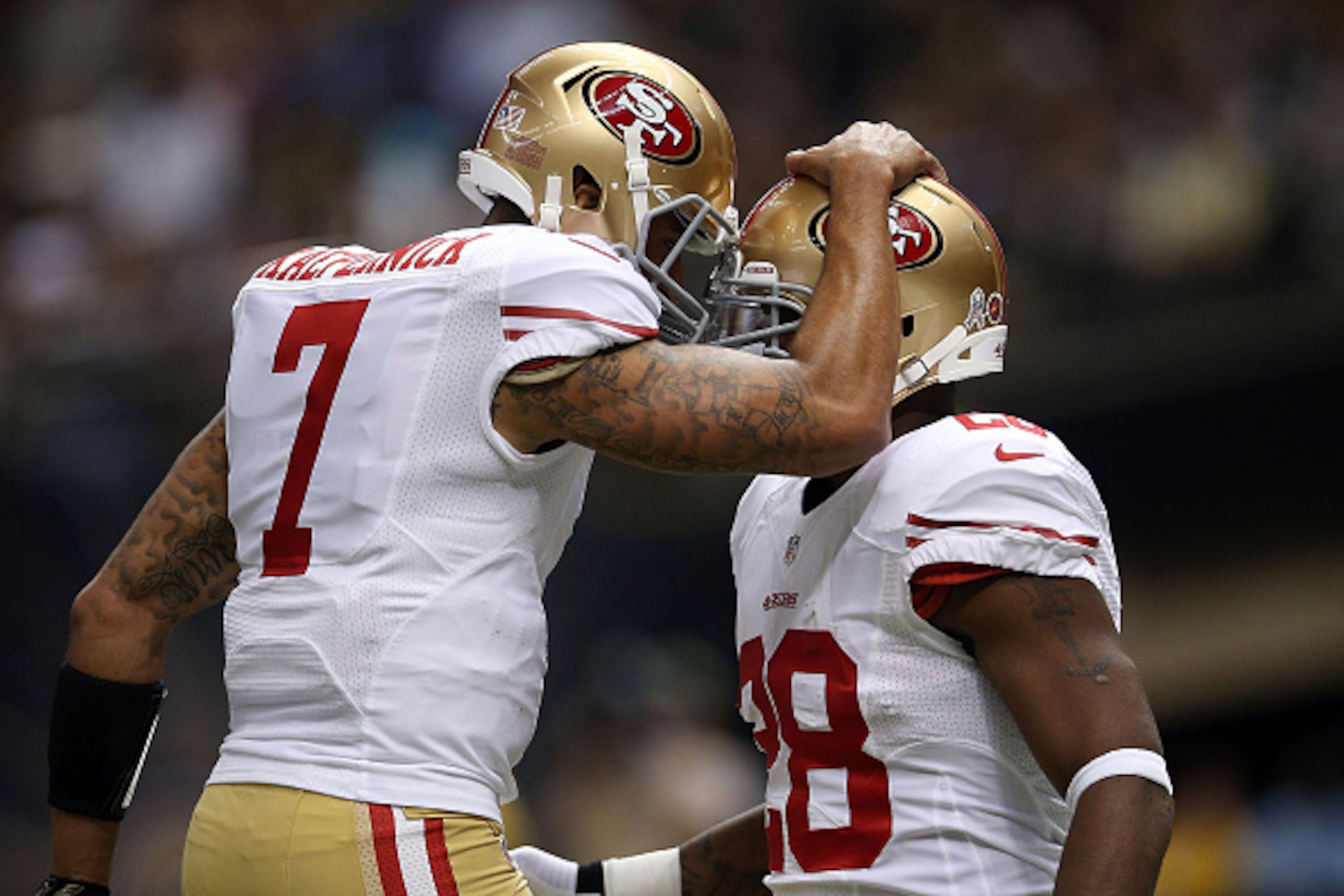

5 Questions Facing the 49ers After Week 10 Victory
The San Francisco 49ers' 27-24 overtime victory over the New Orleans Saints was more than just a season-saver.
It very well could be the critical turning point in what has been an up-and-down start to the 2014 NFL season.
San Francisco did something that no visiting team had accomplished since December of 2012—defeat New Orleans at home in the Mercedes-Benz Superdome.
"FINAL: #49ers 27, Saints 24.
— San Francisco 49ers (@49ers) November 9, 2014"
This overtime thriller pushed the 49ers' record to 5-4, giving them a legitimate chance to contend for a playoff spot come the end of the regular season.
The victory was great, as any win is, but it was anything but perfect. San Francisco was plagued by a flurry of issues—some new and some lingering.
San Francisco was able to pull off the upset despite many of these mistakes, but that does not mean the team can sit back and relax as it prepares itself for the final stretch. What worked in New Orleans may not necessarily apply in later games.
Here are five pressing questions that the 49ers will have to answer in coming weeks. To say that their season hinges on these answers is an understatement. Exactly how the 49ers go about doing so is the bigger issue.
Wide Receiver Inconsistency
1 of 5
Wide receiver Michael Crabtree certainly isn't looking like he's playing in a contract year.
San Francisco's No. 1 wideout has just 40 receptions for just 424 yards and three touchdowns despite being targeted 68 times.
Dropped passes have been a factor here.
Crabtree was targeted eight times against New Orleans but hauled in just three passes. The biggest of these was a 51-yard completion on a fourth-down play in the fourth quarter. This pass helped set up a game-tying field goal as the 49ers were trailing 24-21.
But Crabtree's season has been a mixed bag.
“I always have high expectations for myself,” Crabtree said, via Cam Inman of the San Jose Mercury News. “It ain’t where I want it to be, that’s why I work hard every day, try to catch every pass thrown my way. Whatever they give me, I work my hardest to work with it.”
"#49ers Michael Crabtree weighs in on his and offense's sub-par seasons http://t.co/qBOMSKH0U8
— Cam Inman (@CamInman) November 6, 2014"
Prior to Week 10, Crabtree had seven drops in eight games—second highest in the NFL, according to Pro Football Focus (h/t Inman).
The dropsies plagued fellow wideout Anquan Boldin as well.
Despite hauling in six receptions for 95 yards and a touchdown, Boldin also had four drops in the second half of the game, per ESPN Stats & Info (h/t Paul Gutierrez of ESPN).
"#49ers WR Anquan Boldin had 4 drops in the second half today, equaling his total from last seasonl, per @ESPNStatsInfo.
— Paul Gutierrez (@PGutierrezESPN) November 10, 2014"
One drop would have likely been a touchdown play had the ball not bounced off Boldin's hands.
Some of these mishaps certainly continued the ongoing issues the 49ers are currently enduring in the second half of games this season—we'll get there shortly.
The Fix
As far as drops are concerned, this really is nothing more than a lack of execution. The sure-handedness of players like Boldin was questioned on Sunday. But it's doubtful that this will be the sort of thing San Francisco experiences on a regular basis.
Crabtree's issues create a bigger problem. As a pending free agent—and as a player who will likely see a hefty payday during the offseason—the 49ers' top receiver certainly isn't living up to his mark.
No. 3 wideout Stevie Johnson is putting up similar stats in a much-reduced role. Johnson has 399 yards on 31 receptions and three touchdowns. He has also been targeted fewer times (40). In Sunday's contest, Crabtree was on the field for 44 snaps compared to just 18 for Johnson, per Eric Branch of SFGate.com.
Johnson hauled in all three of his targets in Week 10.
Crabtree still is a bona fide weapon for Colin Kaepernick and the offense. But Johnson has certainly emerged as a likable option. Perhaps we see more of him down the stretch as San Francisco starts to prepare for life after Crabtree.
Even though he isn't a wide receiver, it would be nice to get some added production from Vernon Davis in this regard.
4th-Quarter Offensive Woes
2 of 5
San Francisco's offense has generated just one fourth-quarter touchdown in 2014—a Blaine Gabbert pass that found wide receiver Bruce Ellington in garbage time during the 49ers' 42-17 loss to the Denver Broncos in Week 7.
49ers' play-by-play announcer Ted Robinson put it bluntly when he appeared on KNBR 680's Murph and Mac Show on Monday Morning, stating that San Francisco has yet to score a fourth-quarter touchdown when Colin Kaepernick was on the field.
It's as inexcusable as it is surprising.
The 49ers do have the ability to get out to an early lead in games. They were up against the Dallas Cowboys, Chicago Bears and Arizona Cardinals in Weeks 1 through 3 respectively. San Francisco was up 14-0 over New Orleans in its latest contest.
But things seem to fall apart on offense when the 49ers reach the second half—specifically, the fourth quarter.
Matt Maiocco of CSN Bay Area describes how dropped passes contributed to the lack of execution down the stretch:
"If not for some dropped passes—including what would have likely been an 85-yard touchdown pass to Anquan Boldin—the statistics would have been more impressive. With several misplays, the 49ers continued to struggle to score points in the second half.
"
Here are some sour stats for you to chew on: The 49ers have mustered just 26 fourth-quarter points on the season. Fourteen of these were from touchdowns—the Gabbert pass and a Dontae Johnson pick-six against St. Louis in Week 6.
San Francisco's rushing attempts in the fourth quarter are gaining an average of just 3.6 yards per carry—the lowest out of any quarter. The 49ers' fourth-quarter passer rating is 55.7—vastly different compared to the 123.9 rating in the first quarter of games this year.
While the 49ers were able to pull off the overtime victory in Week 10, they did have chances to take a lead in the fourth. The game-tying field goal was nice, but a touchdown would have proved to be a deciding factor.
"#49ers have not scored a 4th-quarter TD under Kaepernick thus far this season. Need a FG to tie, though. #Saints 24, #49ers 21, 1:52 to go
— Paul Gutierrez (@PGutierrezESPN) November 9, 2014"
The Fix
The stark contrast between San Francisco's first- and fourth-quarter abilities on offense is baffling. But there are some potential causes here.
First, we can jump back onto the anti-Greg Roman bandwagon once more. Scheme and play-calling starts with the 49ers offensive coordinator, but it also falls upon him and the coaching staff to execute the correct in-game adjustments necessary to carry over first-half success.
Roman has been scrutinized for his lack of adjustments over the course of the game. He may never change his stripes, but he does have to bear a primary responsibility for the general lack of execution in the fourth quarter.
Part of the fix could be an increased workload for San Francisco's running backs. The running game has often found itself out of the equation in the second half of games this season. Yes, the ebb and flow of games dictate the approach, but to remove this attack almost entirely makes little sense.
But another critical fix falls upon the players themselves. One could call out a lack of "killer instinct"—an aspect not new to San Francisco this season.
We saw a bit of this against New Orleans. We could have seen more.
This ultimately falls upon the players and the leaders on the roster. Yes, Kaepernick's frequent time-to-execute statements are true, but saying it needs to be backed up by the physical action itself.
Here is where the 49ers offense needs to bind together.
Consistency Along the Offensive Line
3 of 5
Predicting how San Francisco's offensive line will perform week to week is about as tough a challenge as could be right now.
The 49ers O-line has been widely inconsistent all season. True, a part of this has been because of injuries suffered to a number of key players—Mike Iupati (concussion), Anthony Davis (ankle) and Daniel Kilgore (leg).
But injuries cannot be the entire reason.
The 49ers have allowed 31 sacks on the season. Six of these came in Week 7 against the Denver Broncos—unquestionably a pass-rushing powerhouse.
Yet San Francisco followed up that performance with a lackluster eight-sack effort against the St. Louis Rams in Week 9.
Take the two divisional contests against the Rams as a perfect case study. In Week 6, San Francisco gave up zero sacks to a St. Louis squad struggling in the pass rush. In Week 9, the 49ers allowed eight sacks to a Rams team that entered the fray with just six on the season.
Left tackle Joe Staley got the best of his matchup with Rams defensive end Robert Quinn in Week 6. But Quinn beat Staley for two sacks in Week 9. Staley struggled, as did rookie center Marcus Martin who was making his NFL debut in place of Kilgore.
Matt Maiocco of CSN Bay Area broke down all of San Francisco's allowed sacks from Week 9.
Fortunately, the O-line looked much better against New Orleans. Yes, it allowed four sacks during the game. But these were also in part to Colin Kaepernick's in-pocket mistakes.
Christian Gin of Examiner.com breaks this down further:
"None of the four sacks were [the O-line's] fault as Colin Kaepernick poorly misread the rush which resulted in two coverage sacks. They had holes for Frank Gore and Carlos Hyde to give some balance on offense. Pass protection was outstanding in terms of one vs. one matchups, no pressure on standard plays that were not blitzes.
"
While it is nice to see the O-line playing well in what proved to be a critical game, the general lack of consistency is a major question mark moving forward.
The Fix
San Francisco's O-line is best suited to run block—an offensive approach favored by the 49ers for the vast majority of the Jim Harbaugh era.
According to Eric Branch of SFGate.com, the 49ers passed the fewest times between 2011 and 2013 while still allowing the 11th-most sacks in the NFL during that span. The 49ers are passing more in 2014, thus opening up the door for more sacks.
One might think that San Francisco should simply return to a run-heavy offensive approach. This might work to a certain extent, but it doesn't immediately solve all the issues.
Many of the 49ers' O-linemen are getting beat on one-on-one matchups. Look no further than DeMarcus Ware's move on Staley from Week 7 as a perfect example:
"The fake spin resurfaces. Gorgeous. RT "@SBNation: Dang, DeMarcus Ware. Daaaaaaaang. http://t.co/U4P8uZzTuo https://t.co/5KGNzxutJ6
— Chris Trapasso (@ChrisTrapasso) October 20, 2014"
Many of these sacks are coming on four- and five-wide receiver sets. The 49ers are struggling in pass protection when the offense is taking this approach.
While running the ball will play into this unit's strength, perhaps we'll see an increase in formations that utilize the blocking abilities of San Francisco's tight ends.
Vernon Davis and Vance McDonald may not be lighting up the stat sheet, but they can effectively block and assist this unit with pass protection.
What is known is this: If the 49ers want to get any sort of offensive continuity, the O-line will have to play up to its level of expectations and avoid the inconsistency that has plagued it for much of 2014.
.jpg?w=2560 "Chargers Mack")
.jpg?w=2560 "Green Bay Steelers Football")
.jpg?w=2560 "Giants Football")
Colin Kaepernick's Decision-Making Skills
4 of 5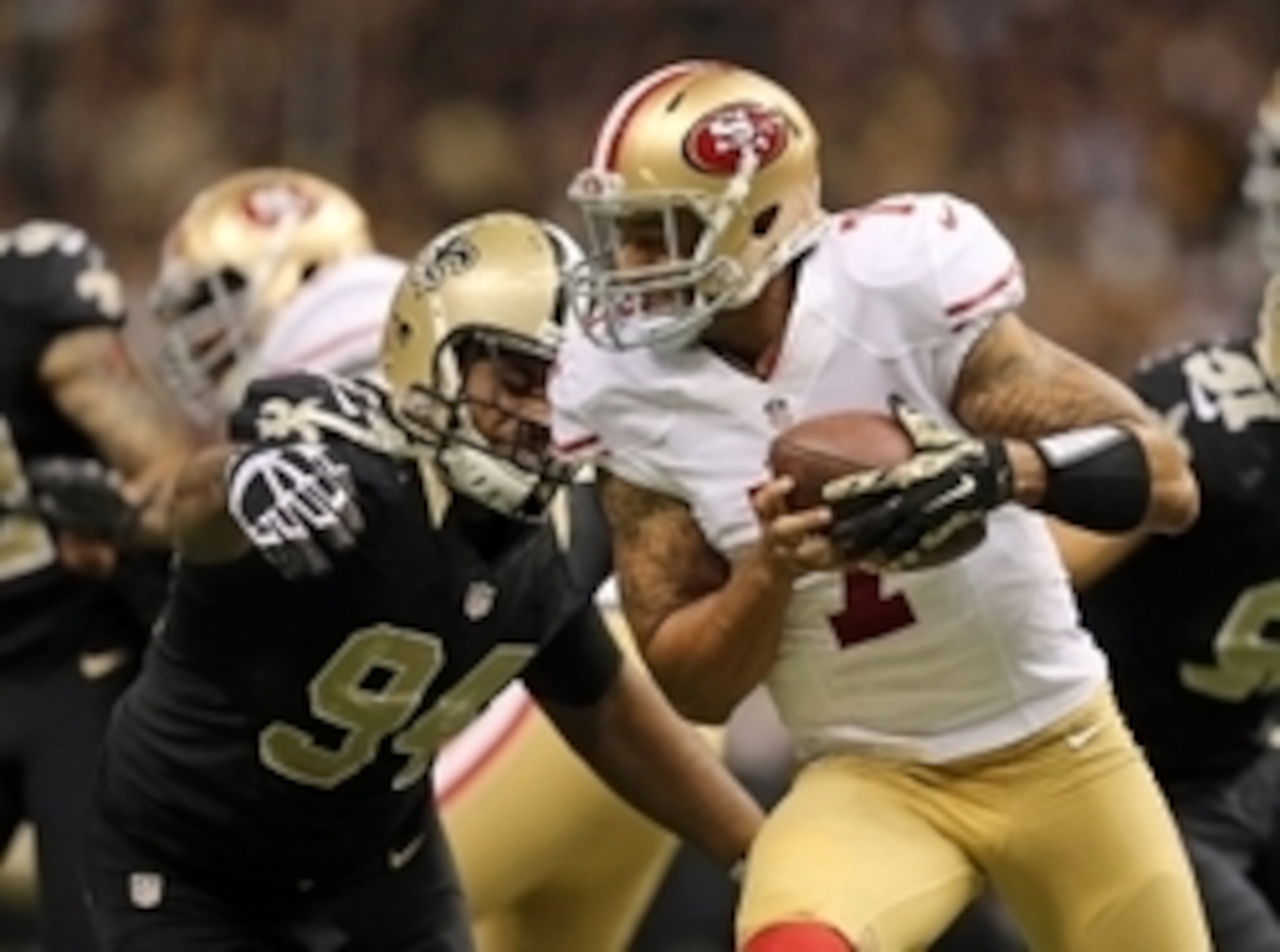
The 49ers obviously want to make Colin Kaepernick the linchpin of their offense.
But what is the correct balance of Kaepernick's abilities combined with San Francisco's ground-game strengths?
On top of that, how can Kaepernick overcome the difficulties experienced in handling opponents' pass-rushing schemes?
As mentioned previously by Christian Gin of Examiner.com, Kaepernick bore responsibility for the vast majority of the four sacks allowed to the Saints in Week 10. The biggest of these was when Kaepernick fumbled the ball after sitting in the pocket for five seconds.
Remember, an incomplete pass isn't always a bad play.
Kaepernick does need to do a better job of reading where defensive pressure is coming from and then making his adjustments—perhaps changing the play at the line or finding his hot-route receiver in a quick dropback.
But when the 49ers' signal-caller does have adequate time, making the right reads and the correct throw will continue to be paramount. Gin elaborates further on what Kaepernick showed us against New Orleans:
"There were some throws that made no sense and he didn't handle pressure correctly, but most of his attempts were on target. With the backs against the wall, he hit Michael Crabtree for a deep throw which arguably saved the 49ers 2014 season. He was also responsible for three of the sacks where he needed to get rid of the ball. The 49ers defense bailed him out on a mistake where he fumbled the ball in their own territory.
"
Kaepernick's Week 10 statistics were not helped by the multitude of drops from his usually sure-handed wide receivers. At the end of the day, Kaepernick finished with just 14 completions on 32 attempts and a touchdown—a 76.3 passer rating.
"Colin Kaepernick had a career-low 43.8 Comp pct on Sunday. Why? 49ers players dropped 6 passes, the most by any team in a game this season.
— ESPN Stats & Info (@ESPNStatsInfo) November 10, 2014"
But Kaepernick actually finished the contest with a respectable plus-4.3 rating according to Jeff Deeney of Pro Football Focus.
"Kaepernick's +4.3 grade yesterday was his highest of the season. He lost 84 yards through the air (plus potential YAC) from dropped passes.
— Jeff Deeney (@PFF_Jeff) November 10, 2014"
Kaepernick's abilities may be polarizing. We are certain to see frequent flashes of brilliance alongside head-scratching plays that make little sense. But the 49ers will need him at his best down the stretch.
The Fix
This is a hard one to wrap a finger around.
San Francisco wants its franchise quarterback to be the heart of its offense. But the heart of the offense has long been bolstered by the running game. It's a change of theory, and the 49ers are experiencing a mixed bag at best.
Becoming a better pocket passer is obviously a part of the game in which Kaepernick will need to improve. But that statement is as vague as the fix is complex. How exactly does a talented quarterback go about improving in this area to the necessary and expected levels within an offense that has yet to fully grasp a change in theory?
There isn't a clear answer.
Perhaps the 49ers need to get back to an identity that worked well enough in previous seasons. This would potentially allow Kaepernick to continue making the dynamic plays he is capable of without needlessly exposing the shortcomings seen over the course of San Francisco's first half of the season.
But that approach is perhaps best answered on the following slide.
Maintaining Offensive Identity
5 of 5
Who are the 49ers on offense? What is their identity? What are their strengths?
An outsider's perspective might suggest San Francisco is a team built to run the ball with a heavy, downhill approach. This weakens opposing defenses, eats up the clock and sets up play action—an area in which the 49ers offense actually thrives.
But there has to be a deeper explanation.
As stated before, Colin Kaepernick has a plethora of talents that make him one of the toughest quarterbacks against which to prepare. It would be a shame to simply relegate him to a secondary role in the moniker of a "game manager." He is anything but.
Yet we have seen the results from a generalized shift in offensive theory—one that emphasized the use of heavy wide receiver sets instead of the old ground-and-pound running approach perfected by this franchise over the years.
San Jose Mercury News columnist Cam Inman's mixed-bag assessment is an understatement.
At no point were these results negatively revealed than in the 49ers' Week 9 offensive debacle to the St. Louis Rams—a 13-10 loss in which San Francisco gained just 263 all-purpose yards.
The poor showing called into question many things, including the frustrations of a number of key players. Frank Gore was one who was uncertain of the 49ers' identity.
“We’ve just got to make our minds up, do what we feel we’re good at, and go do it,” Gore said, via Eric Branch of SFGate.com.
Perhaps this means running the ball more frequently. More importantly, it means running the ball effectively. Gore is averaging 4.0 yards per carry on the season and just 61.4 yards per game.
"Everyone wants 49ers to run more. Running well the bigger issue: Frank Gore averaging under 3 YPC last 3 weeks.
— gregg rosenthal (@greggrosenthal) November 6, 2014"
San Francisco got back to its running ways in Week 10. But Gore averaged just 3.5 yards per carry on 23 rushing attempts. He did, alongside rookie Carlos Hyde, notch a rushing touchdown during the contest. Hyde finished with an average of 9.0 yards per carry on four tries.
Perhaps it is in moments like these when we have to give Greg Roman some credit. Alex Boone did, via Matt Maiocco of CSN Bay Area:
"This is what we said we were going to do and we did it. And [Roman] stuck to the game plan and everybody up front kind of mounted up. We knew it was going to be on us this week. We had to come in here and ground-and-pound and we did a hell of a job doing it.
"
Now comes the tougher task—doing so with consistency.
The Fix
As often stated by Jim Harbaugh, any sort of major problems or losses have everyone's fingerprints on them.
Therefore, the fixes will have to work their way through the coaching staff, through the play-calling and down to the players.
Roman worked out a solid offensive scheme in the first half. It crumbled a bit in the second. Thus, we can prompt a need for better second-half planning and adjustment. Situational play-calling also has to be a part of the solution.
A return to a ground-first approach worked well in Week 10. Straying from that probably isn't the best idea, but the 49ers would be wise to utilize more of Hyde in various rushing packages.
But the burden also falls upon the rookie back, who missed an assignment during one of New Orleans' blitzes on Sunday. The play resulted in a sack of Kaepernick.
Kaepernick also needs to showcase the fortitude and maturation necessary within the 49ers offense. He has shown the ability to do this, but it needs to happen on a more consistent level.
And Kaepernick's targets also need to make their presence known. There simply cannot be the large number of drops experienced in Week 10. There also needs to be an increase in production from players like tight end Vernon Davis and wide receiver Michael Crabtree.
Identity is a confusing yet indispensable element. When a team is winning, it clearly has an identity, right? When it is losing...
You get the picture.
That picture has been painted in each of the 49ers' rough losses on the season—losses that have called into question the identity of the offense and the team in general.
But for the 49ers to be successful down the stretch, they will have to know who they are and how to use their best strengths.
They have the talent. Now comes the part of putting the talent into a machine-like approach.
All statistics, records and accolades courtesy of Pro-Football-Reference.com and ESPN.com unless otherwise indicated.
Peter Panacy is a featured columnist for Bleacher Report, covering the San Francisco 49ers. Be sure to check out his entire archive on 49ers' news, insight and analysis.
Follow him @PeterPanacy on Twitter.
.jpg?w=2560 "Seahawks Cardinals Football")
.jpg?w=2560 "Commanders Cowboys Football")