Is Damian Lillard's Defense a Problem for Blazers, or Something They Can Ignore?
Damian Lillard's defense has been a topic for the wrong reasons since joining the Portland Trail Blazers. Coming from a small school, people recognized his defensive deficiencies would be his Achilles heel in the NBA.
In 2014-15, it's still a problem.
The good news for fans is that you've heard what you want to hear early in the new year. Three-time All-Star LaMarcus Aldridge had endearing things to say about the youngster after Game 1, via The Oregonian's Jason Quick:
TOP NEWS
Jaylen Brown Calls Out Tatum 🧢
LeBron on President Trump's Criticism
Report: Knicks to Sign Knecht
""He's worked on it all preseason,'' LaMarcus Aldridge said. "He has showed people that he is definitely trying to be better defensively, and he's given better effort. I think everybody is seeing that the effort is there. It's just different when you go from being a scorer to learning how to do both. It just takes time. But he has always been an overly competitive guy who wants to do well on both ends.''
"
Even Lillard himself recognized the challenge. "It's a huge deal, because it's our next step," Lillard said.
"Being a good defensive team is our next step, and I'm the point guard, and I most likely will have the biggest challenge on my hands every night. I'm not going to shy away from it."
All sounds good, right?
Unfortunately, the season opener against the Oklahoma City Thunder (after which the two aforementioned quotes took place) said otherwise.
With OKC in town, Quick described:
"Thunder point guard Russell Westbrook had 38 points and six assists and was the most dominant player on the court. He posted Lillard. He duped him backdoor for a layin. And he shot over him. Along the way, he put the Blazers' rising star in foul trouble.
"
The season is still in its infancy, but even a small sample size can be telling. Before Tuesday night's game against the Cleveland Cavaliers, Lillard had given up an average of 25.3 points to opposing floor generals (although he held fellow star Kyrie Irving to just nine points on 3-of-17 shooting in Game 4).
The question here becomes: Should the Blazers be worried, or can they look past this glaring concern?
The easy answer is it's something in between. Let's start with the detractors.
The popular sentiment states Lillard must improve defensively. Just ask someone who knows a thing or two about defense.
"He can be like Patrick Beverley [of the Houston Rockets] if he wants to, but that’s a mindset,” former point guard Gary Payton told Chris Haynes, then of CSNNW.com (now with Cleveland.com). Payton continued:
"I think Damian has to be willing and ready to play that type of way. Right now, he’s scoring so easily and he’s so good at the offensive end, he doesn’t have to think about defense. He doesn’t have to think about it because he knows he can outscore somebody.
"
Then again, Payton makes a point in Lillard's favor whether he intended to or not. For Lillard supporters, the former Weber State product is an elite player despite defensive struggles.
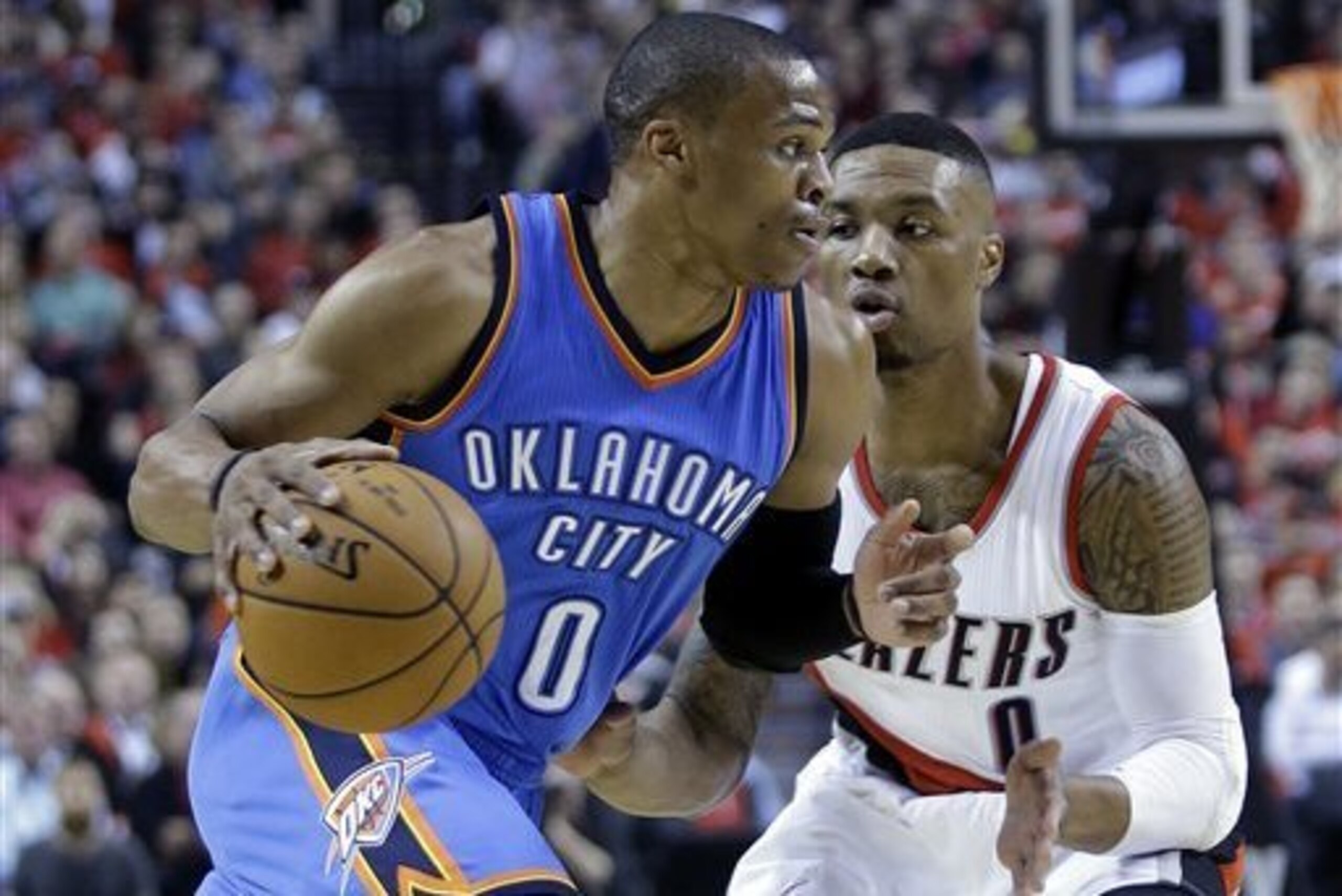
According to Basketball-Reference.com, Lillard's Defensive Win Shares in 2013-14 was just 1.8 compared to his Offensive Win Shares of 7.8. That equates to a total Win Shares of 9.6, which compared to Beverley's 4.2 is downright dominant.
Taking it one step further: Look at Westbrook from last season. Although injured part of the year, OKC's star guard posted a total Win Shares of 5.2, per Basketball-Reference.com—significantly less than Lillard's mark.
Falling in the middle of the two arguments, the crux of the matter is Portland needs a better defensive identity to reach elite status. Luckily for Rip City, it's gotten that early in the year, holding opponents to 92.3 points per game compared to 97.8 scored.
Although people would love for Lillard to be Chris Paul, he's more Derrick Rose with his athleticism and Chauncey Billups with his clutch, long-range shooting. Does Lillard need to improve defensively? Yes. Or at least, it would be ideal for the Trail Blazers' chances moving forward.
But at 24 years old, we can assume Lillard is never going to be Paul on defense. He doesn't need to be an elite defender to be an elite point guard; he just needs to be adequate.
Allowing Wesley Matthews to be a go-to defender and Robin Lopez to be a last resort will be enough. Placing Lillard on the less-dangerous guard each game will allow Matthews to do his damage defensively.
More importantly, it will allow Liilard to remain fresh for late-game offensive production.
It may not be the popular opinion, but getting Lillard to par defensively—not elite—will be what keeps him at an All-Star level or higher. Offensive struggles will fix themselves, but anything this group gets defensively will be a bonus from the ultra-productive, offense-oriented point guard of the future in Rip City.


.jpg?w=2560 "Reported Details of Seahawks-K9 Split ⛓️💥")