Why the St. Louis Rams Need to Release Jake Long This Offseason
The St. Louis Rams gambled on Jake Long when they signed him in the spring of 2013.
They gambled knowing he was already well-worn and damaged, needing triceps surgery during his final year with the Miami Dolphins, and before that in 2011 he tore his biceps. They gambled hoping he could recover and still perform at a high level. They gambled by paying him like he was still the Jake Long who went to four straight Pro Bowls.
Now they’re paying 2014 Jake Long, a tackle who’s torn the same ACL in back-to-back seasons.
TOP NEWS
.jpg?w=2560 "NFL Paris Football")
NFL House in Paris Closes for Protests
.jpg?w=2560 "Seahawks Chiefs Football")
Trevon Diggs Cut by Seahawks
.jpg?w=2560 "Colts Football")
Jonathan Taylor Landing Spots
Long suffered his latest ACL tear Sunday in a loss to the Kansas City Chiefs. This time the injury occurred a little earlier in the season, unlike a year ago when Long tore his ACL and MCL in Week 16. Now a second recovery from a second devastating tear lies ahead for an already declining tackle.
The Rams used a first-round pick (second overall) on Greg Robinson in the 2014 draft, and he’ll now ascend to replace Long as the new blindside protector this season and likely beyond.
But the thinking and ideal situation was to have both Long and Robinson as a tackle tandem, providing core stability for an offensive line that so desperately needs it and has watched its quarterback crumble 23 times this season (the fourth-worst sack total).
Now Long is gone, and he’s probably not coming back.
Or at least he shouldn’t come back. He's a free-agency bust that needs to be acknowledged and a loss who needs to be cut. More importantly, he’s a walking Band-Aid and a financial commitment that now requires far too much risk tolerance.
Salary-cap strategy always comes back to risk management. Can a general manager trust a player to perform at a level that matches his paycheck? Or can a much cheaper player provide a similar return?
There are many numbers—both statistical and those with dollar signs in front of them—that tell us why Long doesn’t meet those core salary-cap requirements and why the Rams should begin another tackle reboot this offseason.
Let’s start with these ones from Mike Garafolo of Fox Sports.
Long has two years remaining on a $34 million contract he signed in 2013, $12 million of which is guaranteed. Nearly half of his base salary in 2014 becomes guaranteed five days into the new league year next March.
That means the truly and fully guaranteed portion of Long’s contract is done this year. Since the NFL plays tricks with the word "guaranteed," we don’t often refer to the final two years of Long’s contract as what they pretty much are: option years. He’s still under team control but can be cut at little cost, with his contract accounting for only $2.5 million in dead money.
That figure is a lot lower than the cost to keep Long and is why he should be cut without hesitation. A tackle with rapidly declining mobility and an ACL that’s been torn twice isn’t worth a commitment of any significance.
Need more financial motivation? Take a look at Long’s cap hit, if you’re brave.
Long’s contract comes with a cap hit of $10.5 million in 2015, according to Over The Cap. That’s slated to make him the sixth-highest-paid left tackle against the cap. When looking at who's either behind or only slightly ahead of him, your jaw hits the floor (and possibly other body parts).
| 2014 Cap hit | |
| Branden Albert | $10.7 million |
| Ryan Clady | $10.6 million |
| Jake Long | $10.5 million |
| Joe Thomas | $10.2 million |
| Duane Brown | $9.5 million |
| Jason Peters | $8.55 million |
There was a time when Long fit in that company, and that time was 2011. His knee shredding has led to a dramatic drop in effectiveness.
His spiral is best illustrated by using the same set of names in another painful list for the Rams’ bank account. Prior to his latest injury Long had played 449 snaps this season (95.3 percent of the Rams’ offensive snaps). During that time he allowed four sacks and 13 quarterback hurries, according to Pro Football Focus (subscription required).
Quickly you’ll notice that’s not exactly on par with the rest of his paycheck peers, particularly the hurries.
| Snaps | Sacks | Hurries | |
| Branden Albert | 476 | 3 | 3 |
| Ryan Clady | 486 | 0 | 8 |
| Jake Long | 449 | 4 | 13 |
| Joe Thomas | 478 | 1 | 3 |
| Duane Brown | 535 | 1 | 9 |
| Jason Peters | 511 | 1 | 8 |
Long is the only name with double-digit hurries there. Houston Texans left tackle Duane Brown has been on the field for 86 more snaps while blocking in front of quarterback Ryan Fitzpatrick, who’s often scattered with his reads and pocket movement. Yet he’s still allowed only a single sack.
Brown is scheduled to earn $1 million less than Long against the cap next year. We see a similar tale of far greater effectiveness with a far lesser cap hit when looking at Philadelphia Eagles tackle Jason Peters. He’s played 62 more snaps than Long while still giving up only a single sack and keeping his hurry total below 10.
Long’s movements aren’t smooth or fluid anymore, and he easily gets beat by sheer speed off the edge.
For an example we can look back to Week 6 when he did his best Foreman vs. Ali impression (he was Foreman). Long was tasked with blocking San Francisco 49ers outside linebacker Dan Skuta. Entering this game Skuta had been a sufficient and often even pretty alright replacement for suspended linebacker Aldon Smith. But he hadn’t registered a sack over 92 defensive snaps.
Lining up opposite Long was just the tonic to change that.
There was nothing special or exotic about the 49ers pass rush on this 1st-and-10 play. It was a standard four-man rush with Skuta lined up wide to the right, looking to turn the corner and pressure Davis.
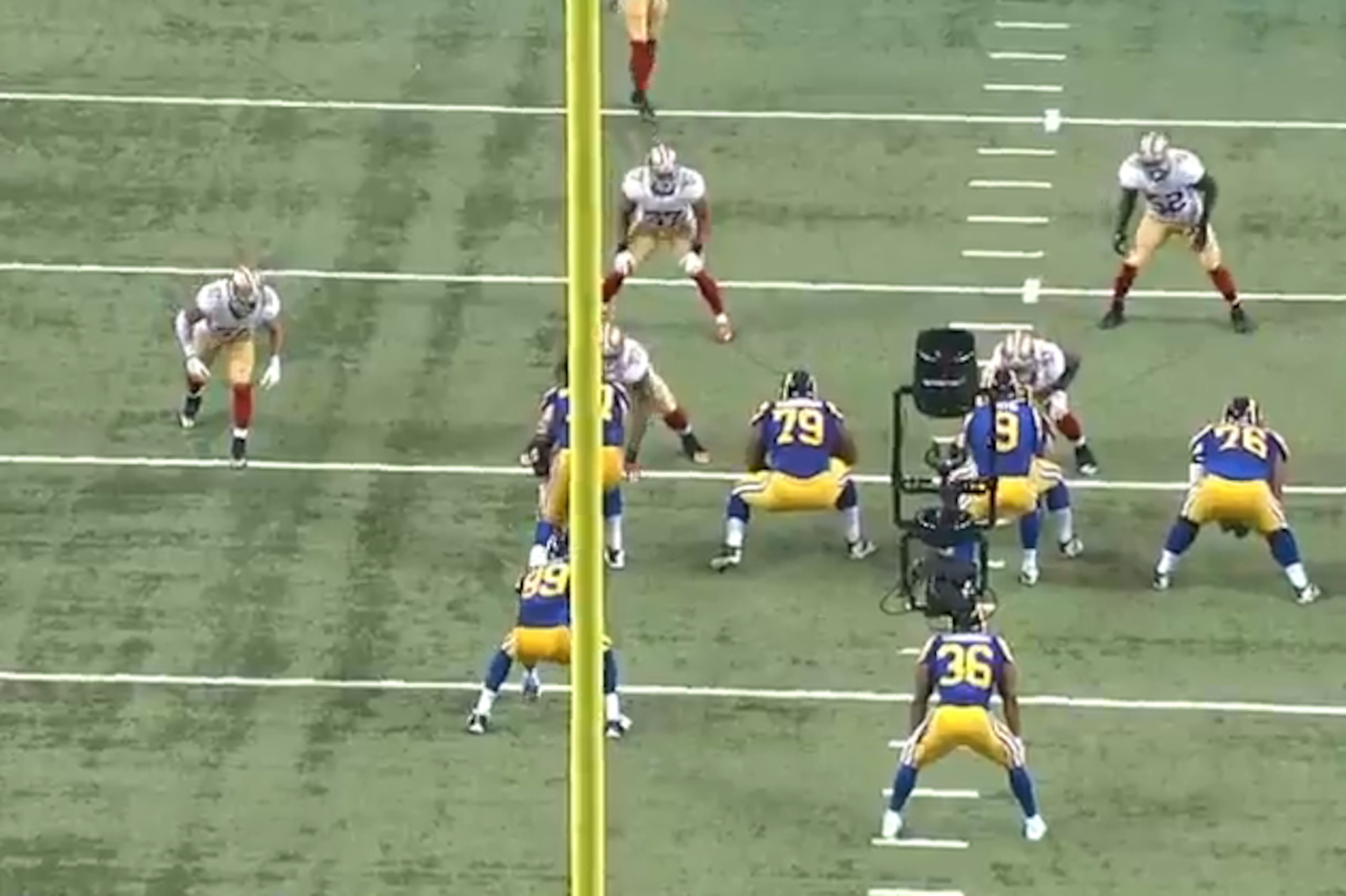
Skuta's desired path is obvious with his alignment. He wants to go the long way and beat the tackle with a quick burst off the line. But ideally Skuta’s journey from pre-snap alignment to sack will be a gentle arc and still relatively direct with only a slight detour around Long.
The pass protector’s goal is to make that arc even longer, pushing Skuta deep into the backfield and behind the quarterback. That would buy Davis the required valuable seconds to step up into the pocket and throw after his play fake.
To drive Skuta wide, Long needs to match quickness with quickness. While the pass-rusher is accelerating out of his two-point stance the blocker needs to take long strides just as fast. When the two engage Long needs to be at an even depth with Skuta and still have a firm base to maintain his stance through contact.
He did the first part fine, sliding three steps to keep pace. But once Long arrived at the right depth his base—the foundation every blocker draws his strength from—was completely gone. Long’s footwork couldn’t keep up, and he stood awkwardly upright, ripe for embarrassment.

Instead of a sturdy wall Long was a lumbering tree. He was able to only partially engage, and one hack from Skuta’s hand easily earned a clear path to Davis.
At that point a 322-pound lineman was just holding on for the ride.
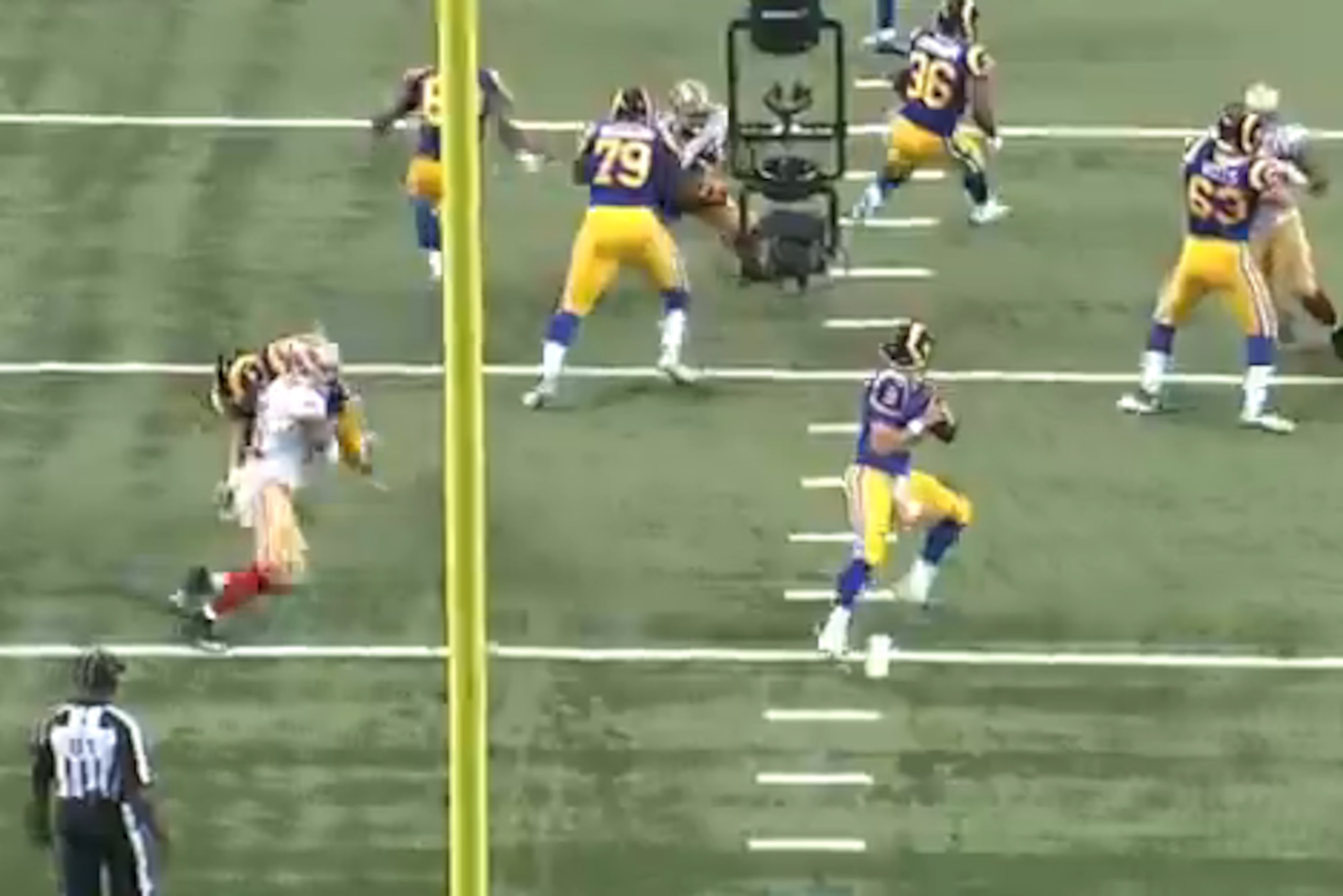
For Davis it was the sort of ride you would never sign your kids up for, mostly because no reasonable parent wants his or her kids getting hit from behind violently by an NFL linebacker.

That's one of many plays Long has showed limited mobility on this season, which was a rare sight in his prime.
If Long was set to be paid a somewhat more manageable salary in 2015, hoping for yet another injury rebound could be justified. He'll still be only 30 years old by next season, and Long's operating at even, say, 70 percent alongside Robinson is an upgrade over Rodger Saffold, who's also injury-prone but can play tackle and guard.
But he is getting paid that money and is declining drastically compared to his position peers at the same pay grade. Cutting Long is a hard future to think about right now with quarterback Sam Bradford out for the year, defensive end Chris Long on injured reserve and both Saffold and center Chris Wells also hurting.
It’s also the right future for the Rams because Long needs to be another team’s financial cement shoes.
.jpg?w=2560)