Everson Griffen Earning Every Penny of 2014 Mega Extension
At the halfway point in the Minnesota Vikings’ 2014 season, defensive end Everson Griffen is emerging as a cornerstone defensive player in Minnesota and is rewarding the team’s faith in him after he was given a fruitful new contract in free agency.
Serious backlash followed after the Vikings extended Griffen with a five-year, $42.5 million deal, figures per ESPN.com.
First ESPN’s Bill Polian graded the Griffen signing a D, tied with many others for the lowest grade given to any defensive-end signing. Then Forbes topped that harsh criticism, calling Griffen the NFL’s most overpaid player of 2014.
TOP NEWS
.jpg?w=2560 "NFL Paris Football")
NFL House in Paris Closes for Protests
.jpg?w=2560 "Seahawks Chiefs Football")
Trevon Diggs Cut by Seahawks
.jpg?w=2560 "Colts Football")
Jonathan Taylor Landing Spots
Neither source gives extensive insight into the criteria Griffen met to be considered such an overpaid player, but the logic is easy to derive.
Griffen had never been a starting player in the NFL before. He spent his first four seasons in Minnesota as a rotational player. In 2013, the year before his extension, he played only 59.7 percent of snaps, via Pro Football Focus premium statistics (subscription required). With qualified defensive ends like Jared Allen and Brian Robison, Griffen was unable to earn a greater share of playing time for four whole seasons.
Number of sacks is the digestible, yet too simplistic statistic that is quickly cited in situations like these. Where sacks strongly hit the radar of analysis of defensive ends, angst about the Griffen signing was sure to follow. After all, he had only 17.5 over the course of his four seasons in Minnesota.
The Vikings smartly looked past that, paying for what was expected of the player in the future instead of paying for what the player had already accomplished. That’s why Jared Allen was politely ushered out of town, sliding Griffen into the starting lineup in his stead.
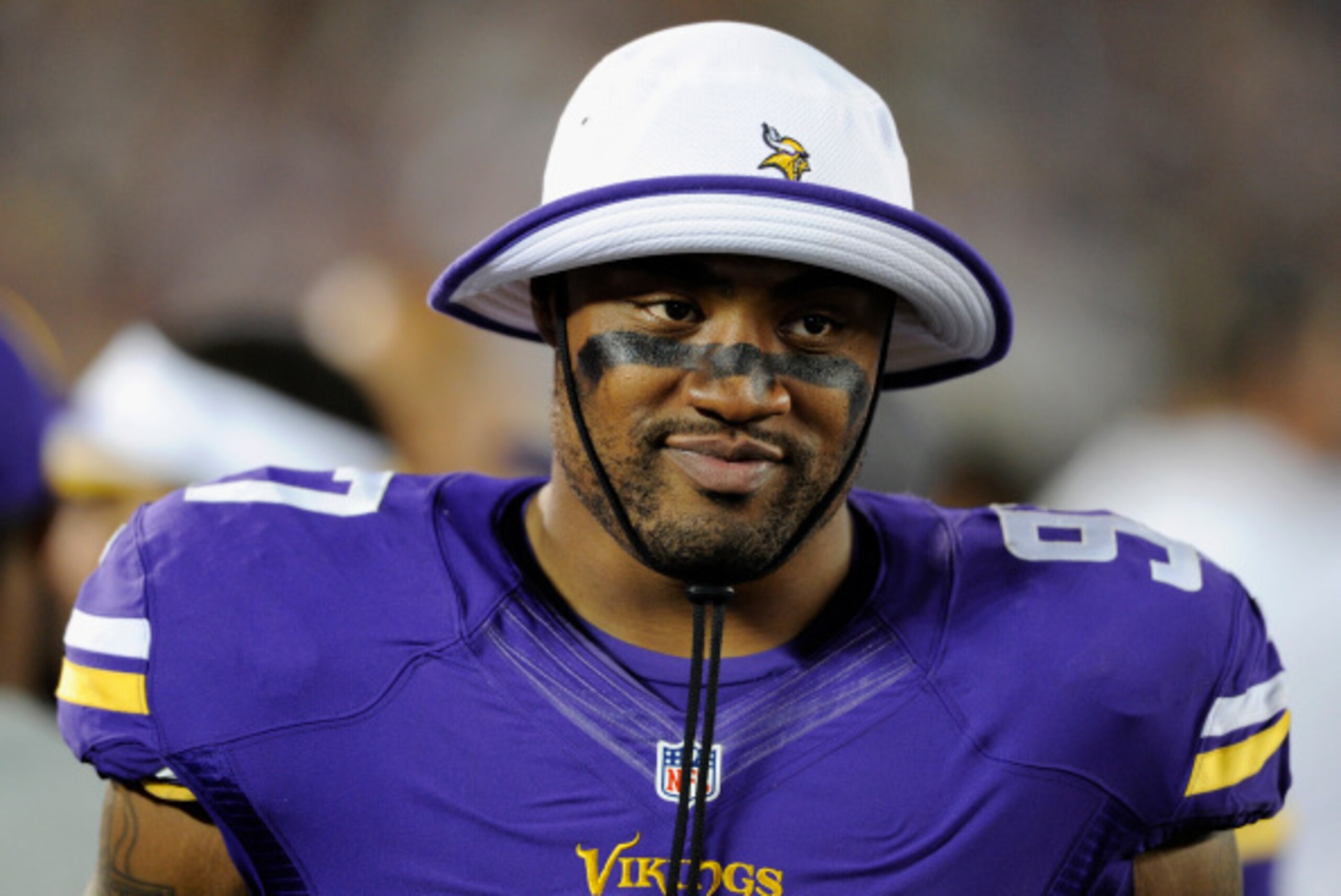
Minnesota coaches have known for a few years that they had a special player in Everson Griffen. That explains why the Vikings once experimented with Griffen at linebacker, trying to find ways to increase his snap count. It also explains why Griffen made such a big impact on special teams early in his career, often seen flying down the field on the kickoff team faster than much smaller players.
His combination of size, speed and quickness is uncommon. Teams rarely stumble across players with his potential, so the Vikings tried to find many ways to let him impact games. He did it, too, just in smaller quantities.
The problem wasn’t that Griffen had not built up a big enough sample size for proper analysis. Some analysts just felt like using indicators that tell little about the quality of the player.
To assess worth, I will compare Griffen with three other 4-3 defensive ends who struck deals over the offseason in the Seahawks’ Michael Bennett, the Buccaneers’ Michael Johnson and the Bears’ Lamarr Houston.
| Years | Guaranteed $ | Avg. Salary | Age | |
| Griffen | 5 | 19.8 mil | 8.5 mil | 26 |
| Bennett | 4 | 16 mil | 7.13 mil | 28 |
| Johnson | 5 | 18 mil | 8.75 mil | 27 |
| Houston | 5 | 15 mil | 7 mil | 27 |
Note that comparing players who sign in different years is tricky. The salary cap is increasing, so players signed in following years will always achieve a higher salary, all else held equal. So no matter where Griffen or any other recently signed end stands in terms of average salary at their position, that ranking will drop in ensuing seasons.
To judge the merits of the four ends who were on the market, let’s compare a sample from the previous two seasons that includes not only sacks, but hits and hurries, too.
| Sacks | Hits | Hurries | |
| Griffen | 1.02 | 1.39 | 4.53 |
| Bennett | 1.14 | 1.96 | 5.51 |
| Johnson | 1.02 | 1.36 | 4.19 |
| Houston | .66 | 1.81 | 4.59 |
Griffen averaged out as an equal or better rusher in each statistical category in comparison to Johnson. He certainly holds his own in comparison to the other two as well.
Now consider the role Griffen played. He was a rotational rusher who was given little positional continuity. Minnesota moved him all around the defensive line. Rushing the passer is an elaborate game of cat and mouse with pass-blockers, so Griffen was disadvantaged by the lack of continuity in his alignments. Also, Griffen played a bigger role in special teams than most ends do.
Factoring the youth of Griffen with the possibility for future growth also enticed Minnesota into spending big.
Through eight weeks in 2014, the four ends stand as follows in the same statistical categories:
| Sacks | Hits | Hurries | |
| Griffen | 1.45 | 1.45 | 3.15 |
| Bennett | .58 | 2.62 | 5.24 |
| Johnson | .70 | 1.40 | 3.49 |
| Houston | .25 | 2.46 | 3.69 |
With eight sacks to date, Griffen holds a firm lead in getting quarterbacks to the ground. He doesn’t measure as well in hits or hurries, but his overall impact is still comparable.
What may be more surprising about Griffen’s 2014 performance thus far is how impactful he has been defending the run. His numbers in run defense makes those of Bennett, Johnson and Houston look pathetic.
| Tackles | Assists | Stops | |
| Griffen | 6.10 | .68 | 5.42 |
| Bennett | 5.57 | 0 | 5.14 |
| Johnson | 4.75 | 1.78 | 3.56 |
| Houston | 2.98 | .85 | 2.55 |
Run defense was one of the biggest unknowns with Griffen. Prior to 2014, he was mostly a rotational rusher who featured on passing downs. The frequency with which he’s making tackles, but especially stops for loss, is a very pleasant surprise.
Now consider one more factoid related to these 2014 statistics. Griffen has played 87.5 percent of the Vikings’ defensive plays, which is the fifth-highest percentage of all NFL defensive linemen, per Football Outsiders.
Houston has played 77.4 percent for the Bears and Bennett 81.5 percent for the Seahawks. Excluding Week 2 when he was out with injury and Week 3 when he was limited, Johnson has played 76.4 percent for the Buccaneers.
That means Griffen is being tasked with a bigger role than any of the other three, no longer getting the frequent rest to stay fresh. His ability to play at such a high level with such a high snap count is impressive.
Early signs say Minnesota made the right move to extend Griffen with such a big contract. ESPN’s Louis Riddick gave his approval with these strong votes of confidence in Griffen’s ability:
"#Vikings DE Everson Griffen one of the best athletes in the #NFL; very good football player. Great move re-signing and letting J.Allen walk.
— Louis Riddick (@LRiddickESPN) October 27, 2014"
"Turn on the tape of yesterday's game between #Bucs &#Vikings, watch DE Michael Johnson & compare to Everson Griffen...Not. Even. Close.
— Louis Riddick (@LRiddickESPN) October 27, 2014"
Griffen seems to be growing into his new role and into the new defensive scheme, too. In the last two games, he has racked up four sacks and 13 hurries in 83 rushes. That calculates to a monstrous 2.89 sacks and 9.4 hurries per 60 rushes.
The tape gives strong indications of his growth as well. It not only shows his immense athletic talents, but also his maturation as a rusher in terms of technique.
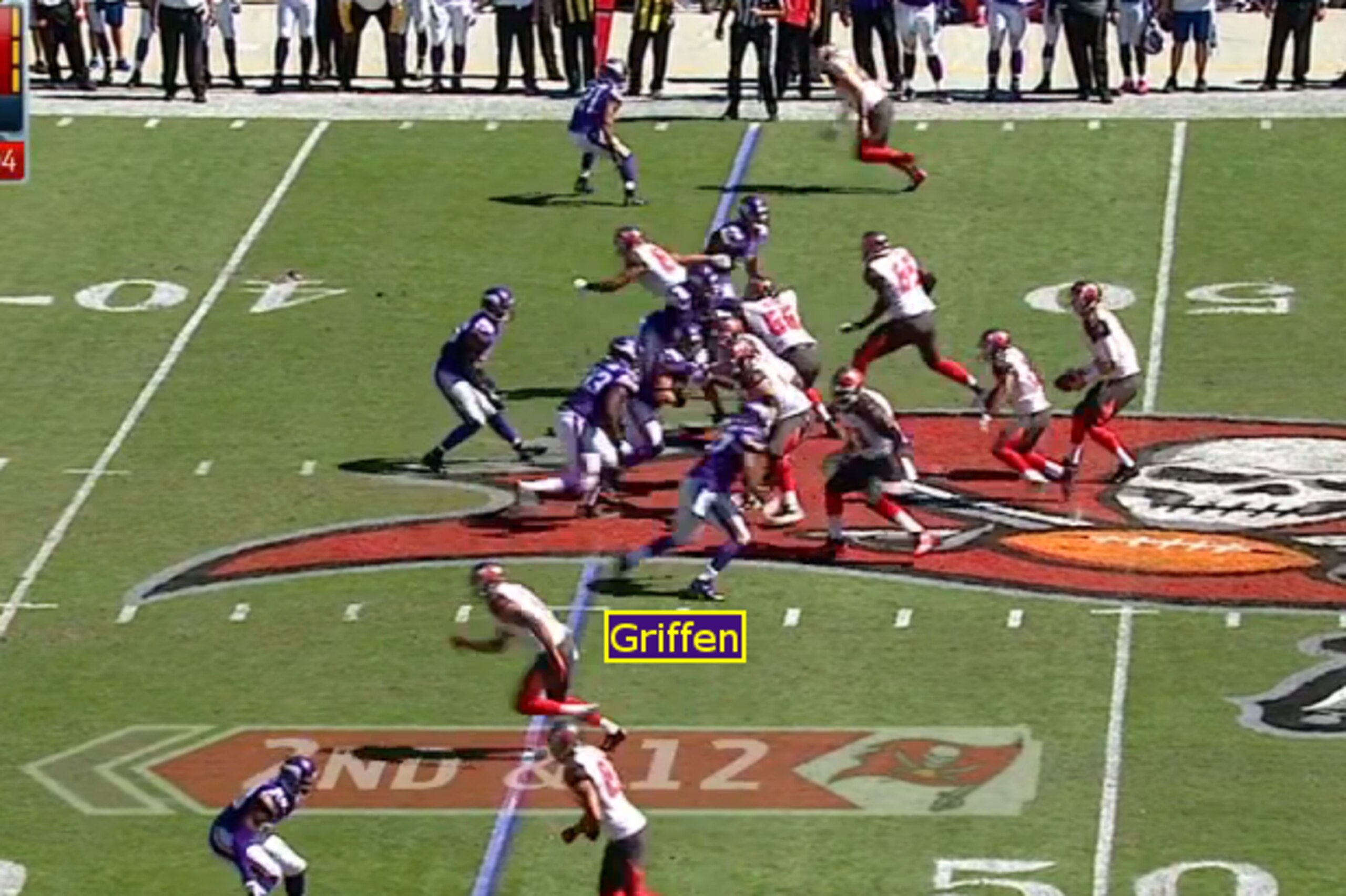
His speed off the ball is evident in this screenshot. That first-step quickness sets the table for everything else he does with this rush.

After Griffen plants his outside foot and converts speed to power, notice how he uses his hands. His left hand gets to the inside shoulder of the tackle, providing power to knock the blocker off balance. His right hand is keeping the left of the tackle off his frame, which keeps the tackle from controlling him.

Griffen then finishes by tossing the tackle aside and puts a hit on Mike Glennon as the quarterback tries to deliver the pass, which falls harmlessly to the turf.
In previous seasons, Griffen was an athletic marvel as a rusher but little more. His spin move could devastate pass-blockers and he could occasionally win around the corner, but this type of technical hand usage was not commonly seen.
The other appealing aspect to the Griffen’s recent play is how his physical skills enable him to make plays that very few other ends in the NFL could, even the very best. Vikings linebacker Chad Greenway alluded to this in his praise of the end’s recent performances, as quoted by Jon Krawczynski of The Associated Press:
"Chad Greenway on Everson Griffen: "He made some plays that guys simply can't make. ... There's plays he makes that are near impossible."
— Jon Krawczynski (@APkrawczynski) October 27, 2014"
This tackle for loss against Tampa Bay surely qualifies.

Tampa Bay ran an end around to Griffen’s side of the field, using some window dressing to disguise the play and pulling the center around to the left to lead.

Griffen is left unblocked. Tampa Bay does this by design, anticipating that no defensive end who first respects the cutback lane from the back side will be able to chase this play down, opting to send blockers to the second level instead. Griffen did step inside first, but the Bucs miscalculated due his athletic ability.
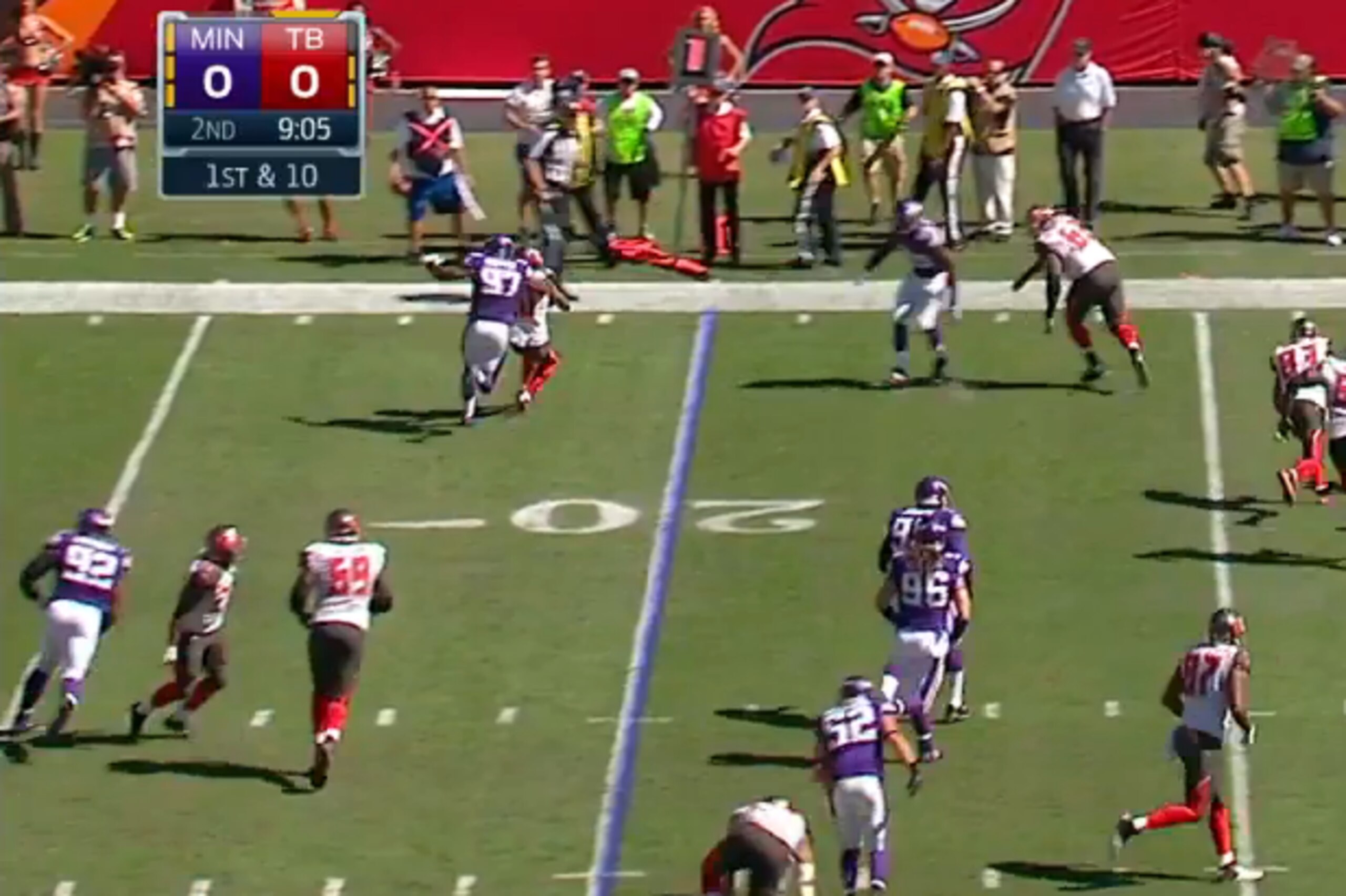
Griffen pursues the receiver and hooks him to the ground for a loss. The runner he tracked down was rookie Robert Herron, who ran a 4.48 40-yard dash in February at the scouting combine, a better-than-average time for a wide receiver.
Nobody expects a defensive end to make a play like this. Tampa Bay certainly did not, which is why Griffen was unaccounted for.
Through eight weeks, Griffen is rounding into one of the finest players on the Vikings’ roster. He has made big strides in his technique as a rusher, maximizing his talent in his increased role as a starter. He still makes game-changing plays that few other defensive ends can as well. For these reasons, the Vikings organization should be thrilled with the way Griffen has responded to the faith put in him.
Forbes and ESPN may want to rethink their stance on whether or not Griffen is worthy of that salary. In fact, both should have known better beforehand.
Statistics via Pro-Football-Reference unless noted otherwise. Salary information via Spotrac.
.jpg?w=2560)