Arsenal Hope Being Cautious with Theo Walcott Will Pay off in the Long Run
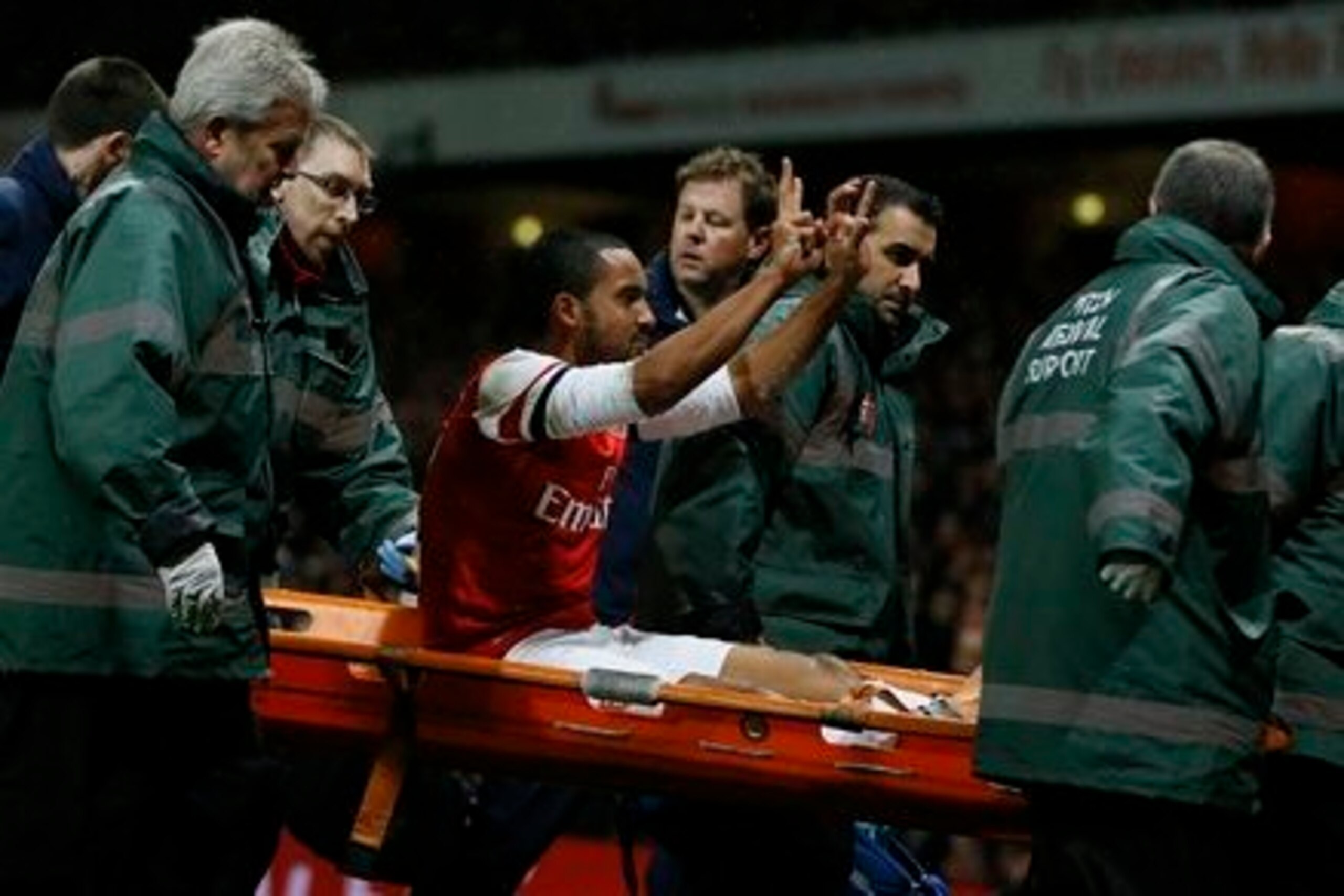
Theo Walcott was last seen on a football pitch taunting Tottenham Hotspur fans, signalling the scoreline with his hands as he was stretchered off during Arsenal’s derby victory last season. It appears his return to action will not be quite so brazen.
On Friday Arsenal manager Arsene Wenger revealed it will be at least another week before Walcott, who suffered cruciate ligament damage during that January game, returns to first-team action—because the 25-year-old winger is still not mentally ready for the full contact that comes with competitive action.
Walcott had been expected to be available for Saturday’s trip to Sunderland, but it now appears the home match against Burnley the following weekend will be Walcott’s return game.
TOP NEWS
Live World Football Moments 🍿

Final Men's Ballon d'Or Rankings 📊
.jpg?w=2560 "NFL Paris Football")
NFL House in Paris Closes for Protests
"I'm not sure to involve him [against Sunderland],” Wenger told reporters, via Phil Cadden of the Express, on Friday. “Certainly next week. He has to get used to contact again.
The Frenchman went on to explain:
"He has been out for nine months and it was a big injury. It takes a bit of time to settle and get used to be kicked again.
"
He has a game that exposes him. He needs to feel he is completely confident. But he is not far. Fitness-wise, he is there to play a part in the game. On the contact front I think he needs a bit more time.
At this juncture, suggesting that there are a few other Arsenal players who need to get better “on the contact front” would be the obvious joke to make. More seriously, it would seem Wenger’s comments will achieve nothing but ensure Walcott gets a, shall we say, “robust" welcome back to the Premier League when he does finally make an appearance (that is not a slur against Burnley—that is just what any defence would do in the same circumstances).
In general, Wenger’s approach makes a lot of sense, even if it does leave the Gunners shorthanded once again for the game against Sunderland (Laurent Koscielny, Jack Wilshere and Abou Diaby are all injured or suspended, joining long-term absentees Olivier Giroud, Mathieu Debuchy and Mesut Ozil). Nevertheless, after so long on the sidelines, there is no point risking Walcott before he is ready, just for the sake of one additional week and additional game.
Equally importantly, there is no point throwing Walcott into a game where the coaches believe there is still a risk his performance (and reticence to be drawn into contact) could prove detrimental to the rest of the team.
Introducing Walcott from the substitutes’ bench against Burnley—a game the Gunners will reasonably expect to be winning comfortably by the hour mark—would seem to be a safe and sensible approach for all concerned.
Walcott told the club’s official website late last month:
"We’re not setting specific comeback matches, but I’m just pleased it’s hopefully now only a matter of weeks before I’ll be back playing. There may be one or two under-21s matches I’ll be involved in first. I’m just looking forward to getting out there and playing again.
Everyone has been so good with me—the Arsenal medical team, the Arsenal fans, and of course my family. Everyone has worked so hard and have been so supportive towards me. And now I'm coming to the end of my rehab, I just can't thank everyone enough.
"
The general interpretation of Wenger’s comments might be that Walcott has become tentative and fearful, that he is now somehow “scared” in the same way Aaron Ramsey was for so long after his horrible leg break against Stoke in 2010.
That might be true in part—it must be remembered that Walcott sustained his injury under no real pressure from another player, so will naturally retain some fear when turning on that same knee again for a while to come—but more it is a case of readjusting to playing again at full speed, after so long confined to strength exercises and solitary routines in the gym.
Walcott has been in training (initially lightly, then with his team-mates) for almost a month, but again it is another step up from that point to playing regularly in the first team once again. Wenger hinted that Walcott’s rehabilitation has not been the easiest process mentally, especially considering it saw him miss Arsenal’s FA Cup victory and England’s World Cup campaign.
"I must say he had a very difficult time,” Wenger added, per the Express. “But he's a very polite and social guy, but behind that, he is mentally very strong. For what he has gone through in the last nine months then you gain more respect for him because he has had some difficult times and he has responded positively. He has done extremely well."
After playing 45 minutes for the under-21s last Friday, missing the Sunderland game would also allow Walcott to play for the youth side once again—perhaps all 90 minutes—as they face Stoke City the same day. That experience could be more beneficial than being thrown into the fray against a Sunderland side determined to show greater backbone following last weekend's 8-0 defeat to Southampton.
Patience has been a virtue for Walcott throughout this recovery process. In an ideal world, Arsenal could benefit from the Englishman’s direct running and finishing ability against Sunderland, but giving him another week to get in an even sharper physical and mental state will benefit both the player and the club much more in the long term.
"I knew how long the rehab would be, it was always going to be around nine months,” Walcott added last month, per the club's website. “But I approached it that I had to enjoy it, and that’s what I have done, it's given me the opportunity to work on my legs and build up the muscle strength.
“If anything, I hope to come back stronger and quicker."

.jpg?w=2560 "Seahawks Chiefs Football")