
Is It Time to Worry About New Orleans Saints QB Drew Brees?
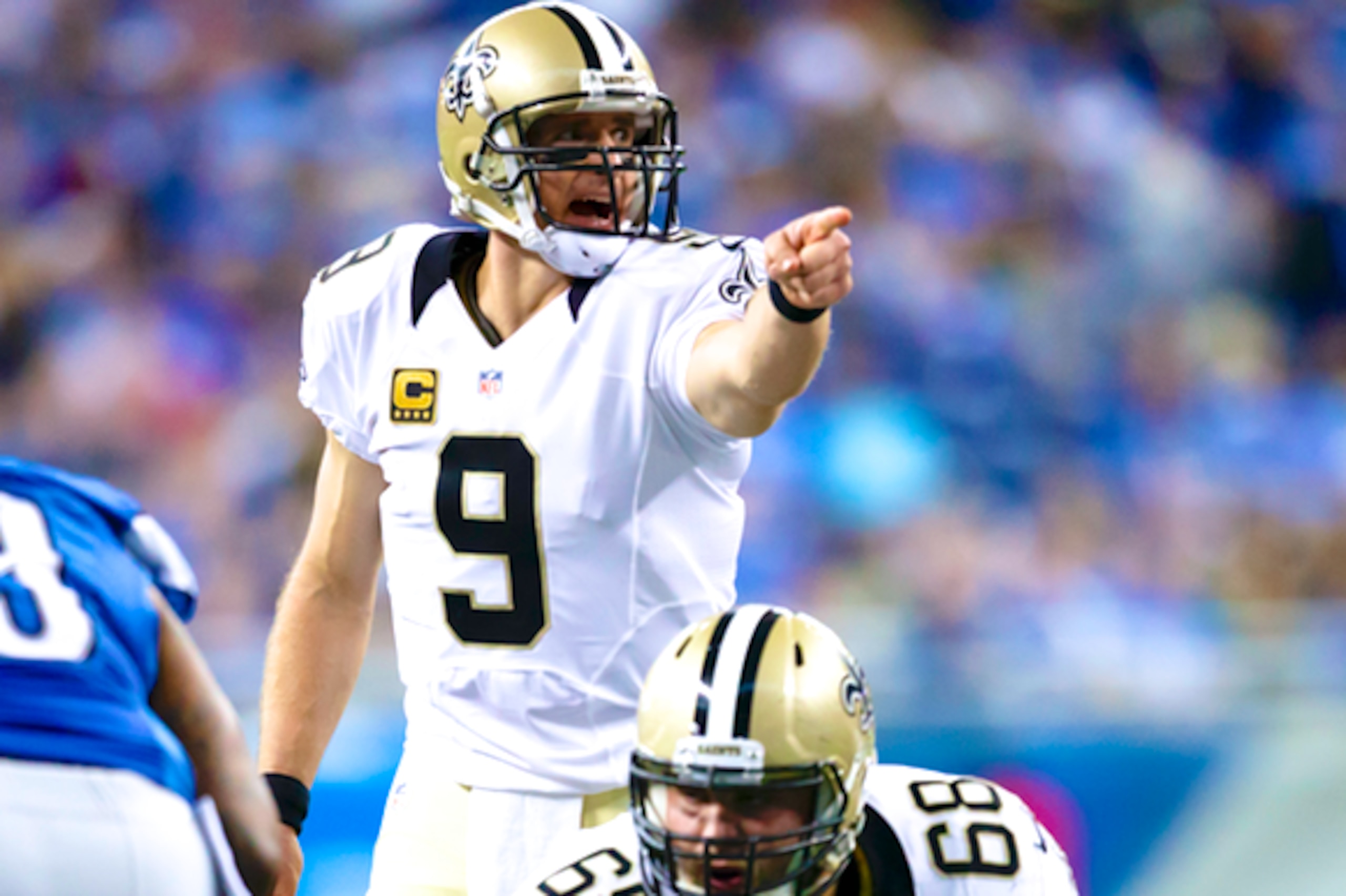
New Orleans Saints starting quarterback Drew Brees has a long-established reputation that shields him from criticism at times.
He has earned that reputation, so it's only fair that he gets the benefit of the doubt when doubt arises. Yet if you take his performances of the past two weeks and place them in a vacuum, it'd be hard to defend him as a top-10 NFL quarterback, nevermind as one in the top four.
Brees is 35 years of age. He has thrown over 7,000 passes in the NFL since entering the league in 2001. He has an incredible 374 touchdowns in his career with a relatively impressive 184 total interceptions. On four separate occasions he has thrown for over 5,000 yards, including each of the past three seasons.
TOP NEWS
.jpg?w=2560 "NFL Paris Football")
NFL House in Paris Closes for Protests
.jpg?w=2560 "Seahawks Chiefs Football")
Trevon Diggs Cut by Seahawks
.jpg?w=2560 "Colts Football")
Jonathan Taylor Landing Spots
He is a Super Bowl winner and a franchise leader who played a major role in the Saints' return to relevance after Hurricane Katrina. Brees and head coach Sean Payton have become the symbols of all that is good about football in New Orleans over the past decade.
Over the past three weeks and two games, Brees' play has suggested that he is declining.
Against the Tampa Bay Buccaneers, the Saints escaped a close game at home by a scoreline of 37-31. Brees threw the ball 57 times, and the offense nearly scored 40 points, so clearly he played well? Past that overly simplistic logic lies the context of Brees' display.
He threw for 371 yards, an impressive number made less impressive by his number of attempts, with two touchdowns and three interceptions. Brees doesn't regularly throw three interceptions. It was just the 11th in his career with the Saints that he has reached that number or surpassed it.
The three interceptions alone didn't make Brees' display worrisome, but rather the nature of how those interceptions came about and the reality that he was fortunate not to have at least two or three more turnovers in the game.
Buccaneers cornerback Alterraun Verner failed to capitalize on two poor throws from Brees before he ultimately got his interception.

The first came early in the first quarter when the Saints were facing a 3rd-and-7 in their own territory. Brees got time in the pocket at the snap, but he stared down his receiver running down the seam. That receiver, Robert Meachem, was badly underthrown to by Brees, allowing Verner to undercut the football.
Verner did this with relative ease and should have had an interception, but he dropped the ball.
This wasn't a situation where Brees needed to be aggressive in pursuit of a play. This wasn't a situation where pressure forced him into a poor decision, and this wasn't a situation where the defense did anything exotic to confuse him. He simply missed the throw and compounded his missed throw by leading the defensive back to the ball.
Midway through the second quarter, Brees attempted to throw the ball down the right sideline in a similar situation. This time his pass floated infield and would have been easily intercepted, but the safety, Major Wright, slipped as he focused on the receiver instead of the football.
It was soon after that play that Verner had his second dropped interception.

On this play, Brees looks at the deep middle of the field when he initially gets the ball before turning to the right side. He doesn't ever look at what he is throwing; instead he immediately releases the ball to his open receiver running toward the sideline.
While his receiver is open, Brees needs to throw the ball with more velocity because his floated pass gives Verner, who is the closest defender to the sideline and not in Brees' line of vision, the time to break back on the ball and extend to try and make the reception.
This play was a little tougher for the defensive back than the previous one, but it's still one he would expect to make.
Verner eventually got his interception late in the fourth quarter. The Saints were forcing the ball down the field with less than 30 seconds left to try and get the game-winning score. Verner was covering Meachem, who got a step in behind the defensive back, but Brees' pass was horribly underthrown once again.
The ball was so underthrown that Verner had time to stop and adjust to it before bringing it in. That wasn't Brees' most worrisome play of the game, though.
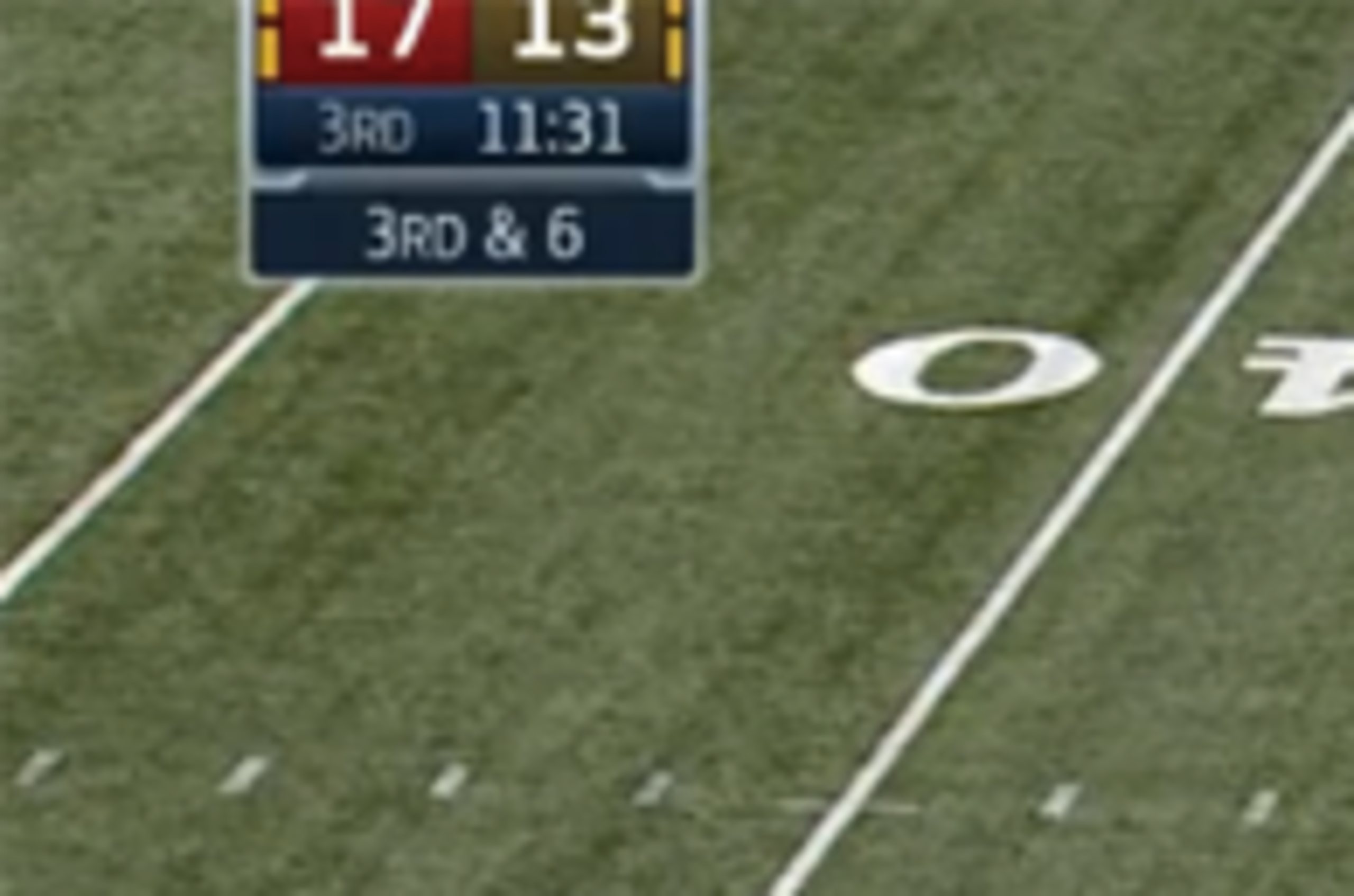
Early in the third quarter, the Saints were trailing, but there was no need for immediate urgency. On 3rd-and-6 in their own territory, the Saints came out with four receivers and one back next to Brees in the shotgun. The Buccaneers were being aggressive with 10 defenders within five yards of the line of scrimmage.
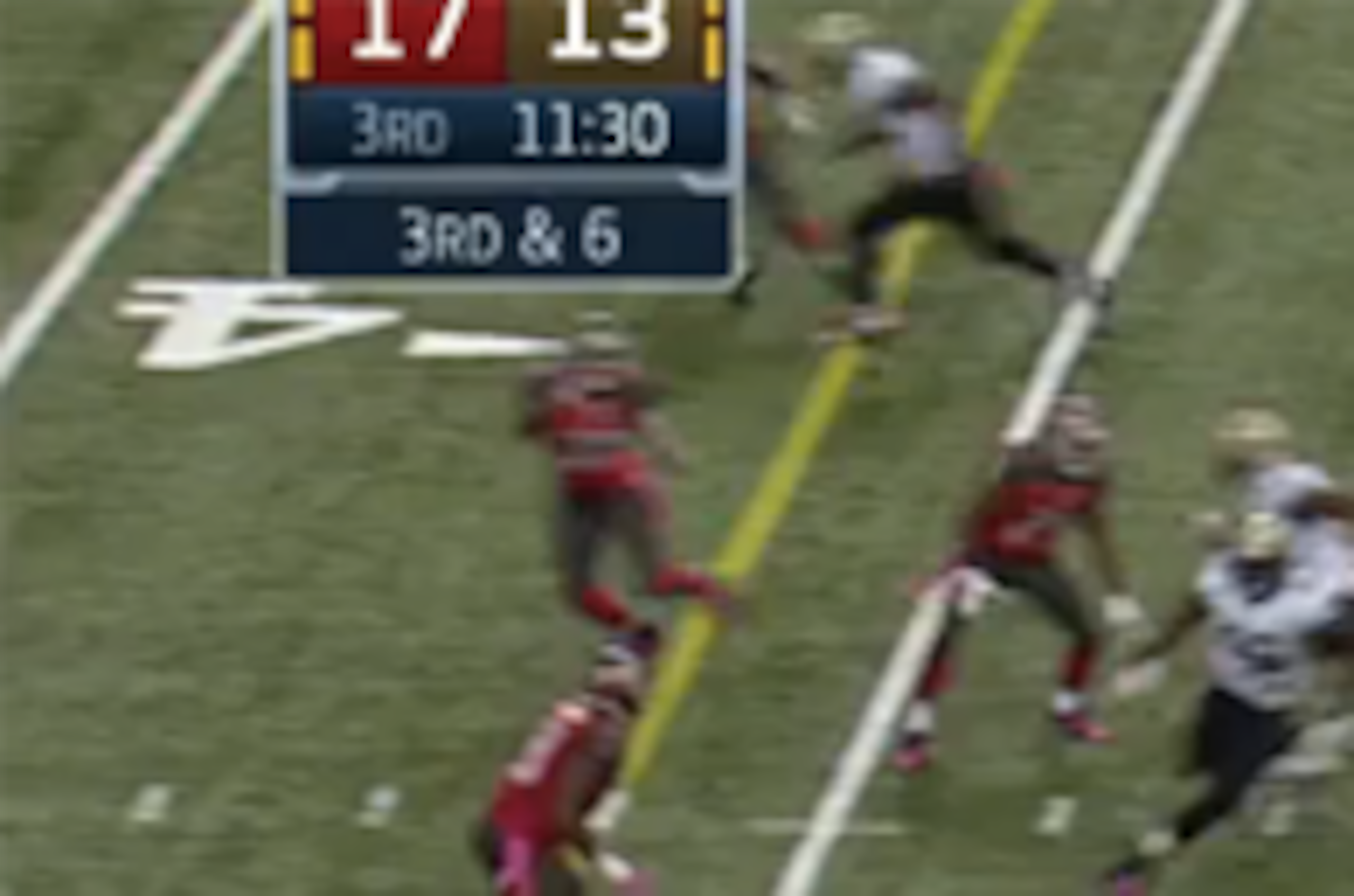
When Brees gets to the top of his drop, the Buccaneers' pressure is closing on him. He has a chance to step up in the pocket. But he needs to be very quick and precise with his footwork, and he's almost certain to be hit after he lets the ball go.
Brees doesn't have anyone open to find at this stage of the play.
When Brees steps up, he steps directly into the back of his blocker instead of sliding past him to the outside. After he has bounced off of his blocker, he starts his throwing motion. This means he didn't make his decision to throw the ball when he was in a good position to; it means he tried to throw the ball while knowing he was falling to the ground.
A receiver running a shallow crossing route was open for a potential first down, but the ball didn't go anywhere near him. Instead, it popped up into the air for a Buccaneers linebacker to pluck with ease. The Buccaneers returned the ball to the Saints end zone for a crucial touchdown.
This isn't the kind of play you expect to see from a seasoned veteran. It's definitely not the kind of play you expect to see from a player who is regularly touted as one of the best quarterbacks in the NFL.
It's the kind of play you expect an overwhelmed rookie to make—a play that lacks poise, understanding or any sort of intelligence.
Brees' first interception in this game had come in similar fashion. With less than two minutes left in the second quarter, he climbed the pocket against some pressure and made a terrible decision to force the ball into the flat.
His pass hung in the air as he threw while falling down, but most importantly, the risk-reward value of the play was never in his favor. Even if the pass had been completed, it would have been to a running back who was going to immediately be tackled in bounds at a time when clock management was important.
Because the Saints were able to escape with a victory, thanks to a long touchdown run from Khiry Robinson in overtime, Brees' poor display was mostly brushed under the rug.
Fast-forward to last weekend and no such excuse existed. Against the Detroit Lions, Brees' raw numbers were significantly better, and he avoided the disastrous plays, but his overall performance wasn't impressive again. The lasting memory of this game will be his fourth-quarter interception that set up the Lions' victory.
That interception was, again, a very poor decision from the quarterback when faced with pressure.
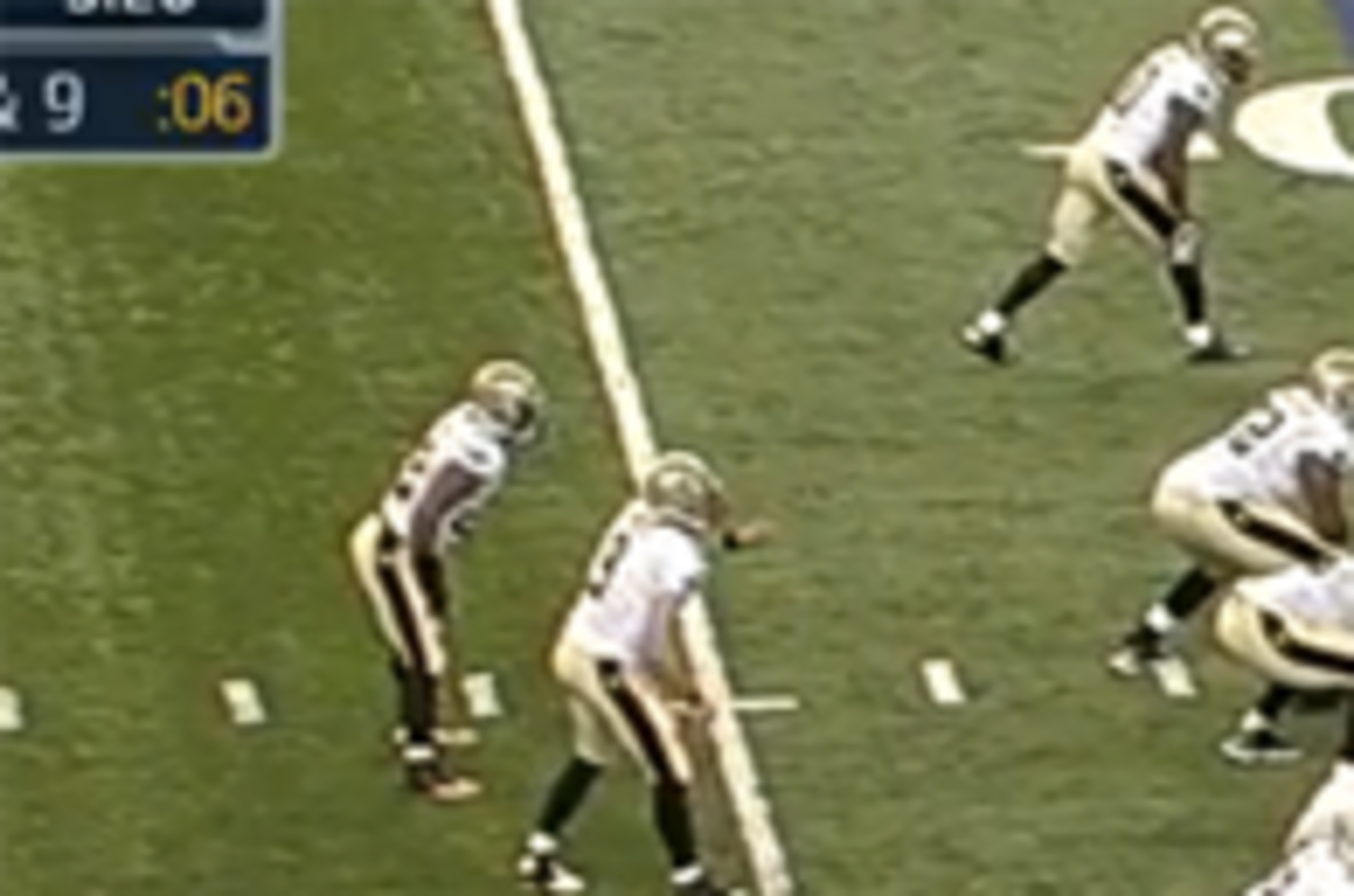
At this point of the game, the Saints were trying to get a first down so they could continue to run the clock down with a six-point lead. The play call was smart on this occasion because the Saints couldn't simply settle for a run that would still leave the Lions over two minutes to score a touchdown.
While the play call to be aggressive was smart, Brees had to understand that worst-case scenario in this situation was take a sack.
Taking a sack would have kept the clock running and given the Saints an opportunity to punt the ball away. Throwing an incomplete pass would have stopped the clock, but it still would have given the Saints a chance to punt the ball away. Forcing the ball into a tight window with a high risk of a turnover was unforgivable.

Brees did very well to evade the edge pressure that came too easily, but while doing that, he kept his eyes trained on just one receiver. While Brees was evading pressure in the pocket, safety Glover Quin was reading his eyes from his position over the middle of the field.
Quin followed Brees' eyes straight to the football for a very easy interception.
Not only did Brees force the ball into a tight window, but he attempted a pass that never had a chance of being completed. There was no awareness of the play's development or any awareness of the game situation. Brees simply made another stupid mistake that made him look like an overwhelmed rookie quarterback.
Of course, Brees did throw for over 300 yards before this point.
While the veteran quarterback had been effective up until that point, he hadn't been spectacular. For the most part, Brees was just checking the ball down and relying on his receivers to make plays with the ball in their hands. When he threw the ball down the field, his accuracy became less reliable, and very few of his positive plays came when he was pressured in the pocket.
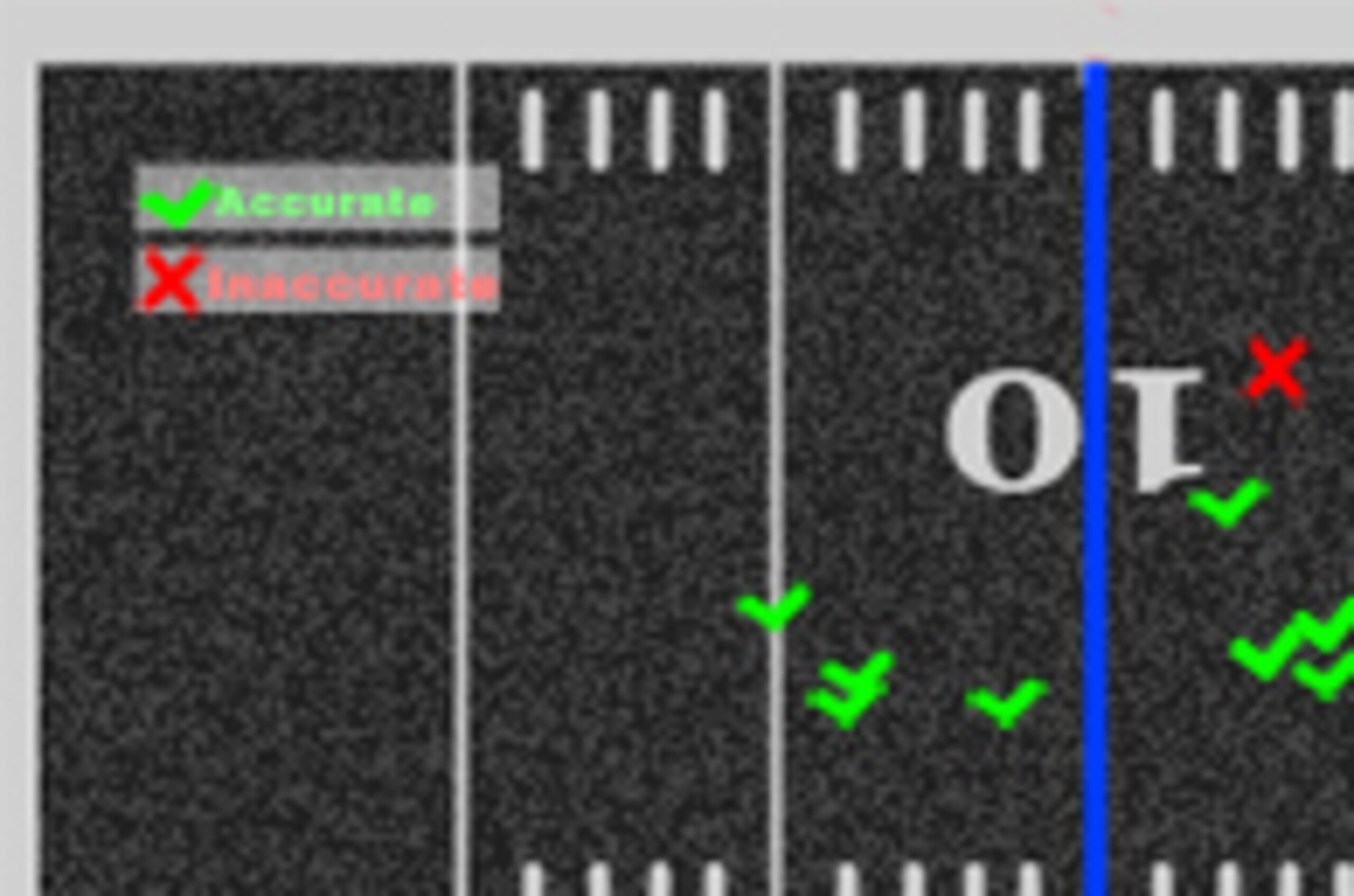
As this chart shows, at least 21 of Brees' 45 pass attempts in this game went either behind the line of scrimmage or within five yards of the line of scrimmage. It's at least 21 rather than a higher number because this chart tracks accurate vs. inaccurate passes; therefore, it doesn't include throwaways or passes batted at the line of scrimmage.
On those 21 plays, Brees threw an accurate pass 18 times. When you look at the remaining qualifying plays, he threw an accurate pass on 11 of 20 pass attempts.
He connected on one deep pass, a third-quarter touchdown to Kenny Stills, and missed on another when his intended receiver appeared to be open in behind the defense. A large percentage of Brees' impressive plays in this game came on the team's final drive of the first quarter.
Brees threw for 75 yards on this drive alone as the offense played with greater urgency, and he was able to find receivers down the field repeatedly. He completed passes of 16, 14, 17 and 18 yards when the ball traveled dramatically more through the air than it did with the receiver after the catch.
On this drive and on the deep touchdown throw to Stills immediately after halftime, Brees looked like the reputable quarterback he is supposed to be.
The Lions pass rush was still getting the better of the Saints offensive line, but the quarterback was working so much quicker within the pocket, and his decision-making was allowing him to read the coverage with ease to locate open receivers. Brees was sharp and making impressive plays instead of being rattled and reliant on checkdowns or screens to move the chains.
Unfortunately, that didn't last, and the Saints were ultimately undone in part because of their poor play at the quarterback position.
A tendency exists in NFL analysis to simply ignore a quarterback once he has reached and sustained a certain level of play. As we've seen with Tom Brady, it can be difficult for some to accept that the consistency and quality we enjoyed so much during earlier years is starting to slip away.
Brees is entering the stage of his career where decline is natural and is typically seen as inevitable save for a select few exemptions.
Entering Week 8, the Saints need Brees to remind them of why he has been considered a great quarterback. Why he was able to set so many records and why he is on his way to the Hall of Fame. The Saints need Brees to show up and carry his team to a victory that will keep it within touching distance of a playoff berth thanks to the exceptionally poor state of the NFC South.
In prime time, at home against a less-than-stellar defense, the script has already been written.
We all know what to expect from this Saints team under those circumstances. Brees and Payton have built a reputation in these situations that intimidates defenses to the point that they help defeat themselves before the game has even begun.
If Brees can't be at his best in this environment, then real concerns and questions about the immediate future of the franchise will need to be asked...and answered.
.jpg?w=2560)