Breaking Down San Francisco 49ers' Pass-Protection Problems
"It all starts up front."
Such is the statement that describes the importance and reliance of an offensive line in the NFL.
Prior to the season, the San Francisco 49ers could boast of one of the best O-lines in the league. Led by stalwarts like Joe Staley, Mike Iupati, Alex Boone and Anthony Davis, it would be an easy assumption that this unit would rank as one of the best in pro football.
TOP NEWS
.jpg?w=2560 "NFL Paris Football")
NFL House in Paris Closes for Protests
.jpg?w=2560 "Seahawks Chiefs Football")
Trevon Diggs Cut by Seahawks
.jpg?w=2560)
B/R's Expert Week 7 NFL Picks 🔮
Yet 2014 has revealed a much different look.
True, the 49ers O-line has been depleted by a plethora of injuries and setbacks. But the overall inconsistency of this unit has been a widespread problem for San Francisco over the first seven weeks.
At no point was this clearer than during the 49ers' embarrassing 42-17 Sunday Night Football loss to the Denver Broncos.
Pass protection suffered the most against Denver. Quarterback Colin Kaepernick was sacked a total of six times—the most of any game this season.
So what is the issue? Is this something the 49ers will continue to experience over the duration of the season, or will it eventually go away once there is some continuity to the health of the O-line.

Breaking Down the Numbers
The 49ers have allowed a total of 19 sacks heading into the team's Week 8 bye—tied for fifth most in the NFL.
Some of these can obviously be attributed to Kaepernick, depending on how one wants to look at his presence within the pocket. But to suggest that it is all upon his shoulders is asinine. The O-line has to bear a sizable portion of the blame.
Let's take a look at San Francisco's Week 7 performance as a case study.
As stated previously, Kaepernick was sacked six times over the course of the game. He was also hit nine times, and the Broncos defense also amassed nine tackles for loss during the process.
We've talked about the context of injury regarding the O-line. Certainly this unit has been banged-up over the course of the season.
But injuries don't account for everything that happened Sunday night. Backup lineman Joe Looney rated the lowest out of this unit, according to Pro Football Focus (h/t Christian Gin of Examiner.com), while right guard Alex Boone was the lone member of the O-line to get a positive grade.
This plays into the thought that the backups may be to blame for the line's pass-protection struggles. But let's take a look at the play of some of the veterans along the line.
Right tackle Davis graded out at minus-3.8 according to Ben Stockwell of PFF. Now, injury is a factor when evaluating Davis, as Week 7 was only his second start of the season. And he had a tough matchup in Von Miller, who was able to get to Kaepernick twice over the course of the game.
Staley himself had a rough assignment, facing off against Broncos pass-rusher DeMarcus Ware. After holding off St. Louis Rams edge-rusher Robert Quinn the previous week, Staley struggled in pass protection against Ware—allowing three sacks and a few hits on Kaepernick in the process.
Breaking Down the Film
Staley's rough night can be highlighted best by this one play—shown in this tweet by Stephen Nelson of Bleacher Report.
But let's take a deeper look at the play itself.
At the 2:43 mark in the second quarter, Ware (to the right) will line up opposite Staley (yellow), on tackle's outside shoulder. Ware will fake to the inside but quickly swing back to the outside en route to Kaepernick. We also notice defensive tackle Sylvester Williams (No. 92) lined up between Looney and Daniel Kilgore.
Williams will fake a pass rush before dropping back.

After noticing Williams dropping back, Looney commits to assisting the center, Kilgore, leaving Staley alone in space. Also notice how Denver's defensive scheme leaves Boone with no one to block.
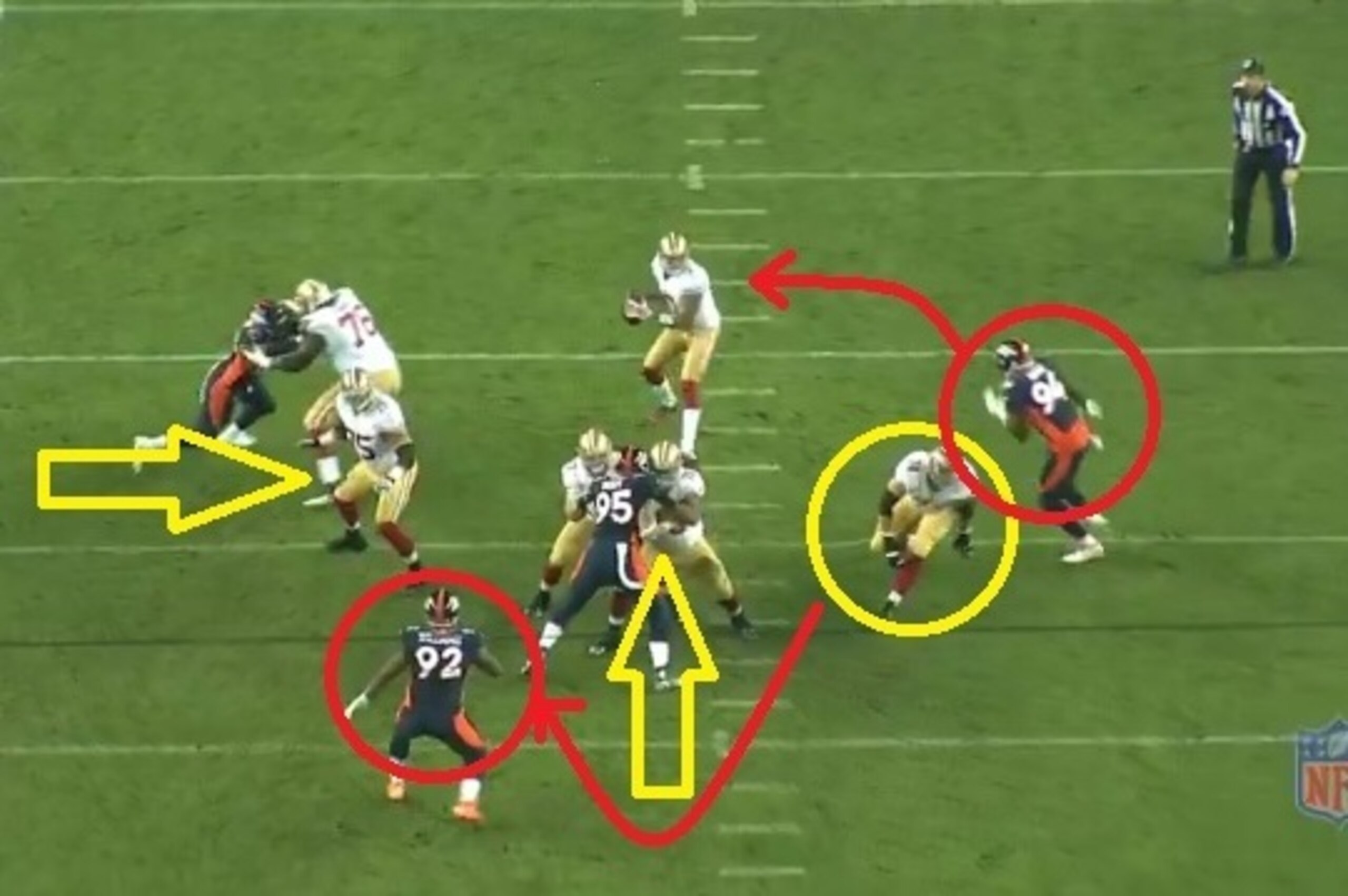
Ware notches his second of three sacks. Staley's protection gaffe embodied the line's struggles on Sunday, but it certainly wasn't the only miscue. As previously noted, Davis had a rough time containing Miller on the opposite side. Let's take a look at Miller's second sack of the night and try to figure out what went wrong for San Francisco's line.
Miller is lined up opposite Davis and will initially fake to the outside.

Davis bites on the move, which allows Miller to execute a spin to the inside. He has an open lane right towards Kaepernick. Notice the additional exterior pressure that closes off any escape route for the 49ers' signal-caller.

While Davis gets beaten badly on this play, almost the entirety of San Francisco's O-line gets overworked here.
The O-line in general had a bad night against the Broncos. There really isn't any way to get around it. As seen in the film, there were multiple occasions when blockers missed their assignments or were completely beaten on pass-rush moves.
This will have to stop if the 49ers hope to establish any momentum over the next few weeks.

Breaking Down the Fixes
Let's get the obvious out of the way first.
Injuries have plagued San Francisco's O-line all season. Whether it's Davis' knee and ankle injuries, Iupati's concussion or the recent leg fracture that will likely sideline Kilgore for the remainder of the year, the O-line has not enjoyed the continuity it has experienced in recent seasons.
Marcus Thompson of the Bay Area News Group describes how the injuries have impacted the play of the offensive line:
"Now, they might have lost their starting center for the rest of the season as Daniel Kilgore was carted off after apparently breaking his left leg. Left guard Mike Iupati missed the game with a concussion. Right tackle Anthony Davis returned from injury and isn't anywhere near the dominant lineman he can be. It's hardly surprising the running game never got going, and the pass protection was a mess. Colin Kaepernick was sacked six times, and that doesn't count the times he pressed the B button to escape from a swarm of Broncos.
"
The number of injuries suffered by the O-line certainly factor into how permeable this unit has been over the course of the season. Getting players like Iupati and Davis back to 100 percent will obviously provide a huge benefit. But their health issues do not explain the overall ineptitude of the unit's performance thus far in 2014.
Let us assume that the healthy returns of Iupati and Davis will help to a certain extent. We'll also bank on rookie Marcus Martin doing a decent job in Kilgore's stead. Martin is slated to be the new starter, according to head coach Jim Harbaugh per Tyler Emerick of 49ers.com.
Will this solve all the pass-protection issues sustained by San Francisco?
We can hope so, but let us factor in some additional fixes.
The first would be to dial up some plays utilizing more multiple-tight end formations. This was a traditional scheme used by offensive coordinator Greg Roman, and it plays right into the 49ers' strengths.
Let's consider the pass-blocking abilities of players like Vernon Davis and Vance McDonald. Davis' attributes are well known. McDonald—while not yet respected as a pass-catcher—has performed adequately enough as a blocker to warrant consideration in protection schemes.
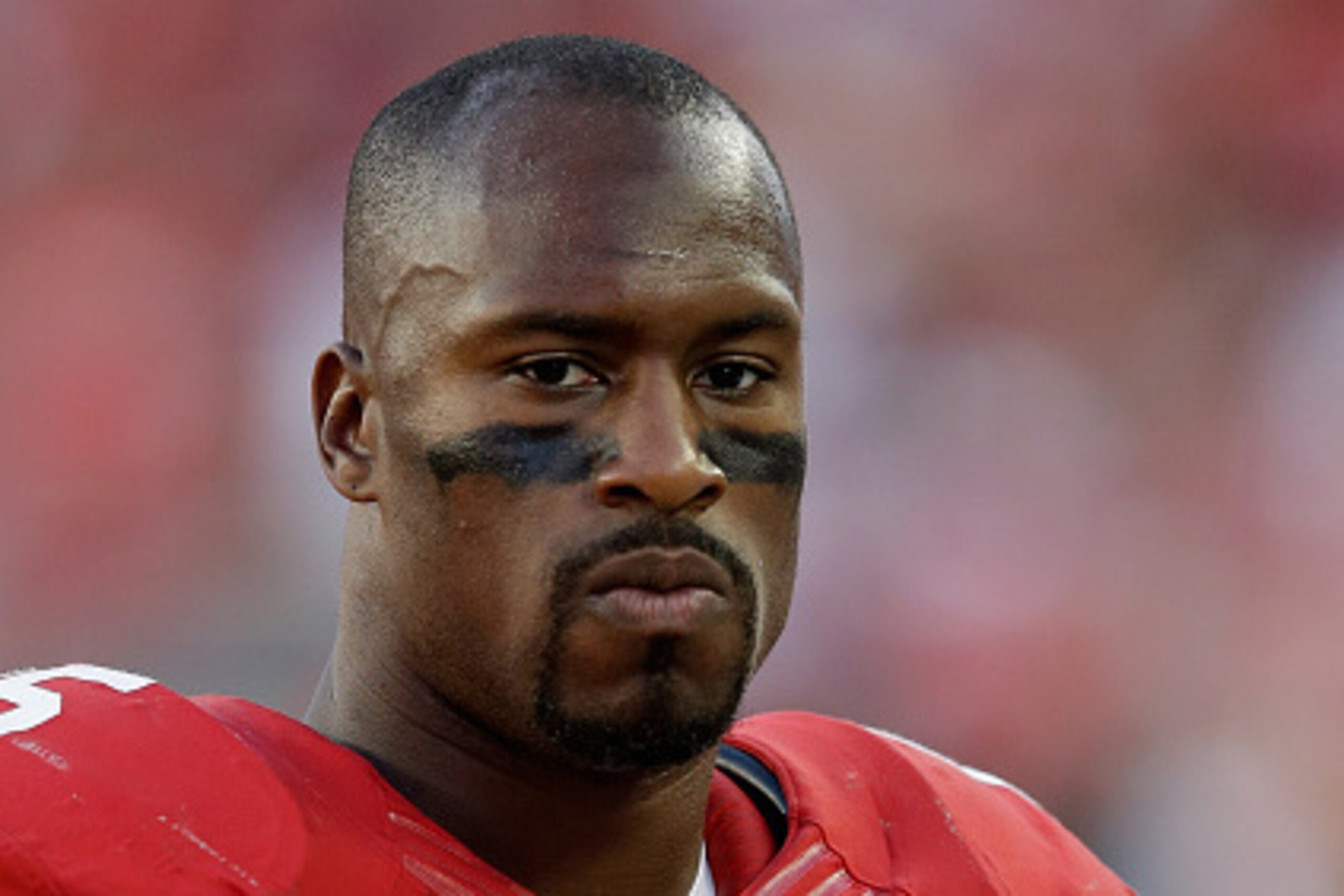
The added blockers will reinforce the O-line, while forcing teams to respect the offensive prowess of Davis who, admittedly is not looking like he is 100 percent after suffering a back injury in Week 4.
Hopefully the bye week helps out in this area.
More importantly, the use of additional tight ends will allow the 49ers to reestablish the running game. In turn, this will give the offense a better opportunity to set up play action, which the 49ers use successfully.
San Francisco should also not abandon its use of extra blockers in the backfield. This means added work for backs like Frank Gore and Bruce Miller.
Both Miller and Gore excel in protection schemes. They are also capable targets out of the backfield, which can keep defenses off balance and neutralize a pass rush. Let's take a look at an example of this at the 7:10 mark of the first quarter against the Broncos.
Highlighted is Miller. He'll motion to the right side of the O-line before cutting over to the left. Denver has to respect his abilities as a receiving option. Meanwhile, Gore will remain in the same spot, to be utilized as a rusher or to assist with pass protection.
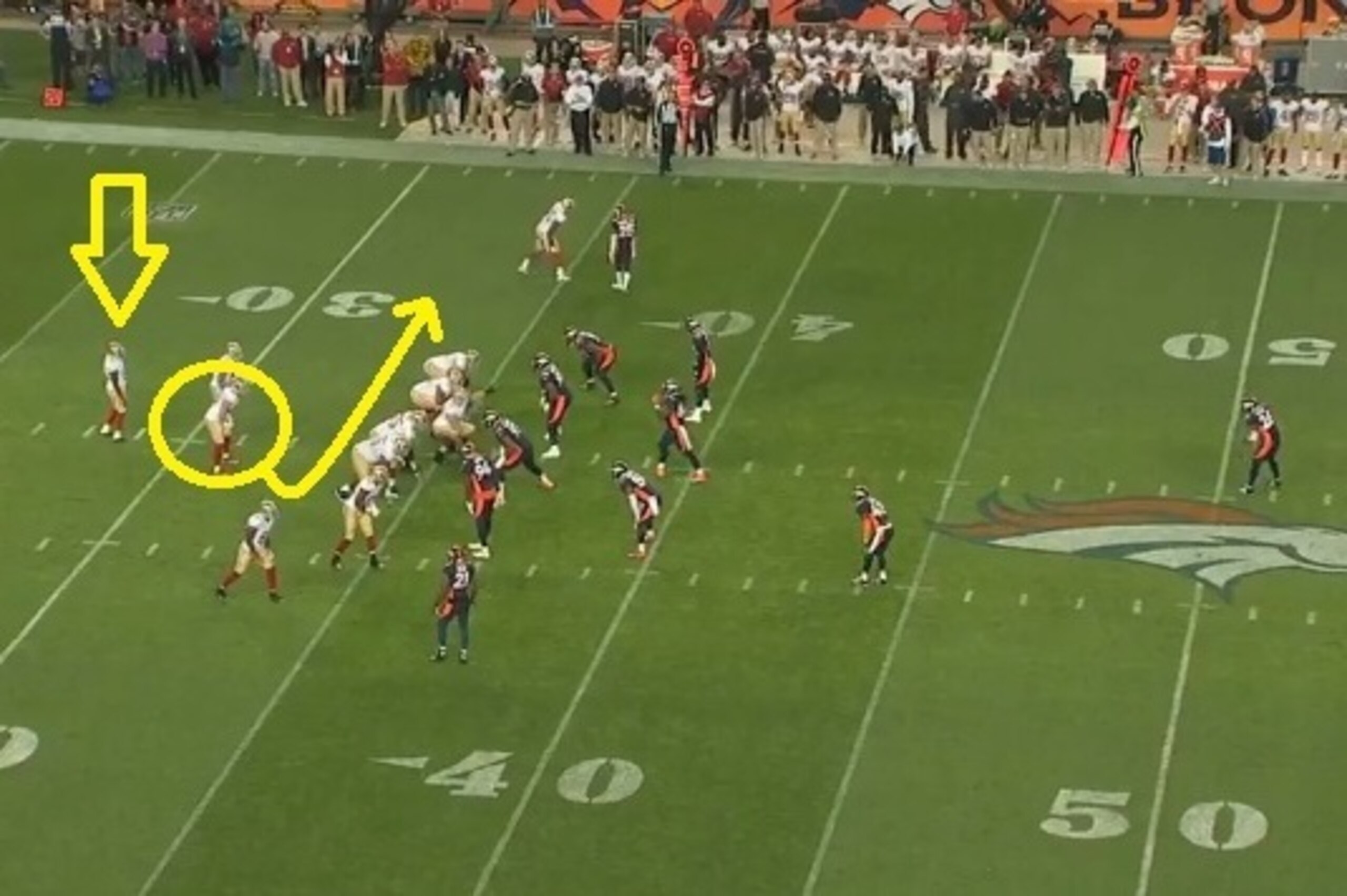
Kaepernick leaves the shotgun to take his spot under center. Miller will move out into the left flat, but the target will be Davis.

Ware is able to get around Anthony Davis on the right of the line. But Gore is in place to assist with the block. This creates a lane for Kaepernick to step up in the pocket. After doing so, he is able to connect with Vernon Davis around the 50-yard line.
Note Anquan Boldin (arrow at the bottom of the photo) and Miller (highlighted at the top) and how each takes two defenders with them in coverage.

This play in the first quarter resulted in a 49ers first down and properly utilized a combination of extra blockers and receiving/blocking options out of the backfield.
It's just one play, but it does provide an example of what can be done against a top-ranked defense such as Denver's.
In all truth, San Francisco's pass-protection woes are a combination of a number of critical things.
Injuries have played a role as has the inconsistent play of a number of the 49ers O-linemen. Hopefully the bye week and added practice will shore this up to a certain extent.
But the 49ers would also be wise to get back to an offensive scheme that assists its pass protection. Instead of the frequent use of multiple-wide receiver sets, San Francisco could attempt to utilize the assistance from proven blockers assisting the O-line.
This is the team's offensive identity, and it provides an element the 49ers have been largely lacking this season.
Your call, San Francisco.
All statistics, records and accolades courtesy of Pro-Football-Reference.com and ESPN.com unless otherwise indicated.
Peter Panacy is a featured columnist for Bleacher Report, covering the San Francisco 49ers. Be sure to check out his entire archive on 49ers' news, insight and analysis.
Follow him @PeterPanacy on Twitter.
.jpg?w=2560 "Colts Football")