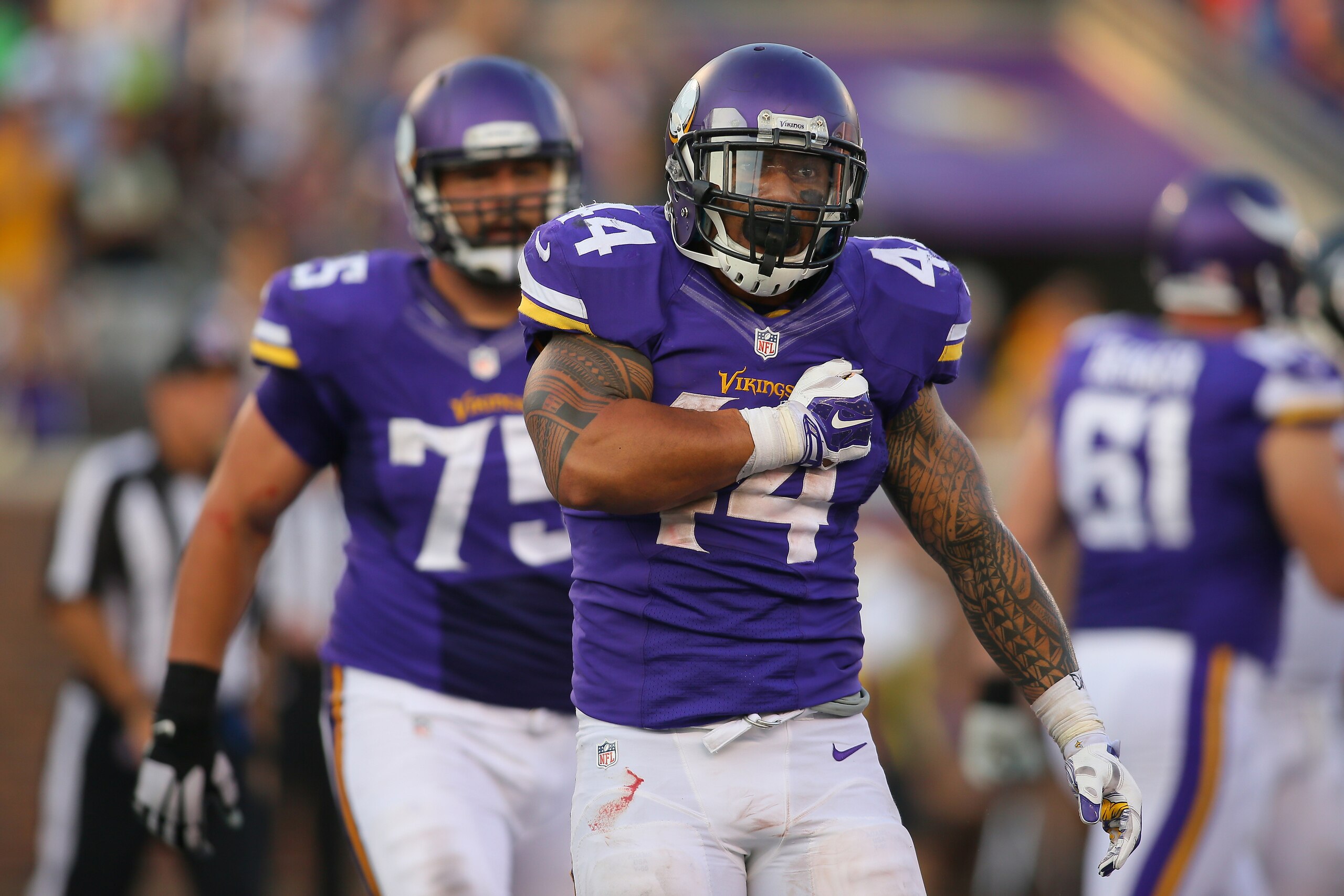

Vikings Need To Use Both Jerick McKinnon and Matt Asiata To Balance Running Game
Lacking a player capable of handling the duties of an every-down running back, the Minnesota Vikings must get back to balancing their snaps between the plodding but effective Matt Asiata and the raw but explosive Jerick McKinnon.
A week ago, the Vikings gave McKinnon—a rookie third-round pick and former option quarterback—47 snaps and 17 touches while Asiata—the first back asked to start in place of Adrian Peterson—was given just 16 and three, respectively. McKinnon showed flashes of his enticing ability, but he also gave ample reason for Asiata to see more snaps this week against the Buffalo Bills.
| J. McKinnon* | 47 | 11/40 | 6/42 | 17/82 |
| M. Asiata | 16 | 2/-5 | 1/18 | 3/13 |
| TOTAL | 63 | 13/35 | 7/60 | 20/95 |
TOP NEWS
.jpg?w=2560 "NFL Paris Football")
NFL House in Paris Closes for Protests
.jpg?w=2560 "Seahawks Chiefs Football")
Trevon Diggs Cut by Seahawks
.jpg?w=2560)
B/R's Expert Week 7 NFL Picks 🔮
At some point, the Vikings will need to find the right balancing point between the two.
"Matt is an extremely dependable guy," Vikings head coach Mike Zimmer told reporters. "It's not a knock on McKinnon at all because I think McKinnon still has the explosiveness. I would just like to see us keep using both."
Translation: Expect to see a more balanced split Sunday when Minnesota travels to Buffalo to face the Bills' top-ranked run defense.
McKinnon's athletic ability can certainly be an asset for the Vikings offense.
On Minnesota's second play from scrimmage against the Detroit Lions last Sunday, McKinnon was able to use a jump cut to break contain to the outside for eight yards. While blocked well, it was a play that Asiata would have struggled to pull off given the agility and acceleration needed from McKinnon.

In the second quarter, McKinnon caught a short checkdown pass, turned to his left and picked up 10 yards using nothing more than acceleration and speed to beat the covering linebacker. To finish off the first half, the rookie back outran DeAndre Levy in the flat for eight yards on a play that likely should have been stopped for no gain.
His signature play of this season—a winding, juke-filled 55-yard run against the Atlanta Falcons in Week 4—provided all the evidence needed of McKinnon's ability to impact a football game. The Vikings were likely hoping his unique explosiveness could combat the speed and aggressiveness of the Lions defensive front last Sunday, when McKinnon compiled 82 total yards.
While an overused comparison in the football vernacular, McKinnon's skill set is very much Darren Sproles-like. In space, he can create something out of very little using his athleticism and short but compact frame. Most linebackers can't handle his change-of-direction ability, and those in the secondary struggle to get him on the ground.
However, McKinnon is still very raw in other important areas of playing the positions, most notably pass protection.
According to Pro Football Focus (subscription required), McKinnon has already allowed seven quarterback disruptions and two sacks, which both lead NFL running backs this season.
The scary part of the equation? McKinnon has only been asked to pass-block on 20 snaps in 2014.
| Pass-Blocking Snaps | 20 | 29th |
| QB Disruptions | 7 | 43rd (Last) |
| QB Sacks | 2 | 43rd (Last) |
| QB Hurries | 5 | 43rd (Last) |
Against the Lions, McKinnon was knocked for one sack and four hurries. He appeared overwhelmed both in the identification portion of blitz pickup and the physical aspect of actually sticking the block.
Pass protection is a major area of concern for the Vikings given the team's inability to win up front along the offensive line and the presence of Teddy Bridgewater—a 21-year-old rookie quarterback—under center.
Asiata, given 37 chances to pass-block this season, has allowed only three total hurries and zero sacks.
The balancing act is much more than just getting McKinnon off the field in situations where he might be asked to protect the quarterback. However, limiting those exposures would help take some stress off a rookie running back who is still learning the position.
Asiata is a runner capable of consistently churning out the three- and four-yard gains between the tackles that help keep an offense ahead of the sticks. So far this season, 136 of Asiata's 226 rushing yards have come running behind the guards and center, per Pro Football Focus (subscription required). He's averaging 3.7 yards on those carries, which is a respectable number and one the Vikings need to stay in manageable down-and-distance situations.
Asiata hasn't been poor as a receiver, either. Of his 13 catches, three have covered 15 or more yards. His catch-and-run off a screen play against the Lions netted 18 yards.
However, turnover plays have been a concern. Asiata lost a fumble in Green Bay, and his dropped pass against the Lions resulted in an interception. For an offense lacking Peterson and tight end Kyle Rudolph, the margin for error is razor thin. Protecting the football is key.
Maybe the best evidence for using Asiata and McKinnon as a complementing duo came in Week 4, when the Vikings rushed for 241 yards—a season high—using both heavily in the game plan. Asiata was given 23 touches in that game—20 rushes and three receptions—while McKinnon was provided 19 in the form of 18 rushes and one reception. The two combined for 252 total yards—152 from McKinnon and 100 from Asiata.
| M. Asiata | 45 | 20/78 | 3/22 | 23/100 |
| J. McKinnon | 34 | 18/135 | 1/17 | 19/152 |
| TOTAL | 79 | 38/213 | 4/39 | 42/252 |
Of course, the Vikings won't be facing the Falcons defense every week. Running 74 plays, including 44 rushing attempts, is an unattainable goal every Sunday.
Still, the snap splits against the Falcons—45 for Asiata, 34 for McKinnon—appears to be a much more effective long-term strategy for the two this season.
Neither McKinnon nor Asiata represent the prototype of a modern three-down running back. Asiata is more of a ground-and-pound runner, and his ball-handling has been suspect at times. McKinnon can break the big play at any time, but he's also liable to get his quarterback hit on any dropback.
Together, the two create a more serviceable duo.
The Vikings are still going to have more rough patches at running back this season. Take away any team's best running back, and that's likely to be the case.
The most effective strategy for masking the absence is still a more even split between two imperfect options.
Zach Kruse covers the NFC North for Bleacher Report.
.jpg?w=2560 "Colts Football")