
Big Plays Aside, Antone Smith Has Limited Upside and Is Not Long-Term Answer
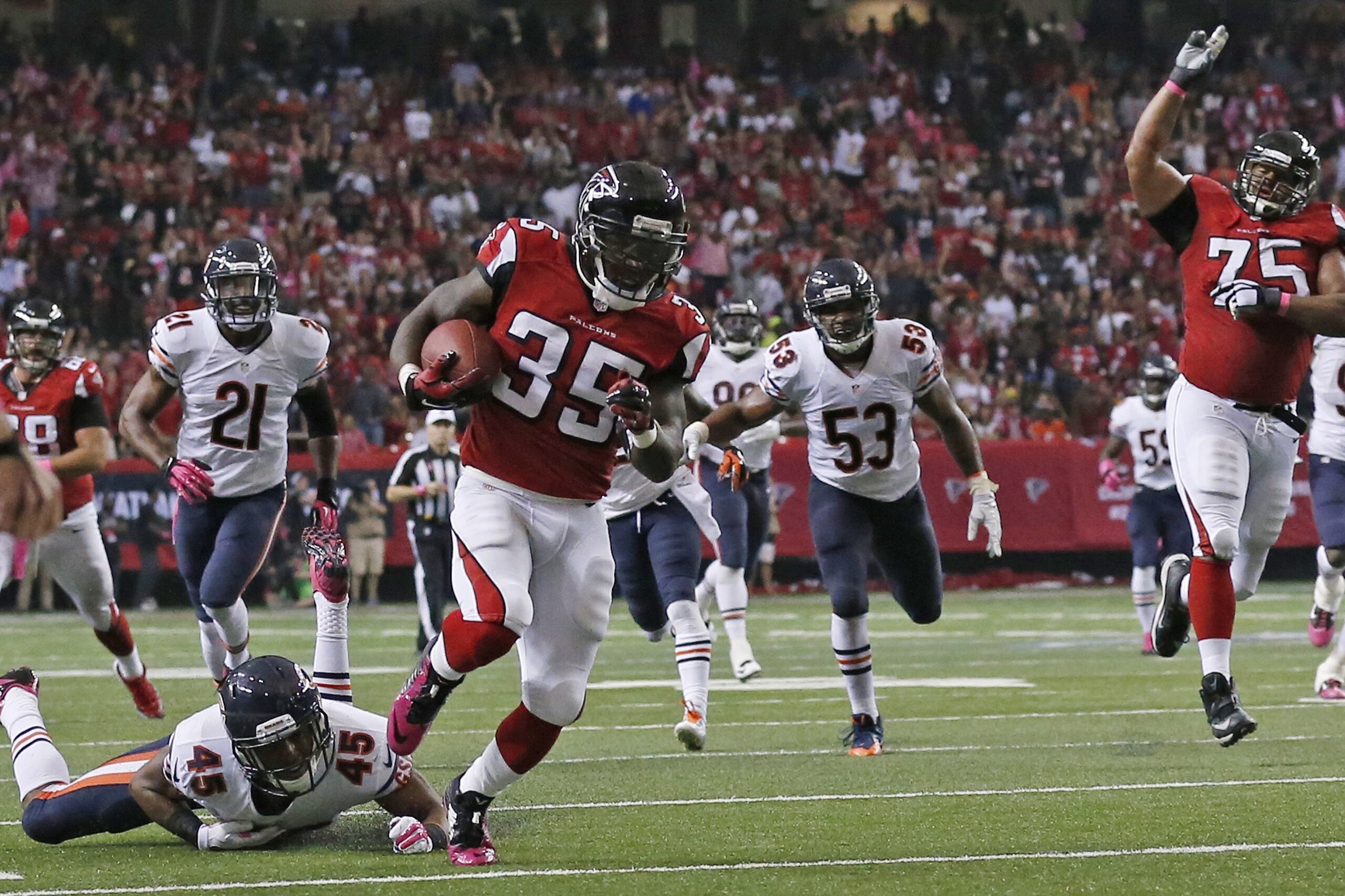
Atlanta Falcons running back Antone Smith has been one of the standout players so far this season.
Smith hasn't been one of the best players in the league. He has stood out because of his big plays—big plays that have come without being given many opportunities to shine. In a crowded Falcons backfield, Smith has the fourth-most carries of anyone on the team and the second-most receptions of any back.
In total, Smith has 13 carries for 126 yards and two touchdowns as well as 10 receptions for 220 yards and three touchdowns.
TOP NEWS
.jpg?w=2560 "NFL Paris Football")
NFL House in Paris Closes for Protests
.jpg?w=2560 "Seahawks Chiefs Football")
Trevon Diggs Cut by Seahawks
.jpg?w=2560 "Colts Football")
Jonathan Taylor Landing Spots
He is averaging 9.7 yards per carry and 22 yards per reception. Amazingly, Smith has a play of at least 38 yards in five of six games this season. In the game when his biggest play went for just 15 yards, he only had two total touches.
The 29-year-old back is doing what Andre Ellington did for the Arizona Cardinals last year, but Ellington got more touches than Smith has to this point.
Even though the Falcons don't have spectacular backs in place above Smith on the depth chart, they do have proven players they can rely on and the very talented rookie Devonta Freeman. In order to argue that Smith deserves more touches, we need to understand his skill set and how these big plays are coming about.
Last week against the Chicago Bears, Smith showed off his acceleration and straight-line speed.

On 3rd-and-6, Smith is lined up next to Matt Ryan in the backfield. The Bears were showing blitz at the snap and didn't break out of it. The Falcons called the perfect play to counter the blitz, running screens to both sides of the field.
Ryan times his pass perfectly to draw all five pass-rushing defenders downfield and out of the play, while Smith has two lead blockers who are at or behind the line of scrimmage. On the second level, Eric Weems, No. 14, is in the perfect position to execute what turns into an important block.

Weems is able to engage and hold his block while one of the leading offensive linemen is able to get downfield and cut down another defender in space. This creates a wide running lane right in front of Smith for him to run through.
Smith didn't need to create a running lane or even locate one, a huge one was created right in front of him because of the execution of his teammates.

Once Smith goes through that lane, he has just one defender to beat coming across the field. That defender has an angle on him, but he has to concede ground as Smith moves toward the sideline. At that point, Smith's acceleration takes over as he pushes his way into space and past the defensive back.
Relying solely on his acceleration, Smith was able to score a relatively easy 41-yard touchdown. Smith's speed makes him a major threat against the defense when it blitzes.

On this play, the Giants rush six defenders after the quarterback. There is no screen play drawn up to counter this play call; instead, Ryan immediately diagnoses the coverage and gets the ball out with haste to Smith running into the flat.
Because of the defense's blitz call, Smith only needs to break one tackle before he is put in space with only the end zone ahead of him. Cornerback Prince Amukamara was initially lazy in his pursuit, as he expected his teammate to make the initial tackle, so he was unable to catch up to Smith before being blocked out of the play.
Smith excels in space, and the quickest way to get him in space is on these types of plays. As a runner, his big plays have come on outside runs.
Obviously, Smith hasn't had enough carries to truly judge him as a between-the-tackles runner, but what has been put on tape hasn't been impressive. Smith appears to be a point-and-go back. That means he doesn't have much creativity or vision to create/find space in tight areas.

The Falcons aren't built to be a power-running team, but on this occasion they come out with a fullback and a tight end to the same side of the field against an eight-man front. The defense also has a safety in position to close on the run very quickly from his area of the field.

Smith is given the ball on a counter that is designed to go off right guard. That is running directly into the thick of the defense, where one defender has already penetrated past his blocker with two more waiting on the second level behind him.
A pulling left guard is supposed to lead the way for Smith on this play, but it's already clear the design of the play isn't going to work because of the lack of bodies waiting for him on that side of his center.
On the other side of the field, the edge-rushers for the defense were too aggressive coming off the edge. They were either blitzing or reacted to the counter motion to start the play. One of the defenders comes clean, so he is chasing Smith down from behind, but he is not in a position to catch him quickly.

By this stage of the play, Smith has already committed to running right. He needed to recognize the situation before this point, so he could plant his right foot in the ground and push back toward his left tackle where there is space to run into.
He couldn't immediately run to that space because he needed to set up an engaged defensive tackle who was holding his blocker at a distance with his eyes on the running back.

Smith attempts to slip through a tiny crack that develops in the middle of the offensive line, but he is crowded out quickly and taken down for a very short gain.
In the open field, it's easy to take advantage of space when it's all around you. If you are faster than everyone on the field and have enough strength to break the tackles of smaller defensive backs, big plays should continue to be inevitable.
However, the mental side of running between the tackles is vitally important for showing off any running back's physical traits when he runs between the tackles. Running between the tackles may look muddled and too crowded at times, but it's still very much an art that needs to be executed by very talented players.
Smith's limitations in this area are likely what has caused him to be a relative unknown to this point in his career.
If the Falcons want more explosiveness in the backfield with a running back who can carry the ball 15 times without limiting their offense, Freeman is the best option. Freeman may not have the straight-line speed of Smith, but he is a nuanced runner who understands how to create and take advantage of space.
Although he has been dealing with an injury also, Ellington in Arizona is showing this season there is a big difference between being a role player who is put in advantageous situations and a feature back who is asked to carry the load.
Smith hasn't done enough yet to say that he can be a feature back.
.jpg?w=2560)