Vikings vs. Bills: Breaking Down Minnesota's Game Plan
The Minnesota Vikings hit the road in Week 7, looking to rebound from a home loss and right the ship. In Buffalo, the Bills are also coming off a home loss. Both teams are at critical points in their season, where a loss on Sunday could snowball into a lost season.
Defense is the relative strength of Minnesota and Buffalo at this point in the season. A tightly-fought, low-scoring affair is most likely to ensue. The Bills fell to New England 37-22 last week, with the defense having uncommon struggles. Maybe Minnesota takes a few pointers from the Patriots and finds the key to unlocking the Bills as well.
TOP NEWS
.jpg?w=2560 "NFL Paris Football")
NFL House in Paris Closes for Protests
.jpg?w=2560 "Seahawks Chiefs Football")
Trevon Diggs Cut by Seahawks
.jpg?w=2560)
B/R's Expert Week 7 NFL Picks 🔮
Judging from last week’s games, the Vikings offense has farther to go to reach a level that can be described as adequate. It was shut down by a suffocating Detroit defense last week. Rookie quarterback Teddy Bridgewater still has not thrown a touchdown pass and the offensive line is in shambles.
The bulk of this week’s game plan focuses on how Norv Turner, Bridgewater and the Minnesota offense can raise its game in Buffalo.
Attack the wide nine on the ground
Vikings fans might be familiar with the term “wide nine” that describes the alignment of defensive ends in a 4-man defensive front. It was a staple of Detroit Lions defenses under Jim Schwartz, who is now the defensive coordinator in Buffalo.
Wide nine refers to the numbering of alignments a defensive lineman can take. The number nine references a position shading the tight end’s outside shoulder, a wider position than normally taken by a 4-3 defensive end. Schwartz’s defenses have long utilized this concept. It’s more of a tendency than an absolute rule but is something that should be addressed by the Vikings in the run game.
Here’s an example of what the wide nine looks like from defensive ends who play it:
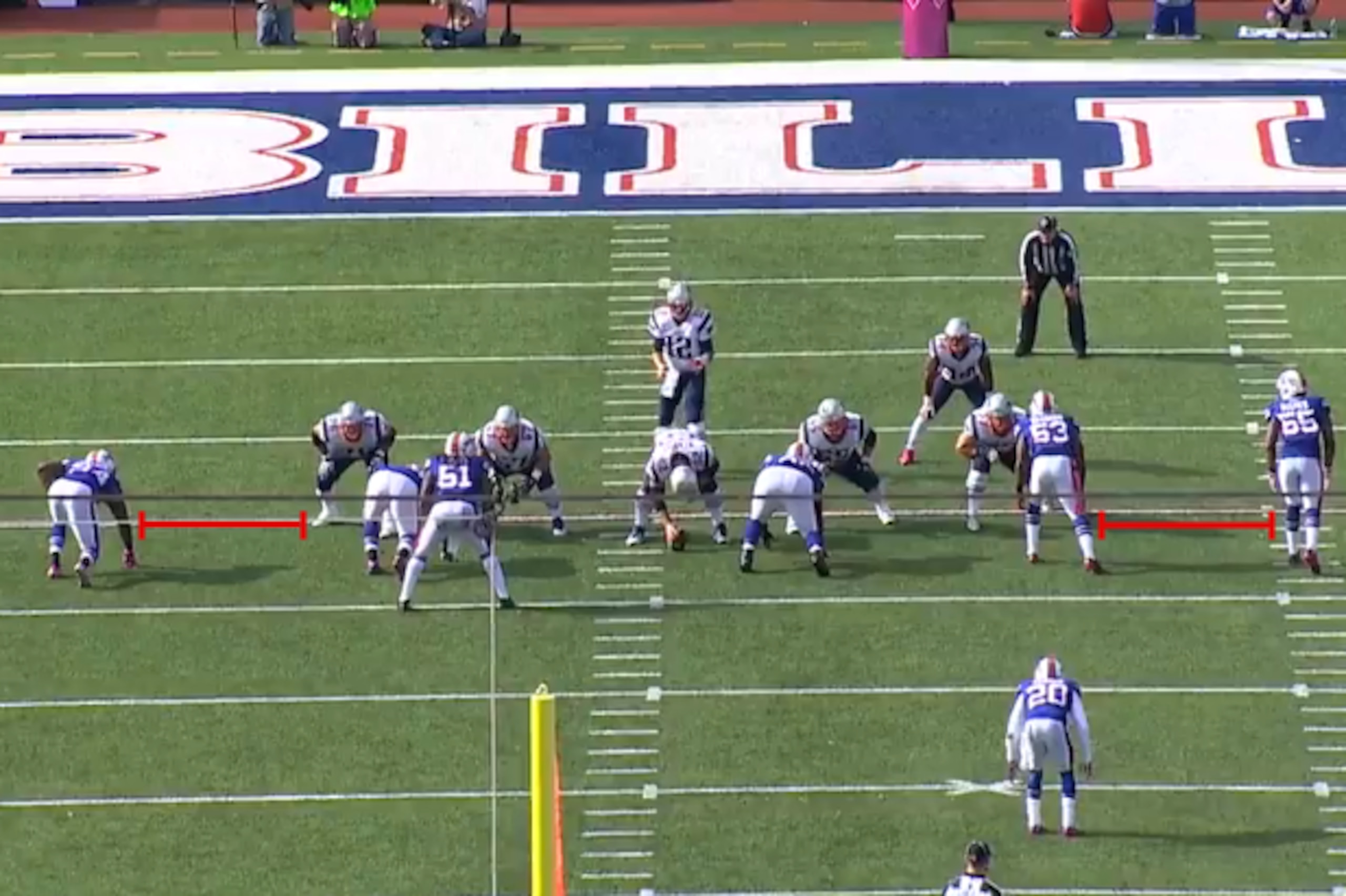
The defensive ends simply line up with a wider alignment than typically seen. Rushers can put extra stress on tacklers with speed rushes from a stance like this.
Taking advantage of its weaknesses in run defense will be important to the offense’s success on Sunday.
One way for Minnesota to attack it is through the use of more read options or packaged plays, as seen in the Atlanta game. Against the wide nine, even more space exists between the tackles to run the play. With read-option calls, the offense can effectively eliminate a defensive end by leaving him unblocked and reading his reaction.
In the above screenshot, a read-option play or packaged play could take away Jerry Hughes, the right defensive end. That gives the offense a five-on-five matchup with blockers to defenders in the running game. If Buffalo adds another defender into the box, the packaged plays give Bridgewater the choice to throw screens to the perimeter or slants over the middle.
Trap plays and counters can also capitalize on the wide alignments of the defensive end. Pulling a guard and kicking out the defensive end is not such a difficult task in this case.
Help out Matt Kalil even if it limits the offense
This key is a continuation of the Vikings’ Week 6 plan against Detroit, though it still didn’t keep Kalil from letting rushers crush his quarterback.
A technique utilized by the Vikings offense is one often seen on college fields with offensive coordinators who don’t trust their offensive lines to pick up blitzes properly. This simplifying technique also keeps tackles from being exposed on the outside.
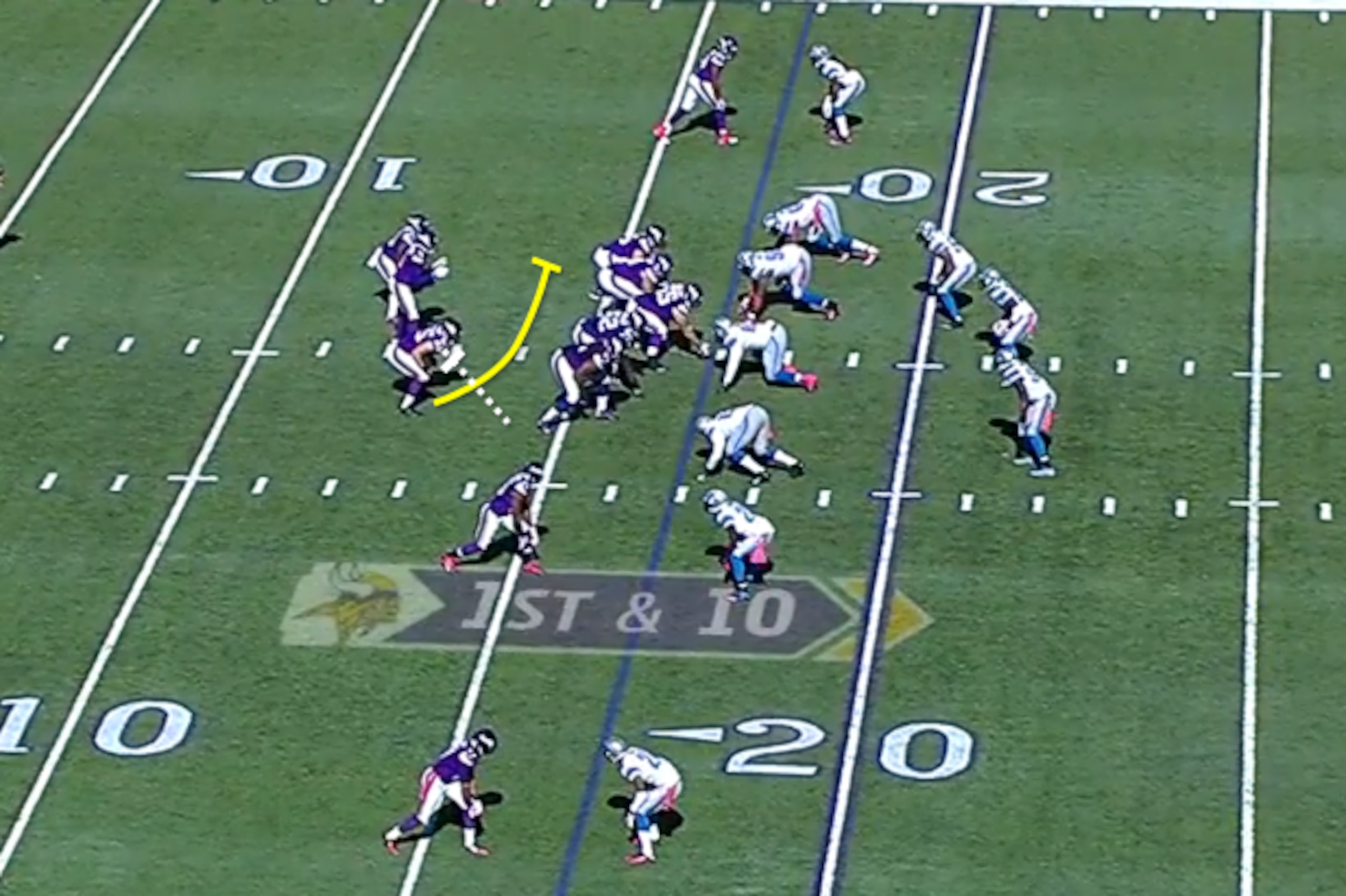
An H-back crosses the formation and picks off the end, almost like a “wham” block. On this play it was tight end Rhett Ellison who has inside out position on the end and gets the pass-block assignment. Play action slows the end down before Ellison gets there, easing his job.
That leaves Kalil to step down and supplement the interior pass blocking. Lightening left guard Charlie Johnson’s load is not a bad idea, either.
Let’s spin the camera angle around and see what this looks like from the end-zone angle.

Is this type of play limiting to the offense? Of course, but less so than having Bridgewater on his back.
Finding ways to mask Kalil must be a priority for Minnesota. The majority of his snaps will be against Hughes, the defensive end whose career has sparked in Buffalo. He leads Buffalo in sacks at this point in the season with five. He also ranks No. 3 in total pressures out of 4-3 defensive ends in the league, via Pro Football Focus premium statistics (subscription required).
Mixing in these tight end blocks with chips and double teams on the edge has a cost to the offense but a net benefit should result, as long as Kalil holds up in one-on-one battles. He can’t be given help every play.
Get the ball out
The Bills defensive line, featuring Hughes, Mario Williams, Kyle Williams and Marcell Dareus, may be even more potent than the unit that ripped apart Minnesota’s offensive line last week. The Vikings don’t have the talent up front to match it. Getting the ball out of Bridgewater’s hands more quickly can be a great equalizer.
Bridgewater shouldered some blame for the eight sacks the Vikings took against Detroit, per Matt Vensel of the Star Tribune:
"Teddy Bridgewater was asked earlier if he felt he should have gotten the ball out faster on any of his eight sacks. "The majority of them."
— Matt Vensel (@mattvensel) October 15, 2014"
The response is more diplomatic than entirely truthful but blame did rest on Bridgewater’s slow trigger on two or three sacks.
With 106 dropbacks under his belt, Bridgewater averages the eighth-slowest release time of quarterbacks who have played 25 percent of offensive snaps or more, via Pro Football Focus premium statistics. Holding onto the ball longer asks more of an offensive line that already struggles to hold its own.
When the ball comes out of his hand in a more timely fashion, the results greatly improve.
| % of Dropbacks | Comp. % | Passer Rating | Sacks | |
| < 2.5 sec. | 48% | 66.0% | 76.6 | 1 |
| > 2.5 sec. | 58% | 58.5% | 64.8 | 9 |
Getting the ball away will take a joint effort from Bridgewater and Turner. The offensive coordinator may consider utilizing shallower drops for the quarterback or calling more plays from shotgun. Route combinations that develop more quickly will be beneficial as well.
For the rookie quarterback, this means quicker diagnosis of coverage and sharper decision-making.
Throw to covered receivers
You read that correctly. For the Vikings offense to be more successful in Week 7, Bridgewater must be willing to throw to covered receivers. Picking his spots is important, though.
Detroit was able to stifle the Minnesota air attack with tight man coverage, often shutting down space for receivers to operate. That left Bridgewater standing in the pocket patting the football while the rush closed.
When Bridgewater recognizes single coverage in advantageous situations, he must be willing to give his receivers a chance to go get the football. The rookie can be guilty of over analysis at times, trying to make the perfect throw into the perfect spot in the defense. That is not always practical.
Quite tellingly, Bridgewater’s throws have failed to net a single defensive pass interference call to this point, via Football Outsiders. Matt Cassel earned two in 19 fewer throws.
The take-home point is that good things can happen when a quarterback throws to receivers who appeared covered. With an accurate throw, the receiver can win the ball in the air or draw flags from officials happy to hand them out. Putting more trust in his receivers is the next step for Bridgewater.
Turn red-zone opportunities into six points
Bridgewater needs to get his first career touchdown pass and the entire offense needs a confidence boost. Settling for more field goals will hardly accomplish that.
Besides, every last point is even more valuable for an offense that would fail to locate them with a map at this point. Finishing offensive drives with six points
Stay disciplined for run and pass
Buffalo’s offense stays balanced in terms of evening up run calls and pass calls. They don’t become as predictable as many other offenses do, so playing assignment-sound defense keeps surprises from being sprung.
This table demonstrates how balanced the Bills offense has been through six weeks:
| Passes | Runs | Ratio | |
| 1st Down | 68 | 68 | 1:1 |
| League Average | 62 | 70 | 1:0.9 |
| 2nd Down | 53 | 47 | 1.1:1 |
| League Average | 56 | 41 | 1.4:1 |
| 3rd Down | 52 | 18 | 2.9:1 |
| League Average | 44 | 14 | 3.1:1 |
On each of the first three downs, Buffalo’s pass to run ratio is closer to one-to-one than the league average. Even on first down, when NFL teams tend to run the ball slightly more often, the Bills are perfectly even.
Scale back the blitzes
Buffalo’s offensive line is the soft spot of the offense. It ranks dead last in the league in Pro Football Focus' pass-block grade. Opposing defenses have only gotten home for eight sacks but have tormented the two Buffalo quarterbacks with hits and pressures at a very high rate.
Joe Buscaglia of WGR gave this blunt assessment after the Buffalo line was shredded by New England last week:
"Catching up from last wk, got through #Bills-Lions All-22. Cyril Richardson was bad on Colin Brownsian levels. Seantrel Henderson awful too.
— Joe Buscaglia (@JoeBuscaglia) October 14, 2014"
Richardson, the starting left guard, and Henderson, the starting right tackle, were both late-round selections for Buffalo who have been rushed into starting duty.
For the Vikings, reliance on the front four to get home makes sense. The defense has enough talent along the defensive line to rattle a couple of rookies who have struggled. Mike Zimmer will still disguise intentions by bluffing blitzes, but he can afford to back out and maximize coverage.
Brian Robison should be the biggest beneficiary of the situation. He gets to tee off on Henderson off the defense’s left side for the majority of the game. Interior rushers Linval Joseph, Sharrif Floyd and Tom Johnson should all be disruptive against the Buffalo interior offensive line as well.
Create turnovers
While Zimmer’s defense has certainly been improving over the course of the season and played a tremendous game against Detroit last week, not enough turnovers are being forced.
Staggeringly, the Vikings are the only team in the NFL to not have recovered a fumble on defense in 2014. The Vikings defense is No. 28 in the league in takeaways per game at 0.8. Winning the turnover battle is the quickest way for a team to turn around its fortunes.
Opportunity presents itself this week. In each of the last two games, in his only starts of the season, Kyle Orton has thrown a costly interception. The theme of both turnovers is Orton staring down his targets and a defender getting a beat on the throw.
The interception he threw against Detroit was jumped by cornerback Rashean Mathis and returned for a touchdown.
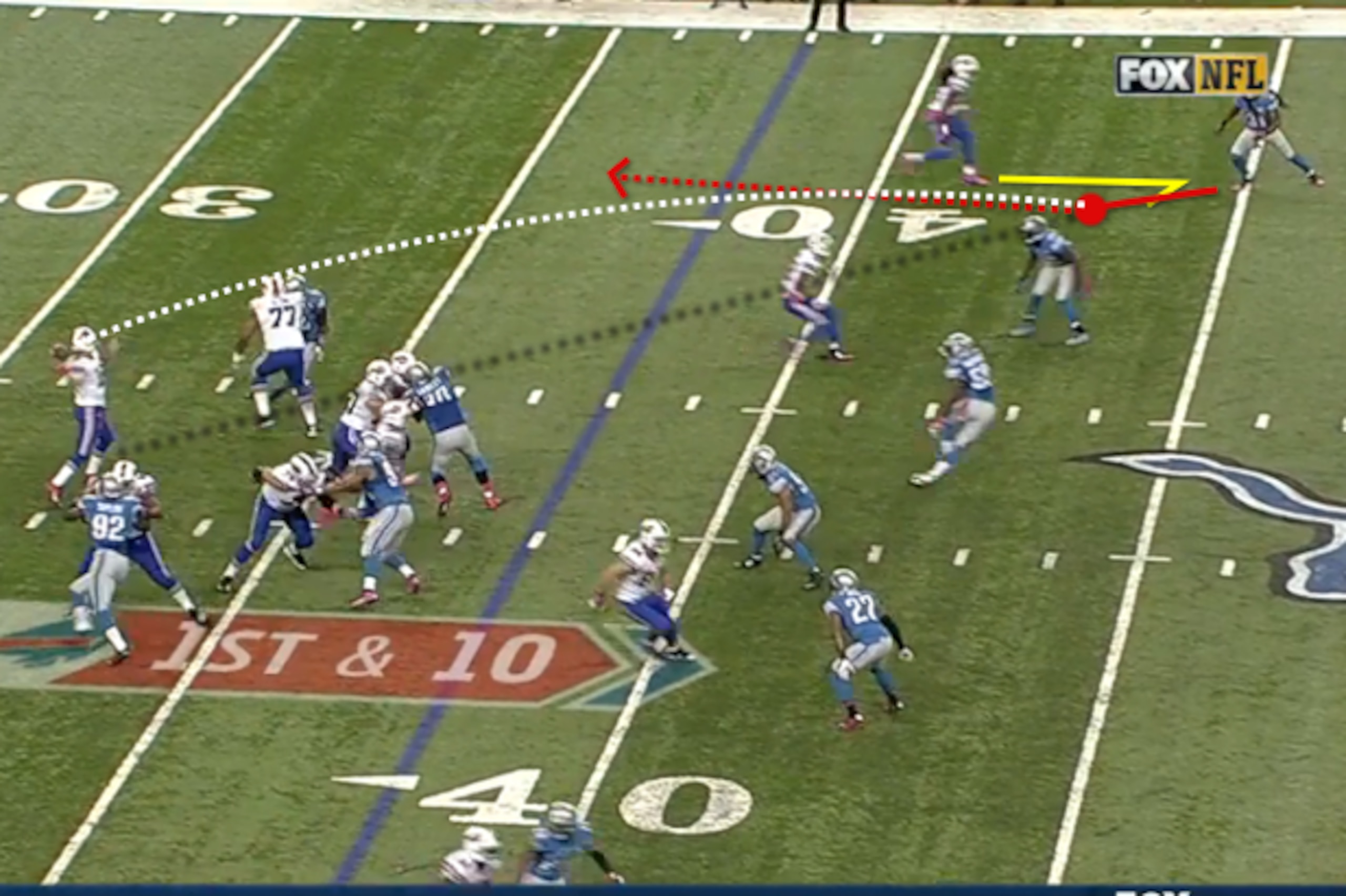
With Orton’s tendency to stare down his receivers, Vikings defenders have something to key on. Following the eyes of a quarterback like Orton will take a defender right to the play.
Minnesota will also consider disguising coverage to try and bait throws from the veteran quarterback. As the secondary becomes more experienced in Zimmer’s scheme, the coach can begin to integrate more complicated calls. He also should have increased trust in his cornerbacks after recent displays, so safeties can be given more freedom to find their way into passing lanes.
Continue to challenge receivers with man coverage
Xavier Rhodes and Josh Robinson have become a reliable duo of cornerbacks in recent weeks. Zimmer has been keen to put both on islands at different points in games because they have the athleticism and physical tools to hang with receivers in man coverage.
Limiting space will be important against Buffalo, too. Sammy Watkins, Robert Woods and Marquise Goodwin can all turn small gains into big ones in the underneath passing game. That gives the Vikings incentive to move cornerbacks up near the line of scrimmage to dissuade screen passes or other underneath routes.
When Buffalo reacts by throwing over the top, the recovery speed of Rhodes and Robinson on the outside gives the Vikings an out.
Win field position battles
The final point of emphasis for the Vikings relates to field position. Minnesota’s numbers through six weeks are not pretty.
Per Football Outsiders, the average offensive drive for the Vikings starts at their 24-yard line. That ranks No. 27 in league. The average drive of the opponent starts at its 31-yard line. That ranks Minnesota No. 26. Frankly, the Vikings have failed to set their drives up for success through starting field position.
Keep an eye on how many short fields Minnesota’s offense gets the benefit of versus how many short fields the defense gets stuck in.
These keys provide the recipe for the Vikings to get back in the win column and to turn their season around. Minnesota has finally reached a soft spot in the schedule. It’s time to take advantage.
.jpg?w=2560 "Titans Colts Football")