When he was brought to Real Madrid from Bayern Munich, it was anticipated Toni Kroos would blend nicely with the club's midfield stalwart, Xabi Alonso. When the Spaniard completed a shock move in the opposite direction in the final days of the summer transfer window, Kroos suddenly found himself needing to be Alonso.
Few have ever doubted the 24-year-old's ability to fill such a void—he is, after all, a three-time Bundesliga champion, a three-time German cup winner, the owner of a Champions League title and, most recently, a World Cup victor.
Yet, the concern has never centred on whether he has the capacity to become a new-wave Alonso, but rather how much time would be needed for him to do so.
TOP NEWS
Live World Football Moments 🍿

Final Men's Ballon d'Or Rankings 📊
.jpg?w=2560 "NFL Paris Football")
NFL House in Paris Closes for Protests
Real Madrid own a squad built to win now, not later. Cristiano Ronaldo's peak years must be capitalised on. The phrase "work in progress" isn't tolerated in the Spanish capital. It's expected that players of Kroos' ilk arrive at the Bernabeu as the "finished article."
There's a need for immediacy, therefore, relating to the German's evolution in Spain. And while it's likely such a process may take longer than is desired, there's evidence to suggest the transformation is gradually taking shape.
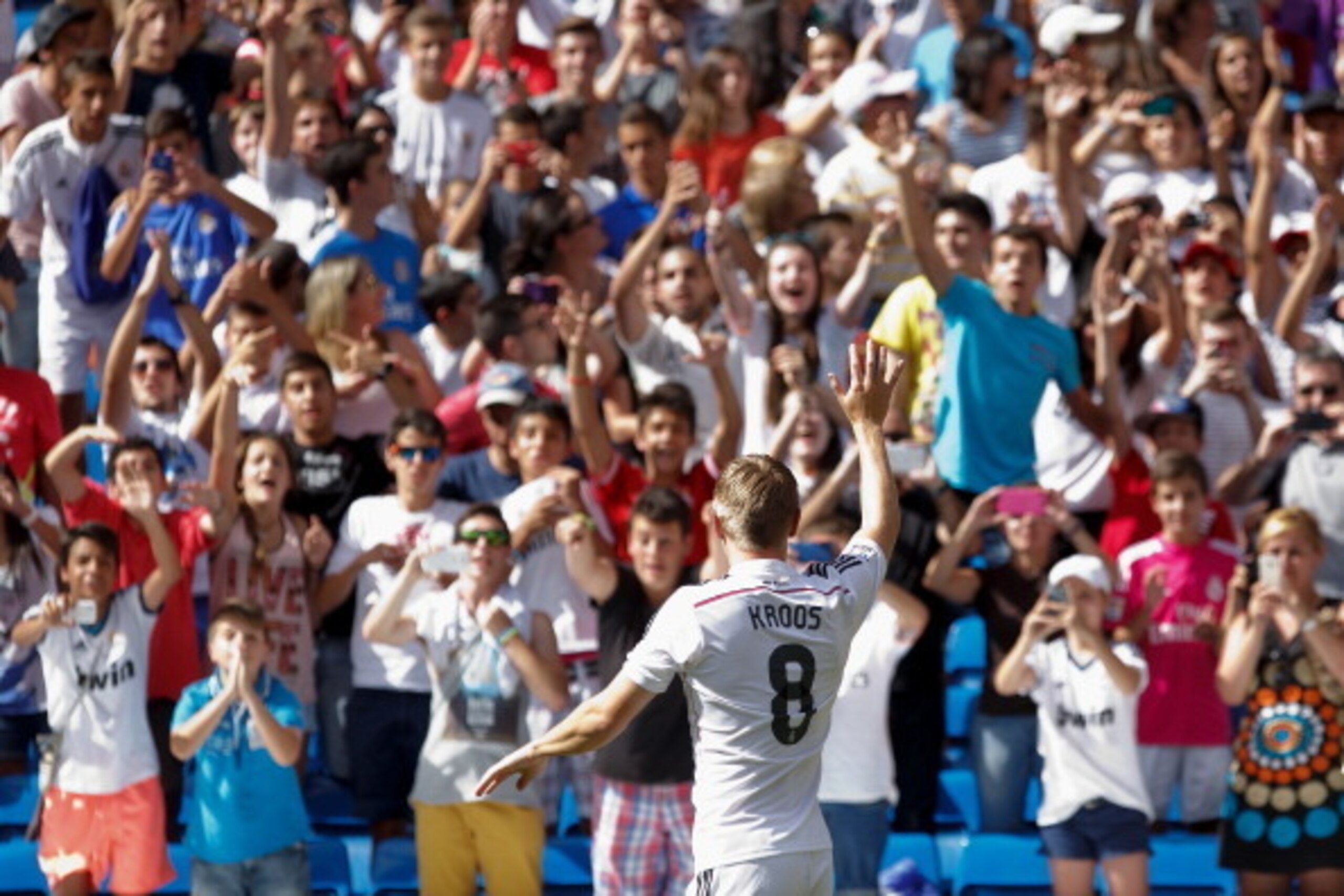
In Alonso's absence, Carlo Ancelotti was quick to place Kroos as the deepest member of his central trio also featuring Luka Modric and James Rodriguez, giving rise to the view that "Toni is the new Xabi." Due to necessity, the advanced midfielder—one bordering on a No. 10—would be re-positioned and moulded into a deep-lying playmaker.
With the ball at his feet, Ancelotti knew Kroos would excel having purchased a gifted technician crafted in Bavaria by Louis van Gaal, Jupp Heynckes and Pep Guardiola.
Economical in his movement, supreme with his vision and laser-like in his distribution, the former Bayern star has already impressed as a creator in white; his three assists from a withdrawn position as notable as his passing accuracy.
His deep role in Real Madrid's flowing attack, one that has blasted 27 goals in six consecutive triumphs, hasn't gone unnoticed, either.
There are issues, though. Defensive ones.
Kroos' natural inclination is always to push forward, an obvious product of his roles with Bayern and Germany. Sitting and holding without the ball is somewhat foreign for the World Cup winner. And it's something Ancelotti is acutely aware of.
"4-4-2 is the best defensive system that exists," the Real Madrid manager said prior to his team's clash with Ludogorets, per Heath Chesters of Inside Spanish Football. "4-3-3 doesn't give the balance required and it's more difficult to pressure higher upfield. Our intention is to defend with a 4-4-2 and attack with a 4-3-3."
Ancelotti chose his words carefully, ensuring particular individuals weren't cited as the reason for the use of two systems. For the reality is, that last season, Real Madrid did defend in a 4-3-3, but they were only able to do because of the established two-way talents of Alonso and Angel Di Maria.
"When we have the ball we play with three midfielders and without it, [Gareth] Bale helps us to defend as part of a line of four, with James [Rodriguez] moving over towards the left," the Italian added after the thrashing of Athletic Bilbao, per Inside Spanish Football's Chesters.
While that defensive switch has helped to protect Rodriguez, it's also been made due to the presence of Kroos, who's still vulnerable to being exposed without possession if he isn't supported by numbers.
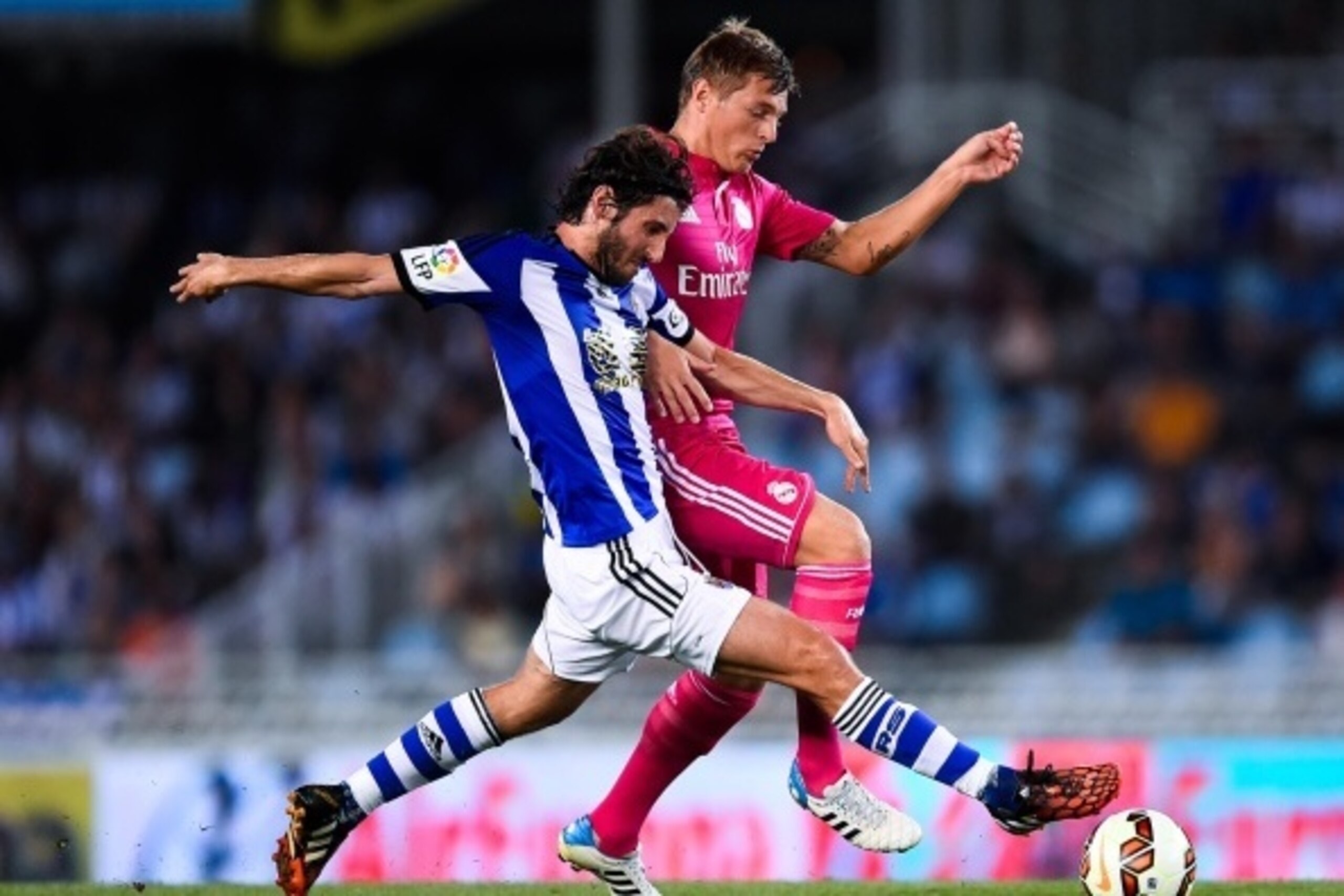
One only needs to look at Real Madrid's tense 2-0 victory over Villarreal for a neat encapsulation of where Kroos currently sits in his transition to Alonso's role.
In possession, Los Blancos' new midfield star completed 87 touches (more than any other Real Madrid player), finished with a passing accuracy of 96 percent, was successful with five of six long-ball attempts and made the assist for Modric's opener, per WhoScored.com.
Sounds like a stat line for a certain ginger-bearded Spaniard, doesn't it?
But Ancelotti's men also suffered a barrage at the back on that afternoon at El Madrigal. The home side ambushed Real's midfield, storming through the middle before pushing the ball to the wings and shelling the visitors' back four with a tirade of crosses.
It was the only outing this season in which a defender has been Ancelotti's finest, with Raphael Varane (along with some help from Iker Casillas) conjuring a herculean effort to deliver a clean sheet and an uncharacteristic victory for the capital club.
Quite simply, Kroos' impact in his deep position, the Alonso role, was only felt in one direction.

One senses, however, Ancelotti won't be distressed with the current tendencies of Kroos, even if his game doesn't yet possess the ultimate balance for the position at the base of the manager's midfield.
For the Italian will have acknowledged that it's the more complex components of the Alonso role—the pinpoint passing from distance, the control of tempo and the incisive distribution—that the German already has covered.
It's establishing oneself as that deep, fluid and cohesive member of Real Madrid's fearsome attack—something he's already achieved—that holds a greater degree of difficulty. Developing the required positional awareness without the ball will come somewhat easily as Kroos continues his transformation away from previous roles.
Thus, the view that "Toni is the new Xabi" isn't entirely accurate just yet, but it isn't far away from being so, either.
.jpg?w=2560 "Seahawks Chiefs Football")