Ravens' Weaknesses Turning Them into Mediocre Team
After five games, the Baltimore Ravens are a highly respectable 3-2 in a very competitive AFC North. Prior to meeting the Indianapolis Colts in Week 5, they were coming off a dominant win over the Carolina Panthers.
Steve Smith Sr. brought needed fire to the receiving corps, rookie linebacker C.J. Mosley looks like not just a long-term starter but also a star, and the run game, featuring a trio of running backs, brought balance to the offense.
But the Ravens' 20-13 loss to the Colts reveals another side to Baltimore—a mediocre side. The loss fell with a heavy thud and made one think, "Well, this is a football team, alright," but little else. Baltimore's weaknesses were exposed, from undrafted rookie left tackle James Hurst to just how thin the team is both at receiver and cornerback.
TOP NEWS
.jpg?w=2560 "NFL Paris Football")
NFL House in Paris Closes for Protests
.jpg?w=2560 "Seahawks Chiefs Football")
Trevon Diggs Cut by Seahawks
.jpg?w=2560)
B/R's Expert Week 7 NFL Picks 🔮
And these weaknesses, which appear poised to persist for at least a few more weeks, could result in a mediocre 8-8 finish for the Ravens yet again. The fire that raged against Carolina in Week 4 appears to have already been snuffed out.
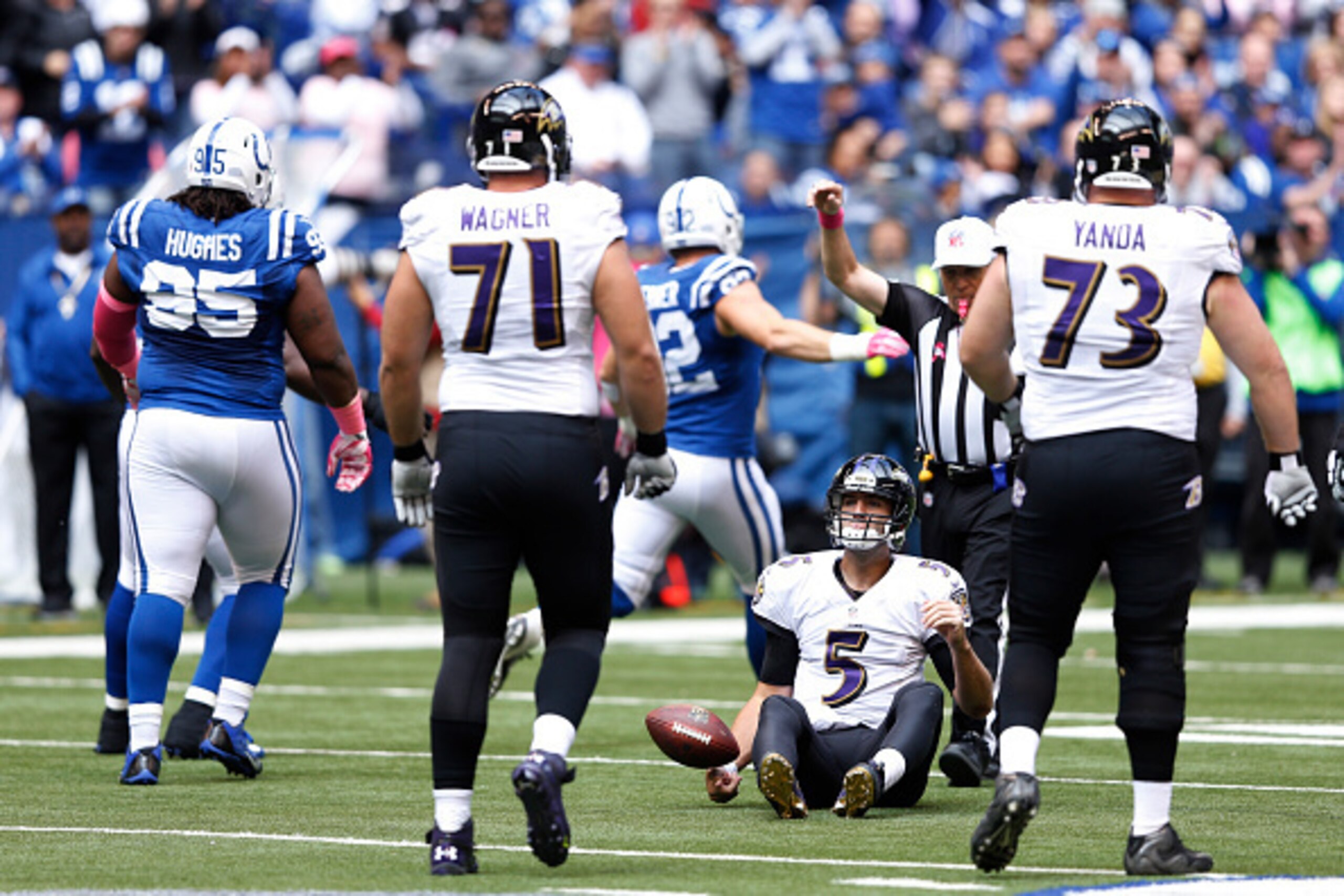
The problems against the Colts were many, starting with Hurst, who gave up three of the four sacks on quarterback Joe Flacco, according to Pro Football Focus (subscription required). Hurst also gave up an additional hit on Flacco and three hurries.
With all that pressure on Flacco, it's no surprise that the quarterback completed only 22 of his 38 pass attempts and threw no touchdown passes. He had 235 passing yards, but with 38 yards lost with the four sacks, the net gain was just 197 yards.
What also surprises is how committed the Ravens were to passing the ball with the run game producing significant gains.
Conventional wisdom says that teams must pass the ball to make up for a point deficit, but the Ravens' stubborn unwillingness to run the ball when it worked on Sunday was a significant mistake. Baltimore collectively ran only 15 times, netting them 90 yards—an average of six yards per carry.
Both Justin Forsett and Bernard Pierce ended the day with strong averages of seven and 7.5 yards, respectively. But between them, they only had 10 carries. With Flacco being beaten up early and often, running should have been Baltimore's safety valve.
Not being consistent on offense will doom the Ravens. The team learned last year, when it couldn't run the ball and Flacco had few weapons to throw to, that a Flacco-heavy approach is not the best way to win games. Abandoning the run on Sunday was a fool's errand. The scoreboard dictated too heavily what the Ravens chose to do.
As a result, the Ravens converted only two of their 14 third- and fourth-down attempts in the game. They also gave up the opportunity to tie the game in the second quarter, with a failed 4th-and-1 on a sack of Flacco rather than take the surer thing: Justin Tucker making a field goal. The Ravens both failed to take the yards and the points they could get.
Head coach John Harbaugh defended this decision when speaking to Aaron Wilson of The Baltimore Sun and other members of the assembled media on Monday, saying, "I'm not real happy with where we're at with our third-and-fourth-down conversion rate. We have to get better at that. It's the execution more than anything. 'Well, if you had kicked the field goal there, you would have tied the game.' Well, it turned out we needed a touchdown."
That's true, but it also misses the point. At that point in the game, the field goal would have tied it. Harbaugh had no idea that the Ravens would ultimately lose by exactly one touchdown and one extra point.
He also pointed to the lack of third-down conversions as the reason for the ninth-ranked rushing offense's inability to run the ball:
"The biggest problem we had is not the number of runs or anything like that, it's not converting. When you go 1-for-11 on third downs and turn the ball over, which is what we did in the first half, that combination means you don't get many plays. It's kind of hard to get a lot of runs under your belt when you don't have many plays under your belt.
"
However, the Ravens could have had more plays and more conversions with more running. Heavy passing resulted in the lack of conversions, while the run game, when used, was producing.
The Ravens also have themselves a Smith problem—Torrey Smith, that is, who dropped a last-second touchdown that would have tied the game and sent it into overtime on Sunday, and who subsequently tweeted about how "sick" that made him feel.
"I'm sick right now...never been in this position before...very trying times for me on and off the field but I will be better from this
— Torrey Smith (@TorreySmithWR) October 5, 2014"
That's the touchdown, the points that Harbaugh should be concerned about. And Smith, in a contract year, needs to get focused. In that tweet, Smith points to "trying times...on and off the field," which have led to a mere 11 catches on 30 targets—a 37 percent catch rate—for 176 yards and one touchdown. He's averaging a paltry 35.2 yards per game.
| 2011 | 95 | 50 | 52.6% | 841 | 16.8 | 7 |
| 2012 | 110 | 49 | 44.5% | 855 | 17.4 | 8 |
| 2013 | 139 | 65 | 46.8% | 1,128 | 17.4 | 4 |
| 2014 | 30 | 11 | 36.7% | 176 | 16.0 | 1 |
| Total | 374 | 175 | 46.8% | 3,000 | 17.1 | 20 |
Smith has never had an impressive catch rate. He struggles yearly with catching even 50 percent of the passes thrown to him. But with tight end Dennis Pitta again not available and Smith Sr. being the only big playmaker on the team at present, the younger Smith must prove his reliability.
Bleacher Report NFL insider Jason Cole believes that everything surrounding Ray Rice and what he did in February is "weighing heavily" on Smith, disrupting his on-field performance. If true, it explains things, but it doesn't excuse him.
The Ravens need Smith, now and every game, to play well and be committed to his team and his craft. With a dearth of receiving talent, Smith cannot perform like this. It drags the team down. He's helping the Ravens dip from contender to mediocre with every drop, every lazy route, every mental lapse.
The defense didn't provide the Ravens with much help on Sunday, either. Yes, it held the venerable Colts offense to just 20 points, quite the accomplishment when facing Andrew Luck in his home stadium. But the Colts' pass protection is poor and Baltimore's pass rush only got to him once, with Pernell McPhee picking up the sack.
Right now, the Ravens are suffering from a lack of splash plays, drive-killers, on defense. They have only five sacks on the season and three interceptions. The only thing going their way is their seven forced fumbles and five recoveries.
Terrell Suggs is dealing with a groin injury that has him slowed. Without Suggs presenting a major threat, fellow outside linebacker Elvis Dumervil cannot pressure quarterbacks. The bright spot, as mentioned earlier, is Mosley, who had a team-high 15 tackles against the Colts, as well as a pass defensed and a quarterback hit.
Mosely is the Ravens' leading tackler, with a combined 49, which includes two tackles for a loss. He has five passes defensed, an interception, a forced fumble and a recovery and is making a strong case to be the league's Defensive Rookie of the Year.
The trouble, beyond the pass rush, is in the secondary. Lardarius Webb is just finally getting comfortable after dealing with a back injury to begin the season. The Colts game was the first full game he's played this year.
And now fellow cornerback Asa Jackson is out for some time—potentially being placed on the injured reserve recall list—with a "severely sprained toe." The Ravens are currently quite thin at cornerback with Jackson's injury.
With a weakened secondary, the need for a stout front seven is even more necessary now. And if that doesn't happen, the Ravens cannot make things worse for the defense by executing on offense as they did Sunday in Indianapolis.
One hand washes the other in football—a good defense helps the offense and vice versa. If neither is clicking, the climb will be steep, difficult and generally unsuccessful.
That's what the Ravens faced in Week 5, and it's something they cannot repeat in Week 6 against Tampa Bay, a 1-4 team that Baltimore should be capable of defeating. The AFC North is a very competitive division this year. The difference between winning it and reaching the postseason and sitting at home in January could come down to one game.
By not maximizing their strengths against the Colts, the Ravens amplified their weaknesses. The Ravens are inching toward mediocrity—or worse—when they play football as they did on Sunday.
.jpg?w=2560 "Colts Football")