Breaking Down the New York Giants' Special Teams Woes
It’s probably one of the oldest—and corniest—football expressions.
Unfortunately, in the case of the New York Giants, it's not a stretch to say that their special teams “haven’t been special” of late.
Just how bad has it been for the groups of players that are supposed to be “specialists” because of their abilities to fly up and down the field to make plays?
TOP NEWS
.jpg?w=2560 "NFL Paris Football")
NFL House in Paris Closes for Protests
.jpg?w=2560 "Seahawks Chiefs Football")
Trevon Diggs Cut by Seahawks
.jpg?w=2560)
B/R's Expert Week 7 NFL Picks 🔮
Brace yourselves, because the numbers aren’t very pretty.
| Kickoff Return | 20.8 yards per return avg. | 24th |
| Punt Return | 6.6 per return avg. | 20th |
| Punt Coverage | 37.3 net avg. | 27th |
| Kickoff Coverage | 18.0 avg. per return | 4th |
(I did warn you!)
The Field Position Battle
There is a reason why special teams is so important in football, and it is quite simple.
Having a good all-around special teams unit will help a team win its field position battle.
Give a halfway decent offense a short field on which to work, and theoretically, it should be able to move the ball down the field.
Likewise, give a decent defense a longer field on which to operate, and chances are it will do its job and get the ball back for its offense.
Let’s see how the Giants have done in the starting field position battle through five games.
| NYG 23 | DET 37 | -14 | L, 14-35 |
| NYG 19 | ARZ 33 | -14 | L, 14-25 |
| NYG 40 | HOU 21 | +19 | W, 30-17 |
| NYG 40 | WSH 15 | +25 | W, 45-14 |
| NYG 30 | ATL 29 | +1 | W, 30-20 |
Notice how the larger the field position difference, the larger the victory for the Giants? That’s not by accident.
The little things mean the difference between a win and a loss. Right now, the Giants are winning in spite of the inconsistencies on special teams.
Breaking Down Some of the Breakdowns
Let’s look at a couple of examples from last week’s game against Atlanta, where speed, or a lack thereof, was an issue.
Devin Hester’s 25-Yard Punt Return
The first issue with this play is that punter Steve Weatherford sent the ball down the middle of the field.
That is a major no-no against an explosive return specialist like Hester—and an even bigger problem when there is questionable speed on the coverage unit to keep up with the returner.
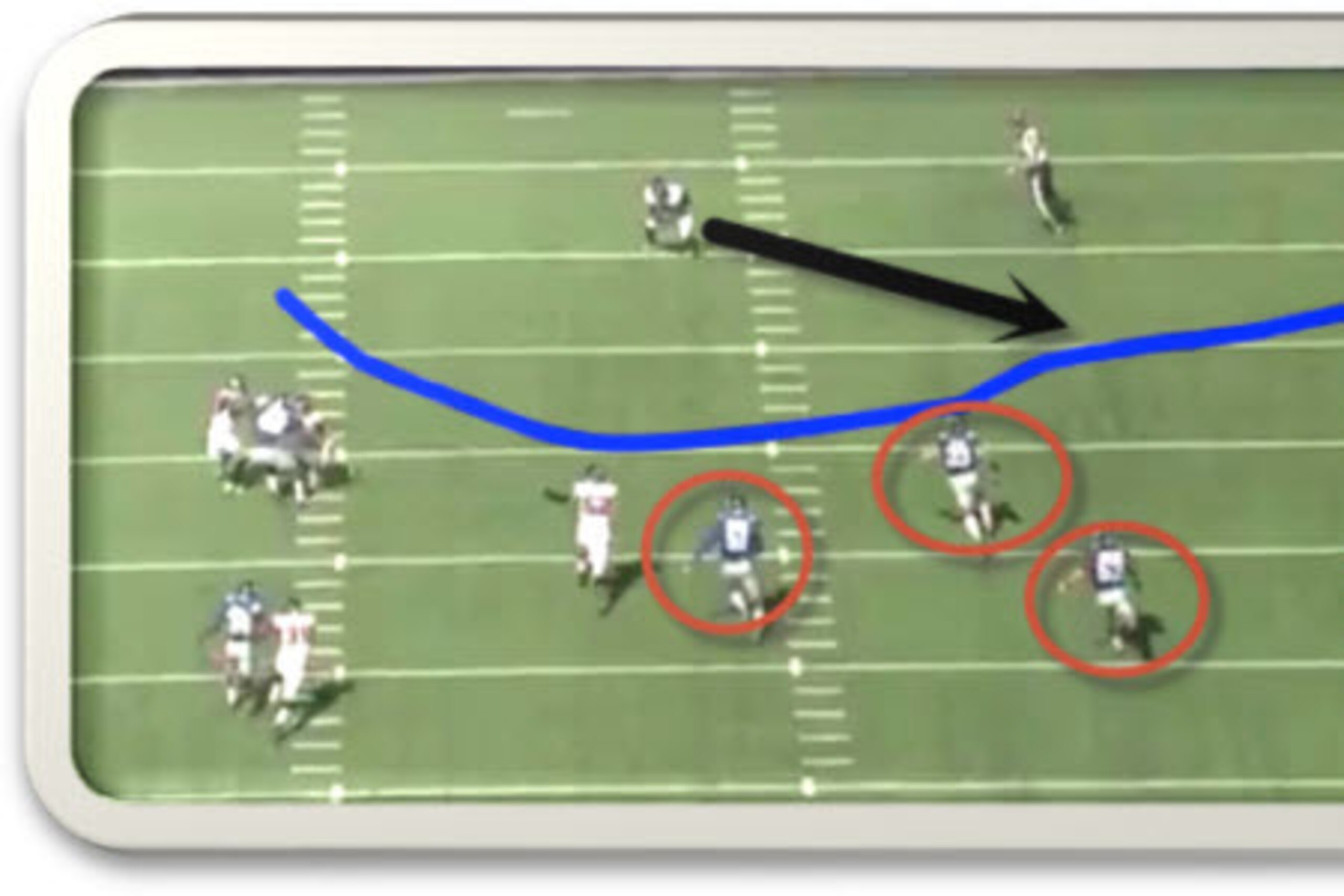
The Giants started in great position to stop Hester—note how there are five Giants (circled) in a position to stop Hester if he cut it back toward their sideline (which he did).
The problem, though, is a lack of speed by the coverage team. The red X's indicate how Atlanta’s players quickly got on top of the five Giants who were initially free in the preceding frame.
Jameel McClain (blue circle) and Zak DeOssie (black arrow) were in position to stop Hester, as shown in the frame below.
Unfortunately, both took bad angles, lunging for Hester and thus landing on the ground as the returner darted by.

This left Mark Herzlich, not exactly known for his speed, to chase Hester. On that chase, Herzlich ran parallel with Hester, appearing to be unsure when to cut in on an angle in an attempt to push him out of bounds.

Weatherford, who could have helped the cause right from the start had he kicked the ball outside of the numbers, ended up having to drive Hester out of bounds—but not until the return specialist picked up 25 yards.
Quintin Demps’ 22-Yard Kickoff Return
A good way to judge the success of a kickoff return is if it reaches at least the 20-yard line.
Such was the case on Quintin Demps’ 22-yard return, a play that originated five yards deep in the end zone that he took out to the 17-yard line.
Demps made the right decision in bringing the ball out, as he had a wall of blockers setting up before him to his left.
The issue—and this has been a problem for the kickoff team on more than one occasion—is that an opposing coverage guy came down the field untouched.
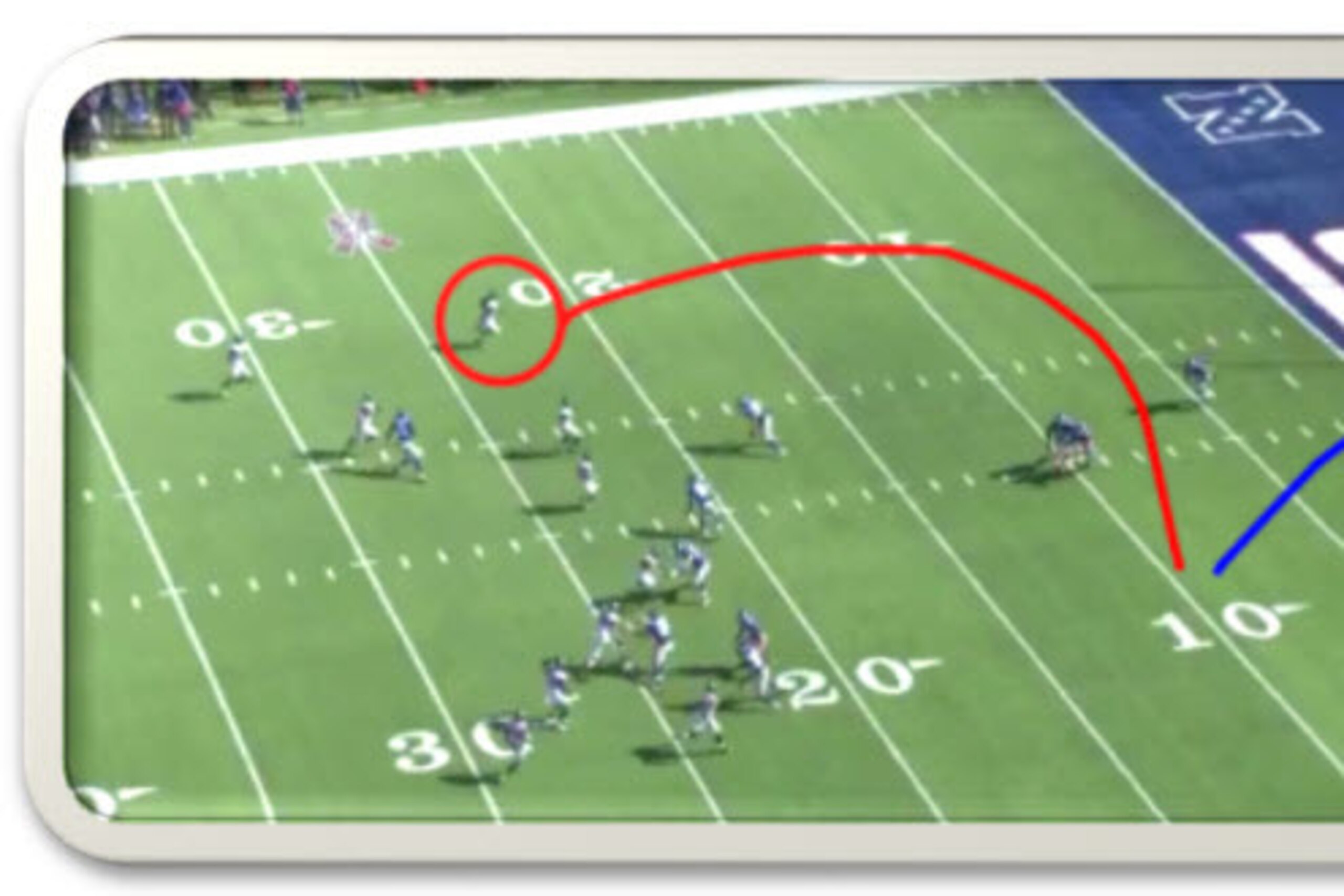
In this case, reserve safety Dezmen Southward came flying down the Giants sideline, cutting across the field to assist in stopping Demps before he reached the 20-yard line.
How to Solve the Problems
The obvious solution is to fire special teams coordinator Tom Quinn. It remains to be seen whether such a move is coming at the end of the season.
The bigger problem that really does need to be addressed, though, is the lack of speed.
Look at any of the game books from this season (available via NFL.com) and something you will probably notice is the majority of Giants players that receive snaps on special teams are reserves.
Contrary to what coaches and players would like us to believe, there is a reason why a starter is a starter and a backup is a backup.
When there is a drop-off in the talent level at one position, it can be attributed to a lack of speed and/or ability, the very same reasons why the player doesn’t rise to the top of the depth chart at his position.
If those same players are staffing special teams, then guess what? The unit isn’t going to be ranked very high in a 32-team league.
This is where coaching now comes into play. A solid special teams coordinator will design schemes to compensate for a lack of speed.
Yes, execution by the players is a big part of the equation. However, watch the Giants on special teams next time and take note of how many guys end up on the ground near the ball-carrier after they unsuccessfully lunged in an attempt to the returner.
That’s usually a speed issue, and if a team can’t keep up with the opponent, it is going to need to find a way to outsmart it through the design and execution of solid schemes.
Statistics and game book information is via NFL.com. Follow me on Twitter: @Patricia_Traina.
.jpg?w=2560 "Titans Colts Football")