Boston Bruins GM Peter Chiarelli Brings Pressure Upon Himself with Boychuk Trade
Give Boston Bruins general manager Peter Chiarelli credit for at least one aspect of trading defenseman Johnny Boychuk on Saturday. In his subsequent press conference, his remarks conveyed an understanding of the risks that come with relinquishing a proven pillar prior to the season.
The move was akin to thrusting the puck at an oncoming opponent amidst an attempted breakout. The trick now is to recover, hold one’s ground, loosen the puck and restore control.
Per Caryn Switaj of the team’s website, Chiarelli offered a multifold rationale, telling the New England hockey press corps the following:

.jpg?w=2560 "NHL Trade Grades Connor Hellebuyck")
"This deal was born out of couple things: one, our cap situation, two, as I said, trying to be proactive on team planning. I look at this a little bit globally. This may be one in the series of two or three steps throughout the course of the year, and I wish I could do everything at once.
"
To pre-empt repercussions, he must establish and maintain a grasp on what those steps are going to be. He will also need a multitude of favorable elements to fall into place.
As precarious as it is to pass early judgment, the initial impression of this deal is shoddy enough. Although they shed precious salary-cap space, the Bruins landed no immediate personnel gains from Boychuk’s buyer, the New York Islanders.
The return package features a second-round draft pick for 2015 and 2016 plus a conditional third-round selection for 2015.
Translation: Boston will not reap direct rewards at any point in 2014-15. In fact, whomever those draft picks turn into will not likely see NHL action until a few seasons down the road.
In turn, that will not pose a solution to the problem of inevitable backlash. Until new circumstances dish up a counterpoint, this deal has the look of little more than the foolhardy sacrifice of a seasoned stay-at-home defenseman.
The 30-year-old Boychuk logged almost five full seasons in Bruins attire, rapidly evolving into an effective bruiser and blocker. He was a staple on the Stanley Cup championship team in 2011 and the finalist team in 2013.
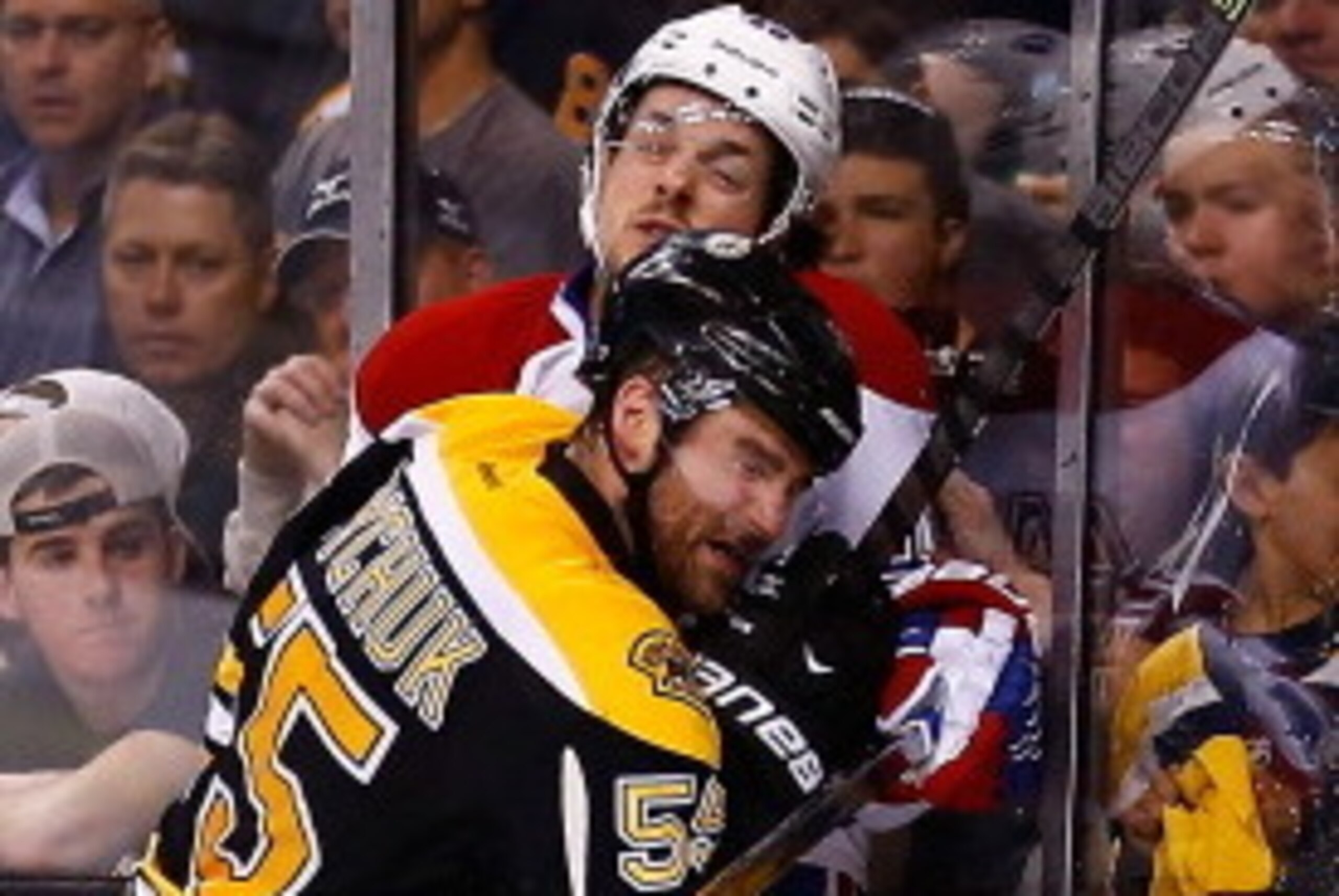
Last year, Boychuk was an indispensable specimen of seasoning and consistency. He helped to prop up the ecosystem of the Boston blue line while Zdeno Chara was aging and Dennis Seidenberg and Adam McQuaid were ailing.
There is no question Boychuk’s presence played an integral role in fostering the rapid development of homegrown stand-ins Matt Bartkowski, Dougie Hamilton, Torey Krug and Kevan Miller. His export means plucking one of the training blades off of those youngsters’ boots.
To ward off second guesses, Chiarelli needs to bank on Bartkowski and Hamilton burgeoning into two-way stalwarts without fail. He needs to hope that the sophomore slide ignores the likes of Krug and Miller.
For veteran presence, consistent health for Seidenberg and McQuaid is a must, especially with the 37-year-old Chara passing his peak. That is a reasonably safe bet for Seidenberg, though not so much for McQuaid given his copious injury history.
In the event of a protracted injury to any member of the blue-line brigade, Chiarelli will need to hope for a rerun of last winter’s rapid reinforcement. That would mean dipping into the prospects pool for the inexperienced likes of Joe Morrow, Zach Trotman or David Warsofsky.
Well, either that or using the prospective financial breathing room to import a more seasoned piece. If he does not use it for that purpose, he may afford himself a deadline do-over if Boston needs an upgrade anywhere entering the homestretch.
Per CapGeek, a series of amendments to the club’s NHL payroll listing has the Bruins $332,524 under the ceiling. But as of Sunday afternoon, that payroll lists only 11 healthy forwards.
In order to achieve a quorum of 12 strikers, let alone a 13th spare, they will have to creep back above the spending limit. Although, this is with Marc Savard still technically in the equation.
Under the current configuration, if and when they place Savard on long-term injured reserve, the Bruins could have up to $4,359,667 in free space.
Even with a multitude of internal swaps between Boston and Providence, they should still hover north of $2,500,000. The two highest-grossing players on CapGeek’s non-roster payroll, David Pastrnak and Brian Ferlin, combine for a $1,800,000 hit.
With a $3,366,667 cap hit, Boychuk was one of the few relatively reasonable ways for the Bruins to achieve that financial freedom. He was not, however, the only way.
For all of the talk of Boston’s indisputable overstock on defense, the same holds true among centers. One pivot, the 33-year-old Chris Kelly, has a comparable cap hit of an even $3 million and has arguably lost his natural slot on the Bruins' depth chart.

Had Chiarelli pursued and executed a Kelly export, he would have still afforded his club more than $2 million in cap space. It would not have been a far cry from the gain in the Boychuk deal, but it would have dealt a softer blow to the roster.
He even could have shed more than a combined $4 million by seeking to deal Kelly and later addressing the defensive dilemma by relinquishing the likes of McQuaid. That could have achieved roughly the same immediate cap gains and the same negligible, mysterious long-term draft gains.
Too late now. Chiarelli made his decision and made his move. If any opportunity to make the newfound cap space worth the sacrifice arises, he must not hesitate.
Recall the addition of quantity and lack of quality the Bruins collected at the 2014 trade deadline. The clear intent at the time was to spell Seidenberg and McQuaid with a couple of veteran rearguard rentals in Andrej Meszaros and Corey Potter.
As it happened, those two combined to play in only five of Boston’s 12 postseason games. The youth movement proved to be the better alternative to the injured mainstays, and a lack of finish on offense was the team’s real second-round downfall.
It is virtually impossible to predict what the Bruins will need the most when the 2014-15 homestretch approaches. Two early candidates, though, may be a little more seasoning on defense or a little more depth on the right wing.
Whatever it is, if anything, Chiarelli should have the means to address it now. But that will not mean anything unless he lands a more impactful piece than he did in March 2014.
The approaching season will be Chiarelli’s ninth as Boston’s GM. He warrants no shortage of credit for his role in helping a repeat playoff no-show transform into a perennial playoff title contender.
But by season’s end, that 2010-11 championship run will mark the exact middle of Chiarelli’s tenure. The last thing he wants at this point is to risk dropping his team from heavyweight to middleweight status.
The voluntary release of Boychuk introduces that risk. Contending for the Cup, or even the Prince of Wales Trophy, will hinge on the Bruins' holdovers compensating for the loss of a key ingredient in the core’s chemistry.
As the season takes shape, those players may or may not create the impression that they can hold up. Chiarelli must arm himself with a plan to obtain legitimate external reinforcement if the latter development transpires.
Unless otherwise indicated, all statistics for this report were found via bruins.nhl.com


.jpg?w=2560 "NFL House in Paris Closes for Protests")
.jpg?w=2560 "Trevon Diggs Cut by Seahawks")