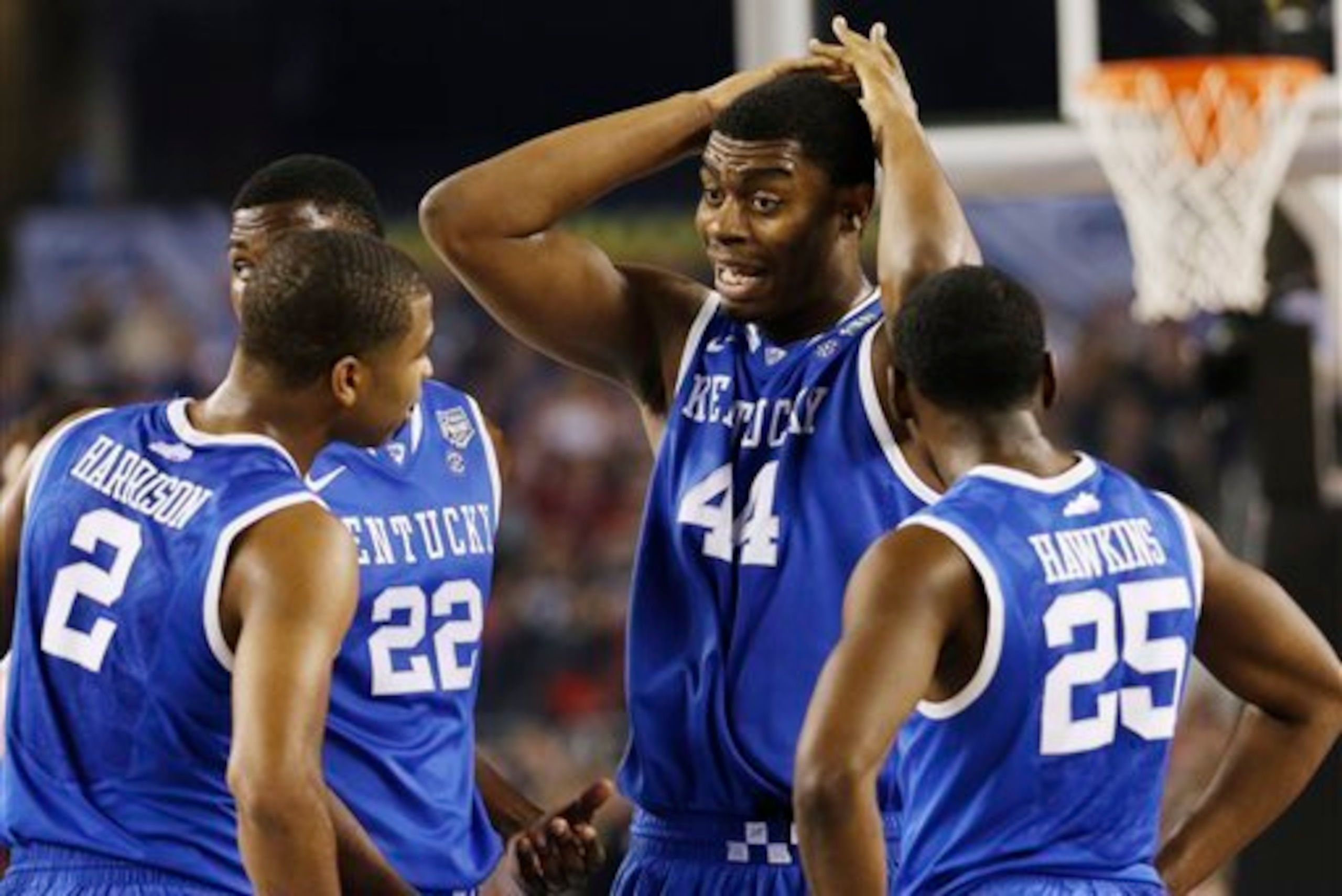

Kentucky Basketball: Ranking Wildcats' 5 Most Indispensable Players in 2014-15

With a roster as deep as the one that the Kentucky Wildcats have assembled for the 2014-15 season, there's a next man up for anyone who goes down. Big men, shooters, slashers, defensive pests—there's a little of everything in the Big Blue this year.
Some Cats, however, are more essential than others. With this many wildly divergent skill sets, there are myriad ways for coach John Calipari to adapt to any loss, but some players simply can't be duplicated.
Here's a look at the five players who will be hardest for Calipari to replace if any should go down this season.
5. Andrew Harrison
1 of 5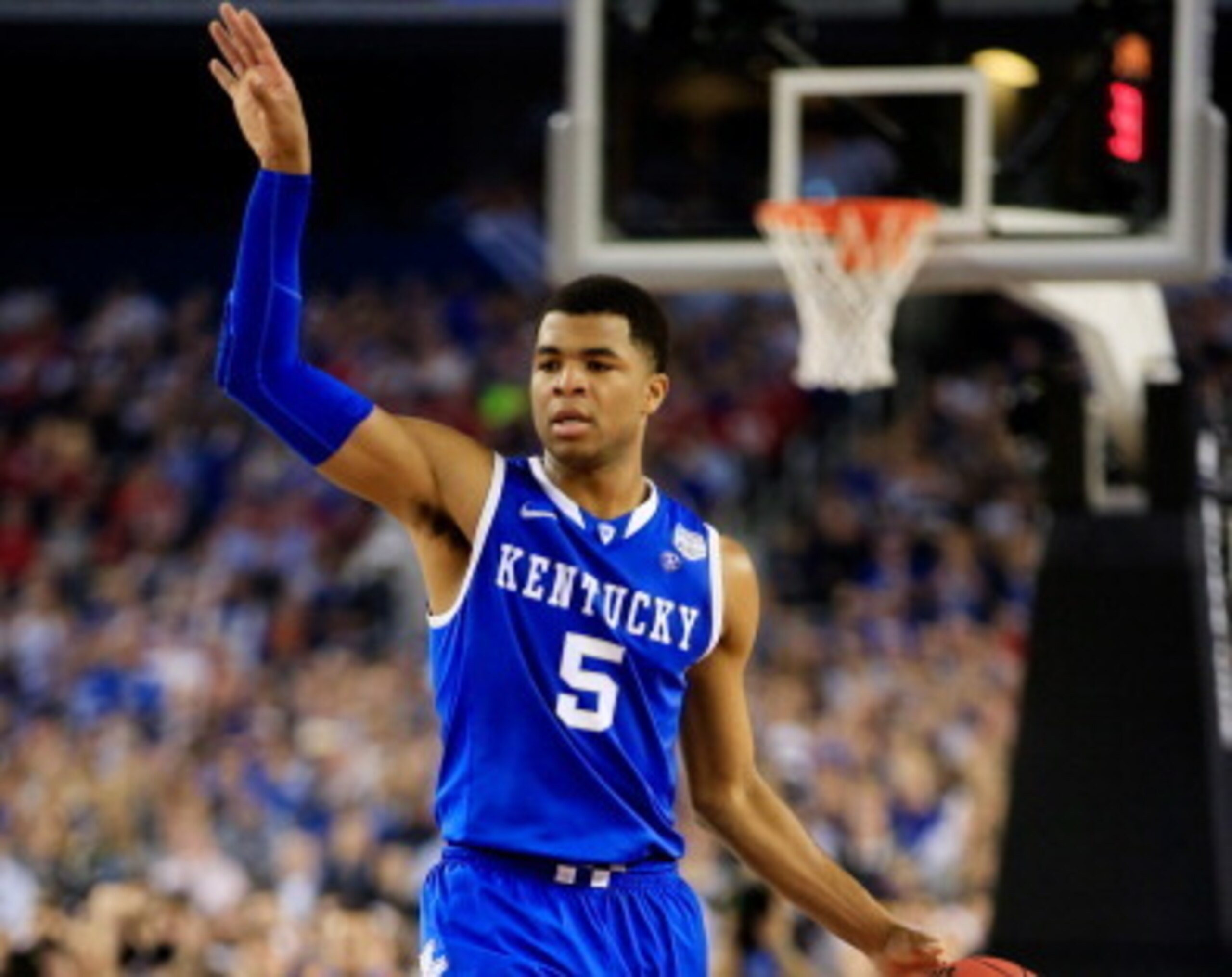
Last season, there was no disputing that UK could ill afford to lose Andrew Harrison. Only one tiny development kept the same from being true this season: 5'9" waterbug Tyler Ulis.
Ulis will be a crowd favorite from his first moments on the Rupp Arena court not only because of his stature but also because of his lightning quickness and pass-first mentality, neither of which came naturally to Harrison as a freshman.
Compare the two players' per-40-minute figures from the Big Blue Bahamas tour:
Harrison: 12.4 points, 9.8 assists, 1.0 steals, 0.0 3-point FG%
Ulis: 15.3 points, 8.0 assists, 2.7 steals, 60.0 3-point FG%
While Harrison did a superb job running the offense, Ulis was just as dangerous as a shooter, defender and facilitator.
The eight-inch height differential makes Harrison much more desirable for matchup purposes, but against most mortal point guards, there wouldn't be a major drop-off from Harrison to Ulis.
4. Dakari Johnson
2 of 5A new, slimmer Dakari Johnson has the potential to be the best center in the SEC. His offseason regimen only shaved off 10 pounds, taking him to 255—but judging from how Johnson looked and moved in the Bahamas, he may as well have lost 40.
While coach John Calipari's claim that Johnson is down to "8 percent body fat" may be taken with a grain of salt, Johnson told Kyle Tucker of Louisville's The Courier-Journal that the weight loss "has changed my game a lot. I'm moving better. I feel like I can run easier up and down the court. I'm just trying to dunk everything. It has changed my whole mentality."
Johnson's extra wind should afford him more opportunities in UK's transition offense. He excelled in that area during the six-game Big Blue Bahamas series, discovering a facet of his game that was never a strength last season.
Fans who salivate over the athleticism Marcus Lee shows on his putback slams will get to see a little of the same from Johnson, the team's best offensive rebounder.
Johnson ripped 16 offensive boards during the Bahamas trip, an average of 5.2 per 40 minutes. According to the DraftExpress database, that's a higher average than major-conference powerhouses Jarnell Stokes of Tennessee, Amile Jefferson of Duke and Cameron Ridley of Texas.
Johnson isn't quite as fast down the court as Willie Cauley-Stein, but the junior isn't a match for Johnson's strength, either. Offensively, Johnson can now blend halfcourt and transition value better than any Kentucky big man, except Karl Towns.
3. Aaron Harrison
3 of 5
There's precious little shooting on this Wildcats team, so an injury to Aaron Harrison would leave enormous shoes to fill. However, unlike a Karl Towns (SPOILER ALERT), there are tailor-made replacements for both Harrison's shooting ability and his size at the 2-guard position.
Freshman Devin Booker is not only 6'5", but he is also a better shooter than Harrison, whose stock skyrocketed through a small postseason sample size. Harrison's goal for this year is to continue exhibiting the form he showed during March and early April, rather than regressing to the 30 percent three-point form present from November through February.
Losing Harrison would be a significant blow to the offense, which would have to adapt to foes packing the lane. The defense, however, would also adapt and become a much more dangerous aspect of UK's game.
Diminutive pest Tyler Ulis could assume the point guard role if Booker struggled with his jumper, pushing Andrew Harrison to the wing. If Calipari insisted on sticking to the two-platoon system, the next man up would be noted defensive enthusiast Dominique Hawkins. Neither is the sort of takeover threat Harrison is, but the team can survive and adapt without him.
2. Alex Poythress
4 of 5Pictured above: an Alex Poythress-led victory over the Dominican Republic national team, a win in which Poythress put together nearly every facet of his game, even the ones we weren't so sure he had.
Poythress scored on lobs, power drives, post-ups and he even drained a pair of three-pointers. That versatility is what the Wildcats are banking on with no other true candidates to take over a game from the wing.
Even more important than Poythress' on-court versatility, however, is his experience. He and Cauley-Stein are the only contributors from both the 2013 NIT first-round upset victims and the 2014 NCAA tournament runners-up. They're the ones with a perspective on what it feels like to gravely disappoint Big Blue Nation.
He's not the classic rah-rah leader, but he's working on it.
"You can be the most laidback person off the court, but on the court you gotta speak up; you gotta be more vocal," Poythress said to Guy Ramsey of UKAthletics.com. "I'm doing a better job of that."
By Cauley-Stein's own admission in the article linked above, Poythress is much more the "older brother" in their relationship, a more focused and level-headed personality. While Cauley-Stein has just as much experience on the court, Poythress is a much better fit as the voice of reason for the younger Cats. And that voice just wouldn't carry the same resonance coming from the sideline.
1. Karl Towns
5 of 5
For those wondering, "Why Towns at No. 1?," think about what's lost if each UK big man goes down.
If Cauley-Stein suffers another injury, is he replaceable? Maybe not totally by one man but the Cats have more than enough pieces to circle the wagons and make up the lost production.
Marcus Lee can be just as effective a shot-blocker as Cauley-Stein. Trey Lyles would be an offensive improvement. Dakari Johnson can make up the rebounding difference. And so on.
If Johnson's injured, it's more minutes for Cauley-Stein. Lyles' or Lee's minutes could be capably filled by Derek Willis. But who replaces the blend of perimeter skills and low-post intimidation that Towns brings to the court?
Towns may be the biggest matchup nightmare in the game by season's end, dragging opposing big men to the arc to open space for UK's slashers and lob-catchers. He's no slouch in the post, either, possessing the most diverse repertoire of any Wildcat, save Lyles. There may be no better passer on the team, except Tyler Ulis.
For Calipari, the ability to utilize a skill set like Towns' is akin to a football coach having a great three-down running back like a Matt Forte or Jamaal Charles, someone who can carry the ball 20-25 times per game and still be a very dangerous threat in the passing game. They make the defense worried whenever and wherever they are on the field, just as Towns will do on the hardwood.
No other Wildcat makes the attack as unpredictable as Towns. Losing him would make Kentucky easier for any opponent to defend. Of course, that's like saying running with the bulls at Pamplona is easier than trying to ride a lion in the Kentucky Derby. I know I'm not trying either anytime soon, are you?
.jpg?w=2560 "NFL Paris Football")

.jpg?w=2560 "Trevon Diggs Cut by Seahawks")