
Japanese Grand Prix 2014 Preview: Start Time, TV Times, Weather, Schedule, Odds
Formula One remains in eastern Asia this weekend for the 30th Japanese Grand Prix.
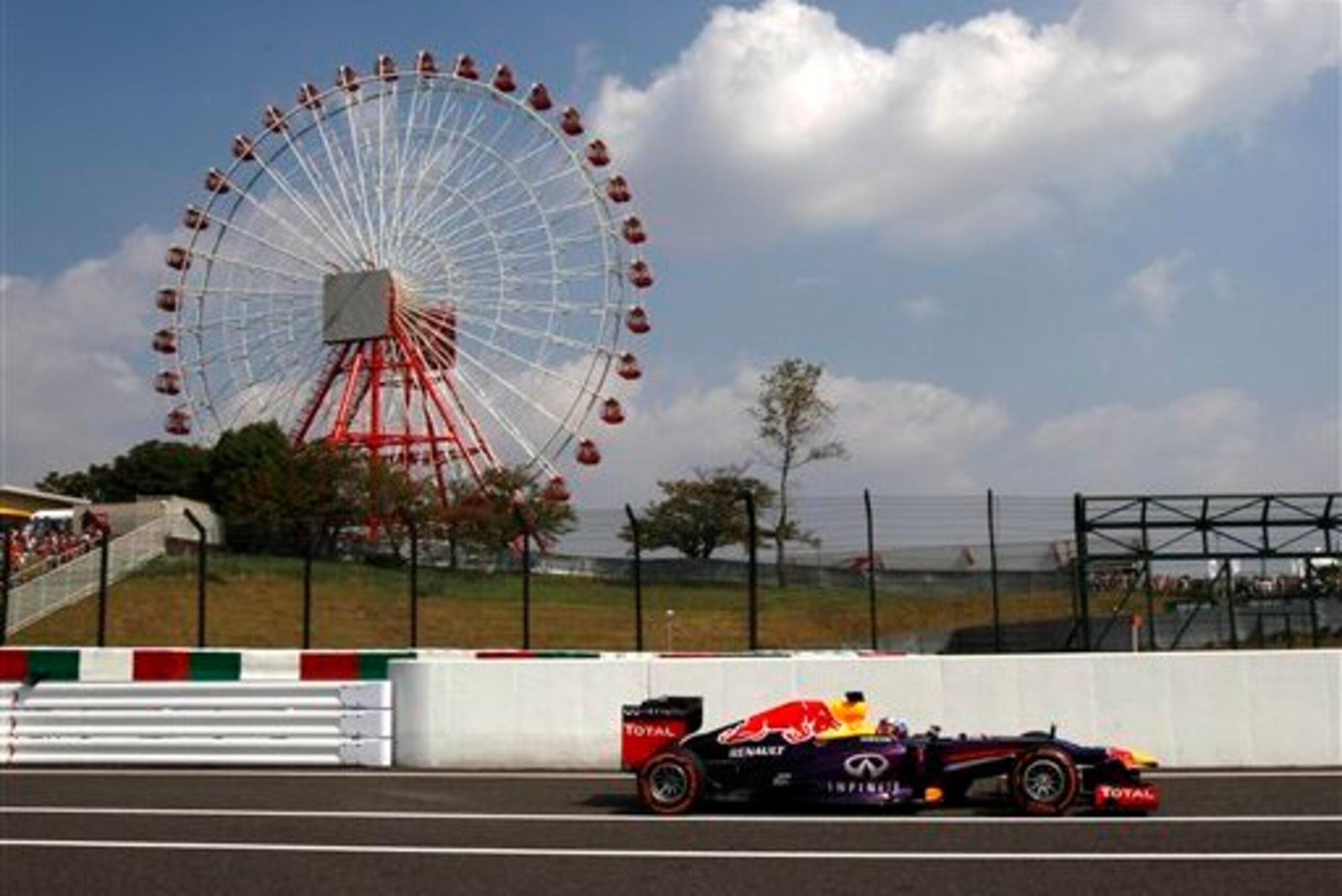
The venue will be the beautiful Suzuka circuit, close to Nagoya in the southern part of Honshu. It will be the 26th time F1 has visited this track.
Lewis Hamilton won his second successive race in Singapore to take a narrow lead in the drivers' championship. Team-mate Nico Rosberg failed to score, while Red Bull's Daniel Ricciardo moved to within 60 points of the championship lead.
The two Mercedes men will again be favourites, but with the possibility of a visit from Typhoon Phanfone on Saturday or Sunday, anything could happen.
Read on for a full preview of the race weekend, including TV times, current standings, a circuit map and guide, tyre and DRS information, weather forecast, odds and session times.
Current Standings
1 of 6
After winning in Singapore, Lewis Hamilton takes a narrow three-point lead into the race. Nico Rosberg didn't score.
Daniel Ricciardo is now just 60 points off the championship lead, while Sebastian Vettel could officially be out of the title chase this weekend.
The current Top 10 (data from Formula1.com) are:
| 1 | Lewis Hamilton | Mercedes | 241 |
| 2 | Nico Rosberg | Mercedes | 238 |
| 3 | Daniel Ricciardo | Red Bull | 181 |
| 4 | Fernando Alonso | Ferrari | 133 |
| 5 | Sebastian Vettel | Red Bull | 124 |
| 6 | Valtteri Bottas | Williams | 122 |
| 7 | Jenson Button | McLaren | 72 |
| 8 | Nico Hulkenberg | Force India | 72 |
| 9 | Felipe Massa | Williams | 65 |
| 10 | Sergio Perez | Force India | 45 |
Mercedes hold a slightly reduced lead over Red Bull in the constructors' championship, but they could be crowned champions this weekend.
The slightly closer Ferrari/Williams and Force India/McLaren battles continue.
The current standings are:
| 1 | Mercedes | 479 |
| 2 | Red Bull | 305 |
| 3 | Williams | 187 |
| 4 | Ferrari | 178 |
| 5 | Force India | 117 |
| 6 | McLaren | 111 |
| 7 | Toro Rosso | 27 |
| 8 | Lotus | 8 |
| 9 | Marussia | 2 |
| 10 | Sauber | 0 |
| 11 | Caterham | 0 |
Suzuka Circuit
2 of 6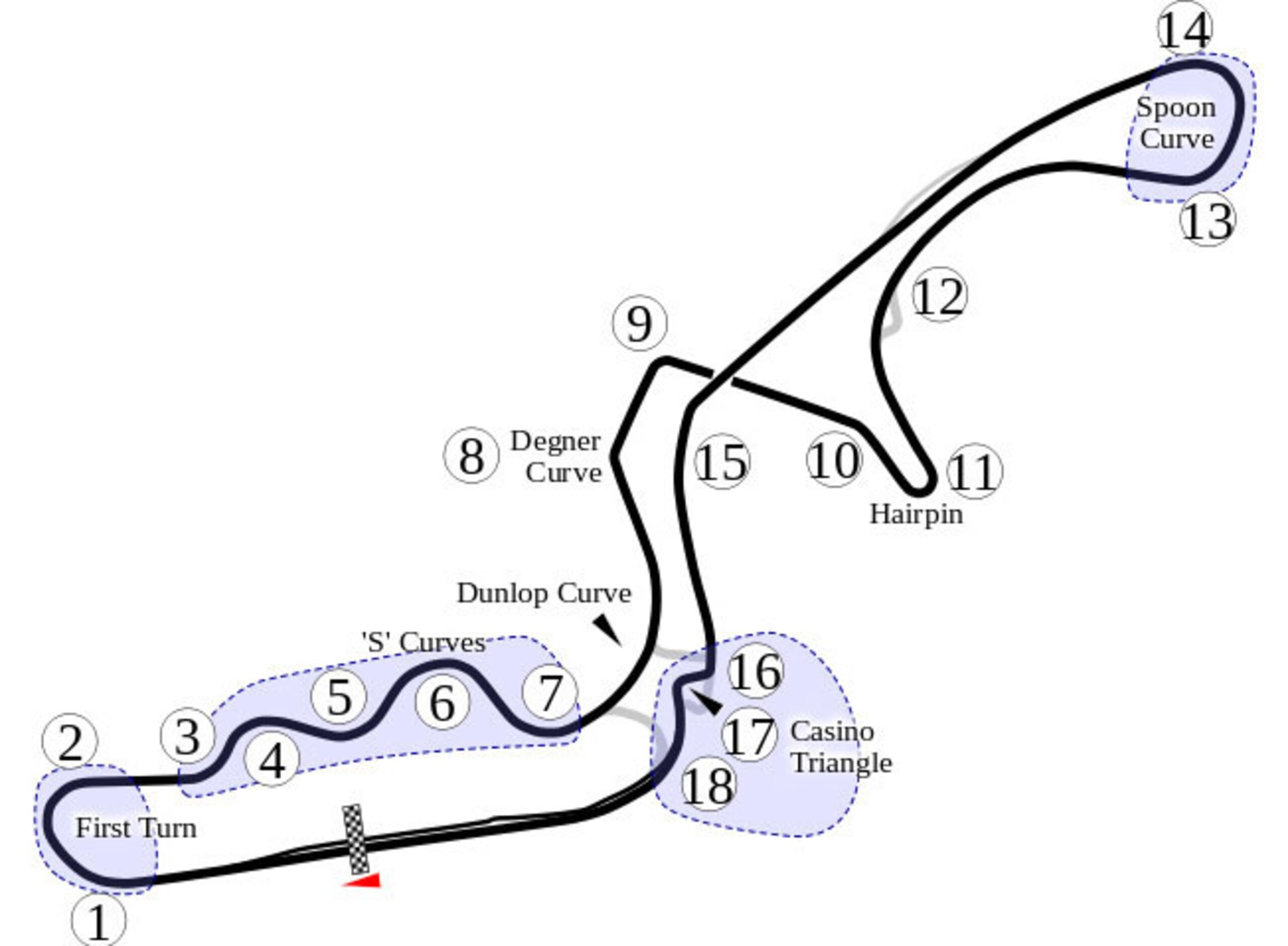
The Suzuka Circuit was built in 1962 as a test track for Honda.
Little has changed since then. Degner started life as a single corner, the chicane wasn't on the original design and 130R was modified slightly in 2003, but the rest of the circuit remains as designer John Hugenholtz intended.
Hopefully, it will stay that way. Suzuka is without question one of the greatest motorsport venues in the world.
Turns 1 and 2
A lap begins with a fairly long run downhill along the pit straight towards Turns 1 and 2, a double right-hander.
The drivers start to turn in before lifting off the throttle as they pass the apex for Turn 1, then brake hard, letting the car drift towards the outside of the track for a good line into the tighter, medium-speed Turn 2.
The kerbs on the outside get a bit of use, then it's onwards towards the Esses.
Turns 3, 4, 5, 6 and 7
The track begins to slope uphill at this point and into one of the best corner sequences anywhere on the planet. Each corner leads into the next, so a mistake in any one of them can result in a lot of lost time down the road.
Turn 3 is a medium-speed left taken with a healthy lift off the throttle. It leads into the slightly slower right-hander of Turn 4, which in turn leads into the left-hand Turn 5. Both need careful throttle control for optimal speed throughout.
Turn 6 is the slowest of the sequence, a slightly longer right, before the drivers head into the very long, quicker left of Turn 7. A quick lift off the throttle is needed for the early apex, then the corner opens, with the cars accelerating throughout and onto a short straight.
Turns 8 and 9
From one exceptional corner sequence to another.
Approaching on the left-hand side of the track, the drivers tap the brakes and turn in for the first Degner (Turn 7). It's extremely easy to carry too much speed into the apex here and run wide into the gravel.
Fortunately, the wall is a fair distance away.
Assuming the driver got through the first part safely, he taps the throttle before braking again, this time for the slower second Degner (Turn 8). Like the first, this one often sees cars come in too quickly and go wide into the gravel.
Only this time, the wall is much closer to the track.
The exit is also tricky. The drivers try to hit the throttle as early as possible as they head under the crossover, but it's easy to put a wheel too wide.
Turns 10 and 11
The drivers come out from the crossover onto a short straight and towards what could be considered yet another pair of corners.
Turn 10 is a flat-out right-hand kink. A normal line through such a corner would see the cars drift towards the left of the track at the exit, but the drivers instead remain on the right here and immediately brake for the hairpin left of Turn 11.
One of the slowest corners on the track, this is one of the best overtaking spots at Suzuka, but mistakes are also common.
At the exit, it's hard on the power and into a long full-throttle section.
Turns 12, 13 and 14
Turn 12 is a long, long right-hander. It's officially called 200R, but unless it's raining heavily it's more like a curved straight.
The cars go through here flat-out, accelerating up through the gears and into a very short straight before yet another great corner, the double-apex left of Spoon (Turns 13 and 14).
From around 290 kilometres an hour, the drivers brake very late and turn in towards the first apex, then have a quick stab at the throttle before braking again for the tighter, slower second apex.
A good exit here is critical, as it leads out onto the long, undulating back straight.
As with so many other corners at Suzuka, it's easy to get Spoon wrong. The most common error is to carry too much speed into the first apex, resulting in a trip across the tarmac.
Turns 15, 16, 17 and 18
The straight heads first downhill, then up, and the 2014 cars will hit speeds of around 320 kilometres an hour as they approach Suzuka's most famous corner—130R (Turn 15).
This extremely quick left-hander was easy flat-out in 2013, but it's unclear whether that will be the case this year.
A short straight follows before the circuit's heaviest braking zone. The cars slow to just 80 kilometres an hour for the first part of the tight right-left chicane.
The second part is slightly quicker, and the drivers aim to get the car straightened up on the exit as quickly as possible before setting off onto the pit straight.
Turn 18 is the flat-out right-hand curve which leads onto the pit straight proper.
Pit Lane
The pit lane entry is on the inside of Turn 18, and the exit is on the pit straight just before Turn 1.
Tyres and DRS
3 of 6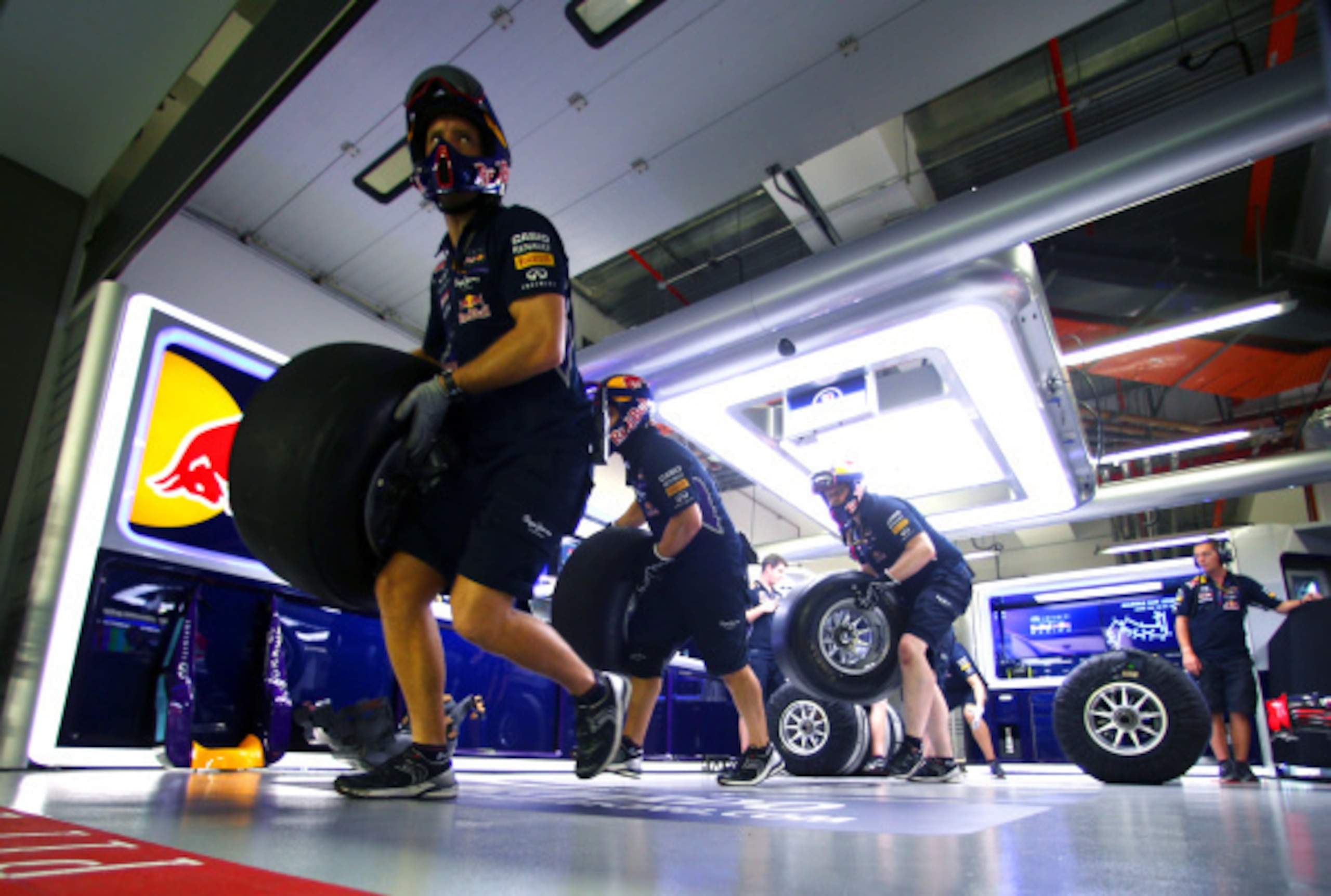
Suzuka is one of the toughest circuits of the year for tyres, with the fronts taking the most abuse.
The plethora of medium and high-speed corners put massive lateral loads through the rubber. Tyre temperatures are kept high for large parts of the lap because so many corners come in groups, one after the other—the tyres get little chance to cool down.
The section between Turn 1 and the hairpin is especially tough.
To combat the expected high wear, Pirelli are supplying the white-marked medium and orange-marked hard compound tyres.
Pirelli boss Paul Hembery expects two or three stops, but if it rains that could go out of the window.
Even if it stays dry, teams like Force India may aim for one less stop than everyone else.
DRS
There is only one DRS zone at the Japanese Grand Prix.
The detection point is just before the final chicane (Turns 16 and 17). The activation point is close to the exit of Turn 18 (just before the pit straight becomes fully straight), and the zone ends at the turn-in point for Turn 1.
.jpg?w=2560 "NFL Paris Football")

.jpg?w=2560 "Seahawks Chiefs Football")
Weather Forecast
4 of 6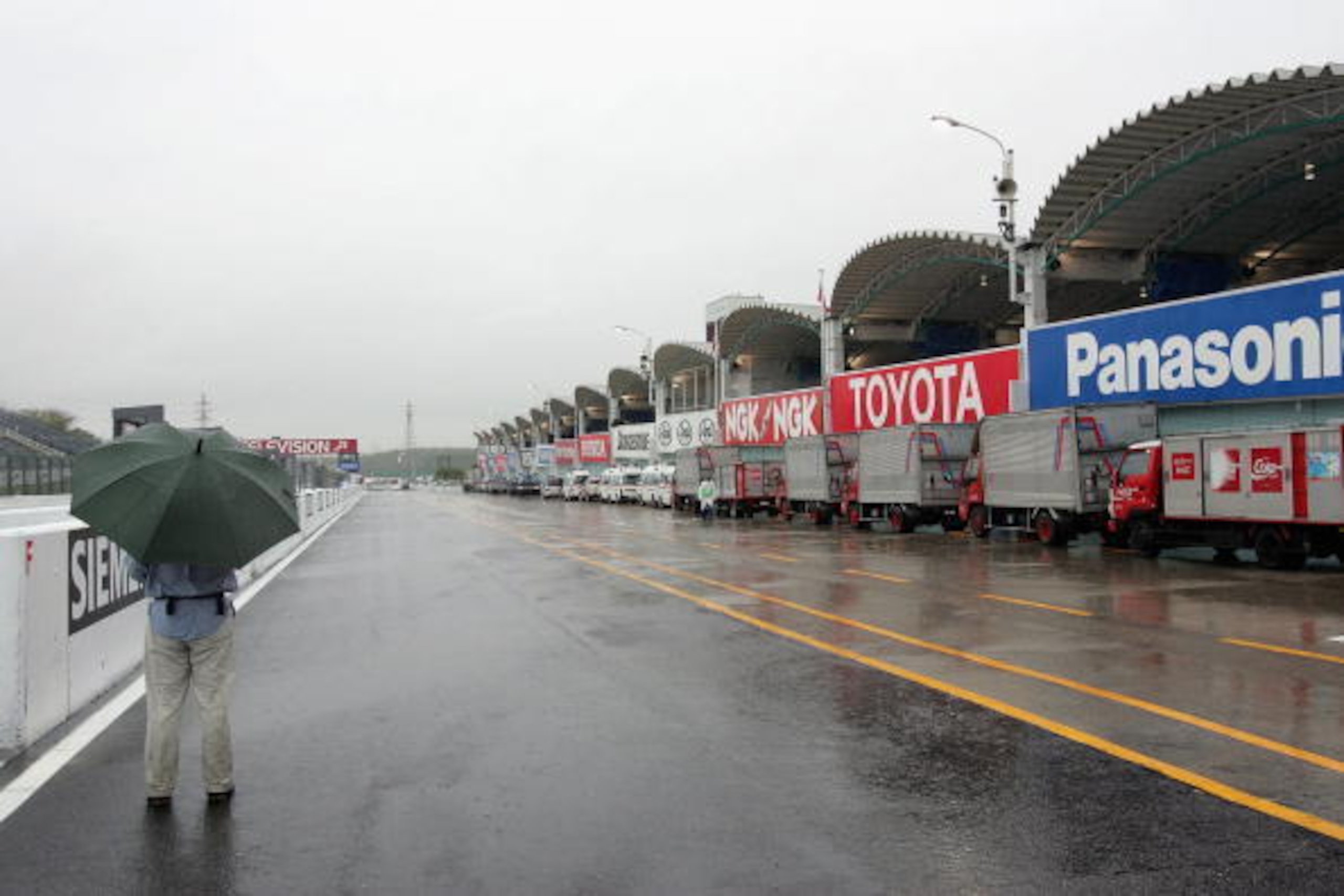
Suzuka lies near the southern end of Honshu, the largest of Japan's islands. It has a humid subtropical climate, with average October daytime temperatures of around 23 degrees Celsius.
Japan's location on the western edge of the Pacific Ocean leaves it in the path of the occasional typhoon.
The normal season runs between May and October, so there's always a chance any given Japanese Grand Prix could be affected, and it has happened in the past—Typhoon Ma-on caused qualifying to be delayed until the morning of the race in 2004.
There's a chance a storm system could affect this year's race, too. At the time of writing, the latest projection from weather.com has Typhoon Phanfone somewhere near the circuit on Saturday and Sunday.
If it hits in the wrong way at the wrong time, the race itself may be under threat. It starts just two-and-a-half hours before sunset, leaving little time for rain delays.
BBC Weather (forecast for nearby Nagoya) and the Joint Typhoon Warning Center will have the latest.
Odds
5 of 6
Lewis Hamilton occupies his usual slot as favourite. The lower odds for the Red Bulls are perhaps in response to the possibility of heavy rain.
The top-10 favourites are:
| Lewis Hamilton | 5-6 |
| Nico Rosberg | 9-4 |
| Daniel Ricciardo | 10-1 |
| Sebastian Vettel | 14-1 |
| Fernando Alonso | 28-1 |
| Valtteri Bottas | 28-1 |
| Felipe Massa | 40-1 |
| Kimi Raikkonen | 100-1 |
| Jenson Button | 200-1 |
| Kevin Magnussen | 250-1 |
Selected Others
The seemingly never-ending quest for a points finish over at Sauber continues. Adrian Sutil is 11-1 to get the job done in Japan, with Esteban Gutierrez 16-1.
Suzuka isn't the most forgiving of circuits, and the bookies consider a safety car likely. The odds for an appearance are 1-2, and 7-4 that it isn't needed.
And Hamilton scores a hat-trick of pole, fastest lap and race win at Suzuka—his second in a row. The odds for any driver to do the same this weekend are 9-4 (1-3 that they won't).
All odds sourced from Oddschecker.com, and correct at the time of publication.
TV Times and Session Times
6 of 6
As always, the Japanese Grand Prix weekend will consist of three free practice sessions, qualifying and the race.
The session times are as follows:
| Practice One | Friday | 10 a.m. |
| Practice Two | Friday | 2 p.m. |
| Practice Three | Saturday | 11 a.m. |
| Qualifying | Saturday | 2 p.m. |
| Race | Sunday | 3 p.m. |
All times given are Suzuka local time (JST). Formula1.com has a handy one-click tool to convert them to your own timezone.
TV Times
In the United Kingdom, live coverage of all sessions will be provided by Sky Sports F1 and the BBC. Their programming times are as follows (all times BST):
| Practice One | Friday | 2 a.m. | 1:45 a.m. | 1:50 a.m. (Two) |
| Practice Two | Friday | 6 a.m. | 5:45 a.m. | 5:55 a.m. (Two) |
| Practice Three | Saturday | 3 a.m. | 2:45 a.m. | 2:55 a.m. (Two) |
| Qualifying | Saturday | 6 a.m. | 5 a.m. | 5 a.m. (One) |
| Race | Sunday | 7 a.m. | 5:30 a.m. | 6 a.m. (One) |
In the United States, live coverage of selected sessions will be provided by NBCSN. Live coverage of second practice starts at 1 a.m. on Friday, with live qualifying coverage beginning at 1 a.m. on Saturday. Live race coverage is from 1:30 a.m. on Sunday. All NBC times given are Eastern.
Enjoy the weekend!
Follow me on Twitter for occasional updates on articles, or if you have any questions or comments.