A Closer Look at the New York Giants' Improved Offensive Line
In Week 1 of the 2014 NFL season, the New York Giants suffered a 35-14 blowout loss to the Detroit Lions, a game that saw the Giants’ "improved" offensive line produce a performance that was eerily similar to the struggles of 2013.
The numbers so far have the starting five—left tackle Will Beatty, left guard Weston Richburg, center J.D. Walton, right guard John Jerry and right tackle Justin Pugh—allowing two sacks for minus-19 yards, three tackles for loss and nine quarterback hits.
With fans and analysts gearing up for yet another long season of watching quarterback Eli Manning struggle to stay on his feet to find open receivers, a miracle happened after that first game.
.jpg?w=2560 "Commanders Eagles Football")


The offensive line improved.
How much did the line improve in the three games following, a stretch that saw them play against two good defenses in Arizona and Houston?
The numbers speak for themselves.
| Arizona | 2.0 | 4 | 2 |
| Houston | 1.0 | 4 | 1 |
| Washington | 1.0 | 3 | 1 |
| Totals | 4.0 | 11 | 4 |
In this article, we will look at some of the problems the offensive line had in that first game that appear to have been corrected.
(Disclaimer: We do not know what the specific line calls were, so we can only gauge what happened based on what the NFL Game Rewind All-22 film shows.)
We will then look at the improvements that the Giants offensive line—and the offense as a whole—heading in the right direction.
Problem No. 1: Communication
The biggest culprit in the offensive line’s shaky start this year was in its communication, a problem that came about due to the unit having failed to work together on a consistent basis all summer long.
Here is an example of what appears to have been a miscommunication in that Week 1 game.
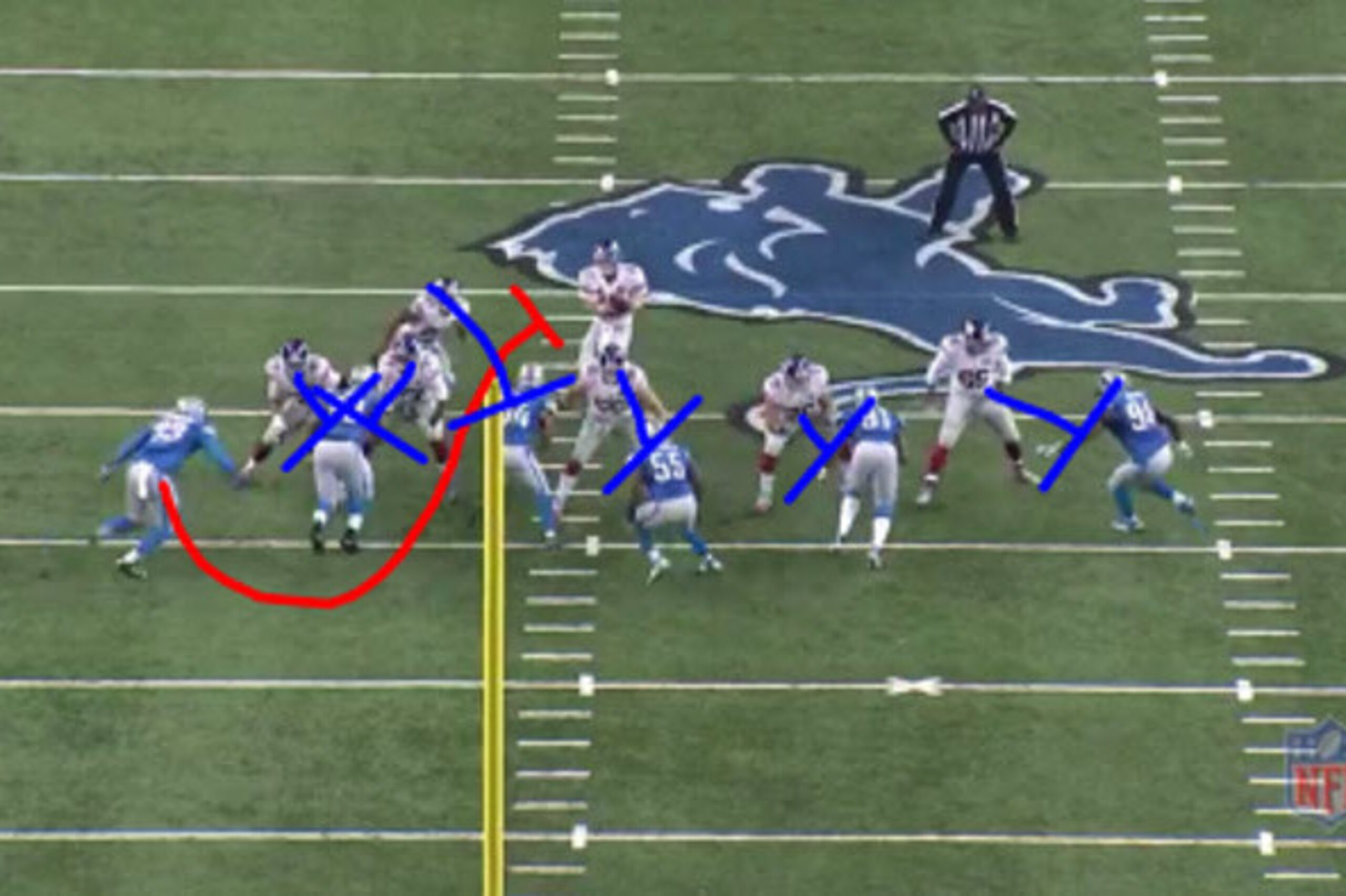
On this play, a sack of Manning, the Lions run a twist, in which their outside rusher crosses inside (red path) untouched.
Meanwhile, the duo of Jerry and Pugh double-team Ndamukong Suh, leaving the outside man, defensive end George Johnson, who had 1.5 of the Lions’ 2.0 sacks against Manning in that game, free to burst through the hole unabated.
Problem No. 2: Guys Losing the Battle in the Trenches
If there is one thing that makes a coaching staff cringe, it is seeing an offensive lineman on the ground while a play is in progress.
If an offensive lineman is on the ground, as was the case on running back Rashad Jennings’ first-quarter run for a two-yard loss, that usually means the opponent overmatched the lineman.

In this instance, both Walton and Beatty (red arrows) are on the ground as Jennings, who is running parallel, is searching for a crease. The defenders for whom Walton and Beatty are responsible, defensive tackle Nick Fairley and linebacker DeAndre Levy, end up stringing out the play.
Problem No. 3: Missed Assignments
As is unfortunately the case on occasion, sometimes an offensive lineman experiences brain lock on an assignment, such as what appears to be the case on a 19-yard pass completion to tight end Larry Donnell, a play in which Manning is hit as he releases the ball.
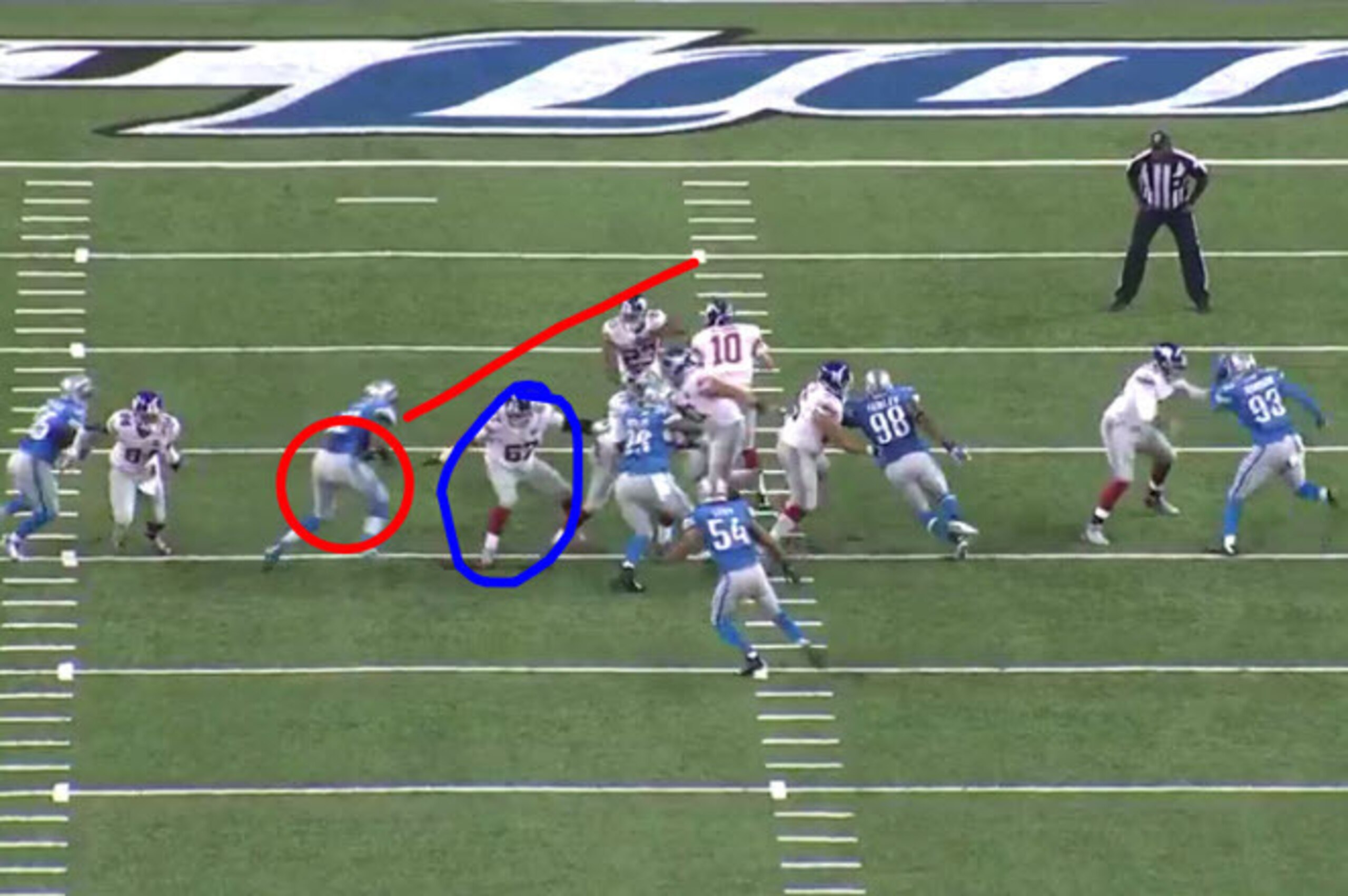
Again, while it is unknown what the specific blocking assignments were on this particular play-action pass, it looks as though Pugh starts to head out to block Levy, only to realize that defensive end Devin Taylor (red circle) is coming free, though the breakdown also could have been on Jennings for not picking Taylor up quickly enough.
Regardless, someone missed an assignment, and Manning paid the price by absorbing one of his nine hits in that game.
So what’s been behind the Giants’ improved offensive line?
No More Musical Linemen
We can start with continuity, as Tom Rock of Newsday pointed out.
Last year due to injuries, the Giants were forced to change their offensive line so many times that none of the configurations had a chance to jell.
While coaches would like to have us think that it doesn’t matter and that every player should be able to step in at a moment’s notice if someone goes down, the truth is that on the offensive line, continuity is important because of the communication aspect.
We saw in the 2014 preseason how the Giants were mixing up their offensive line personnel in the preseason, both in games and daily in practices.
Given the goal in preseason is to evaluate as many players as possible, it is safe to say that the current offensive line configuration barely played an entire game together.
Once the line's personnel settled in and played an entire game, good things were bound to happen sooner than later.
Fortunately for Manning and the rest of the offense, it was sooner.
“The protection has been good for the most part the last couple of weeks and certainly we’ve benefited from that,” head coach Tom Coughlin told reporters.
The biggest benefit, the coach noted, is that the quarterback now has time to read his keys and go through the progression of deciding where to throw the ball.
This, in turn, leads to fewer turnovers resulting from Manning’s tendency to try to make a play by forcing the ball into tight quarters when he is under duress.
The 'Resurrection' of Will Beatty
Will Beatty seemed taken aback when I asked him on Monday if he thinks he is back to his 2012 form.
“Save that question for the end of the year,” he said. “I’ll let you know then.”
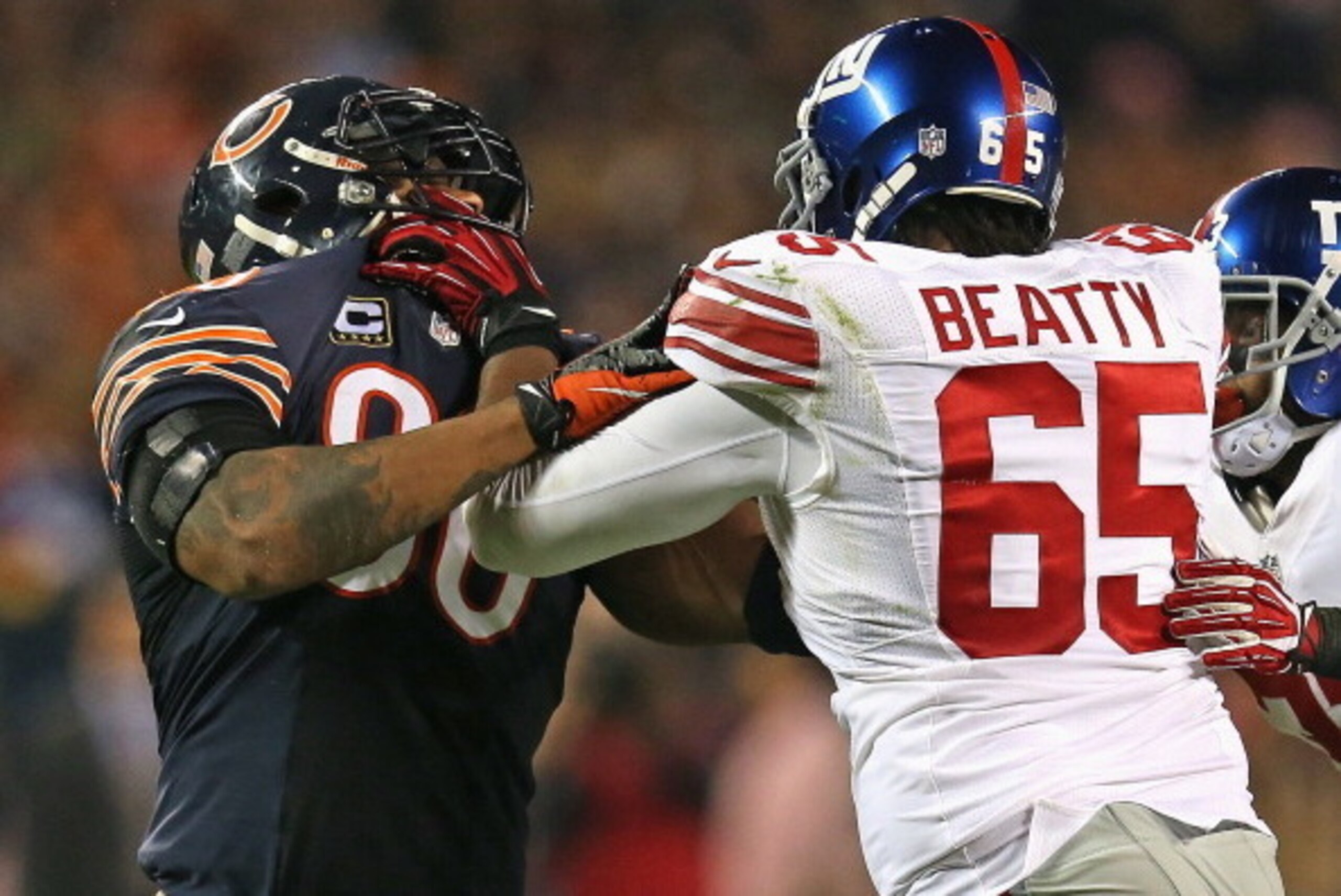
The truth is that 2013 was not a very good season for the Giants’ starting left tackle, who, according to Pro Football focus (subscription required), finished near the bottom of all offensive tackles (38th out of 43) who took 75 percent or more of their team’s snaps.
Two likely reasons for Beatty's disappointing grade included him allowing an alarming 13.0 sacks and 39 quarterback hits.
Fully healed from a broken leg suffered in the Week 17 finale last year, Beatty, who on Monday told reporters last year “was just an anomaly,” is currently PFF's top-rated offensive tackle in the league with a 10.1 grade.
How good has Beatty really been in protecting the quarterback’s blind side? Here is a look at his first four games from 2012 (his contract year), 2013 and this year.
| 2012 | 0 | 0 | 3 |
| 2013 | 4 | 4 | 16 |
| 2014 | 0 | 2 | 2 |
The West Coast Offense Effect
Per PFF, the Giants are tied for seventh in pass-blocking efficiency with an 86.2 mark based on the 26 pressures allowed through four games.
They can probably thank the switch to the West Coast offensive for this high grade.
One of the benefits of switching to a West Coast offense is that it is designed to speed things up, unlike the slower-developing vertical passing game, which Manning and the Giants previously ran.
The biggest difference is that the old offense required five- and seven-drops. For those drops to have any chance of turning into completed passes, the offensive linemen had to hold their blocks for 2.6 seconds or longer.

With the West Coast offense, the drops are shorter—usually no more than three steps. The idea is to get rid of the ball quicker, letting the skill positions win their battles.
When an offensive lineman doesn’t have to hold his block for more than a couple of seconds, most times that can only mean good things for the passing game.
PFF's signature stats note that of Manning’s 147 dropback attempts this season, he has only been under pressure 31 times. Of those pressures, he has been sacked six times and had three dropped passes.
When under pressure, Manning’s accuracy percentage, which is currently at 66.9 percent overall, dips to 56.5 percent.
Now let’s look at Manning’s time in the pocket for the four games, as broken down by PFF, which notes that Manning’s average time in the pocket is 2.27 seconds. That’s down by .46 seconds from last year.
Does .46 of a second really make that much of a difference?
Considering that Manning has a 102.5 passer rating when he has 2.5 seconds or less to throw the ball this season, the answer appears to be, without a doubt, yes.
In having, completed 69 of 97 pass attempts, Manning’s completion percentage when he gets rid of the ball in 2.5 seconds or less is at 71.1 percent.
Maybe all that talk about expecting Manning to complete 70 percent of his throws or higher, a goal that quarterbacks coach Danny Langsdorf shared with reporters during training camp, wasn’t so crazy after all.
Advanced statistics courtesy of Pro Football Focus (subscription required) unless otherwise noted.
All quotes and information obtained firsthand unless otherwise sourced. Follow me on Twitter, @Patricia_Traina.
.jpg?w=2560 "Chiefs Dolphins Football")
.jpg?w=2560 "Cardinals Giants Football")


.jpg?w=2560 "Injury-stricken Seahawks signing veteran RB")