
Colin Kaepernick Not Getting Enough Support Is Cause for Concern but Not Panic
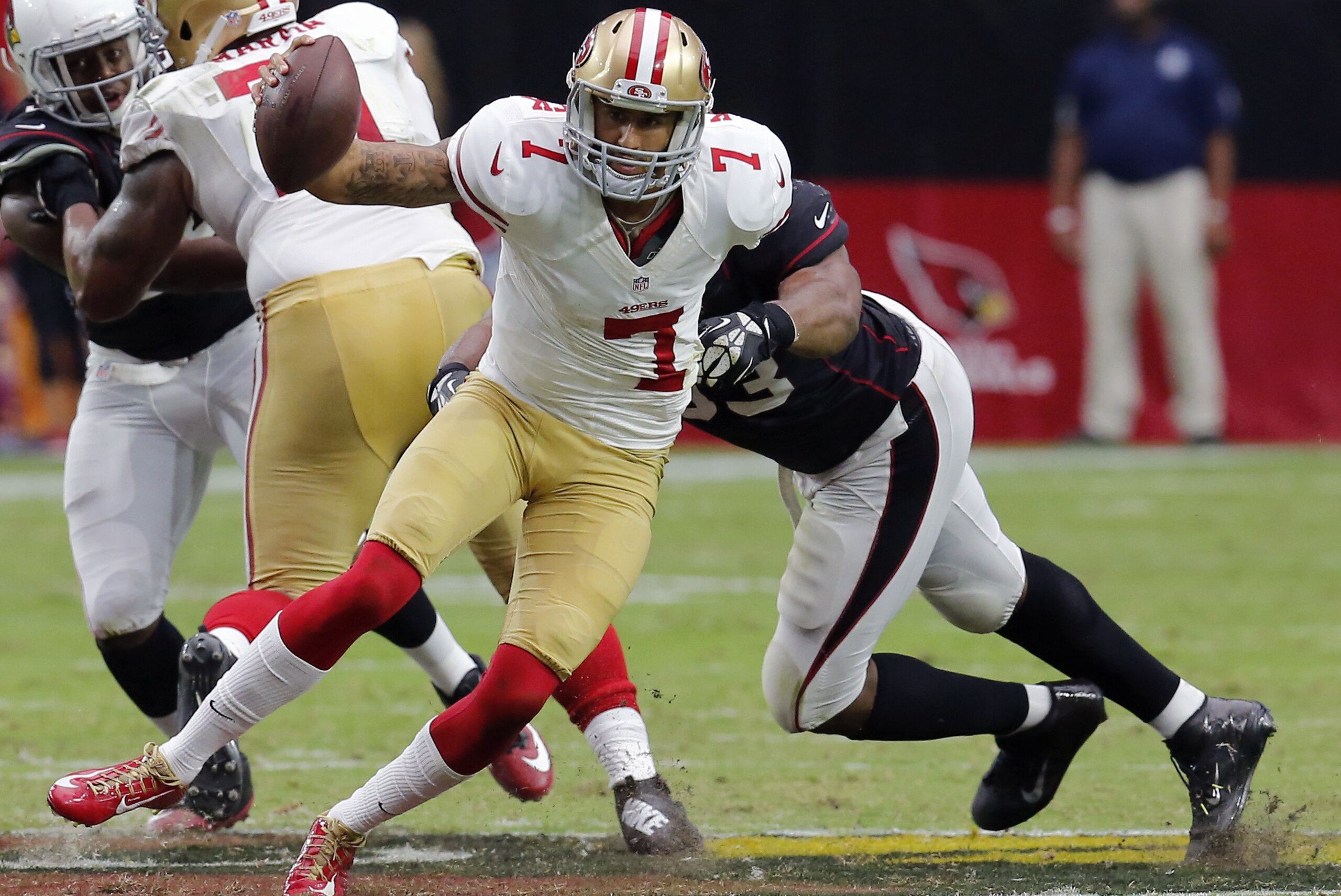
Colin Kaepernick isn’t the primary problem for the San Francisco 49ers. But as we saw last week and again Sunday during a divisional loss to the Arizona Cardinals, a quarterback can have problems without being the problem.
Kaepernick’s completions were nice against the Cards because completing a pass is always preferred over not completing a pass. He set career highs with 29 successful pass attempts (including completions on his first nine throws) and an overall completion rate of 78.4.
But the problem is what he’s doing with those completions or not doing. Or what he’s not being asked to do.


.jpg?w=2560 "Commanders Eagles Football")
His longest pass of the day actually travelled one yard through the air, with Stevie Johnson taking it the other 31 yards. Anquan Boldin finished with six receptions, a fine day. But on those catches he averaged six yards, not a fine day.
Kaepernick averaged only 6.6 yards per completion, and 10 of his successful connections traveled five yards or less through the air. In today’s NFL with passing growing by the week still, that’s below average. In fact, for Kaepernick it’s well below average. This is a quarterback who spent nearly half of last season (seven games) with his YPA over 9.0.
He was able to get chunk yardage with ease in 2013, even with Michael Crabtree out for much of the year.
| +9.0 | 7.5 to 8.9 | 6.0 to 7.4 | Below 6.0 | |
| Number of Games | 7 | 2 | 3 | 4 |
The 49ers are 1-5 since the start of last year, when Kaepernick’s yards per attempt drops below 7.0. This is an offense that may be grounded in the run when it’s operating at a high level, but shots down the field still need to be taken.
Maybe we’ll look back on Week 3 as a blip for both Kaepernick and Greg Roman’s play-calling. But the football season inherently presents us with a small sample size, and what we have so far over three games is a team that’s boomed in the first half and kaboomed in the second.
I explored the 49ers’ second-half crumbling with more depth Sunday night. But Cam Inman from the San Jose Mercury News sprinkled some additional numbers here to show just how isolated San Francisco’s offensive production was Sunday.
Between his arms and legs Kaepernick accounted for 299 offensive yards. Of that, nearly half (46.2 percent) came over the Niners’ first two drives when Kaepernick felt comfortable in his natural habitat: a spread offense.
The new look was necessitated by the absences of both Vernon Davis and Vance McDonald, the team’s top two tight ends. The result was that early effectiveness with formations featuring four or five wide receivers but also a near complete abandonment of the running game. Frank Gore and Carlos Hyde were given only nine carries, averaging 3.4 yards.
When Kaepernick ran early he did it effectively and when necessary. Of his eight runs over those first two drives, five of them went for at least seven yards. That included a 10-yard gain on a designed run.
But then on his other five attempts throughout the rest of the game Kaepernick averaged all of two yards. Overall his 13 run attempts were the second-highest in his career, behind only the 16 he needed to set the single-game quarterback rushing record during the playoffs in 2012. Kaepernick has a career pace of only 5.3 run attempts per game, which has quickly risen to 9.0 early this season.
The running Sunday was partly a product of the space created through the spread offense and Kaepernick jumping on opportunities. Fair enough, but part of this offense’s inability to move the ball downfield in the second half still comes back to its quarterback locking in on one target.
That happened early in the third quarter on a play that should have ended in an interception and maybe even a touchdown going the other way. Needing eight yards on third down, Kaepernick looked to work the left side, where he had Brandon Lloyd running a vertical route to clear space and Michael Crabtree underneath in the slot.
Crabtree broke his route off at about the 42-yard line, heading toward the sideline. Kaepernick thought he saw a window to make a quick pass. But Antonio Cromartie was in zone coverage and had already planted his foot to break on the ball.
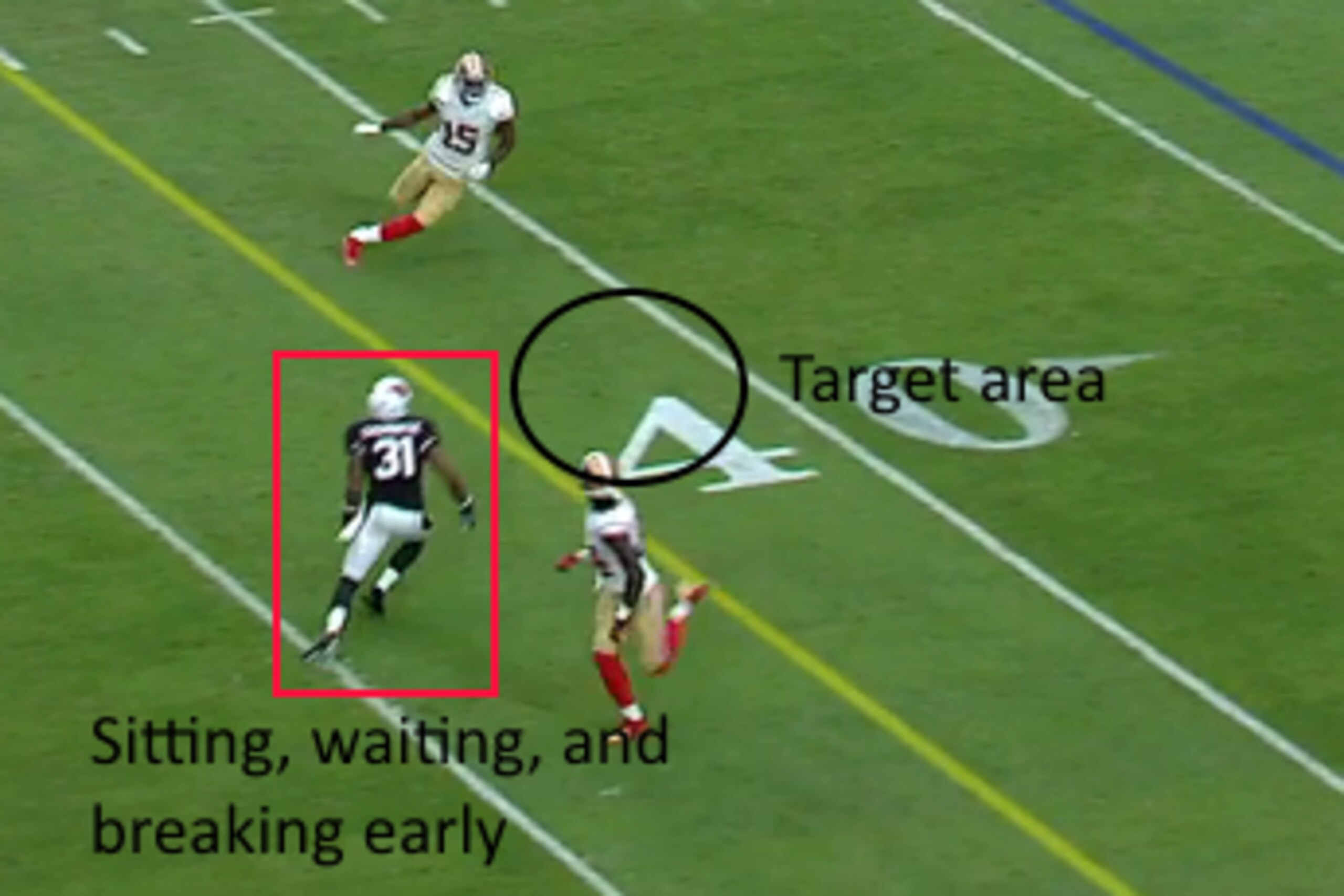
Despite feeling little pressure and having comfort in the pocket, Kaepernick locked in on Crabtree and allowed Cromartie to read his eyes and break early, beating the receiver to the target area where he couldn't quite finish the play.
It was similar to the diving interception by Chris Conte last week, one made possible when Kaepernick was zoned in again and gave the Chicago Bears safety an opportunity to start running downhill long before the ball was released.
In the first half Kaepernick played well within the system he was given, and he gobbled up what was handed to him by the defense. In the second half we saw a quarterback who wasn’t supported by a running game of any kind and had poor protection with Anthony Davis still out.
That’s when his flaws from last week resurfaced, and the Cardinals secondary could be aggressive while pouncing when he honed in on his first read.
The Colin Kaepernick experience will always feature instinctive runs and breaking the pocket when it’s not necessary. That’s how he sees the field and brings his unique brand of controlled chaos to the 49ers offense. We know he can function under pressure too, with his six game-winning drives in 26 career regular-season starts.
But he still needs structure because more running isn’t always effective running. And most of all, he needs support from both his backfield beside/behind him and the offensive line in front.
Smashing panic buttons doesn't need to happen yet. Though there's been reason for concern early (Kaepernick's decisions and a vulnerable pass defense chief among them), the 49ers will get healthier, and they'll revert back to what's paved the road to NFC Championship Game trips in three straight seasons.
Which is mostly running, deception and more running.
.jpg?w=2560 "Chiefs Dolphins Football")


.jpg?w=2560 "Love's Body Already 'Tired'")