How the Boston Bruins Should Deal with Their Salary Cap Issues
The Boston Bruins started training camp on Thursday without two of the players so essential to their team last season: Reilly Smith and Torey Krug. The duo combined for 91 points during the season, and Krug led the team in playoff scoring (Smith was one back of the team lead in postseason goals).
The reason those players aren’t in camp? Boston simply doesn’t have the money to sign them at the moment.
According to CapGeek.com, the Bruins are slated to be roughly $800,000 over the NHL salary cap. Most of the problem stems from the team’s decision to carry over bonuses from 2013-14 (including $4.2 million for Jarome Iginla) into 2014-15.
TOP NEWS

Flyers Regretting Their Offseason Moves 🤦♂️
.jpg?w=2560)
Utah Trade Idea for Travis Konecny 💡
Buy or Sell Latest Rumors 👂

“We’re in a situation based on last year; we kind of went all in and fell short and we’re paying the price a little bit now,” Bruins president Cam Neely told the team's website. “I just hope we get something done really quick. Obviously those guys had great years for us last year, and they’re a big part of our organization moving forward.”
The actual situation isn’t quite as dire as that. Marc Savard accounts for a little over $4.0 million of that cap space. The Bruins have two options with Savard. They can place him on long-term injured reserve on the last day of training camp, which would make them compliant with the salary cap but would also reduce the amount of money they would have to replace him. Alternatively, they could ensure they were as close to the salary cap as possible on opening night and place Savard on long-term injured reserve the next day.
The team pursued the latter option last season because, as Matthew Wuest of CapGeek notes, it ended up giving them roughly $2.3 million in additional cap space:
"The upper limit was $64.3M and the Bruins’ Averaged Club Salary or cap payroll on the final day of training camp was $66,086,309, including healthy Dougie Hamilton ($894,167 cap hit) and Torey Krug ($916,667 cap hit) — whose aggregate Averaged Amount was $1,810,834 — and injured Marc Savard ($4,027,143 cap hit). Rather than simply place Savard on LTIR, a move that would have left them with no cap space and a new upper limit of $66,086,309, the Bruins demoted Hamilton and Krug on the final day of training camp, reducing their Averaged Club Salary from $66,086,309 to $64,275,475 — just $24,525 under the upper limit. Only then did the Bruins place Savard on LTIR, giving them a new upper limit of $68,302,618. The Bruins then recalled Hamilton and Krug and included them on their opening-day roster, bringing their Averaged Club Salary back up to $66,086,309, with the flexibility to add $2,216,309 more in Averaged Amounts, cap space that would not have existed without the one-day demotion of Hamilton and Krug.
"
Presumably the Bruins want to do the same thing once again; they’re a cap team, and every inch of flexibility they can squeeze out helps. As it stands, they could achieve that result rather easily by demoting Dougie Hamilton ($894,187 cap hit) to the minors to get him off the opening day roster and then recall him, at which point they would put Savard on LTIR and have a little under $4.0 million left to sign Krug and Smith.

That’s easy-peasy, but things aren’t quite that simple. Ideally, Boston would love it if Smith and Krug were on hand for what’s left of training camp. Beyond that, the Bruins have nine-NHL ready defencemen, including David Warsofsky, who in this scenario would be demoted and exposed to waivers.
In a perfect world, the Bruins would accomplish several objectives:
- They would clear away their defensive logjam
- They would make enough cap space to sign both Smith and Krug, to one-year deals if necessary but to longer deals if possible
- They would be extremely close to the salary cap so as to create maximum flexibility when Savard is put on LTIR
That trio of objectives explains why a trade involving pending free agent Johnny Boychuk makes some sense. But such a trade isn’t ideal because Boston is a legitimate contender this season and Boychuk is a valuable part of that.
A better solution is to move less valued pieces.
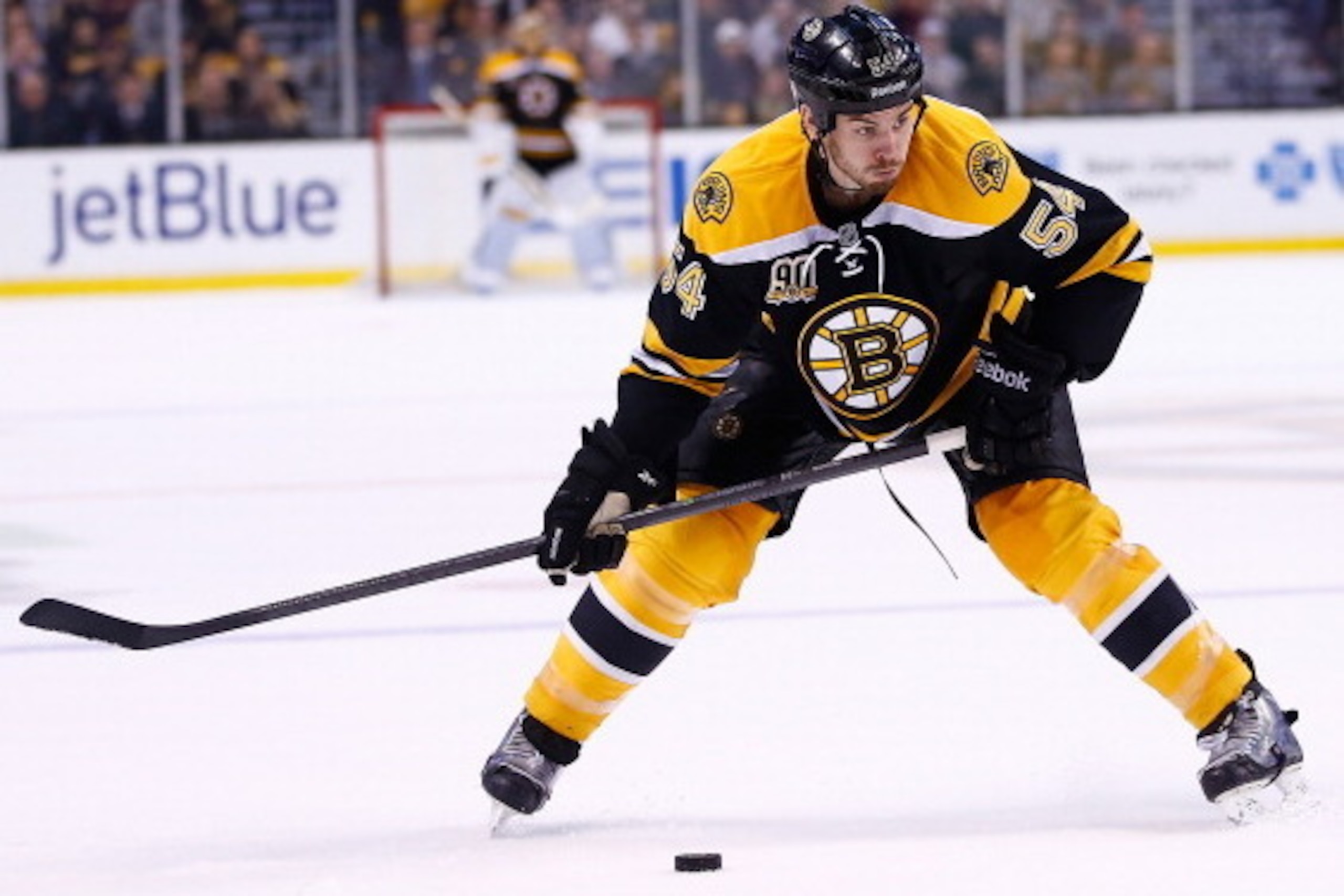
Defenceman Adam McQuaid might fetch an asset in trade, and with a $1.57 million cap hit would clear significant space; alternatively Matt Bartkowski would surely have some value and would clear $1.25 million in cap space. Moving either gets the Bruins on the right side of the salary cap and allows them to keep Warsofsky off the waiver wire. In concert with the right mix of temporary recalls/demotions, they could nuzzle up close to the cap ceiling to create maximum flexibility in-season.

What that doesn’t do is allow the team to sign Krug and Smith. To create space for those two, the next step would be to trade Chris Kelly somewhere, sending along some sort of asset —draft pick(s) and/or prospects—to convince that club to eat the two years left on his contract. Assuming Boston could find a deal (Kelly has a limited no-trade clause that allows him to name eight teams he would accept a trade to) it would then be in a position to sign both of its restricted free agents. Likely the Bruins would retain some salary to make Kelly more palatable; it’s even more likely that the amount of salary retained would put Boston within a hair of the salary cap ceiling.
Obviously, the Bruins haven’t found the right deal yet; if they had Krug and Smith would already be under contract. But the team has options, and in the worst-case scenario it can wait until the first day of the season before signing its young free agents.
Jonathan Willis covers the NHL for Bleacher Report. Follow him on Twitter for more of his work.



.jpg?w=2560 "Report: Giants Releasing Najee")